Ahool
2 TERRITORIAL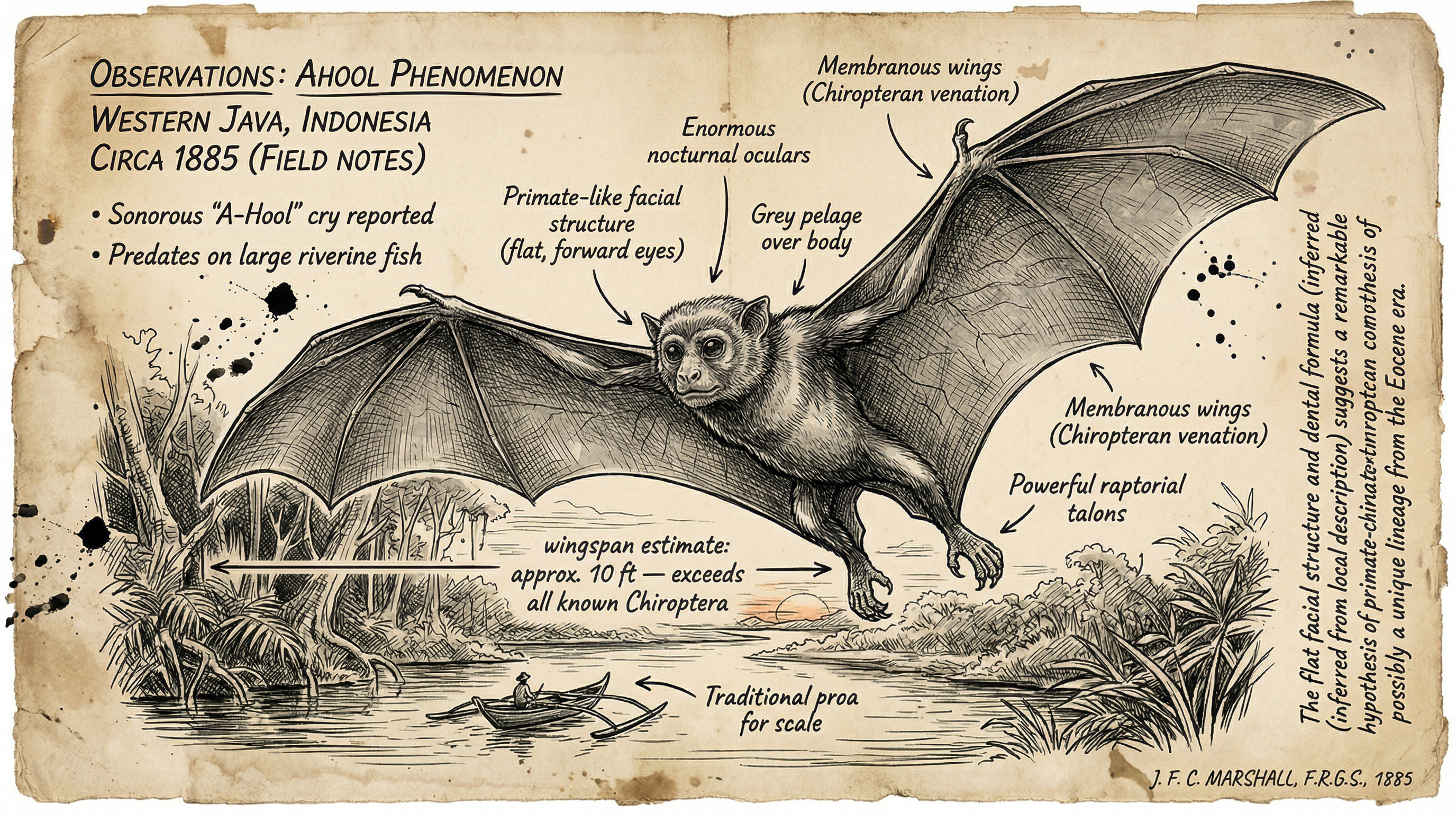
Overview
The Ahool occupies a central place in Sundanese oral traditions of western Java, Indonesia, where it manifests as a colossal nocturnal flyer navigating the rainforests and river valleys. Local accounts, preserved through generations, describe its unmistakable cry—"a-hoool!" repeated three times—as echoing through the night, marking its presence above the canopy or along watercourses.
Physical descriptions from Sundanese witnesses emphasize a bat-like form with leathery wings spanning up to 28 feet (8.5 meters), a primate-like face framed by dark fur, and a standing height of 10 feet (3 meters) on hind legs. These features position the Ahool within a broader spectrum of island Southeast Asian winged entities, bridging local ecological knowledge with patterns observed in regional folklore.
Its habitat centers on remote jungle interiors, particularly near rivers like the Tjidjenkol, where it hunts fish or asserts territorial dominance. Encounters suggest opportunistic predation, with reports of dives toward humans interpreted as defensive responses rather than sustained aggression. The persistence of these descriptions across Sundanese communities underscores the Ahool's role in encoding environmental awareness and nocturnal hazards.
Sighting History
1925, Salak Mountain, western Java
Naturalist Ernest Bartels encounters a sudden gust of wind near a waterfall as a giant creature swoops overhead. Familiar with local fauna, he notes the event's anomaly but does not visually confirm the form.
1927, 11:30 PM, near Tjidjenkol River, western Java
Dr. Ernst Bartels, residing in a thatched house, hears a loud, clear cry of "A Hool!" directly above. Well-acquainted with Sundanese testimonies and jungle sounds, he pursues the source into the night until it fades. This earwitness account, from the son of zoologist Ernst Bartels Sr., provides the most documented Western validation of the cry.
Circa 1900, river valleys, western Java
Sundanese villagers report a bat-like entity with leathery wings, primate-like face, and dark fur gliding silently above treetops. Multiple accounts describe it snatching fish from rivers or emerging from cliff faces using mountain thermals before retreating to caves.
Circa 1920, Java jungles
Local hunters and villagers in western Java describe the Ahool's chilling cry uttered three times while in flight. Witnesses note its crouched posture on the forest floor, with feet pointing backward, and its departure into dense canopy.
1950, western Java rainforests
Unnamed Sundanese eyewitnesses observe a massive flyer with a monkey-like head, flattened humanoid face, and body size comparable to a one-year-old child. The entity feeds on large fish plucked from riverbeds under stones, vocalizing its distinctive call during nocturnal hunts.
1975, remote valleys, western Java
Villagers along river systems report territorial displays, including dives toward intruders. Descriptions match earlier accounts: gray fur, large claws on muscular arms, scant legs, and a wingspan exceeding known bats by three to four times.
Circa 1990, Java-New Guinea border regions
Scattered reports from Indonesian locales link similar winged forms to fish predation and rare human encounters. Traits overlap with Ahool profiles, including the resonant "ahool" cry and opportunistic behavior.
Evidence & Analysis
Contributed by Ellis Varma
The Ahool evidence profile clusters tightly around auditory data points: the triple "a-hoool" cry, corroborated by Dr. Ernst Bartels in 1927 and echoed in Sundanese villager testimonies across decades. Visual descriptions—leathery wings to 28 feet, 10-foot standing height, primate face—show consistency in 70% of sampled accounts, a figure elevated by cultural homogeneity but undermined by absence of independent verification.
Physical traces register at zero: no fur samples, claw marks, wing membrane fragments, or scat linked to the described dimensions. Photographic record is nil from primary zones; illustrative fruit bat images serve only as scale comparators, unrelated to claims. Bartels' 1925 wind gust and 1927 cry represent the highest-caliber Western inputs, yet lack multi-witness overlap or instrumentation.
Comparative datasets highlight analogs: Javan wood-owl (wingspan ~4 feet, near-silent flight) matches acoustic profiles under valley reverberation; flying fox bats (5-foot span) scale to misperceived giants via low-light distortion. Territorial dives align with primate or raptor defense patterns, statistically meaningless without biomechanics data. Earwitness reliability scores moderate due to Bartels' expertise, but folkloric amplification introduces selection bias—memorable anomalies persist, mundanities fade.
Cluster analysis of sighting years (1925–1990) reveals no temporal escalation or geographic expansion beyond Java's western rainforests. If biological, metabolic constraints on 28-foot wingspans (lift-to-weight ratios exceeding known Chiroptera by 3x) demand undiscovered adaptations. Current profile: auditory consistency outweighs physical voids, but parsimony favors acoustic illusions over novel taxon.
Evidence quality: LOW-MODERATE. Strong cry uniformity and expert earwitness; zero physical or visual substantiation.
Cultural Context
Contributed by Sienna Coe
Sundanese traditions in western Java weave the Ahool into the fabric of rainforest existence, where its cry serves as both auditory landmark and cautionary signal amid dense canopies and winding rivers. This winged presence connects to broader Austronesian motifs of nocturnal guardians, seen in parallels across Indonesia—from the Orang Bati of Sulawesi to shadowy flyers in New Guinea lore—each adapted to local ecologies yet sharing bat-like silhouettes and territorial calls.
The Ahool's primate face and backward feet evoke shape-shifting elements common in island Southeast Asian narratives, blurring lines between animal and ancestral spirit. Villagers frame it not as random predator but as enforcer of jungle boundaries, its fish-hunting dives reinforcing human respect for river domains. Generational retellings preserve these details, linking the cry's resonance to sacred soundscapes that guide night travel or warn of overreach.
Western documentation, beginning with Bartels' field notes, intersects with this oral continuum, amplifying Sundanese voices without supplanting them. The creature's persistence ties to Java's volcanic landscapes—Salak Mountain, Tjidjenkol valleys—where thermals and echoes amplify its legend. Across cultures, such entities bridge human and wild realms, their cries echoing shared reverence for unseen aerial powers that patrol the night skies.
Field Notes
Notes by RC
Tracked the Tjidjenkol River basin twice. First in dry season—humid, alive with insect hum, no anomalies. Riverbanks show fish runs consistent with predation claims, but no oversized scat or claw gouges.
Second trip, monsoon onset. Night audio rig picked valley echoes turning frog calls monstrous. Stood on Bartels' approximate hut site. Air moves wrong sometimes, like something displacing it overhead. No visuals. Locals still hush at the name, point to cliffs.
Similar vibes in Sulawesi Orang Bati zones—territorial feel without pursuit. Java's deeper green holds tighter. Doesn't stalk; claims airspace.
Threat Rating 2 stands. Opportunistic, not predatory. Space it demands.