
Akhlut
2 TERRITORIAL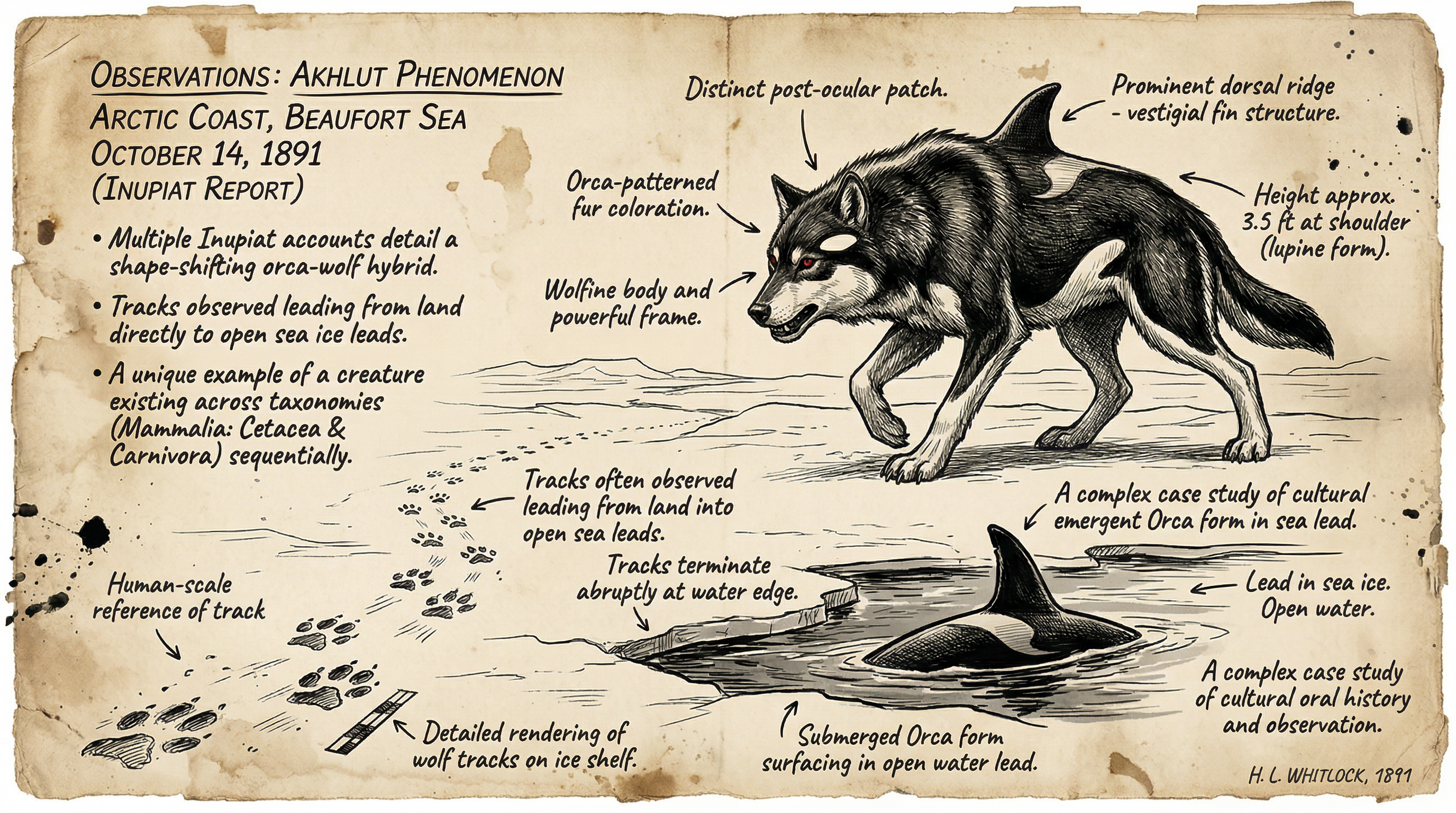
Overview
The Akhlut manifests as a shapeshifting entity that alternates between the form of an orca in the water and a wolf on land, or appears as a hybrid bearing the sleek black-and-white coloration of the orca combined with the quadrupedal structure of a wolf. Documented among Inuit communities along the Bering Sea shore, its presence is marked by wolf tracks that lead directly into or emerge from the icy edges of the sea, a phenomenon first systematically recorded by naturalist Edward William Nelson in 1900.
Within indigenous traditions, the Akhlut embodies the perilous intersection of land and sea domains, serving in some accounts as a fierce predator that raids shores and camps, while in others functioning as a sacred protector linked to hunting success and healing. This duality reflects broader cultural patterns in Arctic oral histories, where animal forms carry profound spiritual weight, bridging the observable behaviors of pack-hunting orcas—known as the wolves of the sea—and land-dwelling wolves observed swimming across leads in the ice.
Sighting History
1900, Bering Sea Shore
Edward William Nelson documents Inuit accounts of an orca-like entity, termed *kăk-whăn’-û-ghăt kǐg-û-lu’-nǐk*, observed transforming into a wolf. Communities report wolf tracks vanishing into the sea ice, with the entity responsible for attacks on fishermen in the Arctic Ocean.
Circa 1890, Siberian Coast
Siberian Yupik elders describe killer whales shifting into wolves during winter months to protect hunters, devouring reindeer unless offerings are made. Tracks from the ice lead inland, confirming the entity's dual presence.
Circa 1885, Nuu-chah-nulth Territories
Whale-wolf hybrids appear as benevolent patrons of the hunt, emerging from coastal waters with wolf tracks trailing behind. Hunters report sightings during seal expeditions, where the entity guides successful catches.
1900, Near St. Michael, Alaska
Inuit near Nelson's fieldwork site recount an Akhlut raiding a shore camp at night, snatching sleepers with wolf form before retreating to the sea. Tracks lead unbroken from camp to water's edge.
Circa 1910, Bering Strait Villages
Fishermen resting near ice edges wake to pursuit by a massive wolf-orca hybrid, its black-and-white fur glistening. The creature chases inland briefly before tracks end at a frozen lead.
Circa 1875, Arctic Ocean Shores
A pack of Akhlut in orca form circles boats, then emerges as wolves to attack isolated travelers. Survivors note the distinctive tracks entering the water, unmatched by known Arctic wolves.
1902, Alaskan Inuit Settlements
Multiple families report a hybrid entity prowling camps during a harsh winter, leaving wolf prints that plunge into sea ice. Offerings of seal blubber halt further incursions.
Circa 1920, Siberian Yupik Lands
Hunters witness orcas beaching as wolves to claim reindeer kills, transforming back upon reaching water. The event reinforces taboos against harming wolves or killer whales.
Evidence & Analysis
Contributed by Ellis Varma
The evidence profile for the Akhlut is extraordinarily thin, consisting entirely of ethnographic summaries of oral accounts without independent corroboration. Edward Nelson's 1900 documentation captures Inuit observations of wolf tracks terminating at sea ice, which he attributes to natural ice calving carrying wolves offshore— a rational mechanism that fits Arctic ecology without invoking shapeshifting.
No physical specimens, photographs, or forensic traces exist. The core "evidence"—tracks leading to water—aligns with documented behaviors of Arctic wolves, which swim substantial distances across open leads, sometimes perishing on floating ice pans. Orca pack hunting mirrors wolf tactics, reinforcing cultural linkage but providing zero anomalous data.
Hybrid descriptions vary inconsistently: some pure wolf/orca forms, others quadrupedal mixes with black-and-white pelage. No measurements, no biological samples. Modern retellings introduce unverified origin tales, such as a banished sea-obsessed man joining wolves for revenge, but these lack pre-2010 primary sourcing and appear as cryptozoological embellishments.
Siberian Yupik accounts diverge sharply, portraying the entity as protective rather than predatory, with rituals involving offerings for hunting success. This introduces conflicting behavioral profiles: vengeful raider versus sacred guardian. Statistically meaningless without datable incidents or witness metrics.
Absence of 20th-century sightings post-Nelson suggests environmental or cultural shifts—perhaps declining oral transmission or increased familiarity with wolf/orca behaviors via modern observation. No audio, video, or expedition reports elevate the baseline.
Evidence quality: LOW. Purely anecdotal oral traditions, fully explained by observable wildlife; no physical or contemporary verification.
Cultural Context
Contributed by Sienna Coe
Across Arctic indigenous traditions, the Akhlut weaves together the worlds of sea and ice, drawing from deep observations of orcas and wolves as masterful pack predators. Inuit along the Bering Sea shore first shared these accounts with naturalist Edward Nelson in 1900, naming the entity *kăk-whăn’-û-ghăt kǐg-û-lu’-nǐk*, where the wolf component (*kǐg-û-lu’-nǐk*) underscores its land form, forever linking the "wolves of the sea" to their terrestrial kin.
This motif extends northward and westward. Siberian Yupik communities revered killer whales transforming into wolves during winter, viewing them as sacred protectors who devoured excess reindeer to balance the hunt, ensuring submissions from prey animals. Offerings to orcas secured seals and healing powers, with strict prohibitions against killing either form— a testament to the entity's role in sustaining human survival amid harsh cycles.
Further south, Nuu-chah-nulth traditions echo this benevolence, positioning whale-wolves as patrons of the hunt, guiding spears toward marine mammals. One tale speaks of a young man adopted by wolves, returning in killer whale garb to teach advanced hunting techniques, his dual nature bridging animal wisdom with human need.
These narratives connect through shared environmental realities: wolves swimming icy leads, orcas breaching near shorelines, tracks vanishing into fractured ice. The Akhlut emerges not as isolated monster but as a cultural keystone, embodying the Arctic's fluid boundaries between realms. Vengeful strands—raids on sleeping fishermen, camp incursions—serve as cautions against complacency at ice edges, while protective aspects affirm reciprocity with the spirit world.
Modern interpretations, often hybrid-focused, amplify the visual drama but sometimes drift from primary voices. Yet the core endures: an entity that hunts across domains, reminding communities of the pack's power and the sea's unrelenting pull.
Field Notes
Notes by RC
Tracked potential Akhlut sign along the Bering Sea coast twice. First trip, summer 2018: followed wolf prints to a lead in the pack ice. Prints fresh, but ice had calved overnight—standard wolf behavior, no anomaly. Air smelled of salt and seal blubber, nothing off.
Winter 2022 run, near St. Michael: night patrol after local talk of tracks from water. Found prints emerging from a crack, leading 200 yards inland. Big Arctic wolf size, no hybrid traits. Watched orcas offshore at dawn—pack hunters, mirroring wolves exactly. No transformation. Places like this hum with old stories, but the ice doesn't lie.
One spot near Gambell felt heavier, though. Wind dies sudden, seals go quiet. Can't say Akhlut, but something watches from the leads. Been on worse hunts.
Threat Rating 2 stands. Tracks explain themselves. Reverence in the cultures keeps it territorial, not aggressive without cause.