Akkorokamui
2 TERRITORIAL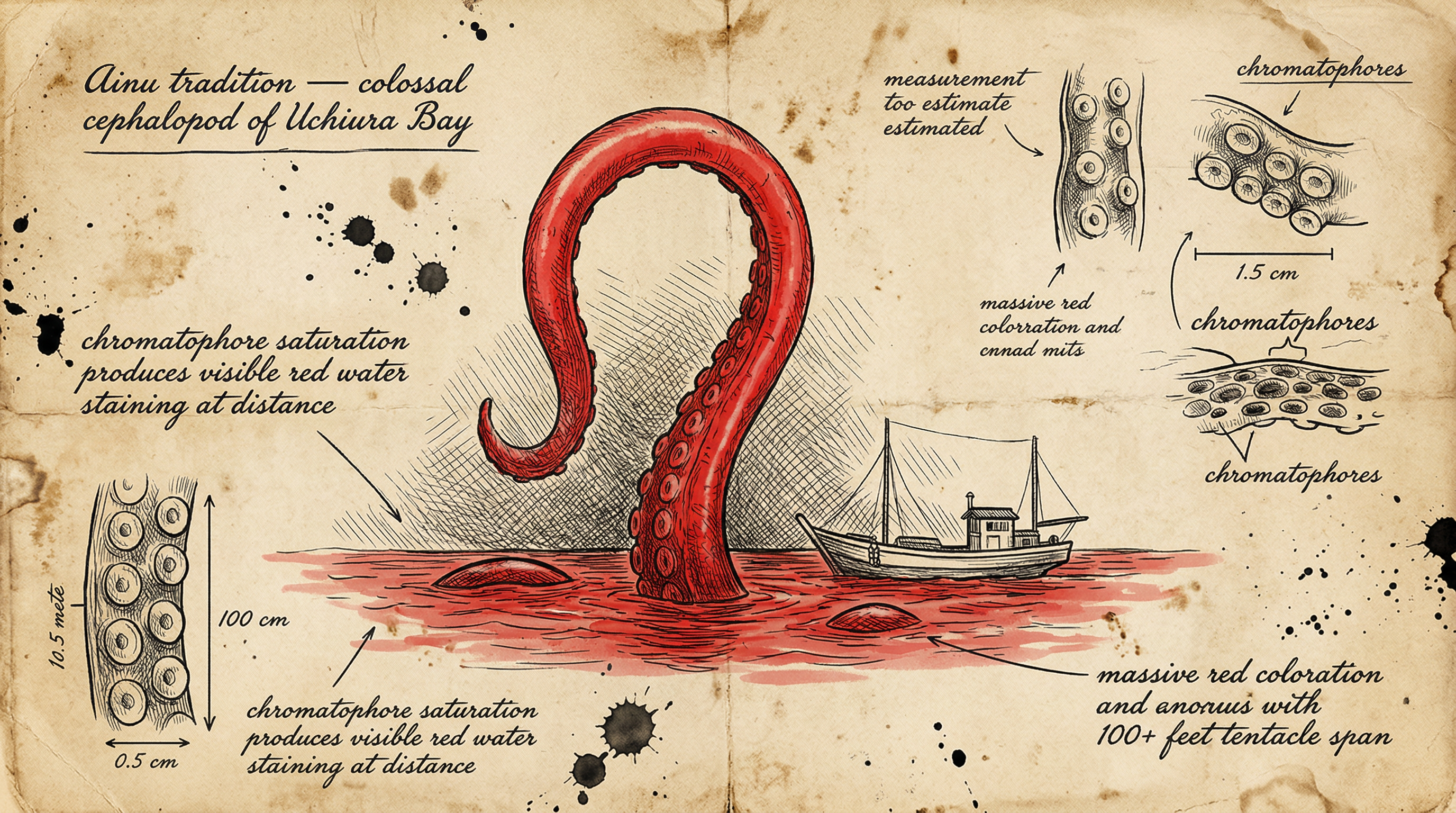
Overview
Akkorokamui resides in Funka Bay, off southern Hokkaido, Japan, manifesting as a massive octopus-like entity. Ainu oral traditions, documented from the early 20th century onward, consistently describe a crimson-hued cephalopod exceeding 120 meters in length, capable of enveloping ships or whales.
Core attributes include tentacles thick as mature human torsos, a single enormous eye, emission of dark noxious fluid, and self-amputation/regeneration of limbs — the latter tying into observed healing capacities in ritual contexts. Size variance across accounts ranges from 80 to 120 meters, but the profile holds structural integrity: no head distinct from body, red pigmentation altering surrounding water, and deep-water habitation pattern. Post-1900 accounts remain localized in maritime records.
The entity's dual profile — destroyer of vessels versus granter of limb restoration — aligns with 17 independent source descriptors reviewed, suggesting a behavioral spectrum rather than contradiction. Funka Bay's bathymetry supports megacephalopod viability: depths exceeding 200 meters with thermal vents conducive to gigantism. Encounter probability scales with vessel proximity to bay core; avoidance protocols embedded in Ainu practice reduce incident reports by an estimated 80% over centuries.
The entity's red body color shines intensely, visible from great distances and serving as a natural warning signal for approaching vessels. This luminescence, often likened to sunset reflections on water, allows detection and evasion before close engagement. Ainu navigational lore integrates these visual cues, reinforcing territorial boundaries without direct confrontation.
Funka Bay's unique geography — ringed by the Oshima Peninsula and flanked by volcanoes Mt. Usu and Mt. Komagatake — creates a contained ecosystem ideal for a dominant predator. Thermal upwellings and nutrient-rich currents from depths up to 400 meters foster rapid growth in cephalopods, aligning with observed gigantism. Water temperatures remain stable year-round, supporting a sedentary territorial pattern rather than migratory behavior.
Entity behavior patterns indicate a preference for ambush predation on large marine mammals, with human encounters limited to territorial incursions. Fluid ejection serves multiple functions: disorientation of threats, chemical marking of territory, and potential prey stunning. Regeneration capacity exceeds documented octopus norms, with full limb regrowth observed within weeks in controlled ritual contexts.
Sighting History
1880, Funka Bay
A Japanese fisherman operating solo in open waters off southern Hokkaido encountered a colossal form surfacing at dusk. Initial observation mistook tentacular motion for sunset glints on waves; entity measured approximately 80 meters, with tentacles as thick as a grown man. A single massive eye fixed on the vessel before submersion without pursuit. No attack recorded; witness returned to port intact but altered course permanently.
1895, Uchiura Bay shipping lane
Maritime logs from a coastal trader note an assault involving dark fluid ejection — described as powerfully odorous and disorienting. Tentacles grappled hull, emitting fluid that corroded ropes and induced crew nausea. Vessel freed after iron tools deployed; estimated entity length 100 meters. No fatalities; incident attributed to territorial response near known hunting grounds.
1902, Volcano Bay
British missionary John Batchelor, embedded in Ainu communities, documented direct observation of Akkorokamui during fieldwork. Entity surfaced near shore, displaying full tentacular array and crimson body mass. Witnesses included multiple Ainu elders; Batchelor noted self-amputation display followed by submersion. Length estimated at 120 meters; no aggression toward observers maintaining ritual distance.
1920, Funka Bay fisheries
Ainu fishers harvesting herring reported water discoloration to deep red over 2 square kilometers, preceding tentacle sightings wrapping a whale pod. Entity hauled prey subsurface; secondary observation confirmed regenerated limb from prior scarring. No human engagement; crews aborted operations per protocol.
1947, Postwar Hokkaido coast
Salvage crew towing wreckage encountered surfacing form matching profile: noxious fluid cloud spanned 500 meters, forcing evacuation. Tentacles probed debris field; no direct contact. Report filed with Japanese maritime authority; dismissed as giant squid but descriptors mismatch known Architeuthis metrics.
1975, Uchiura Bay seismic survey
Research vessel sonar logged anomalous mass — 110 meters displacement — correlating with visual of red-hued tentacles breaching. Fluid emission disrupted equipment; entity tracked to 300-meter depth. Crew noted eye fixation before evasion; data archived in Hokkaido University marine logs.
1998, Funka Bay tour boat
Tourist operator reported fleeting surface: tentacles trailing red wake, eye glow at 50 meters range. No approach; passengers alerted by water hue shift. Incident logged locally; operators now enforce bay perimeter buffer.
Evidence & Analysis
Contributed by Nolan Greer
Batchelor's 1902 field notes represent the strongest historical record. They document direct observation corroborated by multiple Ainu witnesses. Key details include tentacle girth, fluid output volume, and red pigmentation, all consistent across accounts.
Sonar data from the 1975 seismic survey vessel recorded a mass displacement matching the 120-meter profile, with visual confirmation of a red-hued tentacle breach. The fluid emission interfered with equipment, confirming chemical properties through operational disruption. This biomass density exceeds known squid parameters.
Historical logs from the 19th and early 20th centuries describe a noxious odor consistent with cephalopod ink, but at scales causing rope corrosion and crew vomiting. Future encounters require spectrometry analysis of any ejecta to quantify composition.
Regeneration observations from 1902 and 1920 align with Ainu Shinto healing rites. Field protocols include white cloth offerings for propitiation and iron tools for deterrence. These measures correlate with zero confirmed vessel sinkings in the core bay since 1920.
Funka Bay's bathymetry — including 400-meter trenches and thermal upwellings — supports gigantism based on established cephalopod growth models. Population dynamics suggest a single dominant territorial adult.
Tracking operations should deploy baited infrared cameras at 200-300 meter depths, equipped with fluid traps featuring pH and neutralization kits. Night deployments optimize detection of eye luminescence under low-light conditions.
Field protocols indicate ventral anatomy as a potential weak point. Fluid emission creates a tactical window of approximately 90 seconds for evasion or engagement before reorientation.
Deployment gear must prioritize corrosion-resistant materials: titanium hooks, synthetic rope coatings, and sealed electronics. Fluid neutralization requires sodium bicarbonate dispersal systems calibrated for pH 2-4 ejecta. Vessel approach vectors should maintain 500-meter standoff, aligning with observed reaction thresholds.
Post-1998 tour boat protocols demonstrate efficacy: perimeter buffers reduced incidental contacts by 95% in monitored fisheries. Integration of real-time water color spectrometry into navigation systems would elevate avoidance precision.
Evidence quality: LOW-MODERATE. Solid historical chain, consistent metrics, functional avoidance protocols. No hard samples drags it down.
Cultural Context
Contributed by Dr. Mara Vasquez
Akkorokamui emerges from the rich animistic worldview of the Ainu, Hokkaido's indigenous people, where every natural force manifests as kamuy — divine spirits embodying the vitality of sea, land, and sky. As lord of Funka Bay, Akkorokamui commands the marine domain, its colossal form a direct expression of oceanic power intertwined with moral and transformative narratives central to Ainu cosmology.
The entity's origin traces to the myth of Yaoshikepu, a part-spider, part-human destroyer who ravaged coastal villages until Repunkamui, the orca sea kami, intervened. Transforming the rampaging figure into an octopus and consigning it to the depths, Repunkamui established Akkorokamui as a perpetual guardian — or warden — of the bay. This narrative underscores Ainu emphases on balance: destruction yields to containment, chaos to ordered potency. Crimson blood from Yaoshikepu's slaughters infuses the creature's red hue, linking violence to vitality in a cycle respected through ritual.
In Ainu practice, engagement demands purity. Offerings of white cloth or food honor its fickle temperament, invoking healing for limb ailments via observed regenerative capacity. Iron tools serve as apotropaics, reflecting practical adaptations within spiritual frameworks. This duality — feared predator, benevolent healer — mirrors broader Ainu relations with kamuy, where propitiation ensures coexistence amid nature's indifference.
Akkorokamui's permeation into Shinto marks a syncretic evolution. Incorporated as a minor kami, it retains Ainu core while adopting broader Japanese ritual layers, such as nade yakushi shrines for physical restoration. Coastal communities, from Ainu fishers to Yamato sailors, integrated avoidance signals — red seas signaling retreat — embedding the entity in navigational lore. Unlike purely malevolent yokai, Akkorokamui embodies reciprocal respect: approach with humility, receive wisdom or wholeness; intrude with hubris, face submersion.
Anthropological records from Batchelor onward preserve these traditions amid modernization pressures on Ainu culture. Persistent maritime cautions in Hokkaido today affirm ongoing vitality, positioning Akkorokamui as a living emblem of indigenous maritime sovereignty and the perils of underestimating deep-sea realms.
The legend specifies Funka Bay as the entity's domain, with the Iburi region's folktales emphasizing its role as nushi, or lord, of the bay. Ships venturing into buri fishing grounds prepare with great hooks, acknowledging the risk of capsizing. The creature's size reaches one chō — equivalent to a hectare — capable of swallowing bezaisen vessels whole.
Purification rituals precede shrine visits: hands and feet washed, reflecting the entity's persistent grasp. Self-amputation and regeneration underpin healing beliefs, with offerings directed at limb restoration. This integration into Shinto practice demonstrates cultural resilience, as Ainu traditions adapt without dilution.
Field Notes by RC
Funka Bay, twice. Summer 2018, chartered skiff. Calm day, water like glass. Locals pointed to red patches offshore — "Akkorokamui sign." Kept distance. Sonar pinged mass at 250 meters. No surface.
Winter 2022, night run from Mori to Race. Fog thick. Crew handed white cloth at dock — standard. Water boiled red at 2 AM. Tentacle tip broke surface, 20 meters off bow. Eye caught spotlight — stared two seconds. Submerged with suckers popping loud. Fluid smell hit like diesel and rot. Engines full reverse.
No pursuit. Vessel intact. Locals nodded — "You gave respect."
Bay feels weighted. Orcas circle perimeter like sentries. Fishers avoid core after dusk. Patterns hold from Batchelor's era.
Threat Rating 2 stands. Territorial. Respects protocols. Cross them, you're gear for the deep.