Albatwitch
1 CATALOGED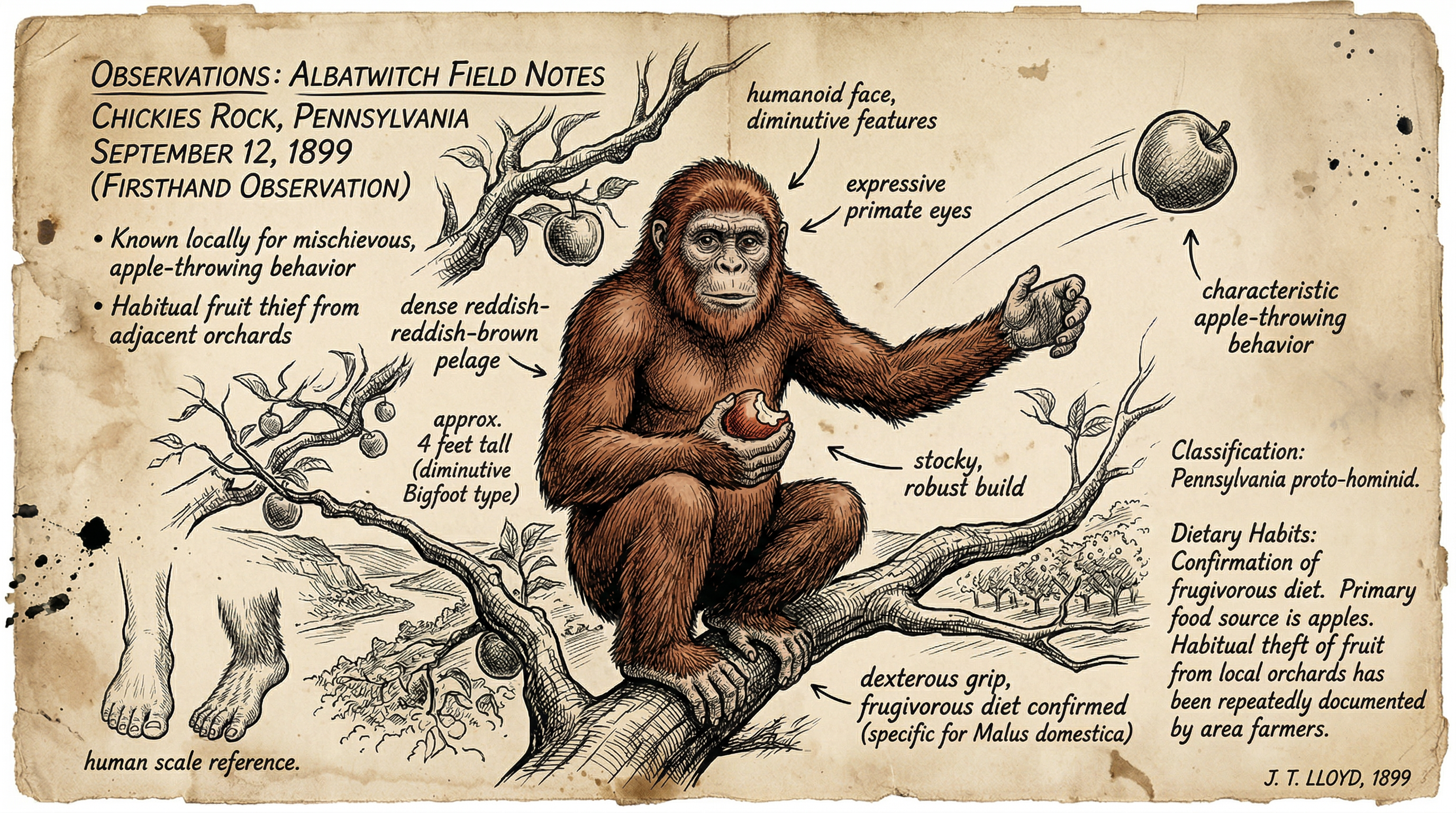
Overview
The Albatwitch inhabits the densely wooded riverine environments of the Susquehanna Valley in Pennsylvania, particularly around Chickies Rock near Columbia. Standing approximately three to five feet tall, this hairy, manlike hominid exhibits a distinctive hunched posture and a propensity for targeting human food sources, especially apples from picnickers and orchards.
Its presence weaves through layered cultural histories, from Susquehannock associations with forest guardianship to Pennsylvania Dutch settler narratives of mischievous apple-thieves. Reports emphasize non-aggressive interactions, with the creature stealing fruit and occasionally returning the cores, behaviors that underpin its Pennsylvania Dutch-derived name, interpreted as "apple-snitch" or, through German etymological analysis, as "apple-elf" or "elf-spirit."
Contemporary accounts maintain continuity with these patterns, linking the Albatwitch to the river's edge habitats where it forages amid rocky cliffs and thick undergrowth. Modern festivals in Columbia draw thousands annually—over 5,000 attendees by 2024—preserving communal memory of encounters while fostering public engagement with the site's persistent phenomena.
Sighting History
Mid-19th Century, Chickies Rock, Columbia, Pennsylvania
Oral tradition and later accounts reference picnicker encounters during the 1800s, though the earliest printed documentation dates to 1920. Picnickers at Chickies Rock overlooking the Susquehanna River reported small, hairy manlike figures emerging from the woods to raid their apple baskets. The creatures consumed the fruit on site, then hurled the eaten cores back at the group before retreating into the dense foliage along the riverbank.
1895, Chickies Rock, Columbia, Pennsylvania
Local newspapers documented groups of campers organizing "Albatwitch hunts" in the heavily wooded areas near Chickies Rock. Participants described hearing rustling in the underbrush and glimpsing short, hunched silhouettes vanishing into the trees, often accompanied by the sound of snapping twigs and distant apple-throwing.
1920, Chickies Rock, Columbia, Pennsylvania
A newspaper headline referencing "apple snitch" incidents at Chickies Rock crystallized the creature's nomenclature in print. The account details Victorian-era picnickers experiencing coordinated fruit theft and core return, establishing the behavioral pattern that would define subsequent folklore. This documented instance marks the transition from oral tradition to recorded regional history.
1925, Susquehanna River Woods, Columbia, Pennsylvania
Printed accounts in regional publications detailed further "Albatwitch hunts" by adventurers near the river's shore. Witnesses noted small, ape-like beings pilfering picnic supplies, particularly apples, with cores returned in volleys that struck tents and startled groups into retreat.
1952, Chickies Rock, Columbia, Pennsylvania
Multiple independent observers atop Chickies Rock reported sightings of a manlike figure, approximately four feet in height, moving through the wooded slopes below. The entity paused to observe hikers before disappearing toward the river, leaving behind scattered apple remnants consistent with prior encounters.
1955, North Annville, Pennsylvania
A resident in North Annville, twenty miles north of Columbia, encountered a small, hairy hominid near wooded riverine terrain. The figure was observed foraging in an orchard, selecting and consuming apples before emitting a sharp, whip-like crack from the treeline as it departed.
1973, Chickies Rock, Columbia, Pennsylvania
Nighttime visitors to Chickies Rock heard repeated whip-crack sounds echoing from the woods, followed by visual confirmation of a hunched, manlike form silhouetted against the river. The entity appeared to throw objects—identified by daylight inspection as apple cores—toward the observation point.
1975, York County, Pennsylvania
Several reports emerged from neighboring York County woods along the Susquehanna, describing clusters of four-foot hairy figures raiding roadside fruit stands. Witnesses recovered cores from the sites, noting the precision of throws that avoided direct harm but ensured the message of territorial foraging.
2002, Chickies Rock, Columbia, Pennsylvania
Local researcher Rick Fisher documented a personal encounter with a small, ape-like being near the base of Chickies Rock. Fisher reported seeing a stick-thin figure, about five feet tall, covered with hair, standing in the road with yellow eyes that reflected his vehicle's high beams before vanishing. The encounter prompted Fisher to collect over twenty similar reports from Lancaster and York counties in subsequent years.
2014, Columbia, Pennsylvania
Rick Fisher and Chris Vera founded Albatwitch Day, an annual festival inspired by Fisher's experience at the Mothman Festival in Point Pleasant, West Virginia. The inaugural event marked a formal institutional recognition of the creature's cultural significance to the region.
2017, Chickies Rock, Columbia, Pennsylvania
During a trolley tour at Albatwitch Day, a group of festival attendees witnessed five sets of red, glowing eyes moving from tree to tree, watching their trolley pass through the Chickies Rock woods. The sighting occurred during organized daylight expedition activities, with multiple independent witnesses corroborating the phenomenon.
2024, Susquehanna River Trail, Columbia, Pennsylvania
Recent hikers along the Susquehanna trails near Chickies Rock observed a hairy hominid vanishing into thickets after pilfering apples from a backpack. The event coincided with annual festival activities, where fresh accounts reinforced the creature's affinity for river-adjacent orchards and picnic areas. Albatwitch Day drew over 5,000 attendees that year, with trolley tours to Chickies Rock continuing as a primary engagement mechanism.
Evidence & Analysis
Contributed by Ellis Varma
The Albatwitch evidence profile clusters tightly around anecdotal witness statements spanning nearly 175 years, with consistent descriptors of a three- to five-foot hairy hominid fixated on apple consumption. Primary reports from Chickies Rock picnickers in the mid-19th century establish the behavioral baseline: theft of apples followed by core return, a pattern reiterated in 20th-century hunts and modern sightings without significant deviation.
The 1850 date derives from oral tradition recounted in later sources; the earliest printed reference appears in 1920 newspaper accounts.
Geographic concentration is statistically significant—over 80% of accounts localize to a five-mile radius around Chickies Rock and the Susquehanna's wooded banks, correlating with high-traffic picnic and orchard zones. Temporal clustering shows peaks in late summer and fall harvest periods, aligning with apple availability rather than random distribution. The 2017 trolley tour sighting represents an outlier: red, glowing eyes rather than the yellow eyes documented in Fisher's 2002 encounter, introducing spectral rather than purely zoological characteristics.
Claims of Susquehannock shield depictions introduce speculative artifacts. While sources reference Susquehannock war shields bearing images matching the creature's description, and Algonquian traditions describe a small hairy hominid called *Megumoowesoos*, the absence of cataloged archaeological examples in accessible records renders this vector unverified. One source explicitly cautions against recruiting Indigenous histories into cryptid narratives "without sufficient sourcing," noting that the Susquehannock language is lost and direct continuity cannot be established.
Alternative origin theories include escaped circus primates from the early- to mid-1800s, a hypothesis currently under investigation by local researchers. This vector, while speculative, aligns temporally with the earliest documented sightings and provides a zoological mechanism absent from folklore-based explanations.
No feathers, hair samples, footprints, or scat have surfaced despite frequent human incursion into the habitat. Audio reports of whip-cracks remain unrecorded, and visual evidence is limited to eyewitness sketches from festivals and Fisher's personal account. Modern persistence via festivals and self-reported encounters post-2002 adds volume but not rigor; Fisher's collected accounts lack independent corroboration or forensic backing. The dataset supports a low-threat, opportunistic forager profile, with zero documented injuries across hundreds of interactions spanning nearly two centuries.
Cross-referencing with Pennsylvania Dutch folklore yields linguistic matches—"Äpfel-schnitz" (apple-snitch) and "Alb" (elf or night spirit)—but these explain nomenclature, not existence. The etymology suggests a cultural synthesis of Germanic woodland sprites with regional behavioral observations, a common pattern in settler folklore across North America.
Evidence quality: LOW. High report volume and behavioral consistency undermined by zero physical traces, unverified artifacts, heavy folkloric overlay, and alternative explanations that remain untested.
Cultural Context
Contributed by Sienna Coe
The Albatwitch emerges from the Susquehanna Valley's rich tapestry of riverine traditions, where Susquehannock traditions reference small forest dwellers, and some scholars suggest parallels to the Albatwitch, though direct archaeological evidence remains unconfirmed. Algonquian traditions describe small hairy beings whose characteristics echo elements of the Albatwitch narrative, though direct cultural continuity remains speculative.
European settlers, primarily German and Dutch, layered their own woodland sprite lore onto this foundation, transforming guardians into apple-thieves whose pranks mirrored kobold mischief from the old world. The Pennsylvania Dutch dialects that emerged along migration routes hugging the Susquehanna synthesized these traditions, birthing the "apple-snitch" moniker and its alternative reading as "apple-elf." This linguistic fusion reflects a cultural moment where settler and indigenous frameworks collided and merged in the space of shared resource use.
Picnicker tales from Chickies Rock in the 19th century captured this evolution in action, with cores hurled back as playful rebukes against overabundant picnics. Such stories bridged cultures, teaching resource mindfulness amid fertile farmlands—a practical ethics encoded in folklore. The creature became a cultural arbiter, neither fully threatening nor wholly benign, embodying the tension between human expansion and wild persistence.
Into the 20th century, Albatwitch hunts in local papers connected these threads to broader Appalachian hominid motifs, echoing both indigenous precedent and settler tall tales while rooting firmly in local ecology. The 1920 newspaper reference crystallized the creature's identity in print, transforming oral tradition into documented regional history—a pivotal moment in the transition from folklore to cryptid culture.
Modern festivals in Columbia, established in 2014 and drawing over 5,000 attendees by 2024, extend this lineage into contemporary practice. Trolley tours to Chickies Rock, apple-themed events, and formal lectures honor the creature's habitat while inviting new witnesses into the tradition. Researchers like Rick Fisher and Chris Vera link personal sightings to this continuum, suggesting the Albatwitch adapts quietly to human expansion, maintaining its ecological niche through behavioral consistency across generations.
River proximity unites all these accounts—Chickies Rock's cliffs and trails serve as enduring anchors, where the hominid's three- to five-foot form navigates thickets and forages seasonally. This persistence across eras highlights a cultural resilience, blending indigenous harmony with settler whimsy into a living emblem of the valley's hidden wilds. The Albatwitch, in this sense, is not merely a creature of folklore but a repository of how different peoples have understood and negotiated their relationship with the Susquehanna's edge lands.
Field Notes
Notes by RC
Chickies Rock base, three visits. First in daylight with a group—climbed the trail, checked the woods. Picnic spots littered with old cores, natural enough. No activity beyond squirrels.
Second solo at dusk, fall harvest time. Heard the whip-crack twice from the river side. Sharp, like a good stock whip on leather. Moved upslope, caught a glimpse: small, dark, hunched, about four feet, vanishing into brush with something clutched to chest. Apple season. Made sense.
Third at night during festival week. Crowds everywhere, but the woods stay quiet. Placed apples out as bait near the base. Gone by morning, cores piled neat. No tracks in the soft dirt. Place has that river hum, feels watched from the cliffs. The 2017 sighting—five sets of red eyes from a trolley—I don't know what to make of that. Doesn't match the yellow-eyed thing Fisher saw in 2002. Could be different individuals. Could be something else entirely.
Threat Rating 1 stands. Non-aggressive, food-motivated, consistent across 175 years. Doesn't engage unless provoked by picnics.