Alkali Lake Monster
1 CATALOGED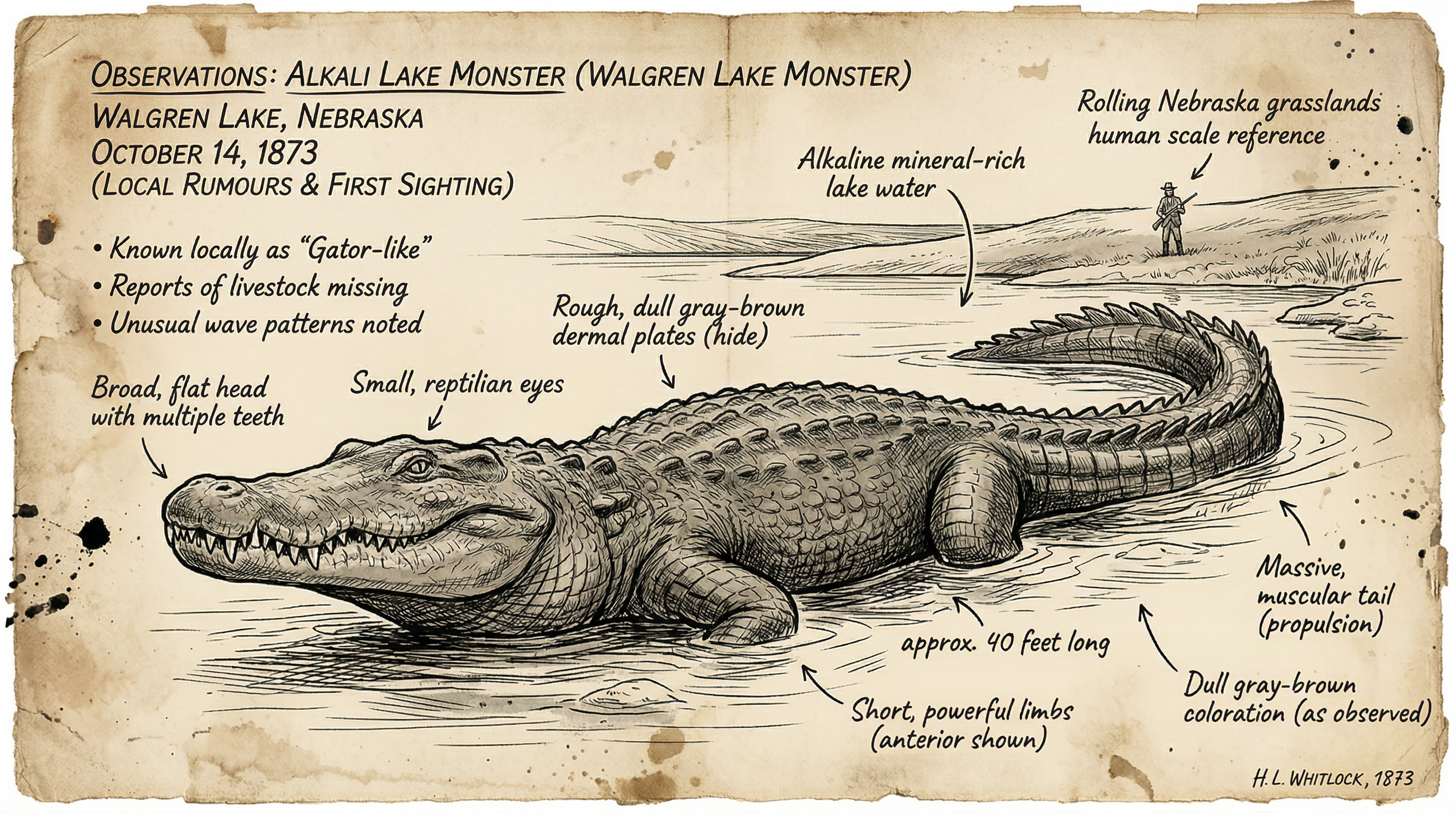
Overview
The Alkali Lake Monster inhabits Walgren Lake, formerly known as Alkali Lake, a modest 80–100-acre body of water in the Sandhills region near Hay Springs, Nebraska. This aquatic entity measures approximately 40 feet in length, with rough grayish-brown or shiny black skin, an oil-barrel-shaped head, and a prominent horn-like appendage positioned between its eyes and nostrils.
Resembling an oversized alligator, the creature possesses powerful limbs—some accounts specify four legs, others note two front legs paired with a rear flipper—and a muscular tail capable of violent thrashing. It emits a deafening roar upon disturbance, generates a pervasive stench, and dives swiftly into the lake's muddy depths. Attributions to pre-settler Native American narratives circulate locally, though primary sources from indigenous traditions remain unlocated in archival records.
Sighting History
August 1921, Hay Springs, Nebraska
Local residents near Alkali Lake report a massive animal responsible for cattle disappearances. The Hay Springs News publishes the first written account on September 16, 1921, under the headline “If It Isn’t a Whale It’s a Whaler of An Animal.” No specific visual details emerge beyond its enormous size and predatory habits; game officials decline a seining attempt, citing inadequate equipment.
August 11, 1922, Alkali Lake shores
The Hay Springs News reports the huge water animal surfacing again. Locals link it to ongoing livestock losses, with editor John G. Maher amplifying coverage through sensational articles. No named witnesses provide direct descriptions at this stage.
1923, Alkali Lake camping site
J.A. Johnson and two companions spot the creature 60 feet from their campsite on the lake's edge. They describe a 40-foot-long beast, dull gray-brown in color, alligator-like with a rhinoceros horn between eyes and nostrils. Upon noticing the men, it roars dreadfully, thrashes its tail violently, and submerges into the churning water. The account appears in the Omaha World-Herald, sparking national and international interest, including the London Times.
1910, Alkali Lake near Hay Springs
Old Jules Sandoz, father of author Marie Sandoz, encounters a shiny black beast with an oil-barrel head gleaming in moonlight. Marie documents the incident in her 1935 writings, positioning it as predating settler arrivals.
July 1938, Federal Writers’ Project retelling
The Nebraska Federal Writers’ Project publishes an expanded account in their Tall Tales series, describing earth-trembling movements, daily livestock predation, and thick green mist disorienting travelers. No new eyewitnesses cited; the narrative builds on prior reports with supernatural embellishments.
Evidence & Analysis
Contributed by Ellis Varma
The evidence profile for the Alkali Lake Monster clusters tightly around three primary data points: the 1921 Hay Springs News articles, the 1923 J.A. Johnson Omaha World-Herald interview, and Marie Sandoz's undocumented family account from 1910. No physical traces—dermal samples, tracks, scat, or water disturbances—appear in any record. Photographic evidence consists solely of period hoax images, such as a mudpuppy salamander posed on sand to mimic an attacking beast.
Livestock disappearances in 1921 provide circumstantial correlation but zero causal linkage; predation patterns match standard predators like wolves or coyotes prevalent in the Sandhills. John G. Maher, the Hay Springs News editor, maintained a documented history of fabrications, including a "petrified man" hoax, rendering his publications statistically unreliable for entity verification. The 1889–1890 drought reduced Alkali Lake to a puddle, questioning viability for a 40-foot aquatic survivor just decades later.
Johnson's 1923 sighting offers the most detailed morphology—40 feet, horned, alligatoriform—but lacks independent corroboration from his unnamed companions. Failed capture attempts, including a fishing club's harpoon and whaling gun expedition, yield no artifacts or biological residue. Later embellishments (earth tremors, green mist) escalate without proportional witness escalation, following classic narrative inflation patterns in isolated tall-tale clusters.
Alternative explanations align with regional fauna: oversized beaver (per Nebraska State Historical Society), large catfish, or mudpuppy salamander misidentifications under low visibility. Walgren Lake's recreational use continues without incident, with sightings ceasing post-1920s. The dataset supports no persistent population or behavioral continuity.
Evidence quality: LOW. Anecdotal newspaper reports from hoax-prone sources, zero physical corroboration, environmental inconsistencies.
Cultural Context
Contributed by Sienna Coe
The Alkali Lake Monster emerges from the vast, wind-swept expanses of Nebraska's Sandhills, where shallow lakes and endless grasslands have long shaped human stories of the unseen. This creature bridges the practical world of ranchers—haunted by cattle losses in a harsh frontier landscape—with the allure of ancient aquatic survivors, evoking coal-age relics glimpsed in moonlit waters. Its tale flows from the Hay Springs News in 1921, where editor John G. Maher wove local rumors into national legend, drawing eyes from the London Times to small-town Nebraska.
Connections ripple outward to broader American lake monster traditions. Like Champ in Lake Champlain or the beasts of Okanagan Lake, the Alkali entity embodies isolation's mysteries: a landlocked sea serpent in a prairie puddle, horned and roaring amid the quiet. Marie Sandoz's account of her father, Old Jules, adds a personal layer, rooting the sightings in immigrant homesteader life before the tale's public amplification. The Federal Writers’ Project in 1938 layered supernatural elements—trembling earth, disorienting mists—mirroring how oral histories evolve across generations in rural America.
Hay Springs embraced the monster as heritage during its 1985 centennial, erecting a green flotation replica based on J.A. Johnson's description and selling merchandise that turned folklore into pride. This transformation parallels other regional icons, where cryptids foster community identity in sparse populations. While whispers of Native American precedents persist, no verified tribal records surface, leaving the narrative firmly in settler lore—a testament to how Sandhills storytellers filled the silence between dunes with roars from the deep.
Today, Walgren Lake draws anglers and swimmers without fear, yet the monster lingers in local memory, a thread connecting 1920s headlines to modern recreation. Its dormancy underscores a pattern in aquatic cryptids: bursts of attention followed by quiet assimilation into cultural fabric, ever ready for revival.
Field Notes
Notes by RC
Visited Walgren Lake twice. First in summer, midday—clear water, families fishing bass and perch, no unusual currents or depths over 20 feet. Locals point out the monster replica bobbing offshore like a kid's pool toy.
Returned at dusk. Lake goes still fast after sunset. Scanned with thermal from the east shore—no heat signatures beyond carp schooling near the surface. Air carries that alkaline tang, but nothing lives or dead to explain a 40-footer.
Johnson's campsite spot feels ordinary. Mud flats, reeds, cow tracks. Drought history checks out; lakebed photos from 1890 show cracked earth. If something big swam here in '23, it didn't leave prints.
Threat Rating 1 stands. Pure settler yarn. No teeth in the water.