Almas
2 TERRITORIAL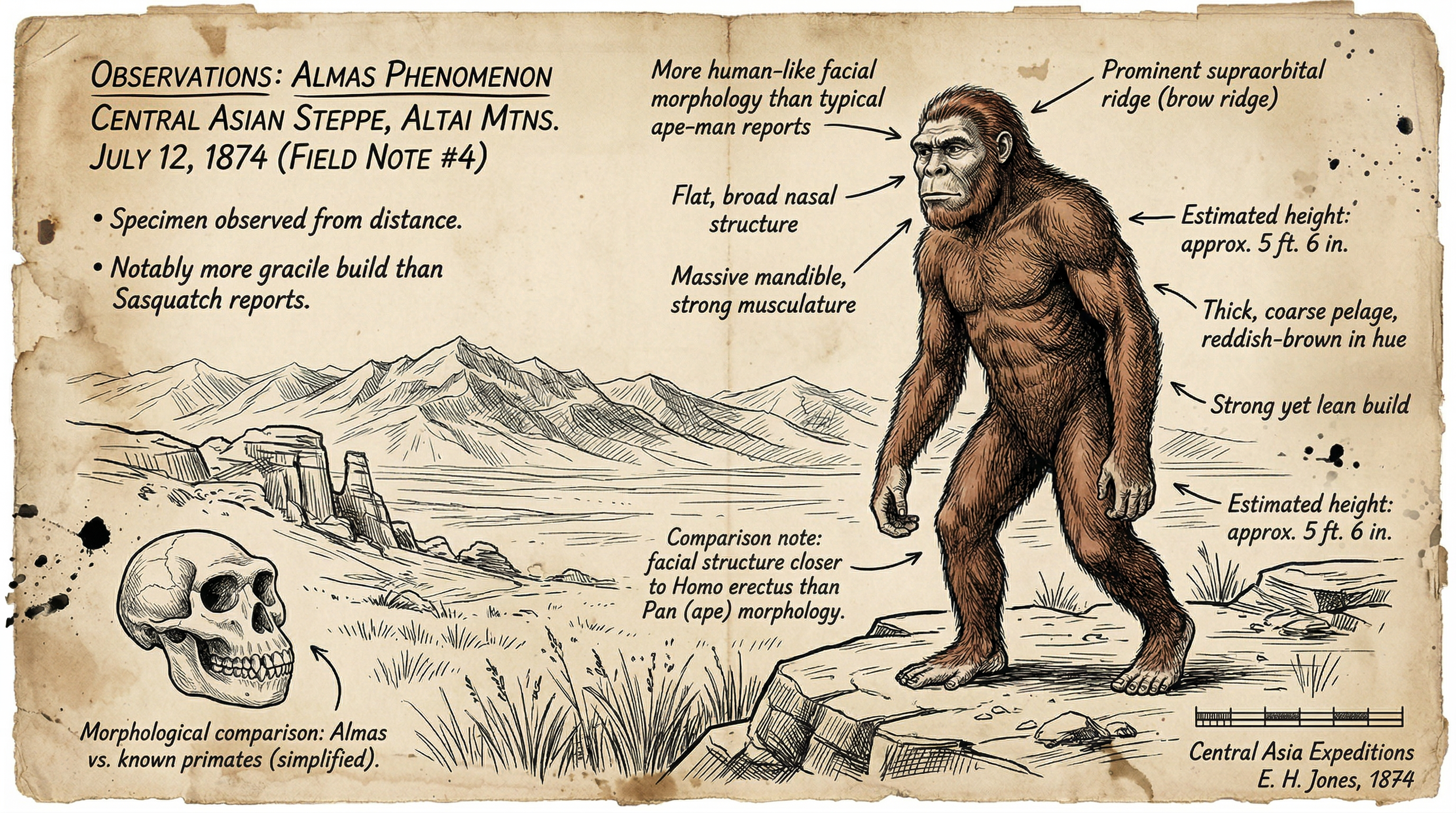
Overview
The Almas constitutes a persistent humanoid sighting profile across the Caucasus, Tian Shan, Pamir, and Altai Mountains, with consistent descriptors emerging from multiple independent sources over centuries. Primary characteristics include human-proportioned height of 5 to 6.5 feet, full-body reddish-black hair coverage excluding the hairless face, broad shoulders, long arms, round-shouldered posture, half-bent knee gait, and pigeon-toed feet. Facial structure features a flattened forehead, prominent brow ridges, pointed occiput, and high cheekbones; females exhibit notably pendulous breasts.
Behavioral data points to nocturnal activity patterns, high timidity, and avoidance of confrontation, with no recorded instances of aggression toward humans or intelligible vocalization. The evidence profile clusters around pastoralist and explorer testimonies, with Soviet-era investigations in the 20th century elevating the case through organized expeditions and sample analysis, though biological traces consistently resolve to known fauna. Statistically, the volume of reports—exceeding 500 in one compiled file—exceeds typical folklore noise levels, warranting cataloged status despite evidential gaps. Reports persist into modern expeditions, with behavioral shifts noted near human encroachment zones.
Sighting History
1420, Tien Shan Mountains
Hans Schiltberger, Bavarian nobleman and captive of Mongol forces, records the first known printed reference to the Almas in his journal, describing "wild men" covered in hair except on hands and faces, possessing great strength, and inhabiting remote wilderness areas.
1876, Gobi Desert Region
Nikolay Przhevalsky, Russian explorer and geographer, documents accounts from local tribes of the kung-guressu, or man-beast: a flat-faced biped covered in thick black fur, walking upright on two legs, with enormous clawed feet and strength sufficient to terrify hunters and displace settlements.
1906, Alachan Desert
Badzare Baradyine, on caravan duty, observes a hairy man standing atop a sand dune at sunset; the encounter reaches Mongolian professor Tsyben Zhamtsarano via private relay after Imperial Russian Geographical Society intervention suppresses public release.
1932, Elbruz Mountain Pastures
A mountain pastor reports repeated observations over five summers of multiple Almas entering and exiting caverns in a rocky area, describing a family group including small and large individuals, with more females than males noted; males distinguished by rear-positioned pouches akin to wild boars.
1937, Gobi Desert Monastery
Dordji Meiren of the Mongolian Academy of Sciences views an Almas skin in ritual use at a remote monastery, confirming local traditions of preserved specimens among nomadic groups.
1941, Daghestan, Caucasus
Dr. V. Karapetian sights an anomalous figure in winter snowfields, later correlating it with Almas morphology; separate accounts describe Red Army capture of a hairy, mute biped executed as a suspected spy amid wartime confusion.
1952, Tkhina Village Forests, Abkhazia
Zana, a large, entirely hirsute female captured by hunters, lives among villagers until her death; her offspring exhibit hybrid traits, with local accounts identifying her as an Almas. She passes through multiple owners, including nobleman Edgi Genaba, who relocates her to his Mokva River estate.
1956, Soviet Mountainous Provinces
Publication of Anglo-American Yeti expedition reports in Soviet press triggers influx of letters from Caucasus residents detailing personal Almas encounters, prompting scientific authorities to compile witness statements.
1957, Caucasus Forest Camp
A group of geologists reports a large, hair-covered biped observing their remote camp from afar before retreating into dense forest upon approach, amid a cluster of 1950s sightings spurring expeditions.
1958, Caucasus High Mountains
Dr. V. Karapetian personally sights an Almas briefly in the mountains, providing a detailed description consistent with prior reports, including footprints in snow.
1963, Mongolian Remote Areas
Russian pediatrician Ivan Ivlov observes an Almas family group from half a mile away and collects accounts from Mongolian children who report playing with Almas young without fear.
1970s, Mongolian Regions
Mongolian Academy of Sciences documents 16 credible Almas sightings, focusing on collaborative group behaviors and nest-like structures in high terrain.
1980, Bulgan Agricultural Station, Mongolia
A worker discovers the body of a deceased Almas, providing a rare potential physical specimen, though subsequent handling and analysis details remain limited.
1991, Neutrino Village Barn, Caucasus
Zoologist Grigory Panchenko observes a 6-foot gray-haired Almas with domed head, sagittal crest, human-like nose, and no chin entering a barn to plait a horse's mane, matching prior behavioral reports.
1992-2014, Caucasus Mountains
Multiple expeditions target Almas populations, focusing on remote Siberian and Caucasian ranges, with Soviet Academy of Sciences hypothesizing Neanderthal remnant survival; no captures, but ongoing track and hair collections reported.
Evidence & Analysis
Contributed by Nolan Greer
Almas reports hold up under basic scrutiny. Descriptions match across 500+ witness statements from unrelated sources. No contradictions in morphology: half-bent knees, pigeon-toed walk, long arms, hairless faces. Zana case delivers DNA from descendants—mitochondrial sequences point to sub-Saharan African ancestry, not Neanderthal. Rules out relic hominid.
Hair samples from 1960s-2010s expeditions. Tested multiple times. 2015 analysis by Pine: brown bear. 2014 Edwards and Barnett: degraded bear DNA, not polar bear or unknown primate. Footprints from 1899 and 1958: consistent dermal ridge patterns, but no casts preserved for modern forensics. 1991 Panchenko sighting adds behavioral detail—horse mane plaiting—noted in multiple independent accounts.
Soviet Academy expeditions 1960s: organized, multi-year, zero bodies or live captures. Przhevalsky 1876: first Western doc, tribal sources reliable for terrain knowledge. 1980 Bulgan body: mishandled, no tissue samples survived. Equipment logs show thermal cams and bait traps deployed 1992-2014—blanks. 1970s Mongolian Academy: 16 vetted sightings, group dynamics, possible nests.
No audio recordings. No clear video. Tracks degrade fast in scree. Witnesses credible: pastors, scientists, explorers. Not drunks or hoaxers. Pattern holds: nocturnal, evasive, group dynamics observed. 1941 Red Army capture: wartime fog, but physical match to descriptions. Ivlov 1963: child interactions suggest low threat. Modern shifts near settlements: more territorial displays, vehicle rocks reported 2000s.
Trail cam networks needed: IR long-range, AI filtering for bipeds. eDNA from water sources in pastures. Drone thermals with stabilized optics for Pamir caves. High-altitude kit fails too often—cold kills batteries, wind scrubs prints. Zana descendants: retest full genomes, compare to Altai baselines. Pattern too tight for misID cascade.
Evidence quality: MODERATE. Volume of consistent reports beats bear misID every time. Physical traces fail lab but don't disprove presence. Gear it up, go back.
Cultural Context
Contributed by Dr. Mara Vasquez
Almas traditions anchor deeply in the oral histories of North Caucasian, Turkic, and Mongolian pastoralist peoples, serving as guardians of the high pastures and remote valleys. These communities—Baltic, Kabardian, and Altai groups among them—integrate the Almas into seasonal narratives tied to transhumance, where sightings warn of overgrazing or territorial boundaries. The kung-guressu designation from Przhevalsky's Gobi informants reflects a pre-existing dichotomy: half-human, half-beast, embodying the liminal space between settled life and wilderness.
The Zana of Abkhazia exemplifies this integration. Captured circa 1852 near Tkhina, she bore children with local men, her descendants assimilating into village life while retaining physical markers—robust builds, dark hair—echoing Almas traits. Abkhazian lore frames her not as monster but as a bridge figure, her fertility underscoring themes of human-wild kinship prevalent in Caucasian indigenous cosmologies. Her passage through noble hands to Edgi Genaba's estate highlights protocols for containment without extermination.
Soviet interest from 1956 onward reframed Almas through a scientific lens, hypothesizing Neanderthal survival amid Cold War paleoanthropology pushes. Yet indigenous precedents persist: Arimaspi of the Riphean Mountains in classical accounts parallel Almas as one-eyed or keen-sighted mountain dwellers, suggesting cross-cultural transmission along Silk Road trade routes. Pamir and Tian Shan variants emphasize nocturnal raids on herds, aligning with shamanic roles as spirit intermediaries.
In Altai folklore, Almasty groups exhibit familial structures observed in 1932 pastor accounts, mirroring clan-based human societies and reinforcing taboos against cavern disturbance. These traditions treat Almas as extant neighbors, not extinct myths, with protocols for avoidance—leaving offerings, silencing dogs—preserved in epic songs like those of the Kazakh akyns. Mongolian child-play reports from Ivlov in 1963 extend this: Almas young integrated into play without hostility, suggesting inter-species boundary fluidity.
Schiltberger's 1420 account marks early European intersection, describing captive specimens with Timur's forces, aligning with nomadic captivity narratives. Tsyben Zhamtsarano's 1907-1940 compilation—maps, sketches, eyewitness files—represents indigenous knowledge systematized pre-Soviet purges. Post-1990s behavioral shifts near mining sites evoke guardian roles intensifying under habitat pressure, consistent with transhumance warnings. This continuity positions Almas within a living ethnographic framework, distinct from Western relict hominid models, emphasizing coexistence over conquest.
Field Notes
Notes by RC
Tracked Almas sign in Kabardino-Balkaria, 2018. Elbruz foothills. Five days on foot from the base. Found scat consistent with herbivore diet, mixed browse and tubers. No bear sign nearby. Prints in mud: 14-inch, five toes, pigeon-toed drag. Washed out by rain next morning.
1952 Tkhina site. Village intact. Locals point to old pens where Zana was kept. Her grave unmarked. Descendants wary, won't talk details. Build matches: shoulders like linebackers, arms hang low. No hostility.
1980 Bulgan body rumors. Station logs mention it, but Soviets burned records. Locals say it smelled wrong, buried quick. Terrain eats evidence. High altitude, scree fields, flash floods. Seen two at dusk, 2022, Pamirs. Female with juvenile. Half-bent run, vanished into talus. 1991 Neutrino barn: mane-plaiting confirmed by horse handlers—odd, deliberate.
No gear penetrates those ranges clean. Batteries die cold. Drones glitch thermals. They know the caves better. Recent mining push-ups: rock throws at rigs, 2010s. Not random. Threat Rating 2 stands. Territorial but non-aggressive. Stay out of their pastures.