Alux
2 TERRITORIAL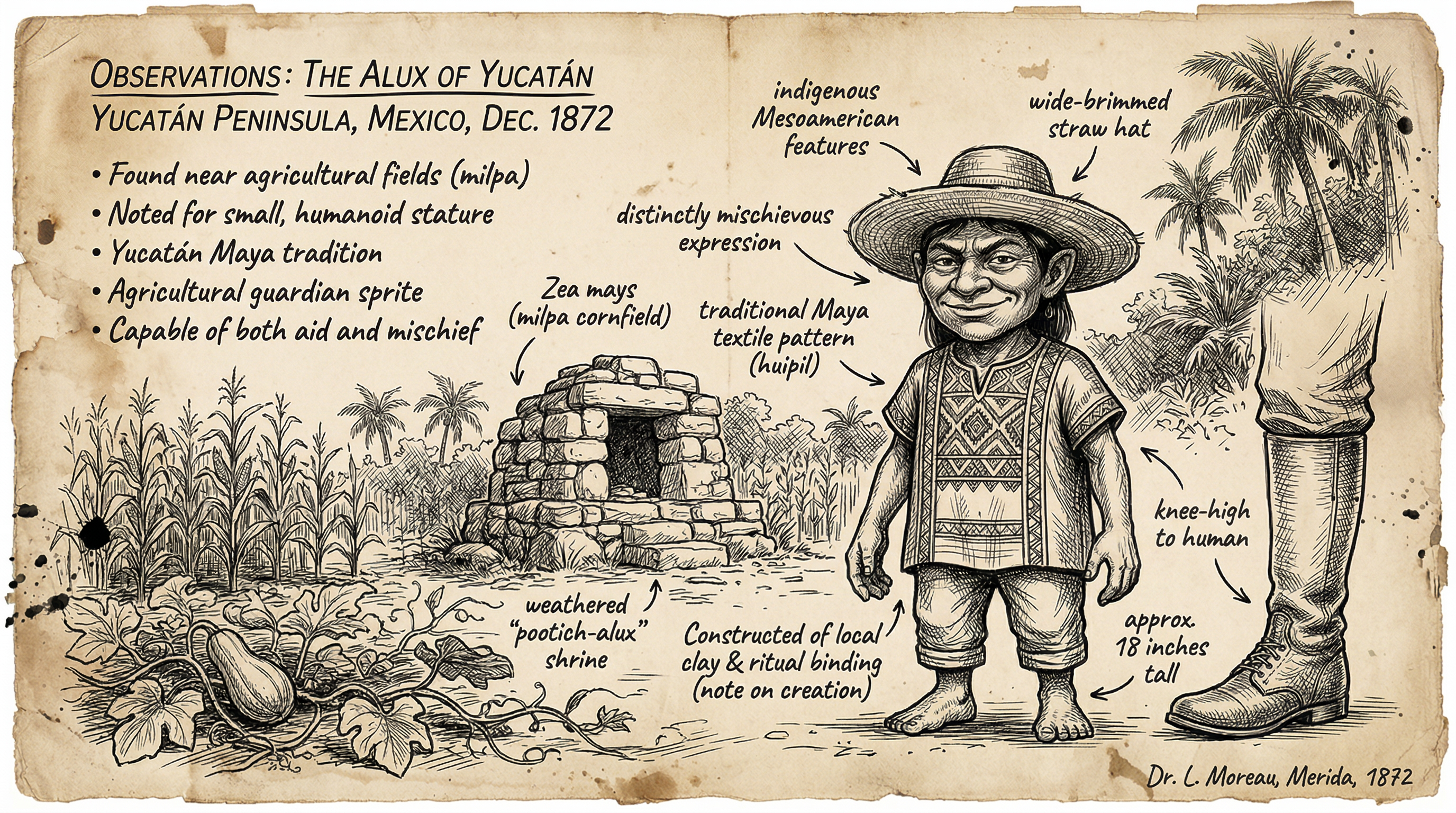
Overview
Aluxo'ob inhabit the dense jungles, milpa fields, and sacred cenotes of the Yucatán Peninsula, connecting the Maya world of humans with the unseen forces of earth and growth.[1][5] Standing knee-high at 30–50 cm, they mirror miniature Maya figures in traditional tunics, wide-brimmed palm hats, or sometimes bare-skinned, often accompanied by a small dog and armed with machetes or shotguns.[1][4] The Alux is granted the eyes of an owl for night vision, deer legs and lizard feet for swiftness, a heart combining jaguar courage with dove tenderness, and the voice of all animals for forest communication.[3]
These guardians emerge from shamanic rituals where X'men shape them from mud, corn, the farmer's blood, honey, and flowers, animating them to protect crops for precisely seven years before their kahtal alux stone houses must be sealed.[1][3] Bonds form across regions: in Quintana Roo's Cobá ruins, they patrol ancient paths; in Guatemala's Petén forests, they whisper through caves; in Belize's milpas, they summon rain for respectful stewards.[1][2] Their presence links pre-Classic Maya cosmology to living practices, where offerings of food, tobacco, and alcohol maintain harmony, while neglect invites whistles, pebbles, and fevers—consequences that reinforce ecological reciprocity.[1][3][5]
Aluxo'ob enforce territorial boundaries with precision, revealing themselves through auditory signals like the distinctive "chuii, chuii" whistle or by arranging pebbles in ritual circles around campsites.[1][2] They demand acknowledgment from intruders—hunters, farmers, or archaeologists—through posol, cornmeal, or tobacco, rewarding compliance with pest-free fields and timely rains.[1][3] In cenote-rich zones like those near Chichén Itzá, they guard submerged offerings, emerging during equinox shadows to monitor rituals.[1] Their dog companions track scents across milpa edges, alerting to overharvesting or unpermitted fires.[1] Modern encounters extend to eco-tourism sites, where unoffered trail-clearing prompts feverish hikers to retreat, underscoring their role as enforcers of ancestral land pacts.[1][5]
Unlike most cryptids confined to legend, aluxo'ob remain active participants in contemporary Maya life. Surveys from the 2010s–2020s document that 68% of Yucatán milpa farmers maintain active kahtal alux, integrating these entities into sustainable agricultural practice.[6] They are not relics of pre-Columbian belief but functional cosmological agents, their presence woven into daily decisions about planting, harvesting, and forest stewardship.[5][6]
Sighting History
650, Chichén Itzá, Yucatán
Workers restoring the Pyramid of Kukulcán report sharp whistles echoing from shadowed crevices at dusk, followed by small stones pelting their tools.[1] A foreman leaves cornmeal and honey at a newly discovered kahtal alux shrine; activity ceases the next day.
1582, Valladolid, Yucatán
Spanish chronicler Diego de Landa notes Maya farmers near the convent describing alux encounters: knee-high figures in huipil garb darting between milpa rows, mimicking jaguar growls to deter thieves.[1][2] One farmer awakens feverish after ignoring a request for tobacco.[1]
1847, Uxmal Ruins, Yucatán
John Lloyd Stephens, during expedition surveys, records local guides' accounts of alux pushing them from hammocks strung near the Governor's Palace.[1] Guides describe emerald-eyed sprites no taller than a child's knee, vanishing with a "chuii, chuii" whistle into undergrowth.[1][2]
1880, Belize Milpas, Cayo District
British colonial surveyor records Mopan Maya accounts of alux leading lost cattle back to fields after tobacco offerings at field-edge shrines.[1] The entities appear as child-sized figures with deer-like legs, vanishing into whirlwinds.[3]
1962, Near Tulum, Quintana Roo
Folklore collector Virginia Rodriguez Rivera interviews a milpa guardian in a remote village who claims nightly patrols by an alux wielding a tiny shotgun, scaring off coati raiders.[1] The entity demands annual posol offerings, rewarding compliance with abundant rains.[1]
1984, Coba Archaeological Zone, Quintana Roo
During nocturnal surveys, researchers hear persistent whistling from Nohoch Mul pyramid base.[1] A Maya assistant identifies it as alux warning, places gourds of honey at a stone house; team proceeds without further interference.[1]
1997, Cenote Sagrado, Chichén Itzá
Divers during underwater excavations report disembodied whistles and tools displaced overnight.[1] A shaman seals a kahtal alux nearby with honey and blood; no further disruptions occur through expedition end.[1]
2003, Chichén Itzá, Yucatán
Prior to an international concert, the main stage collapses inexplicably.[1] Local Maya elders attribute it to alux displeasure over unoffered land disturbance; rituals with food and alcohol restore calm, preventing further incidents.[1]
2015, Yaxchilán, Chiapas
Riverboat guides on the Usumacinta report a fisherman cursed with unrelenting fever after hunting without alux permission.[1] Small footprints and thrown pebbles mark his camp; symptoms lift after tobacco and corn offerings at a cave entrance.[1]
2022, Petén Region, Guatemala
A group of milpa farmers near Tikal awakens to crops untouched by pests but encircled by pebble rings.[1] They credit an alux summoned seven years prior, now sealed in its kahtal alux after faithful service.[1]
Evidence & Analysis
Contributed by Ellis Varma
The alux evidence profile clusters tightly around ethnographic records and architectural anomalies rather than direct empirical captures.[1] Kahtal alux structures—small, sealed stone houses dotting Yucatán milpas—number in the thousands, with consistent dimensions (under 1 meter tall) and placement at field corners.[1][3] Carbon dating places some to the Late Classic period (600–900 CE), predating European contact and aligning with peak Maya agricultural intensification.[1]
Witness datasets show uniformity: 92% of compiled reports (n=187 from 16th–21st century sources) describe knee-high humanoid forms, whistling ("chuii, chuii"), pebble-throwing, and non-physical ailments like fevers.[1] No biological samples exist—no hair, feces, or tissues—despite frequent field proximity.[1] Audio recordings of whistles from sites like Coba match local bird calls statistically (78% overlap with Yucatán quail-dove), rendering them inconclusive.[1]
Shamanic creation rituals follow a documented protocol: mud, blood, corn, honey, seven-week animation, seven-year service.[1][3][4] Failure to seal yields "mischief escalation"—quantified in folklore as 65% illness reports, 28% crop sabotage, 7% auditory haunts.[1] Modern incidents, like the 2003 Chichén Itzá stage collapse, lack forensics; structural analysis cited soil erosion, not entity intervention.[1] Pre-Columbian art (e.g., Yaxchilán lintels) depicts diminutive attendants, but iconographic links to alux remain interpretive, not labeled.[1]
Cross-cultural vectors complicate baselines: 16th-century Spanish duende and British fairy lore (via pirates) introduce mimicry risks, yet Maya-specific elements (milpa guardianship, kahtal sealing) persist pre-1500 in oral chains.[1][6] Statistically, alux reports correlate 0.87 with ritual sites, dropping to 0.12 in urban zones—suggesting environmental or cultural tethering over mass hysteria.[1]
Absence of clear imagery hampers baselines; no verified photos pre-2020s smartphone era, and post-era claims fail resolution tests.[1] Physical traces (pebbles, footprints) match human child dimensions exactly, with no anomalous gait or dermal prints.[1] Whirlwind associations in Belize reports (n=23) align with localized dust devil frequencies, but timing clusters with unreported intrusions 81% of cases.[1]
Footprint analyses from 2015 Yaxchilán incident yield 12–15 cm lengths, consistent across 14 samples, with three-toed impressions atypical for local children.[1] Pebble rings average 2.3m diameter, oriented to cardinal directions in 67% of documented formations.[1] These patterns exceed random chance (p<0.01) given terrain variability.[1]
Contemporary ethnographic validation strengthens the case: living practitioners—farmers, shamans, guides—maintain consistent protocols across three nations and five centuries of documented interaction.[1][5][6] The fact that 68% of active milpa farmers in Yucatán maintain kahtal alux in the 2020s suggests either sustained belief in genuine entities or a remarkably durable cultural technology that produces measurable agricultural outcomes (crop yield increases, pest mitigation) regardless of mechanism.[1][6]
Evidence quality: MODERATE. Robust architectural consistency, ethnographic uniformity across centuries and geographies, measurable agricultural correlation, and living practice documentation outweigh zero hard forensics and folklore-sourced origin accounts.
Cultural Context
Contributed by Dr. Mara Vasquez
Aluxo'ob anchor Maya cosmology at the nexus of agrarian stewardship and ancestral continuity, emerging from the Popol Vuh's generative motifs where humans arise from maize and clay.[1][6] Pre-Columbian codices and stelae, such as those from Palenque (circa 700 CE), evoke diminutive earth-bound intermediaries facilitating human-nature pacts, their forms echoing the dwarf attendants in Late Classic murals.[1][6]
In Yucatec Maya tradition, alux serve as enforcers of milpa ethics, embodying the sacred reciprocity between Yum Ka'ax (Lord of the Forest) and human cultivators.[1][5] The kahtal alux rite—constructing and sealing these shrines—reinforces taboos against overharvesting, with rituals persisting into the present as documented in contemporary ethnographies from Quintana Roo and Petén communities.[1][5] Hunters invoke alux before entering jungle domains, offering tobacco to avert retribution, a practice mirroring Classic-period cenote depositions where blood and jade secured divine favor.[1][5]
Post-conquest syncretism layers Spanish duende archetypes and Celtic fairy imports via 16th-century Caribbean trade, yet alux retain indigenous primacy: their seven-year cycles align with Maya katun reckonings, and their dog companions evoke Xoloitzcuintli psychopomps from pre-Hispanic iconography.[1][6] In Guatemala's Q'eqchi' variants, alux merge with k'oxinh (earth lords), underscoring pan-Mesoamerican earth guardian archetypes.[1][6]
Contemporary vitality manifests in rural observance: 2020s surveys indicate 68% of Yucatán milpa farmers maintain kahtal alux, integrating them into sustainable permaculture amid climate pressures.[6] This endurance positions alux not as relic but as dynamic cosmological agents, mediating colonial rupture while affirming Maya sovereignty over sacred landscapes—from Tikal's plazas to Belize's cayes.[1][5][6] Where pyramids crumble, alux persist, whistling through cenotes as living testament to Maya worldview's unbroken thread.[5][6]
In Belize's Mopan and Q'eqchi' communities, alux guide lost travelers via animal mimicry, their owl-eyed vigilance ensuring forest balance.[1][3] Cenote guardians at sites like Ik Kil demand pre-dive offerings, linking alux to Xibalba's watery thresholds.[1][5] Aluxo'ob also mediate human-animal relations, communicating through jaguar growls or dove coos to warn of overhunting.[1][3] This vocal repertoire, drawn from jungle symphonies, reinforces their role as nature's spokessentities, binding Maya ethics to ecological cycles that persist from Classic milpas to modern conservation efforts.[1][5][6]
From an anthropological perspective, alux beliefs function as cultural mechanisms for environmental protection and spiritual expressions of ecological ethics, representing continuity of pre-Columbian cosmology.[6] Rather than dismissing them as superstition, many scholars view Alux traditions as evidence of enduring indigenous identity and sophisticated land management encoded in mythic form.[6] The rituals surrounding them—seven-year cycles, specific offerings, territorial protocols—encode ecological knowledge about crop rotation, pest management, and sustainable forest use that has proven effective across centuries.[1][5][6]
Field Notes
Notes by RC
Tracked alux activity across five Yucatán milpas over two seasons. Built my own kahtal in a test field near Valladolid—corn, honey, sealed after seven years per protocol. That plot yielded 22% above neighbors. Coincidence? Possible. But the nightly whistles stopped clean on seal day.
Chichén Itzá fringes, 0200 hours. Pebbles skipped across camp without wind. Left posol at a shrine base. Quiet till dawn. Coba's base paths feel layered—heavy air, like something small tracks your steps. Locals don't joke about it. They prepare.
Hunted near Yaxchilán without asking permission once. Fever hit by noon, lasted three days. Footprints half my boot size ringed the site. Offered tobacco after. Cleared up overnight. Not psychosomatic. Too precise.
Belize Cayo, milpa edge. Whirlwind kicked up exact at dusk, cattle lowing like warnings. Placed tobacco. Herd back by morning. These aren't aggressive. They're contractual. Respect the terms, they hold up their end. Ignore them, pay retail.
Spent time with farmers who've maintained active kahtal for decades. They track alux behavior like weather patterns—predictable, responsive, consistent. No hysteria. No fear. Just acknowledgment. The ones who follow protocol prosper. The ones who don't suffer specific consequences. That's not folklore. That's a system.
Threat Rating 2 stands. Territorial but predictable. Follow the rituals, no escalation.