Andean Wolf
1 CATALOGED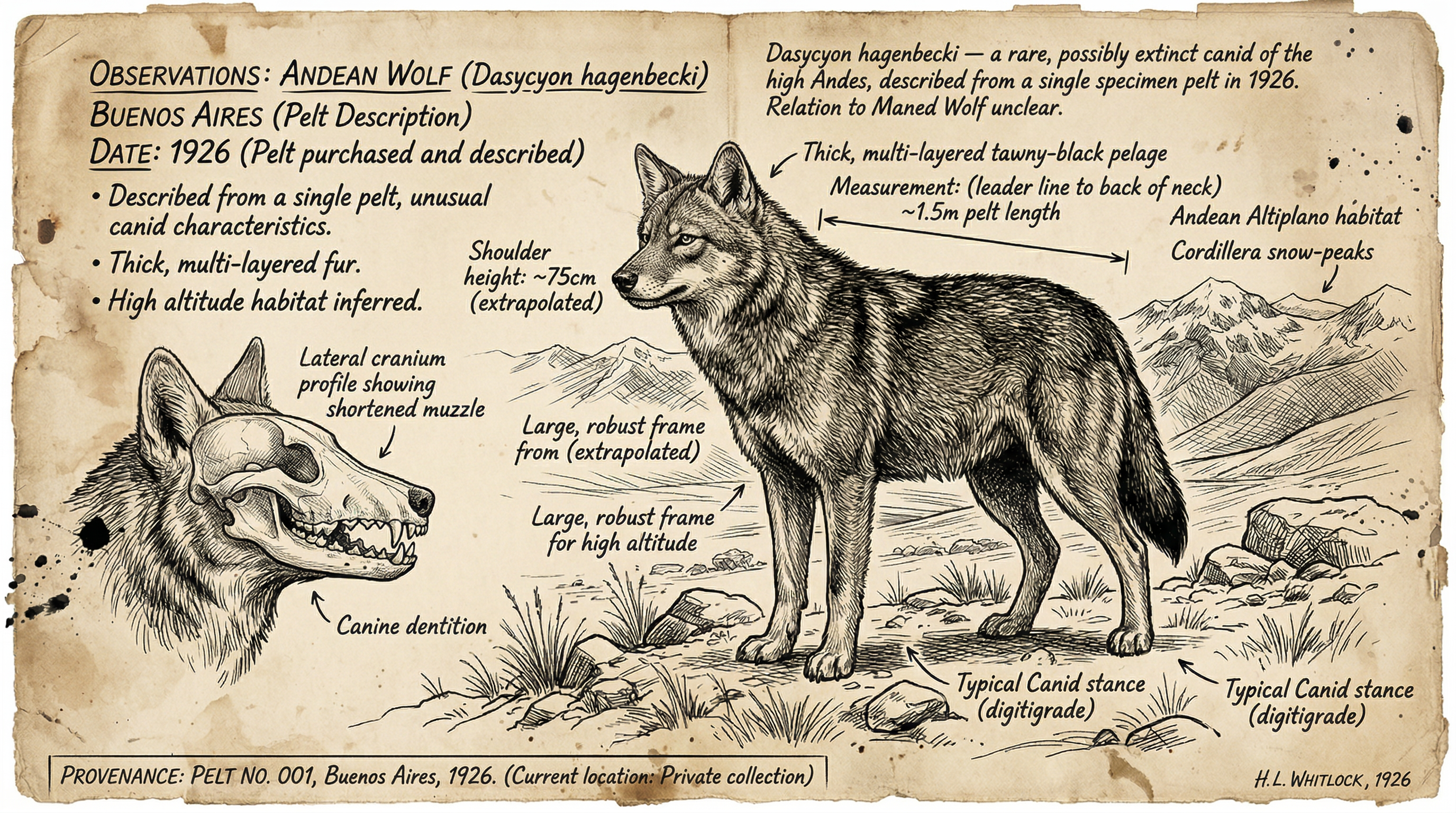
Overview
The Andean Wolf is a proposed canine species from the high Andes Mountains of Argentina and Chile, known from a single pelt and accompanying skull acquired in the 1920s and 1930s. The animal was formally described as *Dasycyon hagenbecki* in 1940 by German zoologist Ingo Krumbiegel, who examined a thick-furred specimen that differed from the lowland maned wolf in size, coloration, and ear structure. No living specimens have ever been documented, no behavioral observations exist, and no field sightings with credible witness testimony have been recorded. The case relies on physical remains subject to contamination and inconclusive analysis.
The Andean Wolf demonstrates how cryptozoological claims enter the historical record through the convergence of material artifacts, scientific authority, and incomplete verification. The specimen arrived with no documented provenance, was examined decades after acquisition, and was formally named on the basis of comparison to a single additional specimen of unknown origin. It remains the only representative of its purported species.
Sighting History
1927, Buenos Aires
German animal dealer Lorenz Hagenbeck acquired a pelt in Buenos Aires purportedly belonging to a wild dog of the Andes Mountains. The seller claimed the specimen originated from high altitude regions, though no verification of origin was attempted. Three additional pelts of identical description were reportedly available for purchase at the same time, all featuring thick, dark fur that resembled a maned wolf but with noticeably longer back hair (approximately 8 inches), smaller rounded ears, and a more robust overall structure. Hagenbeck purchased at least one pelt and sent it to Germany for examination by museums and zoological institutions.
1935, Andes Mountains Origin
Dr. Ingo Krumbiegel examined a skull supposedly recovered from the Andes Mountains that differed significantly from known maned wolf skulls—larger in overall dimensions and with proportions consistent with a highland-adapted canine. The skull's origin could not be independently verified. The geographic mismatch between the skull's reported location (high Andes) and the known range of the maned wolf (lowland regions farther east) led Krumbiegel to conclude the two specimens represented a previously unknown mountain species distinct from lowland populations.
1940, Scientific Description and Publication
Dr. Krumbiegel formally examined the Hagenbeck pelt housed at Munich's zoological museum and, in conjunction with the 1935 skull, declared it a new species. He assigned the scientific name *Dasycyon hagenbecki* to commemorate Hagenbeck's role in acquiring the original specimen. The pelt's characteristics—thick blackish-brown fur, small ears, powerful claws, and a distinctive neck ruff—were documented as distinguishing features. Krumbiegel published a formal scientific description of *Dasycyon hagenbecki*, establishing it in the taxonomic record as a recognized species. The description was based entirely on the single pelt and skull, with no field observations, behavioral data, or additional physical specimens to support the classification. The work received cautious acceptance within the zoological community, though skepticism regarding the specimen's provenance persisted among some researchers. No additional specimens were located despite inquiries among dealers and collectors.
1954, Comparative Hair Analysis
Dr. Fritz Dieterlen conducted a comparative hair analysis of the Hagenbeck pelt, examining samples against hair from various known canines. The analysis revealed hair structure and characteristics significantly similar to German Shepherd dog fur, raising questions about the specimen's origin and taxonomic status. The findings were published but did not immediately prompt removal of the species from scientific literature.
Evidence & Analysis
Contributed by Ellis Varma
The Andean Wolf presents a straightforward evidence profile: one pelt, one skull of unknown provenance, zero living specimens, zero field sightings, zero behavioral observations. The entire taxonomic case rests on material artifacts acquired through commercial channels without documented origin verification.
The 1954 comparative hair analysis by Dieterlen established that the Hagenbeck pelt's hair structure matched German Shepherd fur. This finding indicated a domestic dog origin, yet the specimen remained in circulation within scientific literature. The lack of immediate taxonomic revision suggests institutional inertia—once a species name enters the formal record through a published description, removing it requires explicit correction, which many institutions delayed.
The 1935 skull presents additional problems. Its purported location of origin in the high Andes could not be independently verified. The specimen was lost during World War II, eliminating any possibility of modern analysis. No photographs of adequate quality exist, no detailed measurements were recorded by multiple researchers, and no independent verification confirms that anyone other than Krumbiegel examined the skull directly.
In 2000, researchers attempted DNA analysis of the remaining pelt at Munich's zoological museum. The results proved inconclusive. DNA samples showed contamination from human, dog, wolf, and pig sources—consistent with either poor preservation conditions, handling by multiple people across decades, or sample degradation. The pelt had undergone chemical treatment during preservation, further compromising genetic analysis. No follow-up testing has been conducted since.
The most probable explanation for the pelt's origin is straightforward: it represents a domestic dog, possibly a German Shepherd crossbreed or a dog of mixed lineage. The Buenos Aires seller may have deliberately misrepresented its origin to increase market value. Hagenbeck, operating as a dealer rather than a field researcher, had no mechanism to verify the claim. Krumbiegel, examining the pelt decades later in a museum context, was predisposed to accept it as a new species because such discoveries, while rare, do occur in zoology. The coincidence of timing—a pelt resembling a maned wolf with different proportions, paired with a skull of unknown provenance—was sufficient to establish a species that has never been observed in the field.
Evidence quality: LOW. Single contaminated pelt with hair structure matching domestic dog fur, missing skull of unverified origin, no field observations, no living specimens, no photographic or behavioral data. The evidence profile supports a domestic dog origin rather than a distinct wild species.
Cultural Context
Contributed by Dr. Mara Vasquez
The Andean Wolf occupies an unusual position in cryptozoological literature because it lacks any connection to indigenous Andean traditions, oral histories, or cultural memory. Unlike many cryptids that emerge from existing folklore—the Mothman drawing on indigenous winged-being traditions, for instance—the Andean Wolf is a purely modern, Western creation.
The Andes Mountains are home to multiple indigenous groups with deep cultural histories: the Quechua, Aymara, and various smaller populations maintained sophisticated understandings of their local fauna for centuries. Yet no documented indigenous tradition references an undiscovered mountain canine corresponding to the Andean Wolf's description. The condor, the puma, the vizcacha—these animals hold cultural significance and appear in oral narratives. The Andean Wolf does not.
This absence is significant. It suggests that the Andean Wolf was never part of the lived experience of Andean peoples. It is instead a product of early 20th-century European animal dealing and scientific ambition—a moment when acquiring exotic specimens for museums and private collections was lucrative, when verification of origin was minimal, and when naming a new species could establish a naturalist's reputation.
The Andean Wolf represents the moment when cryptozoology became disconnected from cultural knowledge and grounded instead in material artifacts of questionable provenance. It is a creature born not from observation but from commerce, examined not by field researchers but by museum curators in Munich and Berlin, and validated through scientific nomenclature rather than through any genuine evidence of existence. It serves as a historical marker for how institutional systems can perpetuate claims long after their evidentiary foundation has eroded.
Field Notes
Notes by RC
Haven't been to the Andes. No reason to. The Andean Wolf isn't a field case—it's a desk case. A pelt, a skull, a name. Nothing more.
What's interesting is how it got into the record at all. Hagenbeck bought something in Buenos Aires. He didn't know where it came from. Krumbiegel saw it decades later and decided it was new. That's how you create a species in the early 20th century. You find something that looks different enough, you name it, and if the person naming it has credentials, it stays named.
The hair analysis in 1954 should have been the end of it. German Shepherd fur. Case closed. But by then the name was in the literature. *Dasycyon hagenbecki*. It had weight. Removing it required admitting the mistake, and institutions don't like doing that.
Threat Rating 1 stands. Rating reflects zero field confirmation, zero living specimens, and zero credible threat profile.