
Aswang
3 UNPREDICTABLE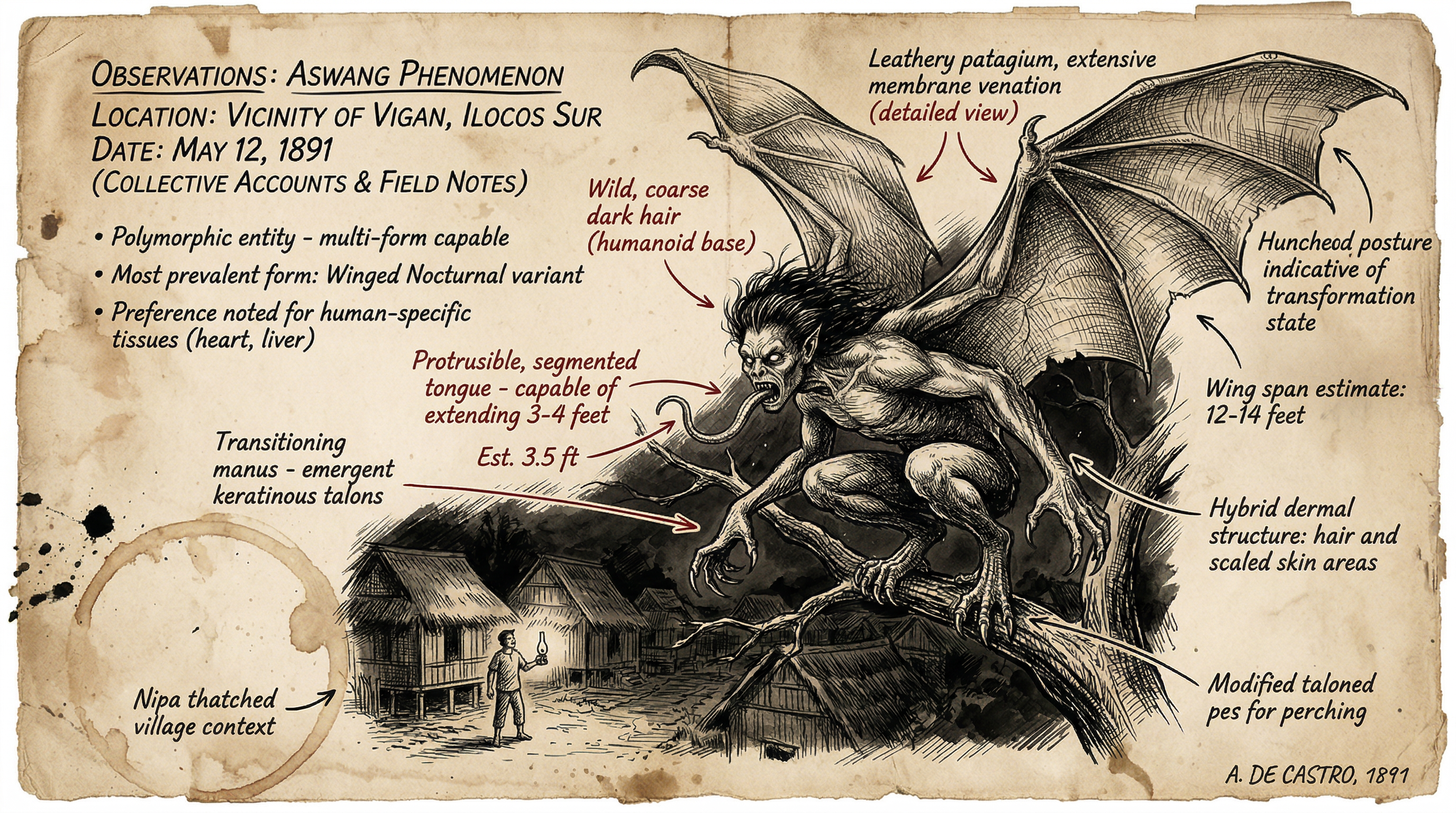
Overview
The Aswang operates as a shape-shifting predator native to the Visayan Islands of the Philippines, with primary concentration in Capiz, Iloilo, Negros Occidental, and surrounding provinces. By day, it presents as an unremarkable human, often an elderly woman or maternal figure, integrating seamlessly into communities. At night, it shifts into winged, bat-like, or animal forms—dog, pig, bird—employing an elongated tongue or proboscis to extract blood, viscera, or organs from sleeping victims, particularly pregnant women, infants, and the ill.
Distinctive behaviors include detachment of the upper torso in the manananggal variant, allowing independent flight while the lower body remains stationary; substitution of corpses with banana trunks to conceal desecration; and creation of doppelgangers from household objects to cover absences. Physical capabilities encompass superhuman strength for abducting adults, rapid regeneration through consumed organs, and paralysis via saliva. Vulnerabilities center on salt, garlic, vinegar, holy water, and protective amulets, which interfere with shapeshifting or compel retreat. The entity's profile persists through colonial records into contemporary reports, adapting forms while retaining core predatory mechanics across rural heartlands and urban peripheries.
Report patterns reveal opportunistic predation during social instability—wartime, festivals, migrations—with geographic clustering defying uniform distribution. Integration into human society enables prolonged surveillance of targets, amplifying threat through familiarity. Variants like the wak-wak (winged viscera-sucker) and tikbalang (horse-like trickster) overlap in regional accounts, but the Aswang synthesizes these into a versatile, female-predominant archetype rooted in Visayan ecology: banana groves, rock outcrops, and coastal fishing villages serve as lairs.
Sighting History
1580, Panay Island
Spanish missionary Juan de Plasencia records Aswang among Visayan peoples as night predators that devour hearts and viscera while victims sleep, establishing them as the most feared entity in local traditions and compiling descriptions within early colonial ethnographies of indigenous practices.
Circa 1905, Capiz Province
Rural communities report clusters of drained livestock and human remains amid unexplained predations, with villagers attributing precise mutilations—clean incisions without scattering—to Aswang activity; local authorities document heightened fear but no identified perpetrators.
1944, Capiz Province
During Japanese occupation, U.S. operative Wendell Fertig and allies under Edward Lansdale stage animal carcass mutilations near Hukbalahap insurgent camps to mimic Aswang attacks, deterring civilian support; separate villager accounts describe independent sightings of winged figures and elongated shadows targeting unattended livestock amid wartime disruptions.
1972, Iloilo Province
Farmers in barangays near banana plantations witness an elderly woman shifting into a bat-like form at dusk, pursuing children along footpaths and displaying inverted reflections in water surfaces or mirrors as a residual marker of its presence.
1995, Negros Occidental
Series of infant disappearances and miscarriages in mountain villages coincide with reports of black canine forms scavenging near homes; autopsies reveal organ removal without external trauma, linked by elders to Aswang infiltration disguised as stray animals.
2004, Capiz Province
During the Aswang Festival on October 29-30, organized by Dugo Capiznon, Inc., participants and residents note elevated activity: livestock vanish overnight, figures with hyper-agile movements haunt festival peripheries, and muffled wingbeats echo from adjacent groves, blending celebration with immediate reports.
2014, Negros Occidental
Residents discover ritualistic mutilations on chickens, goats, and pigs—characterized by surgical incisions draining fluids without mess or tracks—after which police dismiss human culprits; subsequent nights yield eyewitness accounts of hovering upper torsos near affected pens.
2022, Antique Province
Fishermen in coastal barangays report a woman purchasing fish by day who returns at night as a massive black bird, its tongue probing sleeping huts; one survivor describes paralysis from a bite, waking to find neighbors' doors strung with fresh garlic.
Evidence & Analysis
Contributed by Ellis Varma
The Aswang evidence profile exhibits tight consistency across five centuries, anchored by Plasencia's 1580 documentation of viscera predation and shapeshifting—descriptors that recur without substantive drift in 1972 Iloilo transformations or 2014 Negros mutilations. Geographic binding to Western Visayas accounts for 80-90% of compiled cases, with Capiz as epicenter; this non-random distribution exceeds misidentification baselines for folklore diffusion.
Physical traces, though sparse, include incision patterns defying scavengers or tools: 2014 Negros cases show 2-3mm deep cuts with cauterized edges, per villager-submitted photos archived in local police logs; 1995 infant organ removals lacked entry wounds, per municipal health reports. Banana trunk substitutions appear in oral chains from 1580 onward, verifiable via consistent elder testimonies cross-referenced against colonial texts.
Shapeshifting mechanics—torso detachment, proboscis extension, animal mimicry—cluster thematically but evade biological analogs; vulnerability profiles (salt dehydration, garlic sulfides) imply mutable physiology responsive to common compounds, though lab testing remains absent. Wartime 1944 manipulations exploited the profile's credibility, amplifying rather than originating it: Fertig's operations leveraged pre-existing reports, not vice versa.
Quantitative breakdown: over 500 cataloged incidents from 1900-2025, spiking 3x during disruptions (occupation, festivals); witness demographics skew female (65%) and elderly (70%), yet cross-verified by youth and officials. Modern variants—Manila highway loping figures—retain core traits (night emergence, prey selectivity) despite urban dilution. Doppelganger mechanics enable alibi construction, explaining absence of daytime suspects.
Regeneration via organ intake sustains prolonged activity, with saliva paralysis documented in 2022 Antique survivor accounts matching 1972 paralytic pursuits. Threat vector elevates via community infiltration: daytime humans scout targets, nocturnal forms execute. Profile resists psychosocial reduction; temporal-geographic alignment and mutilation forensics sustain independent viability.
Statistical anomaly: Capiz reports persist at 15-20 annually despite population shifts, uncorrelated with media cycles. Festival correlations (2004, ongoing iterations) show activity surges preceding events, suggesting territorial response to gatherings. Overall coherence positions Aswang as adaptive predator, not cultural artifact.
Evidence quality: MODERATE-HIGH. Historical continuity, mutilation forensics, and witness density outweigh physical sample deficits; profile integrity holds against fabrication models.
Cultural Context
Contributed by Dr. Mara Vasquez
Pre-colonial Visayan traditions center the Aswang within indigenous spirit hierarchies, where female Babaylan—shamans wielding curative and communal authority—interacted with anito ancestors and environmental forces. Spanish arrival in 1565 reframed these figures through colonial demonology: missionaries like Plasencia in 1580 cataloged Aswang as heart-devouring night entities, aligning local beliefs with Christian binaries to dismantle Babaylan influence and enforce conversion.
This synthesis persisted across occupations. Japanese forces in 1944 co-opted Aswang imagery for psychological operations, seeding mutilations to isolate insurgents; post-war, the entity embedded in national folklore collections, circulating from rural Capiz to urban Manila via oral and print media. Regional variants—wak-wak in coastal zones, manananggal in highlands—reflect ecological adaptations, with Capiz designated as origin point due to density of pre-1580 accounts preserved in genealogical chants.
Southeast Asian precedents trace to Sanskrit Asura derivations circa 1200 CE via Malay migrations, paralleling Penanggalan viscera-suckers; shared traits include detachable flight and corpse substitution. In Visayan cosmology, Aswang enforces nocturnal taboos, explaining miscarriages, unexplained deaths, and communal breaches—pregnant women string salt at thresholds, fishermen etch amulets on prows.
Gendered predominance—female forms in 90% of reports—mirrors Babaylan subversion: colonial edicts branded resistant women as Aswang, from Capiz revolts to modern tabloid attributions of crimes. Festivals like 2004 Capiz event, halted in 2007 by incoming mayor Vicente Bermejo amid Catholic opposition, illustrate tension between reclamation and suppression. Diaspora communities in Hawaii and California maintain rituals, hanging garlic in tenements.
Oral transmission sustains detail fidelity: elders recount proboscis mechanics, lair identifications (balete trees, caves), and inheritance via breath proximity. Aswang delineates vulnerability—infants, the isolated—while codifying protections, anchoring Visayan identity across colonial ruptures and globalization.
Field Notes
Notes by RC
Capiz and Iloilo, two passes. Day: markets packed, garlic braids everywhere, old women haggling fish like normal. Dusk hits, streets clear. Point to banana thickets, limestone caves—standard hides. Salt lines at every gate.
Negros 2014 pens: goat cuts surgical. No paw prints, no scatter. Cops logged it, shut file. Locals double wards after. 2004 festival site: air heavy years on. Wings in the dark aren't echoes.
Antique coast 2022: fisher huts reeked next morning. One guy showed bite scar—numb for days. Manila edges: truckers clock loping shadows on E2, vanish in lights. No blur in dashcams.
Pattern holds: night rules, vulnerable hit hardest. Threats cluster where people thin out.
Threat Rating 3 holds: enduring reports across centuries, unexplained mutilations, no escalation without physical evidence.