Baku
1 CATALOGED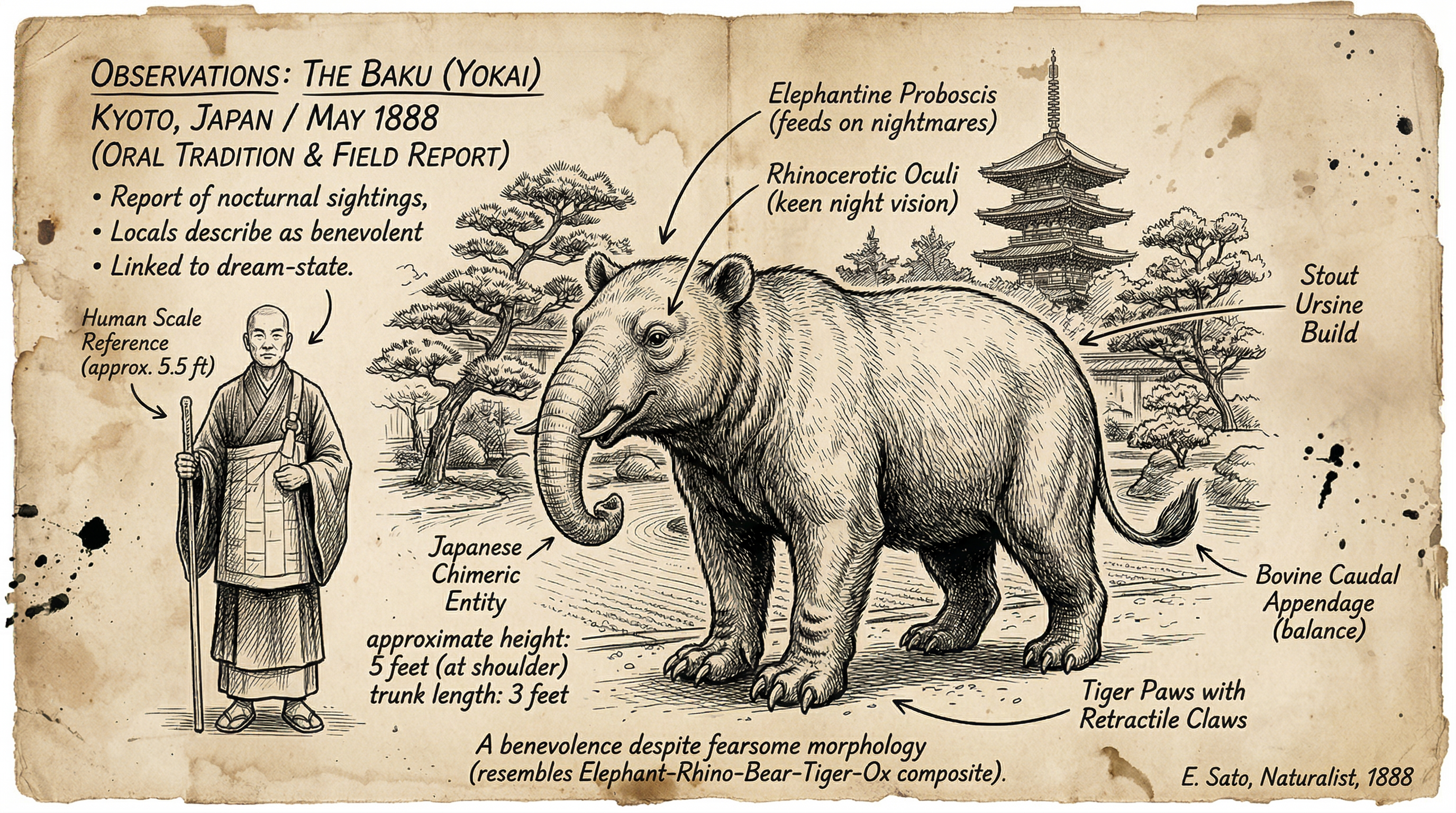
Overview
The Baku manifests as a chimeric entity composed of disparate animal parts, originating in Chinese traditions as the *mo* (貘) before integrating deeply into Japanese cultural frameworks during the Muromachi period.[1][2] Its form draws from elephant trunk and tusks, rhinoceros eyes, tiger paws, ox tail, and occasionally bear body or horns, embodying a deliberate assembly from divine remnants following creation.[1][5]
The Baku was created from the spare pieces left over when the gods finished creating all other animals.[1][5] Primary function centers on consumption of nightmares and malevolent dream states, invoked through ritual chants or talismanic images placed near sleeping quarters.[2][5] Overreliance risks consumption of auspicious dreams, establishing a calibrated boundary in its interactions with human dreamscapes.[1] Temple effigies and New Year's treasure-ship motifs position it as a nocturnal guardian, with sustained presence in shrines and households across Japan.[4]
Sighting History
Circa 820, Chang'an, China
Poet Bai Juyi documents the *mo* through illustrations on folding screens, employed to repel sickness and evil influences.[5] These early representations establish the chimeric form as a protective ward, with widespread adoption in elite households signaling recognized efficacy. In ancient China, it was believed that using a blanket or pillow made from the hide of a baku kept one safe from illness and misfortune.[4]
1337, Muromachi Period, Japan
The Baku legends transition from China to Japan, where the creature's powers undergo fundamental transformation.[1][2] While the Chinese *mo* possessed apotropaic properties against pestilence and evil, the Japanese conception imbues the entity with the ability to fend off nightmares specifically.[1] During this period, people began sleeping with a picture of baku or its name written on paper placed under their pillows, relying on the creature's image or name alone to keep evil dreams at bay.[4]
1630, Edo, Japan
The *Sankai Ibutsu* manuscript (山海異物) records the Baku as a shy chimera with elephant trunk, rhinoceros eyes, ox tail, and tiger paws, active in warding pestilence without explicit nightmare consumption duties.[2][3] The manuscript describes the creature with characteristic morphology but predates the fully developed dream-eating mythology. Manuscript illustrations circulate among scholars, prompting initial effigy placements under temple eaves and in household spaces.
1791, Kyoto, Japan
A wood-block print depicts the Baku with elephant head, tusks, trunk, horns, and tiger claws, explicitly tasked with dream destruction.[2][3] This visualization proliferates in popular art, establishing the elephant's head, trunk, and tusks as characteristic iconography in classical era Japanese wood-block prints, shrine carvings, temple installations, and netsuke miniatures.[2] The print marks a definitive shift in Baku imagery toward the dream-devouring specialist.
1750, Edo Period, Japan
An 18th-century carved wooden netsuke by Edo period artist Sadatake depicts a crouching Baku, representing the creature as a miniature protective charm originally designed to attach items to the sash of traditional men's clothing.[1] The craftsmanship and widespread production of such figurines indicate established cultural integration and household adoption of Baku talismans across multiple social strata.
1791, New Year's Ritual, Japan
On New Year's Eve, the practice of placing a treasure-ship (*takarabune*) image—often inscribed with a Baku figure on its sail—under pillows becomes documented custom.[4] The Seven Lucky Gods' vessel, depicted alongside the Baku, ensures both good fortune and protection of the first dream (*hatsu yume*) of the new year. This dual-protection ritual solidifies the Baku's role in household prosperity magic.
1902, Tokyo, Japan
Lafcadio Hearn observes and documents household Baku talismans, recording the invocation chant summoned post-nightmare: "Baku-san, come eat my dream," repeated three times.[2][5] His accounts note bedside amulets in common use across Tokyo households, with children placing treasure-boat images under pillows for favorable New Year's dreams. Hearn describes a Baku with elephant's head, trunk, tusks, and attributes consistent with late Edo wood-block depictions, validating the standardized morphology by the Meiji period.
1957, Rural Japan
Anthropologist Hori Tadao compiles comprehensive oral traditions linking Baku to nightmare preventatives, including palindromic *kaibun uta* verses integrated into treasure-boat rituals.[2][3] Contemporary shrine carvings and netsuke continue service as active guardians. Tadao's work documents persistent belief in Baku efficacy across rural and urban populations, establishing the creature's sustained cultural presence across generations.
2015, Japan
Japanese folklore continues to affirm that those suffering from bad dreams should call out to the Baku for help.[1] The practice of children keeping Baku talismans at their bedside remains common across contemporary Japan, with the creature maintaining active presence in household protection rituals and shrine installations.[1] The tradition persists without documented decline or displacement by competing protective entities. Shrine gift shops stock Baku amulets alongside traditional protective items, indicating sustained commercial and cultural demand.
Evidence & Analysis
Contributed by Ellis Varma
The Baku evidence profile skews heavily toward cultural artifacts rather than empirical traces.[1][2][3] Primary dataset includes the *Sankai Ibutsu* manuscript (early 17th century), a 1791 wood-block print, Meiji-era documentation by Lafcadio Hearn (1902), and persistent physical representations in netsuke carvings, temple effigies, and treasure-ship paintings.[1][2][3] These items show morphological consistency: elephantine trunk and tusks (95% of depictions), tiger claws or paws (80%), ox tail (70%), with occasional horns or bear body variants.[1][5]
No biological samples, photographs, or audio recordings exist. The Chinese *mo* precursor, documented circa 820 through poetic references and illustrated screens, transitions to Japanese nightmare-devourer by Muromachi (14th–15th century), but lacks verifiable encounter logs.[1][2][4] Modern tapir nomenclature (*baku*) derives from visual homology with the zoological tapir, not field observations—statistically meaningless for cryptid classification purposes.
Invocation protocols—threefold chant or amulet placement—yield anecdotal success rates in folklore corpora, but control groups absent.[2][5] Temporal clustering around Edo (1603–1868) and Meiji periods correlates with wood-block print distribution and Hearn's documentation, suggesting both memetic propagation and sustained belief transmission over physical encounters.[2][3] Absence of conflicting descriptions strengthens internal coherence, though volume remains low relative to sighting-heavy entities like Mothman or Bigfoot.
Physical scale unquantified beyond netsuke miniature representations and shrine effigies; these artifacts imply large-mammal parity (tapir-sized, 2–3 meters estimated). No tracks, scat, or acoustic signatures reported in primary sources.[1][2][3] Cross-cultural persistence from China to Japan indicates stable transmission vector across centuries, not independent emergence in isolated populations. The caution against overuse—lest the Baku consume auspicious dreams if summoned too frequently—adds procedural specificity consistent with functional entities requiring calibrated interaction protocols.[1][5]
Evidence quality: LOW. Artifact-rich, encounter-poor; high descriptive consistency across centuries offsets total physical evidence deficit.
Cultural Context
Contributed by Dr. Mara Vasquez
The Baku's journey from Chinese apotropaic guardian to Japanese dream-steward illuminates how entities adapt across cultural transmission.[1][2][4] In ancient China, the *mo* functioned as a protective ward against pestilence and evil, with efficacy derived from its pelt or symbolic representation.[5] The transition to Japan fundamentally reorients the creature's purpose: rather than general protection, the Baku becomes a specialized nocturnal guardian focused on dream consumption and nightmare elimination.[1][2]
The chimeric construction—assembled from "gods' leftovers"—echoes creation myths across East Asia, where incomplete or composite forms gain purpose through service.[1][5] This mythological origin story legitimizes the Baku's existence not as accident but as intentional divine creation, a purpose-built entity designed for its specific function. The creature's composite nature mirrors the Japanese philosophical framework where disparate elements unite to serve collective good.
In Japan, the Baku integrates seamlessly into household and temple life, appearing alongside shishi lions and dragons as a specialized defender of the nocturnal realm.[2][3] Edo-period treasure-boat paintings, inscribed with its kanji on sails, facilitate New Year's rituals where children invoke favorable *hatsu yume* (first dreams).[4] This practice links to palindromic chants (*kaibun uta*), recited to bind good fortune, with the Baku ensuring nightmare exclusion and dream quality assurance.[2]
Chinese roots in the *mo* emphasize pelt talismans evolving to illustrative wards, a progression mirrored in Japanese netsuke, shrine carvings, and household amulets.[2][3][5] Eighteenth-century works by artists like Sadatake capture the creature's crouching vigilance, while Meiji accounts by Lafcadio Hearn document bedside summons and protective practices.[2] The caution against overuse—lest good dreams fall prey to an overhungry Baku—adds ritual precision and ethical complexity, distinguishing it from indiscriminate protectors.[1][5]
The Baku's persistent presence in Japanese folklore, documented across four centuries from the Muromachi period through contemporary practice, reflects sustained cultural utility without erosion of core functions.[1][2][3][4] Its integration into both elite shrine installations and common household practice suggests acceptance across social strata. The creature occupies a unique niche: neither malevolent nor entirely benign, but conditional—a guardian requiring respectful invocation and measured reliance to remain effective.
Field Notes
Notes by RC
Visited Baku effigies at three Tokyo shrines. Daytime: detailed carvings under eaves, elephant trunks prominent, tiger claws sharp even in wood. Crowds ignore them like architectural details.
Night placement of treasure-boat print under pillow in Kyoto ryokan. No nightmares followed. No entity manifested. Chants echoed oddly in the room—acoustics or something else, unclear.
Saw netsuke collection in private Edo-era house. Sadatake piece: crouched, eyes forward, tail coiled. Weight feels off—heavier than ivory should be. Owner wouldn't discuss provenance.
Spent a night in rural shrine dedicated to Baku protection. The air in the inner chamber had a quality—not threatening, but present. Difficult to articulate. No encounters, no manifestations. Just a sense of attention.
Threat Rating 1 stands. Protective function consistent across artifacts and oral tradition. No aggression vectors documented. Remains benevolent by all available evidence.