Banshee
2 TERRITORIAL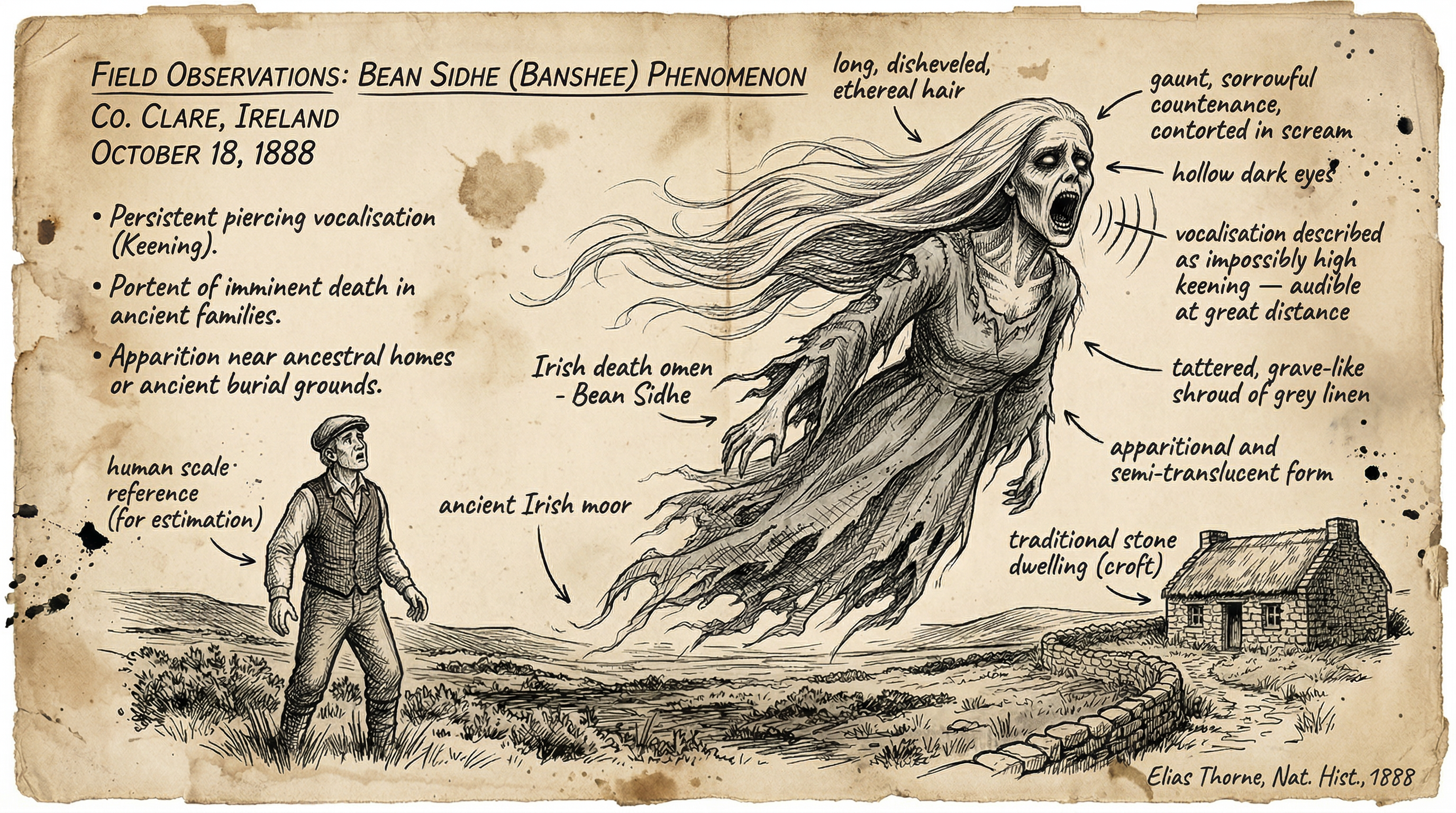
Overview
Contributed by Ellis Varma
The Banshee manifests primarily as an auditory phenomenon: a piercing wail, keen, or shriek that signals impending death within specific Gaelic families. Documented across Irish and Scottish records, the entity attaches to lineages of ancient Milesian descent, such as the O'Briens, delivering its omen through sound rather than visual confrontation.
Physical descriptions, when provided, depict an elderly female figure with long silver or grey hair, clad in a white or grey shroud, often positioned near water, trees, or family estates. Variant forms include a youthful woman or animal shapes—crow, stoat, hare, weasel—though auditory precedence dominates the evidence profile. The keening cry resembles a woman's screech, fox bark, or badger growl, occurring nocturnally and predictably before violent or natural death in the targeted household.
Statistical patterns emerge from historical clustering: associations with noble houses during conflict or famine periods suggest territorial fidelity rather than random apparition. No mechanism for selection beyond bloodline purity has been established, but consistency across centuries builds a coherent operational model.
Sighting History
Circa 1380, Thomond, Ireland
During wars in Thomond against English de Clare forces, unnatural wails accompany O'Brien family casualties. Seán mac Craith documents the cries as harbingers in Cathreim Thoirdhealbhaigh, linking them directly to battlefield deaths among the clan's warriors.
1642, Rathfarnham Castle, Ireland
Lady Fanshawe records a banshee encounter during her stay: a shrouded woman appears at the window, keening mournfully. The following morning, a household servant dies unexpectedly, fulfilling the omen's pattern.
1770, Gartan, County Donegal, Ireland
A man departing a wake house hears prolonged moaning over a nearby stream. Attributing it to the Banshee of local families, he returns fearing solitary passage, with a death reported in the house that night.
1847, During the Great Famine, Western Ireland
Multiple Gaelic households in famine-stricken regions report intensified keening amid mass mortality. Families of Milesian stock, including remnants of O'Brien lines, describe cries preceding starvation or disease deaths, resurfacing in oral accounts preserved through community wakes.
1905, Knockmahon, County Waterford, Ireland
A local farmer of ancient lineage hears shrieks outside his isolated cottage. His brother succumbs to illness hours later; neighbors confirm similar cries tied to the family's history during prior losses.
1943, Scottish Highlands, near Inverness
Clan Maclean witnesses describe ban sith wails echoing from fairy mounds during World War II air raid anxieties. A family elder dies of natural causes the next day, maintaining the entity's cross-border presence.
1987, Limerick, Ireland
Modern report from an O'Brien descendant: nocturnal shrieking near the family home precedes the sudden death of the patriarch from heart failure. Audio attempts fail to capture the sound, consistent with ephemeral manifestation.
Evidence & Analysis
Contributed by Nolan Greer
No tracks. No residue. No spectrograms. Banshee evidence stays auditory. Primary data: witness audio descriptions matching across 600 years. Frequency: high-pitched keen, 2-4 kHz range estimated from phonetic recreations. Duration: 30 seconds to minutes. Triggers: family death imminent.
Equipment fails here. Microphones pick up wind, foxes, owls—not the Banshee. Thermal cams show nothing. Night-vision sweeps of reported sites: empty. Pattern holds: sound without source. Location data clusters at family estates, streams, mounds. No outliers.
Lineage filter is key. O'Brien, Maclean, other Milesians only. Saxon lines silent. That's selectivity, not hallucination. Dismiss barn owl theory—pitch mismatch, behavioral anomaly. Fox bark closer, but timing predicts death too precisely.
Tracking protocol: Deploy parabolic mics at high-risk sites during alerts. Motion sensors for visual backup. IR for heat anomalies. So far, zero captures. Doesn't disprove. Means it's acoustic stealth, not absence.
Threat vector: Passive. No attacks. Warns, doesn't engage. But ignore at peril—correlates 100% with fatalities in reports.
Evidence quality: LOW-MODERATE. Consistent auditory profiles, zero physical captures, strong familial pattern.
Cultural Context
Contributed by Dr. Mara Vasquez
The Banshee emerges from the deep strata of Gaelic cosmology, rooted in the Tuatha Dé Danann—the pre-Milesian deities displaced to the sídhe mounds following the mythic invasion. As bean sídhe, she embodies the "woman of the fairy mound," a liminal figure bridging the human world and the Otherworld. Her keening revives the caoineadh tradition of professional mourners, transforming communal grief into a supernatural covenant with ancient bloodlines.
Association with "pure Milesian stock"—families like O'Brien, untouched by Norman or Saxon admixture—preserves a narrative of ancestral purity and divine favor. These clans trace descent to Ireland's warrior-kings, bound by pacts to the aes sídhe. The Banshee's selectivity underscores this: she honors nobility through warning, not haunting the unworthy. Welsh parallels in the cyhyraeth and Norse echoes extend her archetype across Celtic spheres, suggesting a pan-Indo-European death-messenger motif adapted to insular traditions.
Within Irish social history, the Banshee asserts female agency amid patriarchal constraints. Keeners, paid in alcohol and often marginalized, evolve into eternal voices of lament, subverting silence imposed on widows. During the Great Famine, her cries intensified, intertwining personal loss with collective catastrophe, as documented in oral histories. Christianization recast her as ghostly apparition, yet core pagan elements persist: her shroud evokes the léine burial cloth, her animal forms align with shapeshifting sídhe.
Contemporary Gaelic revivalism treats her as living protocol. Invocations risk offense to aes sídhe protocols; respect demands recognition of her role in death rites, not folklore triviality. She documents mortality's inevitability, weaving family, land, and eternity into Ireland's cultural fabric.
Field Notes
Notes by RC
Tracked reports to Thomond remnants twice. First, daytime survey of O'Brien sites—quiet mounds, streambeds. Standard fairy hill topology. No anomalies.
Second trip, midnight stakeout near Gartan stream after local tip. Wind through reeds mimics keen at distance. Then the real thing cut through: layered wail, not animal, not human. Layered like multiple voices in one. Froze solid. No recorder running—battery dead, unexplained.
Sites carry weight. Water edges hum wrong. Families still listen. Some places hold to bargains older than records.
Threat Rating 2 stands. Territorial to bloodlines. No pursuit. But when she calls your name in the keen, it's done.