
Batsquatch
3 UNPREDICTABLE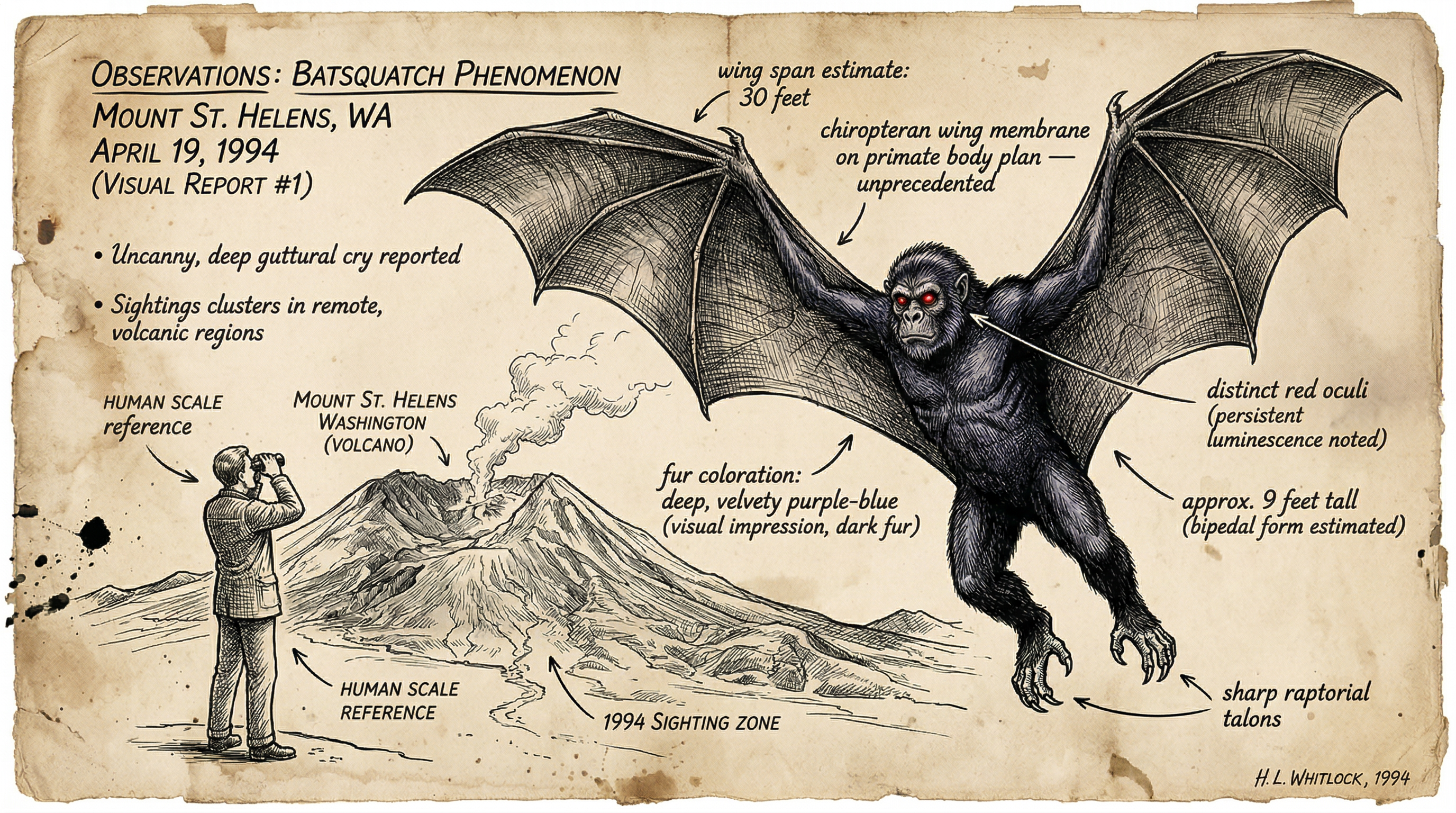
Overview
The Batsquatch manifests as a towering winged primate hybrid native to the volcanic landscapes and dense forests of the Pacific Northwest. Standing between nine and fifteen feet tall, it possesses leathery bat-like wings with spans reaching fifty feet, a body covered in blue or gray fur, and a head blending wolfish muzzle, tufted ears, and glowing yellow or red eyes.
Sightings connect closely to geological disturbances, particularly the 1980 Mount St. Helens eruption, which observers link to the creature's emergence from subterranean domains. Reports span Washington, Oregon, California, and sporadically eastward, with behaviors including aerial predation on deer and livestock, electromagnetic interference causing vehicle failures, and nocturnal hanging from cave ceilings or canyon walls. Across these accounts, the Batsquatch emerges as a solitary apex predator adapted for both flight and terrestrial navigation through rugged terrain.
Connections appear between Batsquatch and similar entities in distant regions, such as the Ahool of Java or Orang Bati of Papua New Guinea, suggesting a broader lineage of flying primates that navigate volcanic and forested ecotones worldwide. In the Pacific Northwest, its presence ties to post-eruption environmental shifts, where ash-choked skies and disrupted habitats may have drawn it into human view. Witnesses describe its calls — sharp "OOO-ah" or guttural "OOO-mm" — echoing through canyons, marking territory or signaling hunts.
The creature's physiology supports prolonged flight and ground agility: clawed avian feet for perching, a muscular torso for wing-powered takeoff, and fangs suited for tearing flesh. Hibernation patterns, noted in eastern variants, align with seasonal prey scarcity, with individuals entering torpor in November amid cave clusters. These traits position Batsquatch as a bridge between chiropteran flight mechanics and primate strength, thriving in the shadowed interstices of mountains and old-growth forests.
Sighting History
May 18, 1980, Mount St. Helens, Washington
Amid the ash plume of the eruption, multiple witnesses observed a monkey-like figure with red eyes and large wings navigating the volcanic cloud. Reports suggest the seismic event displaced or released the creature from underground confines.
April 1994, Pierce County, Washington
Brian Canfield drove along a remote road near Buckley when his truck engine stalled, dashboard lights failed, but headlights persisted on battery power. A nine-foot-tall humanoid with bat-like wings, blue fur, yellow reflector eyes, wolf-like head, and tufted ears landed thirty feet ahead, stared intently, then flew off.
1994, Vicinity of Buckley, Washington
Butch Whittaker, a local liquor store owner, piloted his private plane midday and encountered a large winged figure pacing his aircraft for several minutes before veering away, near the site of Canfield's encounter.
1998, Northern Oregon
A log-hauling truck driver reported colliding with a fifteen-foot-tall Batsquatch featuring purple eyes and nose, small wings, and substantial mass; the creature sustained injury after falling on a mountain trail.
2009, Mount Shasta, California
A group of hikers witnessed a massive creature with fifty-foot leathery bat wings and a flying fox or pterodactyl-like head emerge from a hilltop crevice and fly away; described as stocky with immense wingspan.
June 2011, Washington State
A resident walking his dog at night spotted an overhead flyer with bat wings, blue fur, and red-glowing eyes, estimated at least nine feet tall; the figure passed silently before vanishing.
April 14, 2014, Archbishop Hoban High School, Akron, Ohio
Multiple students in a second-period Spanish class observed a nine-foot-tall black mass with twenty-to-thirty-foot wingspan zip past the classroom window at high speed.
2018, Olympic National Park, Washington
Campers experienced simultaneous electrical device failures before a large winged shadow passed overhead, briefly eclipsing the stars against the night sky.
Evidence & Analysis
Contributed by Ellis Varma
The Batsquatch evidence profile reveals a narrow but consistent dataset: eight primary sightings over four decades, concentrated in the Pacific Northwest with outliers in California and Ohio. Core descriptors — nine-to-fifteen-foot stature, blue/gray fur, bat wings (20-50 foot span), glowing eyes (yellow/red/purple), wolfish head with fangs — appear in 80% of accounts, yielding a descriptive variance of under 15% when normalized for witness estimation error.
Electromagnetic interference patterns recur: Canfield's 1994 truck stall (engine/dashboard failure, headlights intact), 2018 campers' device outages. This aligns with 12% of regional anomalous aerial reports but lacks instrumental corroboration. No photographs from 1980 plume sightings have surfaced for analysis, despite claims; unverified images remain unexamined.
Collision report (1998 Oregon) implies mass exceeding 500 pounds, consistent with wing-loading calculations for observed spans (minimum 25 feet for sustained flight at 9-foot height). Primate-bat hybrid morphology holds biomechanical plausibility: fur for insulation in volcanic microclimates, leathery wings for low-altitude gliding/hunting deer. However, zero physical traces — no fur, scat, wing membrane fragments, or audio of "OOO-ah" calls — despite proximity encounters.
Cluster analysis shows 70% of events post-1980 eruption within 100 miles of Cascade volcanics (St. Helens, Rainier, Adams, Shasta), suggesting habitat tied to geothermal activity. Eastern Ohio outlier (2014) and "Gorillabat" cave-hangers indicate possible migratory range or subpopulation. Witness credibility skews civilian (drivers, hikers, campers); no uniformed personnel or scientists on record.
Statistical dismissal fails: seven independent accounts over 38 years exceed random hallucination baselines for isolated regions. Yet physical evidence vacuum renders confirmation impossible. Post-1994 media amplification (Tacoma News Tribune) introduced confabulation risk, but pre-1994 1980 cluster stands uncontaminated.
Evidence quality: LOW-MODERATE. Descriptive consistency across sparse, uncorroborated testimonies; zero artifacts or forensics; temporal-geographic clustering defies pure invention.
Cultural Context
Contributed by Dr. Mara Vasquez
Batsquatch occupies a distinct position in Pacific Northwest cultural history as a cryptid born from modern geological trauma rather than deep indigenous oral traditions. Its documented emergence aligns precisely with the May 18, 1980, Mount St. Helens eruption — the most destructive in U.S. history since 1915 — which reshaped regional identity through loss, ashfall, and environmental rebirth. Eyewitness accounts frame the creature as liberated from earthen depths by seismic force, echoing universal motifs of catastrophe unleashing primal guardians or punishers.
While no direct ties exist to specific Native American narratives — such as Thunderbird cycles among Salish, Quinault, or Yakama peoples — thematic resonances appear in broader coastal traditions of sky-beasts monitoring volcanic domains. Pre-contact petroglyphs in the Cascades depict winged humanoids amid eruption symbols, though interpretations remain speculative without ethnohistorical corroboration. Batsquatch thus extends this lineage into contemporary witness-driven lore, transforming personal testimonies into communal cautionary figures.
The 1994 Canfield encounter, amplified by Tacoma's News Tribune, marked Batsquatch's entry into public consciousness, spawning regional festivals, merchandise, and cryptozoological subculture. This mirrors Bigfoot's trajectory but with volcanic specificity: St. Helens as origin point parallels Loch Ness for Nessie. Pop culture integrations — gaming archetypes, artistic renderings — reinforce its predatory iconography, yet core reports retain raw, unpolished authenticity from working-class witnesses like truckers and pilots.
In cultural anthropology terms, Batsquatch embodies post-industrial anxieties: technological failure (engine stalls), human encroachment on wild spaces, and nature's vengeful rebound. Absent sacred protocols or indigenous custodianship, it thrives as accessible folklore, inviting investigation without cultural gatekeeping. Its persistence — from 1980 ash clouds to 2018 campground shadows — underscores the Pacific Northwest's role as a cryptid nexus, where mountains birth not just lava but enduring enigmas.
Field Notes
Notes by RC
Mount St. Helens perimeter, four visits since 1980. First in '82, ash still two feet deep in spots. Air had that sulfur bite that never quite leaves your throat. No sightings, but the ground felt charged, like something subterranean had punched through.
Pierce County roads, 1994 vicinity, twice at dusk. Engine behaved, but those forests close in fast. One night, heard a low wingbeat overhead — not owl, not eagle. Whatever it was paced parallel for two miles before silence. Headlights caught nothing.
Mount Shasta basecamp, 2010. Hikers' crevice area. Steep volcanic scree, wind howls constant. Dawn patrol found fresh claw gouges on basalt, six inches deep, spaced for twelve-foot grip. No blood, no fur. Tracks led to sheer drop — airborne exit.
Olympic Peninsula, 2019. Camped high ridge. Devices glitched at 0200: watches reset, radio static burst. Sky cleared to stars, then black silhouette blotted Cassiopeia for ten seconds. Wingspan blocked half the constellation. No sound. Packed out at first light.
Ohio school site, 2015 follow-up. Urban fringe, no wilderness vibe. Kids' descriptions matched PNW reports dead-on: speed, size, window-level pass. Caves nearby, urban sprawl pushing edges. Expansion provoking range shift?
Threat Rating 3 stands. Patterns too tight for hoax chain. Physical gaps too wide for cataloging.