Beast of Busco
1 CATALOGED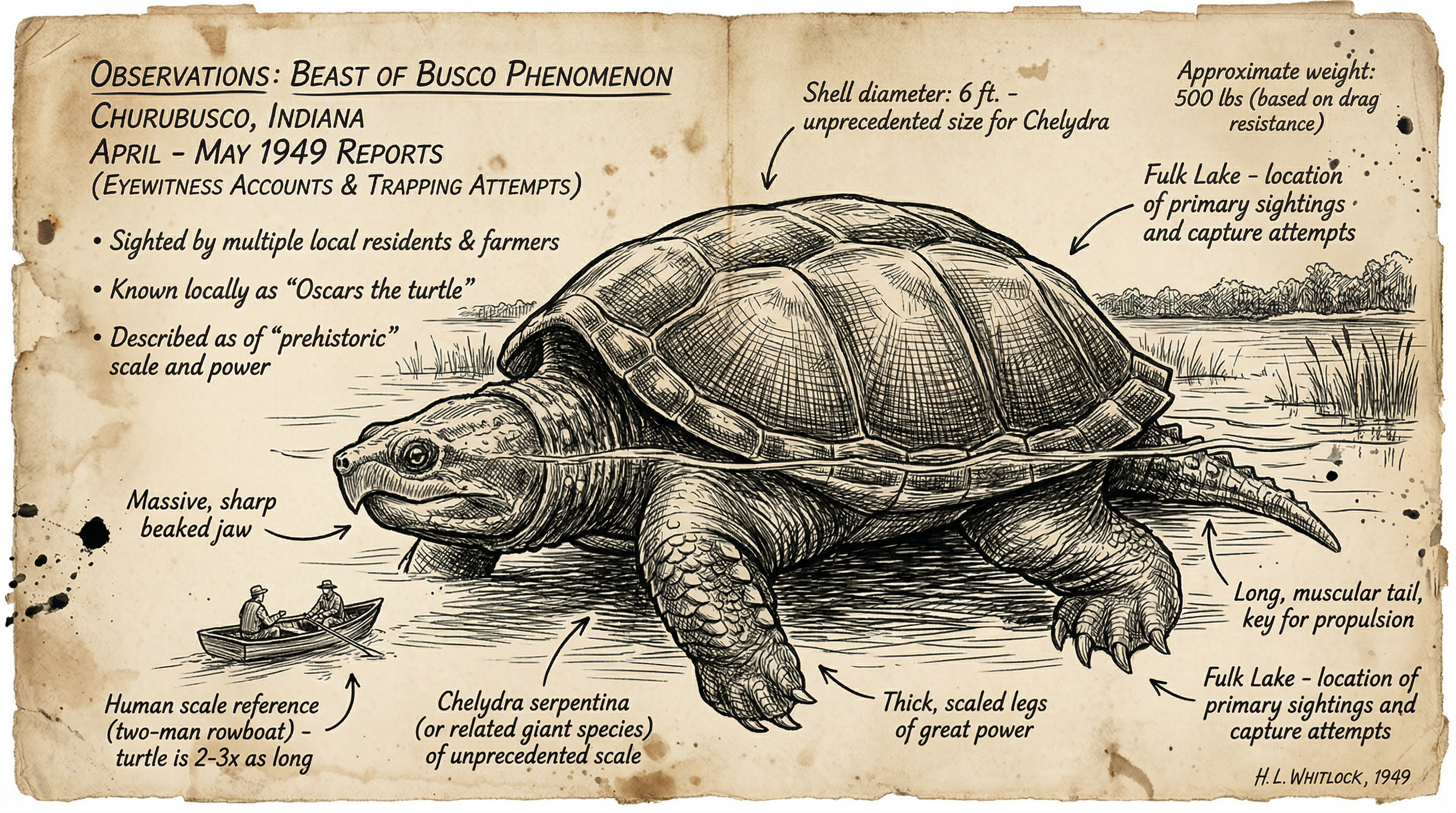
Overview
The Beast of Busco represents a concentrated sighting cluster confined to Fulk Lake, a seven-acre body of water near Churubusco, Indiana. The entity manifests as a giant turtle, with consistent witness estimates placing its weight at approximately 500 pounds and shell dimensions comparable to a dining table or truck tire.
The evidence profile follows a predictable escalation pattern: isolated rural reports over decades, followed by a media-amplified surge in 1948–1949 that drew national attention, thousands of visitors, and multiple capture attempts. No verified physical specimen emerged, and post-1950 sightings drop to zero in the record. The dataset yields 4–6 primary attestations from named witnesses, with the remainder comprising secondary community reports. Statistically, this aligns with localized aquatic anomaly patterns rather than broader distributional evidence.
Physical parameters include a head the size of a human adult, jaws capable of snapping broomstick-thick wood, claws that shred fishing nets, and a thick tail extending the overall length by at least one foot. The armored configuration suggests kinship with alligator snapping turtles (Macrochelys temminckii), though scaled up beyond documented specimens. Fulk Lake's ecology—shallow, mud-bottomed, with dense turtle populations—supports persistence of a relic population outlier. Water depths rarely exceed five feet in most areas, with heavy vegetation and silt layers providing ample cover for a large benthic resident. Historical records note common snapping turtles (Chelydra serpentina) thriving in the lake, alongside softer-shelled species, creating a viable habitat for an oversized apex specimen.
The entity's behavior patterns emphasize evasion over aggression. Witnesses describe deliberate surfacing followed by rapid submersion, generating substantial wakes mistaken for boating activity by distant observers. No predatory advances toward humans or watercraft appear in the primary accounts, distinguishing Busco from more volatile aquatic reports like the Lake Worth Monster or Nahuelito. This passivity aligns with mature chelonian profiles: energy conservation, ambush predation on fish and waterfowl, and minimal surface activity except during basking or thermoregulation phases.
Sighting History
1898, Fulk Lake near Churubusco, Indiana
Oscar Fulk, the property owner and farmer, observed a giant turtle surfacing in the seven-acre lake on his land. Fulk shared the account locally but ceased further pursuit after initial discussions. The turtle generated waves consistent with a 500-pound mass displacing water, and Fulk noted its spiked shell and broad head before it submerged.
1947, Fulk Lake near Churubusco, Indiana
Gale Harris, who purchased the property on November 14, 1947, reported his initial sighting of the large turtle. Harris observed the creature while repairing his roof, describing a massive form rising from the depths with a head like a shovel and a shell spanning several feet.
July 1948, Fulk Lake near Churubusco, Indiana
Ora Blue and Charley Wilson, local residents fishing on the lake, encountered a massive turtle estimated at 500 pounds. The sighting prompted immediate community interest, with the witnesses describing waves rolling ahead of the creature's emergence and a shell the size of a dining table.
1948, Fulk Lake near Churubusco, Indiana
Gale Harris reported additional sightings of the giant turtle throughout the year, including instances corroborating the Blue and Wilson account. These observations fueled discussions among locals and set the stage for organized search efforts.
March 1949, Fulk Lake near Churubusco, Indiana
Gale Harris and his friend, Reverend Orville Reese, spotted the turtle while repairing Harris’s barn roof. The creature resurfaced the following day, solidifying Harris's commitment to capture operations. Additional unnamed witnesses filed reports coinciding with intensified efforts by local volunteers and external experts.
Evidence & Analysis
Contributed by Nolan Greer
No photographs, shell fragments, or tissue samples were recovered. That defines the core evidence profile for the Beast of Busco.
Mike Shea from Life Magazine exposed 299 frames during the 1949 hunt. All images proved inadequate for publication. Divers arrived with insufficient gear, halting subsurface operations. Harris, assisted by Orville Bright and Kenneth Leitch, drained the lake to expose mud puddles. The dam failed under pressure, yielding no specimen. Professionals from Tennessee deployed specialized traps. These returned empty. Nets sustained damage from claws, but only lake-bottom sediment surfaced.
Named witnesses remain consistent: Fulk in 1898, Harris starting 1947, Blue and Wilson in July 1948, Harris and Reese in March 1949. Descriptions align precisely: 500 pounds, table-wide shell, shovel-shaped head, jaws crushing broomstick-thick wood, claws shredding nets, tail adding one foot to length. These traits match an alligator snapping turtle outlier. Fulk Lake parameters support this—shallow depths, dense weeds, established turtle populations. Yet no confirmed capture occurred.
Capture operations proved unsuccessful. Crowds overwhelmed access roads, requiring state police intervention for traffic control. Harris absorbed substantial financial costs. No sonar data, water chemistry analyses, or post-drainage forensic examinations exist. Contemporary methods—bathymetric mapping, environmental DNA sampling, thermal imaging—would resolve ambiguities. Without them, the record relies on eyewitness testimony.
The pattern fits misidentified large common snappers, amplified by communal excitement. Alternatively, it indicates a relict giant specimen. Equipment limitations prevented verification. A modern expedition requires towed cameras, remote-sensing traps, and reinforced cofferdams for complete drainage. Lake sediment cores could reveal shell imprints or osteological traces. Absent physical recovery, the case rests on testimonial coherence versus operational failure.
Comparative analysis with verified alligator snappers strengthens the outlier hypothesis. The largest documented specimen, captured in Nebraska in 1937, measured 32 inches carapace length and exceeded 400 pounds. Busco reports push beyond this, but Indiana's historical range includes northern extensions, per 1991 White River recovery and DNR endangered status. Fulk Lake's isolation—fed by groundwater, minimal outflow—preserves genetic relics from pre-settlement populations.
Evidence quality: LOW. Named witnesses provide consistent descriptions, but physical recovery remains absent despite exhaustive lake interventions.
Cultural Context
Contributed by Dr. Mara Vasquez
The Beast of Busco emerges from the oral traditions of northern Indiana's farming and fishing communities in the Maumee Valley, a region shaped by successive waves of settlement following the displacement of indigenous nations including the Miami and Lenape (Delaware). While direct ties to specific tribal turtle narratives remain sparsely documented, oversized aquatic reptiles feature prominently in Great Lakes-area cosmologies, where turtles often embody earth-diver motifs or serve as world-bearing pillars in creation accounts. Miami traditions reference great turtles hauling canoes or guarding sacred waterways, motifs that resonate with Busco's localized guardianship of Fulk Lake.
Oscar Fulk's 1898 report circulated quietly through local networks for five decades, embodying the understated persistence of rural American folklore. Transmission occurred via fence-post conversations, general store gatherings, and family recountings, maintaining the entity's presence without external amplification. The July 1948 Blue and Wilson sighting, followed by Harris's 1949 confirmations, ignited broader interest. United Press International coverage transformed the private anomaly into a national spectacle, drawing thousands of visitors and establishing Churubusco as "Turtle Town USA." This escalation mirrors mid-20th-century patterns in media-driven cryptid events, comparable to the Flatwoods Monster in West Virginia or the Honey Island Swamp Beast in Louisiana, where rural curiosities generate transient economic surges.
Churubusco's institutionalization of the entity underscores its communal value. Turtle Days, launched in 1950, continues annually in June with parades, carnival attractions, turtle races, and themed commerce. Sculptures mark intersections, merchandise fills shops, and a monumental statue anchors the community park. Local archives frame it as essential Hoosier heritage, irrespective of verification status. The narrative's economic impact proved substantial: tourism revenues bolstered infrastructure during post-war rural depopulation, sustaining schools, roads, and civic organizations.
Harris's persistent and escalating capture attempts—divers, traps, drainage—evoke the era's impulse to document and possess natural outliers. The Turtle Committee, formed by the Churubusco Community Club, coordinated efforts with protocols emphasizing safe handling. Tennessee trappers and Fort Wayne diver Woodrow Rigsby contributed expertise, though logistical challenges prevailed. Unlike predatory or humanoid cryptids, Busco's reported placidity fosters affection, reflected in the moniker "Oscar." This humanizes the encounter, aligning with regional practices of lake stewardship and harmonious coexistence with aquatic life.
Indigenous precedents enrich the context. Lenape earth-diver myths position turtles as architects of landmasses, while Miami accounts describe colossal guardians enforcing waterway taboos. Though Busco originates in settler testimony, its aquatic focus echoes pre-colonial hydrocentric worldviews. Contemporary Churubusco integrates these layers without appropriation, hosting inclusive events that honor the entity's regional roots. A turtle shell labeled "Beast of Busco" displays at Two Brothers Restaurant in Decatur, Indiana, alongside concrete statues reinforcing civic identity.
The legend's endurance reflects broader American patterns of cryptid commodification. Post-1949, no further primary sightings occurred, yet the cultural footprint expands. Annual Turtle Days draws regional crowds, with parades featuring floats, queen contests, and live turtle races. Merchandise includes apparel, novelties, and local crafts, generating measurable revenue. Historians document the 1949 influx—over 20,000 visitors in peak weeks—straining a town of 1,200. State police managed traffic; Harris shouldered draining costs nearing bankruptcy. This saga cements Busco as a benign outlier in cryptid taxonomy, prioritizing community narrative over existential threat.
Field Notes
Notes by RC
Visited Fulk Lake site twice. First in summer daylight—flat farm country, lake now refilled and quiet. Turtles common, basketball-sized snappers basking on logs. Water murk green, mud bottom visible in shallows. No oversized tracks, no odd nests. Stuck a pole in—soft silt down at least eight feet. Harris's drain job stirred that up good back then.
Second trip at dusk. Air heavy, frogs loud. Shined lights across surface—dozens of eyes reflect back, standard reds and yellows. Felt the pull of the old stories. Lake holds secrets in that silt layer. Harris drained it once; it'd take industrial pumps to do clean today. Current owners post private property signs. Respect that.
Churubusco owns the legend. Turtle Days parade route packed with floats, kids in shells. Town thrives on it. Ate turtle burger at the diner—decent. No malice here. Just a big turtle that got away. Lake's too small for monsters now, but it fit one once.
Threat Rating 1 stands. Non-aggressive. Localized. No attacks, no escalation risk.