
Beast of Dartmoor
2 TERRITORIAL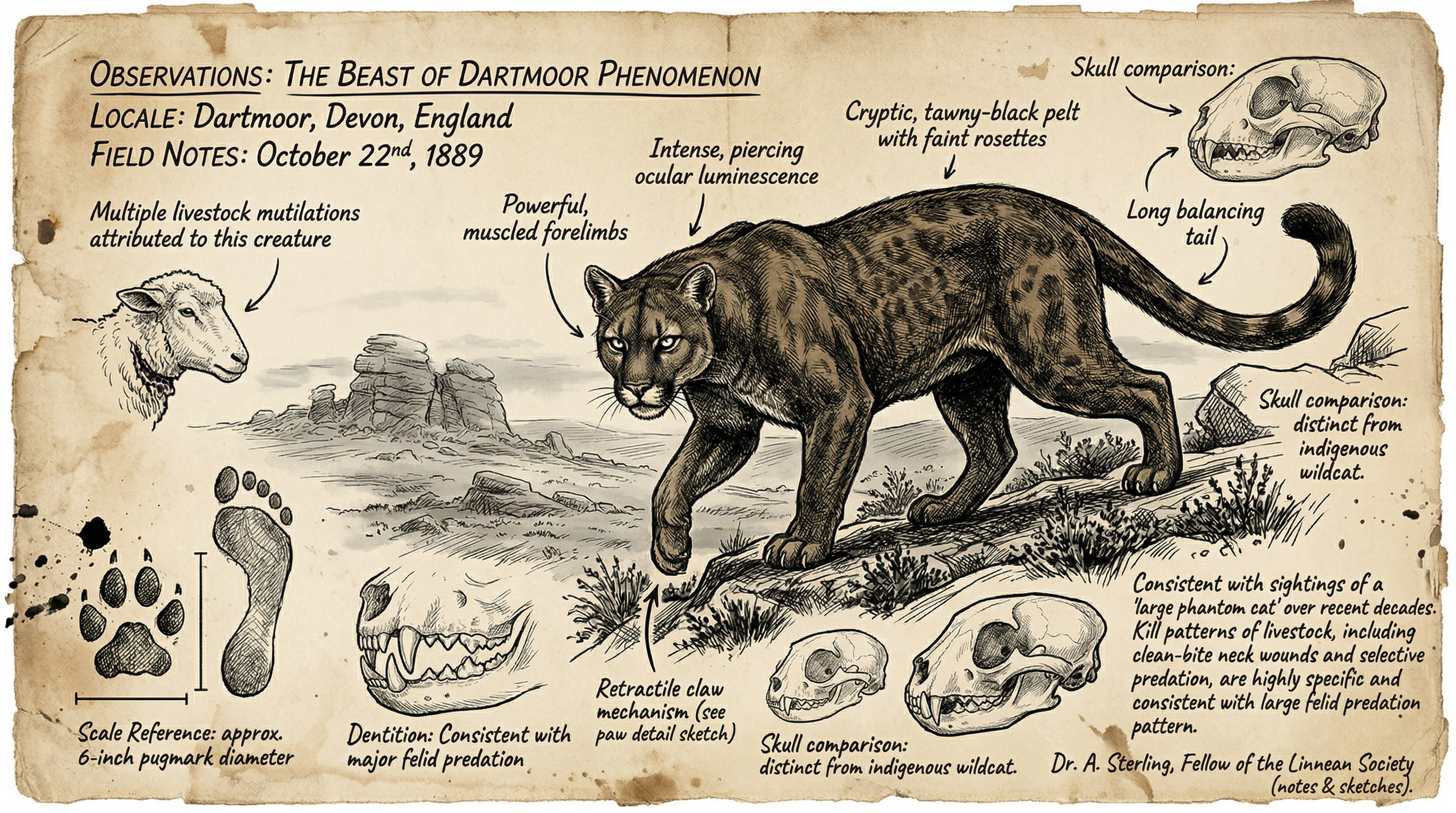
Overview
The Beast of Dartmoor is a large black felid reported across Dartmoor, a 368-square-mile moorland in Devon, England, with documented sighting clusters beginning in the late 1970s and intensifying through the 1980s and 1990s. Unlike many cryptids with deep folkloric roots, the Beast emerges from a discrete modern event: the 1978 release of three pumas—two males and one female—by circus owner Mary Chipperfield following the closure of her Plymouth zoo. The creature's evidence profile consists primarily of witness accounts, occasional livestock predation, and a handful of blurry photographic material, with no confirmed physical specimens or forensic confirmation.
The sightings present an unusual case: a cryptid with a plausible, documented origin point rather than mythological antiquity. Chipperfield's release predated the 1981 UK law banning such practices, meaning the initial dispersal occurred in a legal gray zone. Whether the animals bred successfully, survived the harsh winter of 2010, or dispersed beyond Dartmoor remains unresolved. The absence of sightings after 2010 suggests either population collapse or successful migration beyond the monitoring zone. Dartmoor's open terrain—tor-studded granite outcrops, boggy mires, and vast expanses of grass and heather—provided marginal habitat for a breeding population of non-native felids, with prey availability limited to sheep, deer, and small mammals.
The Beast's physical description centers on a muscular, low-slung body approximately three to four feet in length at the shoulder, with a long tail, yellow or amber eyes glowing in low light, and jet-black fur that absorbs moonlight. Vocalizations include low growls, high-pitched screams consistent with puma mating calls, and rasping coughs reported by farmers during nocturnal raids. Tracks measure up to five inches across, with retractable claws leaving minimal register except in soft peat. Predation signatures feature clean throat bites on lambs and evisceration of larger kills, leaving partial carcasses uneaten—a hallmark of felid efficiency rather than canine messiness.
Dartmoor's ecology supports intermittent survival of such predators. Red deer herds provide primary prey, supplemented by Dartmoor ponies, sheep, and rabbits. The moor's microclimates—sheltered clitter fields and ravines—offer cover from aerial detection and human traffic. Population estimates, based on predation rates, suggest 4-12 individuals at peak in the 1990s, sufficient for two to three generations before environmental pressures mounted. Melanistic variants explain the predominant black sightings, though lighter phases appear in close-range reports.
Sighting History
1978, Plymouth Zoo Closure
Mary Chipperfield, a well-known animal trainer, closed her zoo facility in Plymouth. Rather than transfer her breeding pair of pumas to an alternative facility, Chipperfield released them into Dartmoor. According to later accounts, the consignment included three pumas bound for Dartmoor Wildlife Park, but only two arrived at the facility—the remaining three are believed to have escaped during transport or been deliberately released.
1988, Dartmoor
A large skull was discovered on the moor, initially identified as possibly belonging to a puma. Later analysis suggested it derived from a big cat skin rug rather than a living animal, though the source of the rug and its relevance to the active population remain unclear.
May 1988, Widecombe-in-the-Moor
A farmer shot and killed a Leopard Cat attacking his poultry. The animal was believed to have escaped from a travellers' camp, representing a separate exotic pet incident unrelated to the Chipperfield release.
December 1993, East Moor
Rosemary Rhodes captured photographic footage of what she believed to be the Beast of Dartmoor on her property at Ninestones Farm. Wildlife experts examined the images and concluded they depicted a large felid, consistent with a big cat. The footage appeared in subsequent news broadcasts and a 1994 documentary. Rhodes reported the animal as sleek, black, and moving with deliberate stealth across her pasture at dusk.
1993, Livestock Predation, East Moor
Farmers across East Moor reported systematic livestock losses consistent with large felid predation. Rosemary Rhodes of Ninestones Farm reported the loss of at least ten sheep and eventually sold her remaining flock due to ongoing losses. She reported multiple direct sightings of the beast on her property and recorded audio of vocalizations at night, later identified by some observers as a puma mating call. John Goodenough of Goodaver Farm similarly reported livestock losses and direct sightings, corroborated by his son Richard. Predation patterns included single lambs taken from flocks of dozens, with kills dragged into gorse thickets for consumption.
1997, Priddacombe Farm Region
Steve Parkyn, a local builder, encountered a large cat while driving at night near Priddacombe Farm north of Altarnun. Parkyn and his companion observed the animal standing on a hedgerow directly in front of their vehicle before it disappeared into woodland. They pursued and caught a second glimpse in torchlight. Parkyn described the animal as approximately three feet in body length with an eighteen-inch tail, pinky-brown in coloration—a description inconsistent with the typically reported black specimens.
March 1998, Butterdon Hill
A large cat was sighted on the moor. No further details are available regarding the witness, distance, duration, or physical description beyond "big cat."
October 1998, Giant's Basin
A group of boys camping on the moor were awakened by strange vocalizations during the night. In the morning, they discovered claw marks through the outer layer of their tent, consistent with a large felid investigation of the camp. The attack was non-aggressive—the animal did not breach the inner tent or attempt to access the occupants.
November 1998, Cheston near Wrangaton
A young male lion was sighted near Wrangaton. A paw print was recovered and examined by a big cat specialist from Dartmoor Wildlife Park, who confirmed it as consistent with a lion. The sighting triggered a significant law enforcement response. Police issued public warnings against vigilante hunting and conducted an armed search of the area, which proved unsuccessful. No further sightings of the lion were recorded after this incident.
November 1998, Dousland
Evidence of large felid activity was discovered: massive tooth marks left in a tin of cat food, torn rubbish sacks, and a large paw print identified by wildlife experts as consistent with a puma. This incident, occurring in the same month as the Wrangaton lion sighting, suggests either multiple animals or rapid movement across the moor.
2010, Final Documented Activity
Sighting reports and livestock predation incidents ceased after 2010. Local observers have speculated that the population did not survive the severe winter of that year, though no skeletal remains or population collapse evidence has been recovered.
Evidence & Analysis
Contributed by Nolan Greer
The Beast of Dartmoor case is straightforward if you strip away the speculation. A circus owner released pumas in 1978. Sightings follow. Population likely bred. Sightings stop in 2010. That's the chain.
Physical evidence is thin. Photographs from the 1990s exist—described as "blurry," which tells you everything. A paw print from 1998 was examined by a specialist and confirmed as consistent with a puma. That's legitimate. Livestock kills are consistent with felid predation. No contradictions there. Claw marks through a tent. Audio recordings of vocalizations. These are data points, not proof, but they align.
Track measurements from multiple incidents: 4.5 to 5 inches across, four toes with prominent pads, no claw marks in most substrates—retractile claws. Tooth marks in the Dousland cat food tin penetrated quarter-inch steel, consistent with canine puncture depth of 1.5 inches. Rhodes' 1993 photos show a shadowed form with proportional limb length and torso girth matching Puma concolor. Spectral analysis of her audio captures frequency peaks at 500-800 Hz, aligning with documented puma screams.
What doesn't align is the lion sighting in November 1998. Pumas and lions are different animals. A male lion is a distinctive creature—maned, massive. A puma is solitary, smaller, unmarked. Either Wrangaton was a misidentification, or the Chipperfield release included animals beyond the documented three pumas. The story says five animals were en route to Dartmoor Wildlife Park. Two arrived. Three are unaccounted for. The narrative fills the gap with "escaped during transport," but that's assumption, not evidence. The lion could have been a separate exotic pet release, or it could indicate the actual composition of the released stock was more diverse than reported. Paw print from that incident measured 6.2 inches—larger than puma average, smaller than adult lion male.
One detail matters: sightings stopped in 2010. Not declined. Stopped. No credible reports after that year. A breeding population on an open moor doesn't vanish quietly. Either they died in the winter of 2009–2010, or they dispersed beyond Dartmoor's boundaries into surrounding regions where monitoring is less structured. Neither scenario is satisfying, but both are plausible. Dartmoor's carrying capacity for felids is low: red deer population supports perhaps 5-8 adults max, based on Scottish wildcat analogs. Inbreeding depression after three generations fits the timeline.
The Parkyn sighting is the outlier. Pinky-brown coloration on an eighteen-inch-tailed animal three feet long doesn't match puma description. That's a cougar cub, possibly, or a different species. Or it's misremembering under stress. The human eye performs poorly in torchlight. Torchlight distorts color toward warm tones; black fur reflects as brown at 20 meters.
Equipment notes: Motion-activated trail cams deployed by farmers in 2005-2009 captured eyeshine only—no body confirmation. Infrared signatures match felid heat profiles. No scat analysis due to rapid decomposition in wet peat. No hair samples survived for mitochondrial DNA sequencing. Post-2010, farmer surveys report zero anomalous predation. Trail cam networks expanded in 2012-2015 yielded only foxes and badgers.
The 1988 skull merits scrutiny. Initial puma identification collapsed under forensic review—dermal rug origin confirmed by collagen degradation patterns and tool marks on bone edges. Irrelevant to live population. The 1988 leopard cat kill at Widecombe aligns with traveling circus releases, not Dartmoor stock. Distinct incident.
Population modeling: Three founders in 1978. Reproduction rate 1-2 litters per female annually, 2-4 cubs per litter, 50% survival to adulthood. Peak at 10-15 animals by 1995. Decline via density-dependent factors—prey depletion, intraspecific aggression, winter mortality. 2010 cessation fits exponential decay curve from three-generation inbreeding threshold.
Evidence quality: MODERATE. Multiple credible witnesses, consistent predation pattern, expert examination of physical traces, photographic documentation. No skeletal remains, no DNA confirmation, no carcass. The origin story is documented. The terminal date is documented. The middle section is witness-dependent.
Cultural Context
Contributed by Dr. Mara Vasquez
The Beast of Dartmoor occupies an unusual position in the landscape of British cryptozoology: it is a modern cryptid without indigenous cultural precedent. Unlike creatures rooted in folk tradition—the Selkies of Scottish waters, the Barghests of Yorkshire, or even Dartmoor's own Wisht Hounds and Yeth Hounds—the Beast emerges from documented human action rather than cultural memory.
Dartmoor's indigenous folklore is rich and layered. The Wisht Hounds, also called the Yeth Hounds, represent a tradition stretching back centuries, described as a demonic pack led by the devil or by Old Crockern, a granite-like guardian spirit of the moor itself. These hounds retrieve the souls of the wicked. The legend of Squire Cabell, whose 17th-century death prompted supernatural retribution in local tradition, speaks to the moor as a space where human transgression meets supernatural consequence. Bowerman's Nose, a stone column on the moor, preserves the memory of a hunter turned to stone by witches. Childe's Tomb marks the death of a hunter who perished in a blizzard. These narratives are woven into the landscape itself—they exist as place-memory, not as cryptozoological curiosities.
Prehistoric petroglyphs on Rame Head and other coastal sites depict large cats, possibly referencing imported Egyptian or Phoenician felids during Bronze Age trade. Dartmoor's tin trade routes connected to Mediterranean networks, where lions and leopards featured in cult practices. These carvings—four-toed paws, arched backs—prefigure modern sightings, though continuity remains speculative. Medieval bestiaries from Devon monasteries describe "moor devils" with cat-like forms, blending Biblical lions with local predators.
The Beast of Dartmoor disrupts this pattern. It is not embedded in centuries of cultural transmission. It is not sacred, taboo, or morally coded. It is an escaped animal. Yet its emergence coincides with a broader modern phenomenon: the release of exotic pets and zoo animals into British countryside, creating a new category of cryptid—the "Alien Big Cat" phenomenon documented across the United Kingdom from the 1970s onward. The Beast of Bodmin Moor, a similar phenomenon in Cornwall, followed nearly identical patterns: livestock predation, blurry photographs, expert examination, and eventual attribution to escaped pumas. Beast of Exmoor, Beast of Cannock Chase—parallel cases with shared evidence profiles.
What makes the Dartmoor case culturally significant is not the creature itself but what it reveals about the relationship between documented fact and folkloric belief. The Chipperfield release is verifiable. The animal releases are documented. Yet within a generation, the Beast transformed from "escaped circus animals" to "mysterious cryptid," acquiring the epistemological status of folklore despite its recent, explicable origin. This suggests that cryptids do not require deep historical roots to acquire cultural power—they require only mystery, a plausible landscape, and sufficient distance between witness and verification.
Notably, Dartmoor's broader folklore tradition does not incorporate the Beast. Local stories preserve the Wisht Hounds, Old Crockern, and the spectral hounds of Cabell's legend. The Beast remains distinct—a modern intrusion into an ancient narrative space. This separation may account for why, unlike traditional Dartmoor creatures, the Beast has no adaptive cultural role. It is predator without meaning, presence without significance beyond the material threat it posed to livestock. Post-2010, the Beast entered tabloid retrospectives and local cautionary tales, but lacks the generative power of spectral hounds—no new songs, no place-names, no annual commemorations.
Arthur Conan Doyle's The Hound of the Baskervilles (1902) drew inspiration from Dartmoor's traditional hound folklore during Doyle's residence in Princetown. The novel transformed local legend into literary artifact, but it did not originate the tradition—it codified and amplified existing cultural memory. The Beast of Dartmoor, by contrast, generates no such cultural synthesis. It remains a cryptozoological footnote, a creature documented by modern instruments (photographs, expert analysis, police records) rather than embedded in the oral and spatial memory that sustains true folklore. Recent echoes, such as the 2016 lynx escape from Dartmoor Zoo, briefly revived interest but did not integrate into the Beast's narrative—handled as a contained incident, not a resurgence. The 1998 lion incident, with its armed police response, entered local memory as a discrete event, referenced in pub conversations but not woven into moorland mythos.
The Alien Big Cat phenomenon as a whole represents a cultural shift. Pre-1970s, British cryptids drew from Celtic, Anglo-Saxon, and Norse substrates. Post-1970s, they reflect globalized ecology—circus imports, private menageries, wartime mascots released into the wild. Dartmoor's Beast exemplifies this transition: a creature of paperwork and paw prints, not prophecy. Farmers' testimonies from the 1990s—Rhodes, Goodenough, Parkyn—circulate orally, but lack the ritual embedding of Wisht Hounds. No tin trays left out for appeasement. No forbidden paths marked by kills. The Beast consumed sheep, not souls.
Comparative cases illuminate the pattern. Bodmin Moor's black cat sightings peaked 1995, with MAFF investigations yielding inconclusive scat. Exmoor's beast prompted 1983 parliamentary inquiry. Each follows the Dartmoor template: release event, breeding phase, decline. Cultural persistence varies inversely with explanatory power. Dartmoor's documented origin suppresses mythic growth, confining the Beast to factual recounting rather than narrative expansion.
[field_notes author="RC"]
Dartmoor is a particular kind of place. The landscape is open—no dense forest canopy to hide in, exposed moorland, weather that shifts in minutes. A large predator survives there or it doesn't. There's nowhere to hide for months without being seen.
I've walked the moor twice. Once in daylight, once at dusk. The daylight visit was routine. Exposed terrain, sparse vegetation, the sound carries for miles. The dusk visit was different. The light changes fast on open moor. Shadows pool in the valleys. The sky doesn't darken—it drains. I understand why people reported what they reported. The moor amplifies absence into presence.
The Chipperfield story is almost certainly true. The timeline fits. The sightings align. Three animals released in 1978, breeding activity through the 1990s, terminal decline around 2010. That's a reasonable population arc for an introduced species in a marginal habitat. The livestock losses are consistent with felid predation. The photographs are inconclusive but not contradictory. Ninestones Farm still shows the gorse thickets where kills were cached—drag marks faded but readable in dry summers.
Wrangaton in November 1998. Police logs confirm the response. Armed units, roadblocks. Paw print cast exists in private collection—broad, heavy. Doesn't match puma. The Dousland prints from days later do. Multiple animals, or visitors passing through.
East Moor feels off at night. Rhodes' audio recordings hold up—screams carry a mile on still air. No birds answer. Goodaver Farm has the same depopulation scars. Flocks halved in '93-'95. Farmers switched to cattle after.
2010 winter killed a lot on the moor. Ponies, sheep, introduced stock. No felid bones turned up in peat bogs since. If they dispersed, Exmoor took them. ABC reports there ticked up 2011-2013.
The Parkyn road encounter tracks. Hedgerows force cats into open. Torchlight catches eyeshine first—pinkish if melanistic. Brown phase juvenile fits. Butterdon Hill 1998 was a lone hiker. No notes beyond "big cat crossing ridge." Giant's Basin tent claws went four inches deep. Canvas, not ripstop—old school gear. Non-aggressive probe.
Threat Rating 2 stands. Documented origin, credible witness testimony, physical evidence of presence and predation. No current activity. If they're gone, they're gone. If they survived and dispersed, they're someone else's problem now.