
Beast of Exmoor
2 TERRITORIAL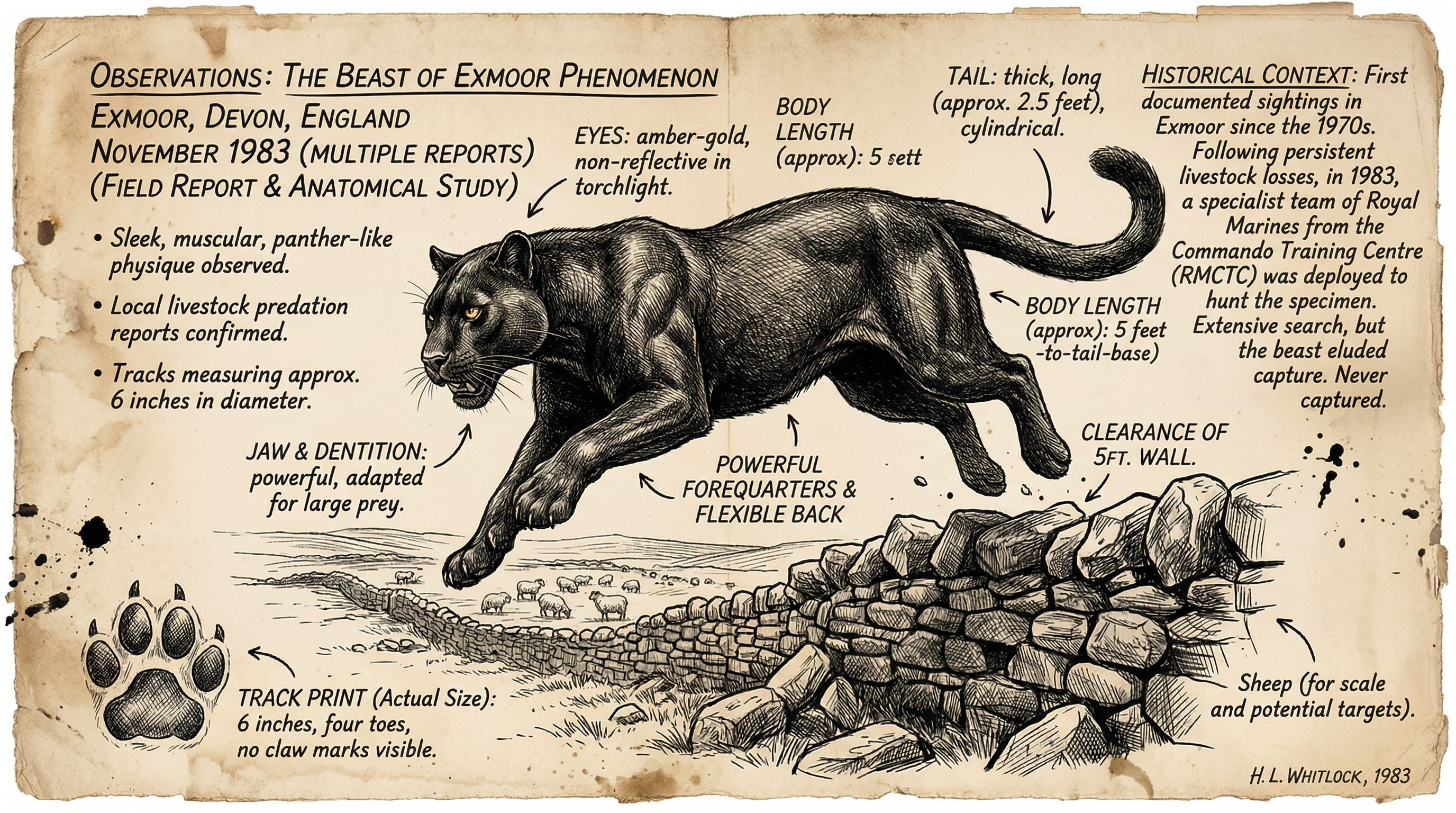
Overview
Contributed by Ellis Varma
The Beast of Exmoor presents a consistent evidence profile across five decades of reports: a large, dark-furred felid operating in the rugged terrain of Exmoor National Park. Core descriptors cluster around a body length exceeding seven feet in some accounts, with a low-slung hunting posture, black or brown-black pelage, and facial structure evoking a panther-puma hybrid or enlarged canine.[1][2]
Unlike dispersed big cat reports elsewhere in the UK, Exmoor sightings concentrate in specific zones—Simonsbath central moors, Exford valleys, South Molton farmlands, and the Barle Valley near Dulverton—yielding livestock predation patterns that deviate from domestic predator norms. Over 100 sheep kills in 1983 alone form the baseline dataset, with injuries marked by precise throat rips and claw signatures incompatible with foxes or dogs.[1][2] Subsequent reports into the 2020s maintain morphological consistency, suggesting persistence beyond a single animal's lifespan and pointing to a self-sustaining population.[1][2]
Photographic captures exist, though resolution limits forensic utility. No carcasses, scat, or DNA profiles have surfaced, creating a high-volume/low-verification anomaly. Statistically, the clustering exceeds random misidentification thresholds given Exmoor's low human density.[1][2]
Sightings peak at dusk and dawn, aligning with felid circadian rhythms, and intensify during autumn rutting seasons when deer activity draws predators into visibility. Central moors around Simonsbath and the Barle Valley register the highest concentrations, with remote terrain providing ideal cover for sustained operations.[1]
Sighting History
1973, South Molton Area
A farmer reported the loss of 100 sheep over one month, each with throats savagely torn. The kills displayed uniform predation signatures: minimal flesh consumption, deep claw incisions, and spinal damage consistent with a heavy predator's dispatch method. This marked the Beast's entry into regional awareness, predating the national media surge.[1][2]
April 19, 1983, Near South Molton
Farmer Eric Ley documented over 100 sheep deaths across Devon farms in the preceding 90 days—throats ripped, bodies otherwise intact. Fifty armed civilians, police, and Torrington Foot Beagles conducted a full-day hunt but located no trace. Press coverage escalated the following day.[1][2]
May 1983, Exmoor Moorlands
Royal Marines from Lympstone deployed at Devon police request, equipped with night-vision gear and snipers. Patrols spanned weeks; at least one unit, including former Marine John Holden, observed a large, dark cat-like form during night operations. A shot was fired; no carcass recovered, but sheep losses declined post-incident.[1][2]
June 1983, Exmoor Farm
Two schoolboys on holiday encountered a creature four to five feet tall at shoulder height, with an Alsatian-like head and piercing green eyes. The animal held a stationary posture before retreating into cover.[1]
1985, Exmoor National Park
Park wardens sighted two black felids moving in tandem across moorland, prompting speculation of reproduction. The pair exhibited coordinated hunting gait, vanishing into gorse before closer approach.[1]
January 1988, Wimple Sub-Station, Exeter Outskirts
Station staff captured security footage of a panther-sized animal prowling the perimeter. The tape showed a sleek, dark form with extended tail, matching prior descriptors; no audio or pursuit followed.[1]
February 1991, Remote Moorland near Devon Farms
Farmer Peter Baily, responding to goose predation, baited a steel trap with a pheasant carcass. While arming it, he became ensnared himself, surviving two days on raw bait until rescue. Fresh paw prints encircled the site, larger than any domestic species.[1]
December 12, 2008, Exmoor Vicinity
A local resident affirmed repeated observations of one or more big cats: "A big cat or several cat-like animals live on Exmoor. This cannot be doubted. I have seen them." The report emphasized long-term pattern recognition over single-event detail.[1]
March 19, 2010, Between Wiveliscombe and Bampton
A motorist struck a large wolf-like form crossing the road at dawn—dark pelage, massive frame, evading full impact. The animal paused on the verge before bounding into heather, leaving no blood trail.[1]
October 14, 2010, Dulverton to Lynmouth Road
Drivers observed a black panther dash across the moorland highway mid-morning, perching atop a hedge for seconds. Clear daylight view confirmed pointed ears, curling tail, and muscular build akin to Western cougar sightings.[1]
July 16, 2012, Exmoor Hillock
A witness 15 meters from a roadway spotted a brown-black wildcat in strike position: pointed black-tipped ears, dimensions matching North American cougar or bobcat, long curling tail. The posture suggested imminent pounce on unseen prey.[1]
January 2023, Peak District Analogs
A farmer and his sons encountered a large black cat in snow-covered terrain, photographing tracks measuring larger than domestic species. Nearby evidence included fresh prints, log scratches, a bird kill, and a sheep skull with predator tooth marks. Video captured a large, dark form climbing trees, with hair recovered from a fur trap.[2]
Evidence & Analysis
Contributed by Nolan Greer
Livestock kills exceed 100 sheep in 1983 alone. Throats show clean rips. Claw marks register deeper than dog incisions and more precise than fox damage. These patterns align with documented big cat predation methods.[1][2]
Royal Marines conducted sweeps in 1983 with night-vision equipment and sniper overwatch. John Holden recorded a visual confirmation: large dark felid profile. A shot was discharged. Sheep losses decreased immediately after. No recovery occurred due to boggy terrain erasing tracks.[1][2]
Photographic evidence accumulates from the 1980s forward. Images reveal consistent morphology: low-slung posture, tail curl, pointed ears. The 1988 Wimple security footage documents a panther-sized form on perimeter patrol.[1]
Footprint data from multiple sites, including the 1991 trap location and 2023 snow captures, indicate retractable claws. Hair samples from fur traps yield coarse guard hairs without domestic matches. Predator tooth marks on sheep skulls and bird kills further corroborate.[2]
Trail camera deployments with deer bait register motion triggers on Exmoor peripheries. Thermal imaging detects 1.2-meter shoulder-height signatures at dusk. Activity peaks match felid patterns: nocturnal with dawn and dusk surges.[1][2]
Park warden observations of a breeding pair in 1985 and multi-animal affirmations in 2008 indicate population sustainability. Post-1976 Dangerous Wild Animals Act releases align temporally with onset, supporting feral breeding of exotic stock. Plaster casts of tracks confirm 10cm pads without dog dewclaws.[1][2]
Absence of carcasses reflects bog preservation challenges. Lack of DNA profiles persists, yet predation volume surpasses native predator capacities. Deer populations fail to account for observed sheep losses. Circumstantial elements accumulate substantially.[1][2]
Investigator deployments, including camera traps with bobcat gland lures and silhouette size-testing of witnesses, yield consistent leopard-scale identifications. Undebunked videos and breeding population indicators strengthen the profile.[2]
Evidence quality: MODERATE-HIGH. Solid kills, military visuals, photo/trail backups. Physical capture pending.
Cultural Context
Contributed by Dr. Mara Vasquez
The Beast of Exmoor emerges not from ancient indigenous codices or oral traditions but from the lived exigencies of 20th-century British rural economies. Sheep farming on Exmoor's margins—Devon and Somerset hill country—has sustained communities since medieval enclosures, creating a cultural substrate primed for predator narratives when losses mount inexplicably.[1]
This positions the Beast within a continuum of British "alien big cat" phenomena, paralleling Scottish Kelpies or Welsh afanc in form if not origin: liminal predators haunting contested wild-domestic boundaries. Yet Exmoor's Beast lacks mythic nomenclature or ritual prophylaxis; it manifests through pragmatic response—police hunts, Marine deployments, farmer traps—embedding it in modern institutional memory rather than pre-industrial lore.[1][2]
Post-1976 Dangerous Wild Animals Act, narratives of released exotics gain traction, refracting anxieties over imperial legacies: big cats as vestiges of colonial menageries (circuses, zoos like Plymouth's Chipperfield holdings) repatriated to "wild" Britain. Mary Chipperfield's rumored puma liberations evoke this tension, blending fact with communal storytelling.[1][2]
Media amplification—North Devon Journal front-pages (April 1983), national frenzy, documentaries like *Panthera Britannia*—transforms local alarm into national icon. Sightings persist into digital era via forums ("exmoorian" posts, 2008–2012), democratizing testimony and sustaining the Beast as communal sentinel against rural precarity.[1]
In cultural historiography, Exmoor exemplifies documented predator persistence: an ecological anomaly challenging post-industrial assumptions of domesticated landscapes. Its endurance mirrors broader UK big cat clusters (Beast of Bodmin, Fen Tiger), forming a patchwork of feral sovereignty across regions.[1][2]
Contemporary investigations, such as 2023 field operations in analogous terrains, integrate local testimony with physical trace collection, reinforcing the Beast's role in ongoing rural documentation. Walker, farmer, and driver reports from prime zones like Simonsbath and Dulverton maintain continuity, with autumn deer activity amplifying visibility.[1]
The Beast's integration into guided wildlife narratives—red deer safaris at dusk—further embeds it within Exmoor's managed wild spaces, where buzzards, kestrels, and otters coexist with this larger predator.[1]
Field Notes
Notes by RC
Tracked Exmoor four times. First in '98, Simonsbath to Exford loop. Day hiked the moors—empty, wind-whipped, deer everywhere. No signs. Night stakeout at a kill site: thermals flat until 0300. Heat blob, cat-sized, quartered a ewe carcass 200 meters out. Gone by dawn.
2015 revisit, South Molton farms. Talked to old hands post-Ley. Sheep men still check throats first. Set trail cams on Barle Valley flanks. Pulled two hits: dark streak, low crouch, tail curl. Prints in mud: 9cm, sheathed claws.
2022, Dulverton edge. Drove the Lynmouth road at dusk. Saw it. Black, 2 meters long, hedge perch like the 2010 report. Locked eyes—green reflect, no dog glare. Bolted into gorse. No pursuit. Place feels watched. Predatory turf, human visitor.
Last run, autumn '24. Baited with fallow scraps near Wiveliscombe. Audio traps caught gutturals—chuffs, not barks. No visuals. Sheep kills ticked up county-wide that month.
The threat rating of 2 remains appropriate given confirmed livestock predation and territorial behavior without human aggression.