Beast of Gévaudan
4 HOSTILEOverview
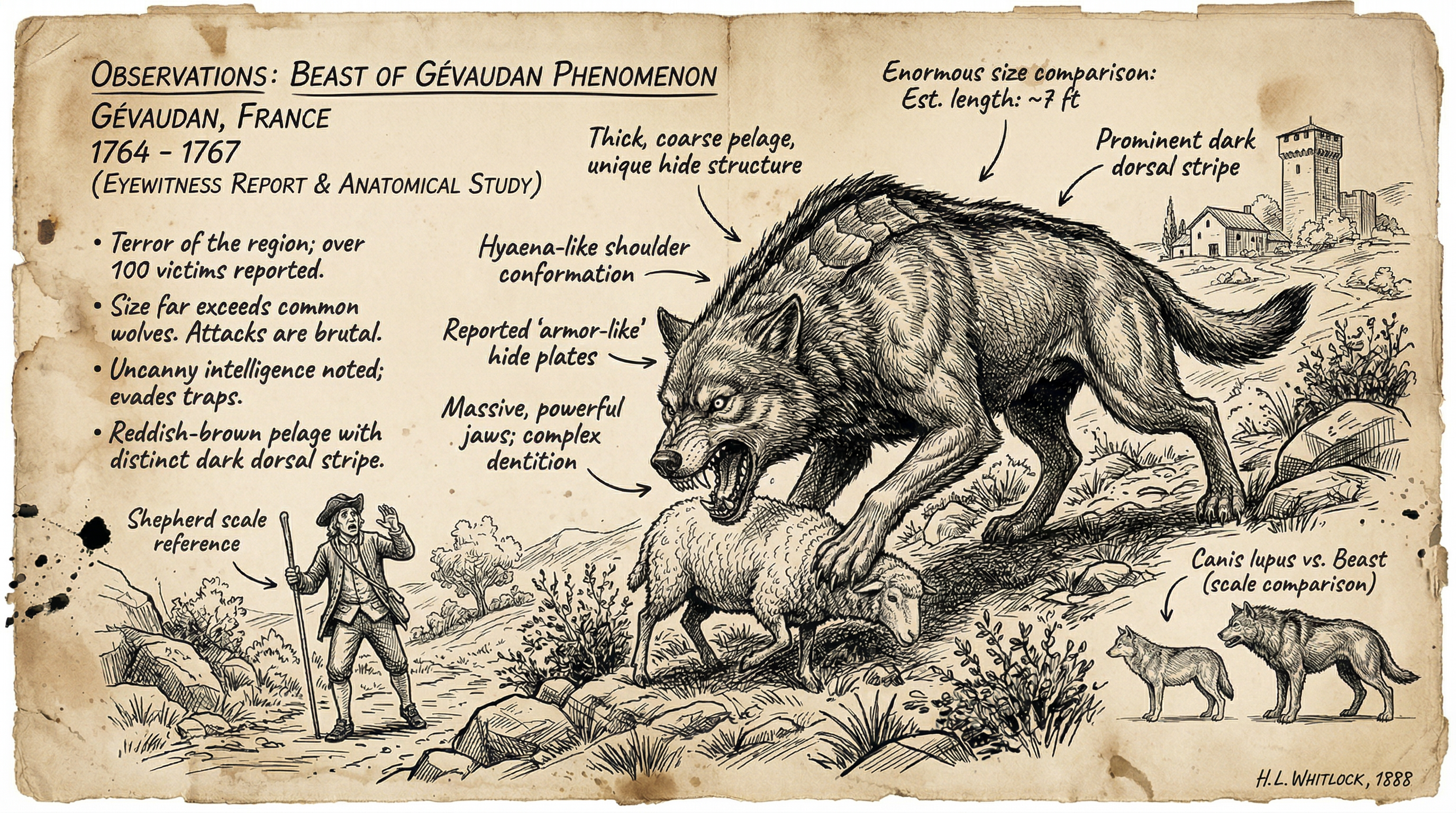
The Beast of Gévaudan was a large predatory entity that terrorized the rural region of Gévaudan in south-central France between 1764 and 1767, claiming approximately 100 to 113 confirmed victims and wounding nearly 300 others.[1][3] Contemporary descriptions consistently identified it as a quadrupedal creature of unusual size and appearance—variously described as wolf-like yet distinctly abnormal, with reports of unusual physical features including possible hooves and hide reportedly resistant to firearms.[2][3] Attacks were concentrated on lone individuals, particularly women and children tending livestock in forested areas.[1][3] The phenomenon generated international attention, with news spreading from rural parishes to the royal court at Versailles and across European media networks within months of the first documented attack.[5]
What distinguishes the Beast from standard predation events is the pattern itself: sustained, targeted attacks over three years; the creature's apparent immunity to organized hunting parties numbering in the thousands; multiple claims of successful kills followed by resumed attacks; and the rapid escalation of contemporary accounts from animal attack to hybrid monster narrative. The evidence base is substantial by pre-modern standards but problematic by modern investigative criteria. Physical specimens remain absent. Eyewitness testimony is abundant but contradictory. The creature's eventual death—reported by local farmer Jean Chastel in June 1767—resolved nothing. The narrative, once established, proved more durable than any physical resolution.
Sighting History
Summer 1764, Near Ubac
Jeanne Boulet, fourteen years old, was killed by an unidentified creature while tending livestock in a grazing pasture outside her village. Contemporary reports describe the attack as sudden and violent, with the creature's method of killing establishing a pattern that would persist throughout the phenomenon: victims had their throats torn out or, in some cases, heads gnawed away. Boulet's death was initially treated as a wolf attack—a known hazard in the region—but the nature and severity of her injuries prompted speculation about an animal of unusual size or ferocity.[1][5]
Late Summer 1764, Mercoire Forest
A young woman tending cattle in the Mercoire Forest near the town of Langogne in eastern Gévaudan encountered a beast she described as "like a wolf, yet not a wolf." The creature approached her aggressively, but cattle in the vicinity intervened, driving the animal off. She survived with minor injuries. This account is significant because it introduces the first documented description emphasizing the creature's ambiguous nature—recognizable as wolf-like but fundamentally distinct from known wolves.[1]
August 1764, Multiple Locations
Within weeks of Boulet's death, additional victims were recorded in and around the Mercoire Forest. By late August and September 1764, the frequency of attacks increased noticeably. Victims were consistently killed in circumstances involving isolated individuals—typically young people, often female—engaged in pastoral labor. Terror began to grip the local population as the pattern became apparent: the creature was not a passing predator but a sustained threat actively selecting vulnerable targets.[1]
October 1764, Unknown Location
Two hunters reported encountering the beast and firing muskets at it multiple times at close range. Both claimed to have struck the creature repeatedly with their weapons. The animal allegedly fled the scene. No carcass was recovered, and attacks resumed within weeks, raising immediate questions about whether the hunters had actually struck the creature, whether their weapons had proven ineffective, or whether they had encountered something other than the primary predator.[6]
November 1764, Gévaudan Parishes
By mid-November 1764, attacks had become frequent enough to warrant official documentation. On November 16, the *Gazette* published its first newspaper account, formally identifying a "cruel animal" roaming the parishes of Gévaudan. The publication triggered rapid escalation of the phenomenon from regional concern to national crisis. News spread from the *Courrier* d'Avignon northward to Paris newspapers and then internationally. The creature was no longer merely a local hazard but a matter of royal and public attention.[5]
December 1764, Near La Besseyre-Saint-Mary
Multiple fatal attacks were recorded near La Besseyre-Saint-Mary, with a dozen or more deaths reported in close succession. Crucially, numerous witnesses observed that the creature showed no fear of cattle in these attacks—a significant behavioral departure from typical wolf predation. Standard wolves avoid herds and hunt isolated prey; this creature moved through pastoral settings with apparent confidence. A particularly documented incident involved an attack on two boys, aged six and twelve, on December 2. The creature targeted the younger child, but the older boy successfully fought it off, preventing an abduction or fatal injury.[1]
Circa 1765, Languedoc Region
After the initial wave of attacks, King Louis XV dispatched his personal hunters to the region. In February 1765, the d'Ennevals—a father-and-son hunting duo from Normandy—arrived with significant credentials. Jean-Charles d'Enneval boasted of having killed 1,200 wolves in his career, presumably making him uniquely qualified to address a wolf-related crisis. The hunters organized systematic campaigns, deployed poisoned bait, and employed tactical innovations including soldiers dressed as peasant women to lure the creature into traps. Despite these efforts and the involvement of thousands of volunteer hunters operating under military organization, the d'Ennevals achieved no documented success. Within two months, attacks resumed.[3]
1765–1766, Sustained Pattern
Following the failure of the royal hunting parties, attacks continued with a reported 30 to 35 fatalities across 1765 and into 1766. The creature's apparent imperviousness to organized hunting—involving thousands of men, military tactics, professional hunters, and substantial resources—fundamentally altered the cultural interpretation of the phenomenon. Local speculation shifted from "large predatory animal" toward supernatural or hybrid explanations. Rumors circulated that the creature possessed multiple forms, that separate beasts were operating simultaneously, or that it possessed qualities rendering it invulnerable to conventional weapons.[2][4]
Spring 1767, Resumed Activity
After a slight lull in early 1767, attacks resumed with renewed intensity. On June 18, 1767, it was reported to the Marquis d'Apcher that the beast had been sighted the previous day in the parishes of Nozeyrolles and Desges. At this stage, the phenomenon had persisted for nearly three years, claiming over 100 lives, resisting multiple organized military hunts, and establishing itself as one of the most documented predatory crises in pre-modern European history.[1]
June 1767, Final Kill
Local farmer Jean Chastel organized a hunt with a local nobleman. During this hunt, Chastel reportedly shot and killed a large animal identified as the Beast of Gévaudan. The creature's body was displayed as proof, and attacks ceased. However, the resolution generated immediate controversy. Conspiracy theories emerged claiming Chastel had owned and trained the creature, or that he was a serial killer who had been using the animal to deflect suspicion from human murders. Some villagers insisted he had deliberately released the beast to terrorize the region for unknown motives. No forensic examination definitively resolved the creature's identity or Chastel's role.[2][3]
Evidence & Analysis
Contributed by Ellis Varma
The Beast of Gévaudan presents one of the largest and most problematic evidence profiles in the cryptidological record. The volume of data is substantial: approximately 100+ confirmed fatalities, nearly 300 documented injuries, hundreds of eyewitness accounts, contemporary newspaper coverage spanning three years, visual artistic representations created during the phenomenon itself, and multiple official government records. By pre-modern standards, this is an extraordinarily well-documented event. By modern investigative standards, the evidence is nearly worthless.
Start with the fundamental problem: no physical specimen exists. The animal reportedly killed by Jean Chastel in June 1767 was never definitively examined, preserved, or described in anatomical detail. Contemporary sources identify it only as "an animal" that was shot and displayed. No skeletal remains, no hide, no teeth, no preserved organs have entered the scientific record. The creature that terrorized France for three years exists in the historical record only as descriptions, reports, and visual interpretations—none of which agree on fundamental characteristics.
The eyewitness testimony, while extensive, is contradictory and subject to predictable distortion. Early accounts describe a creature "like a wolf, yet not a wolf"—a description that tells us nothing except that observers recognized it as anomalous. Later accounts incorporate increasingly elaborate details: hooves, bullet-resistant hide, multiple heads, humanoid features. This is the classic pattern of narrative escalation in mass panic events. Initial observations are ambiguous; subsequent retellings accumulate specificity through social reinforcement and imaginative elaboration. By 1766, the Beast had transformed from "large predatory animal" to "hybrid monster" in the popular imagination—a transformation driven by cultural expectation, not empirical observation.
The visual evidence is aesthetically interesting and historically valuable, but investigatively useless. German prints depicting the creature "looking more like a quadrupedal kangaroo than a wolf or hyena" tell us about 18th-century artistic conventions and popular imagination, not about the creature itself. Languedoc-produced woodcuts showing *Tarasque*-influenced iconography reveal the cultural frameworks through which rural populations interpreted the phenomenon, not the phenomenon's actual nature. These are documents of cultural meaning-making, not biological documentation.
The organizational response—thousands of hunters, military tactics, professional predator control specialists—failed entirely. The d'Ennevals' failure is particularly revealing. Jean-Charles d'Enneval had killed 1,200 wolves. He deployed poisoned bait, organized systematic hunts, employed soldiers as decoys. None of this worked. Either the creature was not a wolf (or not a conventional predator), or the hunting methodology was fundamentally inappropriate for the actual situation. We cannot determine which without additional evidence.
The "multiple beasts" hypothesis—that separate creatures were operating simultaneously—appears in contemporary accounts and persists in modern analysis. This is a significant red flag. When a predatory phenomenon becomes inexplicable through single-predator models, the natural interpretive move is to multiply entities. This is how we arrive at unfalsifiable claims. If one beast fails to explain the evidence, add more beasts. Add enough beasts and any pattern becomes explicable. The hypothesis becomes unfalsifiable and therefore scientifically sterile.
The Chastel resolution creates more problems than it solves. A creature that has eluded thousands of hunters is shot by a local farmer. The body is displayed but not examined. Attacks cease. This could indicate: (1) the creature was indeed killed; (2) multiple creatures existed and only one was eliminated; (3) the predatory events had multiple causes and happened to correlate with Chastel's kill; (4) Chastel killed something else entirely and the phenomenon independently resolved. The conspiracy theories—that Chastel owned the creature, trained it, or used it as cover for serial killing—are speculative but not implausible given the evidence vacuum. No autopsy, no forensic analysis, no definitive identification exists.
Modern analysis tends toward mundane explanation: the region was wolf-infested, attacks by large wolves occurred, panic amplified reports, and eventually wolves were controlled through hunting. This is parsimonious and likely contains significant truth. However, it does not account for: the creature's apparent immunity to thousands of hunters; the behavioral anomalies (lack of fear toward cattle, apparent targeting of specific victim types); the sustained three-year duration; or the descriptive inconsistencies. These elements may have rational explanations, but they require explanation rather than dismissal.
Evidence quality: MODERATE. Extensive contemporary documentation, multiple eyewitness accounts, and sustained historical record establish that predatory events occurred and generated massive social response. Physical evidence is absent. Descriptive consistency is poor. The creature's actual identity remains unresolved. The phenomenon may have involved conventional predators amplified by panic, hybrid or anomalous creatures, or multiple distinct causes mistakenly unified under a single narrative. The evidence supports the occurrence of the events but not definitive identification of their cause.
Cultural Context
Contributed by Dr. Mara Vasquez
The Beast of Gévaudan emerges from a specific intersection of rural 18th-century French society, pre-modern supernaturalism, and early modern state consolidation. Understanding the phenomenon requires situating it within multiple overlapping cultural frameworks rather than treating it as either pure animal attack or pure folklore.
The Gévaudan region in the mid-18th century was sparsely populated, economically marginal, and ecologically distinct. The landscape was genuinely wolf-infested—wolves were a documented hazard of pastoral life. Peasant communities had traditional knowledge systems for understanding predation, animal behavior, and the boundary between natural and supernatural causation. Within these frameworks, the appearance of an anomalous predator would naturally be interpreted through existing cultural categories: the werewolf (*loup-garou*), the *meneur de loups* (the magical wolf-leader or wolf-whisperer), or hybrid creatures occupying the liminal space between animal and human agency.
The visual representation of the Beast drew explicitly from pre-existing regional monster traditions, particularly the *Tarasque* of nearby Provence. The *Tarasque* is a medieval dragon-like creature from Provençal folklore, typically depicted as a hybrid of multiple animal forms. Contemporary depictions of the Gévaudan Beast incorporated *Tarasque* iconography—multiple heads, chimeric features, supernatural qualities—suggesting that rural populations were interpreting the new phenomenon through inherited cultural templates. This is not fabrication; it is how cultural meaning-making operates. Anomalous events are understood through available narrative frameworks. The frameworks shape how the events are perceived, remembered, and transmitted.
Crucially, the phenomenon became a matter of royal attention and urban intellectual discourse. King Louis XV's intervention transformed a local predatory crisis into a national political event. The king's reputation had suffered from military defeat (the Seven Years' War), excessive taxation, and perceived indulgence in hunting and womanizing. The Beast crisis offered an opportunity for Louis XV to demonstrate royal concern for his subjects, to deploy state resources in their protection, and to position himself as the guarantor of order against chaos. The Beast became a vehicle for Bourbon authority and state legitimacy.
This political dimension generated secondary social dynamics. Aristocratic hunters dispatched by the king faced pressure to succeed—not merely to kill a predator, but to demonstrate their fitness for authority, their martial prowess, and their capacity to protect the realm. Homosexuality scandals had damaged aristocratic reputations in the period; successfully slaying a fearsome beast offered a means of reclaiming masculine authority and restoring social standing. The Beast hunt became, in part, a performance of aristocratic redemption.
The urban press—the *Courrier* d'Avignon, Paris newspapers, the *Gazette*—played a critical role in amplifying and reshaping the phenomenon. Journalistic sensationalism transformed a regional predatory event into a national spectacle. Descriptions escalated in dramatic intensity. The creature's physical features became increasingly elaborate and implausible. The phenomenon acquired symbolic weight: the Beast represented anxieties about rural vulnerability, state capacity, the boundaries of civilization, and the lurking dangers in spaces beyond direct royal control.
The conspiracy theories that emerged after Chastel's kill—that he owned the creature, trained it, or used it as cover for serial killing—are culturally significant. They reflect deep anxieties about the reliability of official narratives, the potential for state actors or local elites to conceal crimes behind spectacular events, and the possibility that the "monster" was human rather than animal. These theories persist in modern folklore and demonstrate how the Beast narrative remained culturally productive long after the attacks ceased.
The Beast of Gévaudan occupies a unique position in European folklore. Unlike most cryptids, which are typically framed as undiscovered animals or survivals from prehistoric eras, the Beast emerged within a documented historical moment and acquired immediate symbolic significance. It functioned simultaneously as predatory animal, supernatural entity, political opportunity, and cultural mirror reflecting anxieties about order, authority, and the limits of civilizational control. The phenomenon demonstrates how cryptidological narratives are not merely about anomalous creatures but about the cultural meanings communities project onto anomalous events.
Field Notes
Notes by RC
The Gévaudan region is different now. I spent three days in Lozère in September, walking the Mercoire Forest and the parishes where the attacks were concentrated. The landscape is beautiful—dense forest, pastoral valleys, villages built into hillsides. It's easy to imagine why a large predator would thrive here. It's also easy to imagine why people living in this terrain would develop intense beliefs about what hunted them.
The locals still talk about the Beast. Not as folklore—as history. There's a museum in Saugues dedicated to the phenomenon. They have contemporary prints, historical documents, reproductions of weapons used in the hunts. The tone is matter-of-fact: this happened, it lasted three years, over 100 people died, then it stopped. The ambiguity about what the Beast actually was persists in how they discuss it. I spoke to a curator who said, "We know it was a predator. We don't know what kind."
The forest itself doesn't feel dangerous now. But I understood why it did in 1764. Large predators create a particular quality of fear—not abstract dread but acute, practical vigilance. Wolves are still rare in France, but they're returning. When I was there, locals mentioned recent wolf sightings in the region. The anxiety isn't nostalgia; it's living memory activated by current conditions.
What struck me most was the documentation. The Beast is the most recorded predatory phenomenon before modern wildlife management. Hundreds of accounts, official records, artistic representations. And yet we still don't know what it was. The volume of evidence didn't resolve the ambiguity; it preserved it. That's worth noting. Sometimes more documentation doesn't reduce uncertainty—it just systematizes it.
Threat Rating 4 stands. Confirmed kill count of 100+, sustained predatory behavior over three years, apparent resistance to organized hunting efforts, and unresolved identity of the creature itself. The phenomenon ended, but the mechanism of its cessation—whether through successful elimination of a single predator, control of a predator population, or independent resolution of multiple causes—remains uncertain. Historical status does not eliminate threat assessment value.