Beast of Gevaudan
4 HOSTILE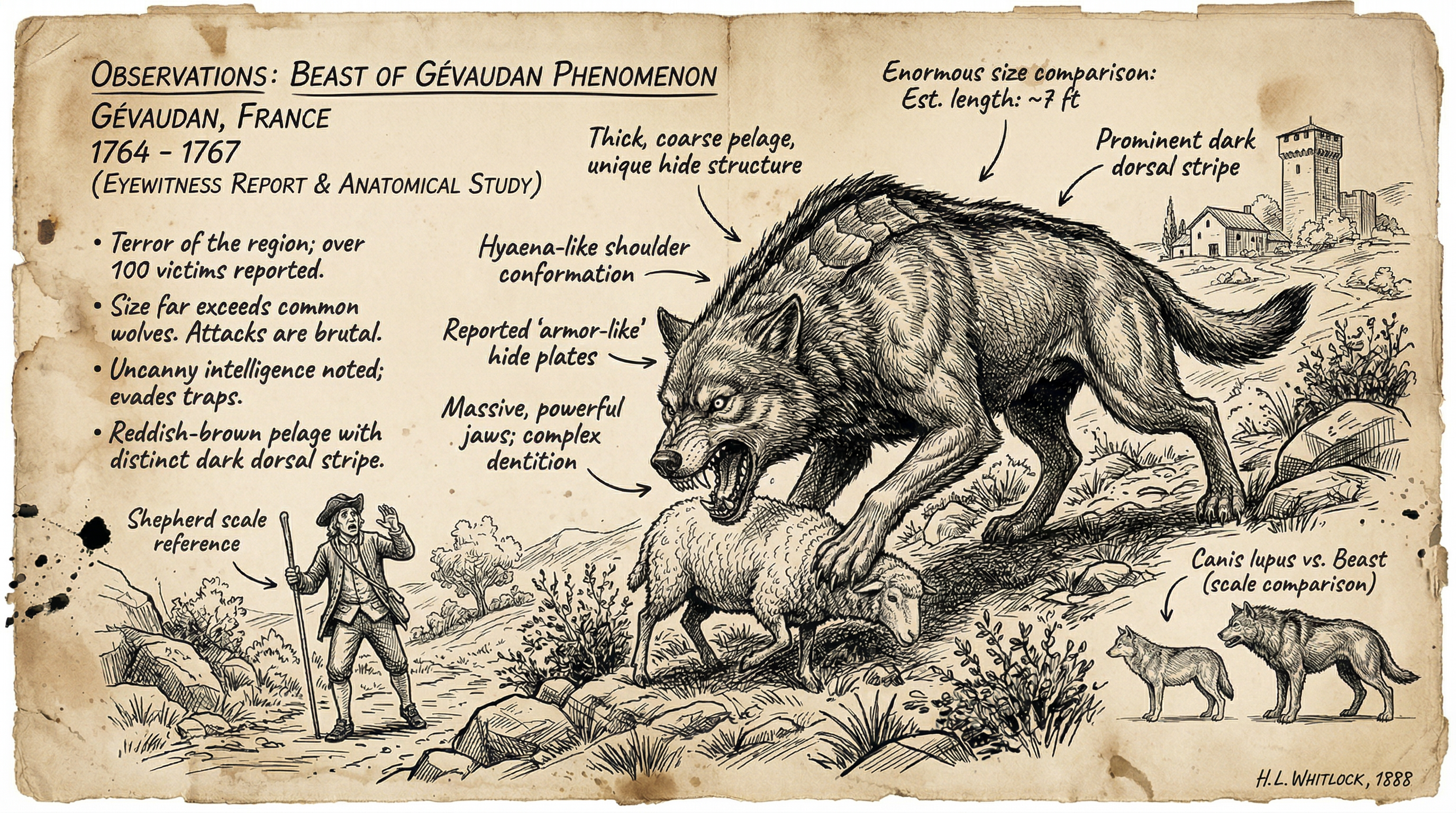
Overview
The Beast of Gévaudan manifests as a large canine predator that terrorized the rural highlands of southern France from 1764 to 1767, claiming over 100 lives and wounding nearly 300 more, with a marked preference for women and children. This entity operated across a vast territory encompassing the modern departments of Lozère, Cantal, and Haute-Loire, evading repeated military expeditions and royal hunts until its final dispatch by local hands.
Rooted in the pastoral landscapes of Gévaudan, the Beast drew from pre-existing regional iconographies, particularly the Tarasque tradition of Provence and Languedoc, where draconic and lupine monsters featured in ceremonial processions and popular narratives. Its emergence coincided with ecological pressures from wolf depredations, amplifying local anxieties into a phenomenon that reshaped perceptions of predation in eighteenth-century Europe.
Sighting History
June 30, 1764, Mercoire Forest near Langogne
A young woman tending cattle in the Mercoire Forest encounters a beast resembling a wolf but larger and distinct, advancing aggressively toward her. This marks the first recorded attack, initiating a pattern of predation on isolated shepherds and livestock tenders in the forested parishes of eastern Gévaudan.
August 11, 1764, Paulhac
Marie-Jeanne Vallet, a 20-year-old servant, and other peasant women cross a footbridge when the Beast emerges. Vallet wounds it with a pitchfork during a large hunt organized by local noble Antoine de Beauterne, an event that elevates her status as the "Maid of Gévaudan" in regional lore.
November 16, 1764, Parishes of Gévaudan
The Gazette publishes its initial account of a "cruel animal" roaming Gévaudan parishes. Concurrently, the Courrier d'Avignon sensationalizes the threat, likening the Beast to hyenas, lions, and giant serpents, as attacks intensify with victims' throats torn out and bodies partially consumed.
January 1765, Near Paulhac
Jacques Portefaix, a boy tending cattle with peers, confronts the Beast in a meadow. The children repel it collectively, drawing royal attention and embedding Portefaix's defiance into local ceremonial traditions across Languedoc.
September 20, 1765, Bois de Pommier
François Antoine, the king's gun-bearer, kills a massive wolf measuring the size of a young bull and parades its body to Versailles, claiming victory. Attacks resume within two months, with 30 to 35 further fatalities reported over the next 18 months.
February 17, 1766, Regional Forests
Captain Jean-Baptiste Duhamel arrives with dragoons and bloodhounds, organizing 30,000 volunteers into military formations. Poisoned baits and decoys dressed as peasant women fail to end the rampage, as mutilated bodies continue appearing at woodland edges.
June 19, 1767, Sogne d’Auvers
Local farmer and hunter Jean Chastel shoots a large canid during a pilgrimage hunt. The animal's remains, hastily prepared, arrive in Versailles decomposed and unexamined by naturalist Buffon. No further attacks occur in the region.
Circa 1764–1767, La Besseyre-Saint-Mary and Nozeyrolles
Dozens of additional incidents cluster here, including attacks on boys aged 6 and 12 on December 2, 1764, where the older child fends off the Beast. Spring 1767 sees renewed assaults near Desges, prompting increased local pilgrimages to Notre-Dame-des-Estours before Chastel's kill.
Evidence & Analysis
Contributed by Ellis Varma
The evidence profile for the Beast of Gévaudan stands out for its volume and contemporaneity, yet its quality fractures under scrutiny. Over 100 fatalities and nearly 300 injuries form a dataset unmatched in European predation records, corroborated by press accounts in the Gazette, Courrier d'Avignon, and international broadsheets from Paris to Copenhagen.
Visual documentation includes a German print from September 1764 rendering the entity as a quadrupedal kangaroo-like form attacking a man; a French engraving by M. Ray depicting a semi-erect reptilian lion; a Languedoc colored woodcut; and a Danish portrayal by Thomas Borup in an improbably cheerful style. These inconsistencies reflect regional iconographic variances rather than unified observation—statistically meaningless for taxonomic identification.
Official responses provide procedural data: Étienne Lafont's delegations, Duhamel's 30,000-man mobilization with poisoned baits and female decoys, François Antoine's September 20, 1765 kill (a large wolf sent to Versailles), and Jean Chastel's June 19, 1767 dispatch. No preserved specimens exist; Antoine's wolf underwent no forensic analysis, and Chastel's carcass decomposed en route, evading Buffon's examination.
Attack patterns show selectivity: throats torn, heads removed, blood drained, preference for women and children—deviating from standard wolf behavior, where males and livestock predominate. Over 2,000 wolves culled regionally, yet predation persisted, suggesting either multiple animals or an anomalous specimen. Modern wolf-pack hypotheses fail to explain the post-Antoine resurgence or behavioral anomalies without invoking coordinated agency.
The international media amplification—first in Avignon, then Paris, Germany, Denmark—created feedback loops, but core witness testimonies predate sensationalism. No biological traces, no pelts, no skeletal remains: the physical gap is total.
Evidence quality: MODERATE-HIGH. Exceptional documentary density and victim count outweigh the absence of specimens; behavioral outliers and failed culls elevate beyond prosaic dismissal.
Cultural Context
Contributed by Sienna Coe
The Beast of Gévaudan weaves into the fabric of southern French traditions, echoing the Tarasque—a draconic reptilian entity tamed by Sainte Marthe in Provençal lore, whose iconography permeated Languedoc processions from the fifteenth century. This shared Rhône corridor imagery shaped Gévaudan's visual depictions, from kangaroo-like forms in German prints to reptilian lions in French engravings, bridging ceremonial monsters with lived predation.
In the impoverished highlands of Gévaudan, pastoral life intertwined with wolf threats, transforming ecological peril into monstrous narrative. The Beast's preference for women and children mirrored vulnerabilities in rural society, while its decapitations and blood-drinking evoked deeper fears of consumption and erasure. Local responses—pilgrimages to Notre-Dame-de-Beaulieu and des-Estours—linked the entity to divine retribution, as priests framed it as God's judgment on peasant sin.
King Louis XV's interventions politicized the crisis, deploying hunters like Duhamel and Antoine amid post-Seven Years' War unpopularity. Bounties equivalent to a year's wages and 30,000 volunteers militarized the hunt, yet Chastel's local triumph underscored tensions between courtly spectacle and vernacular knowledge. The Church compounded terror, positioning villagers as doubly hunted—by fang and sermon.
As one of Europe's first global news phenomena, the Beast crossed borders via Avignon presses to Parisian gazettes and foreign broadsheets, spawning werewolf attributions and meneurs de loups—wolf whisperers commanding packs through occult means. This narrative persistence connects to broader European lycanthropic strands, from French loup-garou tales to Germanic wolf-men, where human-animal boundaries blur in times of disorder.
The Gévaudan events thus form a nexus: regional folklore amplifies real trauma, state power exploits rural dread, and media forges a transcontinental archetype. From Tarasque festivals to Chastel's silver-laced bullet in oral traditions, the Beast endures as a cultural fulcrum between wilderness peril and communal resilience.
Field Notes
Notes by RC
Tracked the Gévaudan sites twice. First in summer, high in the Lozère hills—Mercoire Forest feels like it hides things in the folds of the terrain. Steep ravines, thick underbrush, perfect for something big to vanish. Locals still point out the shepherd paths where it hit.
Winter pass through Sogne d’Auvers. Chastel's chapel stands, bullet-scarred relic they claim. Ground's got that heavy silence, wind carrying off through the pines. No wolves now, but the isolation presses. You get why 30,000 men couldn't corner it.
Portefaix meadow's just a field, but the stories stick because kids fought it bare-handed. Places like this don't forget. The air quality changes—thicker, watchful.
Threat Rating 4 stands. Documented kills in triple digits. Multiple "final" beasts shot, attacks resume. Doesn't fit wolves. Fits predator with intent.