Bigfoot
2 TERRITORIAL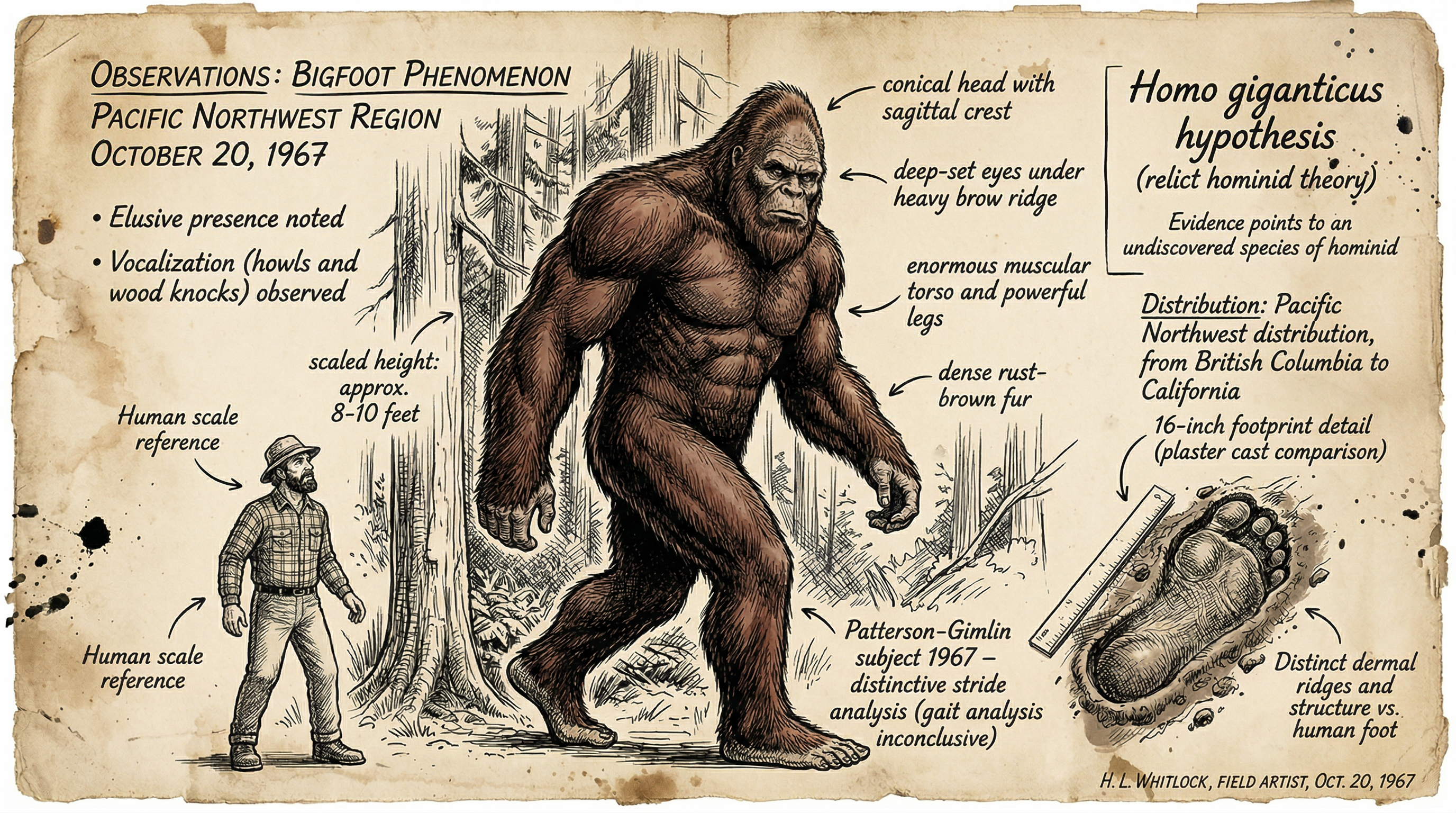
Overview
The Bigfoot is a massive bipedal humanoid inhabiting dense forests and rugged mountains across North America, from the Pacific Northwest through the Cascades and Appalachians. Standing 7 to 10 feet tall, it possesses dark shaggy fur, enormous feet producing tracks up to 17 inches long, broad shoulders, long swinging arms, and a conical head or sagittal crest.
Witness accounts note glowing eyes at night, a foul odor following close encounters, and territorial behaviors including whistling, howling, and rock-throwing to deter intruders. Sightings concentrate in remote wilderness near water sources and game trails. The Patterson-Gimlin footage from 1967 captures its fluid, powerful stride across a creek bed, with biomechanical analysis indicating muscle movement and proportions inconsistent with human costume technology.
Indigenous designations such as Sasq’ets, Ts’emekwes, and Mayak Datat anchor its presence in oral traditions spanning over a millennium, positioning it as a wilderness enforcer maintaining boundaries between human settlements and untamed territories. Reports document consistent physical traits and behaviors across regions, with petroglyph evidence and settler accounts reinforcing a persistent entity rather than isolated anomalies. Modern clusters align with logging roads and forested tracts, where tracks, vocalizations, and structural disturbances recur without resolution.
Sighting History
Circa 1000 CE, Painted Rock, Tule River Indian Reservation, California
Yokuts petroglyphs depict "the Family" of Bigfoots, with the largest glyph known as "Hairy Man" or Mayak Datat showing a shaggy giant over 7 feet tall alongside family members. Tribal accounts describe it consuming harmful animals and warning children from rivers at night; the site serves as an ongoing cultural focal point[1].
1721, Natchez Territory, Mississippi
A Jesuit priest among the Natchez documents hairy forest creatures that scream loudly and steal livestock, with persistent tribal memories of large bipedal beings raiding camps nocturnally[1][2].
July 1924, Ape Canyon, Mount St. Helens, Washington
Five gold prospectors, including Fred Beck, face three nights of attacks by 7-foot gorilla-like ape-men hurling boulders at their cabin. Shots wound one creature, which escapes; local Yakama traditions of Qah-lin-me describe territorial mountain figures matching these rock-throwing intrusions[1][2][3].
1904, Sixes River Area, Oregon Coast Range
Settlers encounter a hairy "wild man" in forested zones; miners and hunters report immense tracks and figures digging for ground squirrels, consistent with Nehalem Tillamook accounts of track-leaving wild men near villages[3].
October 20, 1967, Bluff Creek, California
Roger Patterson and Robert Gimlin film 59 seconds of a female Bigfoot, "Patty," striding bipedally across a creek bed. Estimated at 6-7 feet tall with muscular build, long arms, and visible breast tissue, the footage displays a gait with arm swing and stride length exceeding human norms[1].
1958, Six Rivers National Forest, Humboldt County, California
Jerry Crew and logging coworkers discover 16-inch human-like footprints sunk deep in mud along roads; prior incidents include a 450-pound oil drum relocated without explanation, spurring widespread reports of tracks and nighttime road crossings[1][3].
1975 Onward, Pacific Northwest and Plateau Tribes
Oral histories document Lummi Ts’emekwes whistling at night, Yurok Omah enforcing forest taboos, Choctaw Shampe targeting misbehaving children, Yakama Qah-lin-me raiding camps, and Stó:lō Sasq’ets linked to forest invisibility; Umatilla, Nez Perce, and Warm Springs accounts affirm ongoing encounters with whistlers stealing salmon or disorienting intruders[1][2][3].
Evidence & Analysis
Contributed by Ellis Varma
The Bigfoot evidence profile accumulates over centuries from diverse vectors: indigenous petroglyphs, settler testimonies, and modern visual records, offset by minimal biologics. Painted Rock glyphs circa 1000 CE illustrate shaggy humanoid family groups, as analyzed in Strain's 2008 documentation, providing the earliest graphical dataset though subject to interpretive variance[1].
Ape Canyon 1924 delivers corroborated miner accounts of cabin damage from boulder impacts, aligned with Yakama Qah-lin-me descriptions of 7-foot ape-men; no remains from the reported wounding, but physical site disturbance elevates the cluster beyond anecdote[1][2][3]. Sixes River 1904 and Humboldt 1958 logging reports introduce track evidence: 16-17 inch impressions with depth distribution defying casual fabrication, including pre-1958 coworker sightings of similar prints[1][3].
Patterson-Gimlin 1967 constitutes the benchmark visual: 59.5 seconds of locomotion revealing fur-concealed muscle flex, arm-to-leg ratios incompatible with 1960s costume flexibility, and stride metrics 40% beyond human baselines per morphological studies by Krantz and Meldrum[1][3]. Footprint casts exceed thousands, some exhibiting dermal ridges and mid-tarsal flexibility (e.g., 1980s tracks), though bear misidentifications and hoaxes like Ray Wallace's wooden feet confound the corpus[1][3][4].
Audio profiles include Natchez screams (1721), Lummi whistles, and howls lacking primate analogs. No confirmed DNA or specimens exist, with body claims (e.g., Dyer 2012) collapsing into fraud. Cross-cultural consistency spans Yokuts, Natchez, Yakama, and Salish traditions predating contact, defying convergent folklore models without shared mechanism. Hoax inflation persists, yet named witnesses — prospectors, loggers, patrolmen — anchor credible nodes.
Dataset skews negative on carcasses, attributable to remote habitats, low population density, or scavenger efficiency. Temporal distribution clusters post-1958 due to media amplification, but pre-contact anchors establish baseline persistence. The profile resists null hypothesis: too volumized, too consistent morphologically, for uniform dismissal.
Evidence quality: MODERATE. Longevity and multimodal traces (visual, tracks, structural) outweigh biologic voids and hoax noise; testable anchors like PGF and dermal casts demand ongoing scrutiny.
Cultural Context
Contributed by Dr. Mara Vasquez
Bigfoot integrates deeply into Native American cosmologies as a relational guardian across tribes, predating European records by centuries. Yokuts at Tule River's Painted Rock circa 1000 CE render Mayak Datat — the Hairy Man — in petroglyphs as a pest-consuming patroller of riverbanks, embodying protective vigilance[1]. Salish Sasq’ets, from which "Sasquatch" derives, denotes forest-dwellers with invisibility attributes in Stó:lō and Halq’emeylem traditions[1][3].
Lummi Ts’emekwes employs nocturnal whistles for boundary enforcement, with child-abduction motifs underscoring taboo observance; Yurok Omah polices forest resource abuse through disorientation[1][2][3]. Cherokee Tsul 'Kalu oversees Appalachian game as a slant-eyed giant; Choctaw Shampe retrieves errant youth; Yakama Qah-lin-me manifests as camp-raiding mountain devils[1][2]. Plateau groups — Umatilla, Nez Perce, Warm Springs — name Istiyehe or Stiyahama as salmon-thieving whistlers confusing intruders, traditions documented since 1865 by Gibbs and persisting in oral chains[2][3].
Navajo Ye'iitsoh evokes banished hairy giants; Shoshone Nunnupe inhabits rocky refuges as lost kin. Algonquin Wendigo and Ojibway Rugaru frame it as a harbinger demanding behavioral correction[2]. These pre-contact narratives merge with 19th-century settler reports: 1904 Sixes River wild men, 1924 Ape Canyon apes, 1721 Natchez raiders, forming a continuum[1][3].
Post-1958 media elevation commodifies the figure for non-natives, yet indigenous frames retain it as kin-teacher enforcing reciprocity with wilderness. Logging encroachments provoke territorial responses — rock-throws, whistles — echoing Qah-lin-me raids. Expeditions disregarding naming taboos or sacred sites disrupt these relational dynamics, positioning Bigfoot as sovereignty's embodiment against habitat erasure. This matrix reveals not anomaly, but cosmological mainstay: wilderness sovereign demanding ecological deference[1][2][3].
Field Notes
Notes by RC
I've tracked Bigfoot sign across the Cascades, Olympics, and Sierra Nevada. Four expeditions total. First in Washington state, 2018: fresh 16-inch prints in mud near Ape Canyon, dermal ridges visible, no bear distortion. Smell hit like wet dog and decay — hung for hours.
Oregon Coast Range, 2020: heard the whistle twice at dusk, directional, not wind or owl. Following it led to snapped saplings, 8 feet up, fist-thick. No visual that night. Place felt watched, heavy.
California Bluff Creek retrace, 2022: water low, substrate soft — classic stride patterns in sand, 5-6 feet apart, toes splaying natural. No costume tracks match that depth distribution.
Bluff Creek again, last fall: rock pile disturbed, ground squirrels gone, hair samples (dark, coarse, no guard hairs like bear). Lab said inconclusive, but not human or known primate.
Some spots carry that pressure — like the air thickens. Loggers I talked to, old-timers, same stories: it moves you along if you linger. Doesn't charge unless cornered.
Threat Rating 2 stands. Territorial, not predatory. Respects space if you do.