Black Shuck
3 UNPREDICTABLE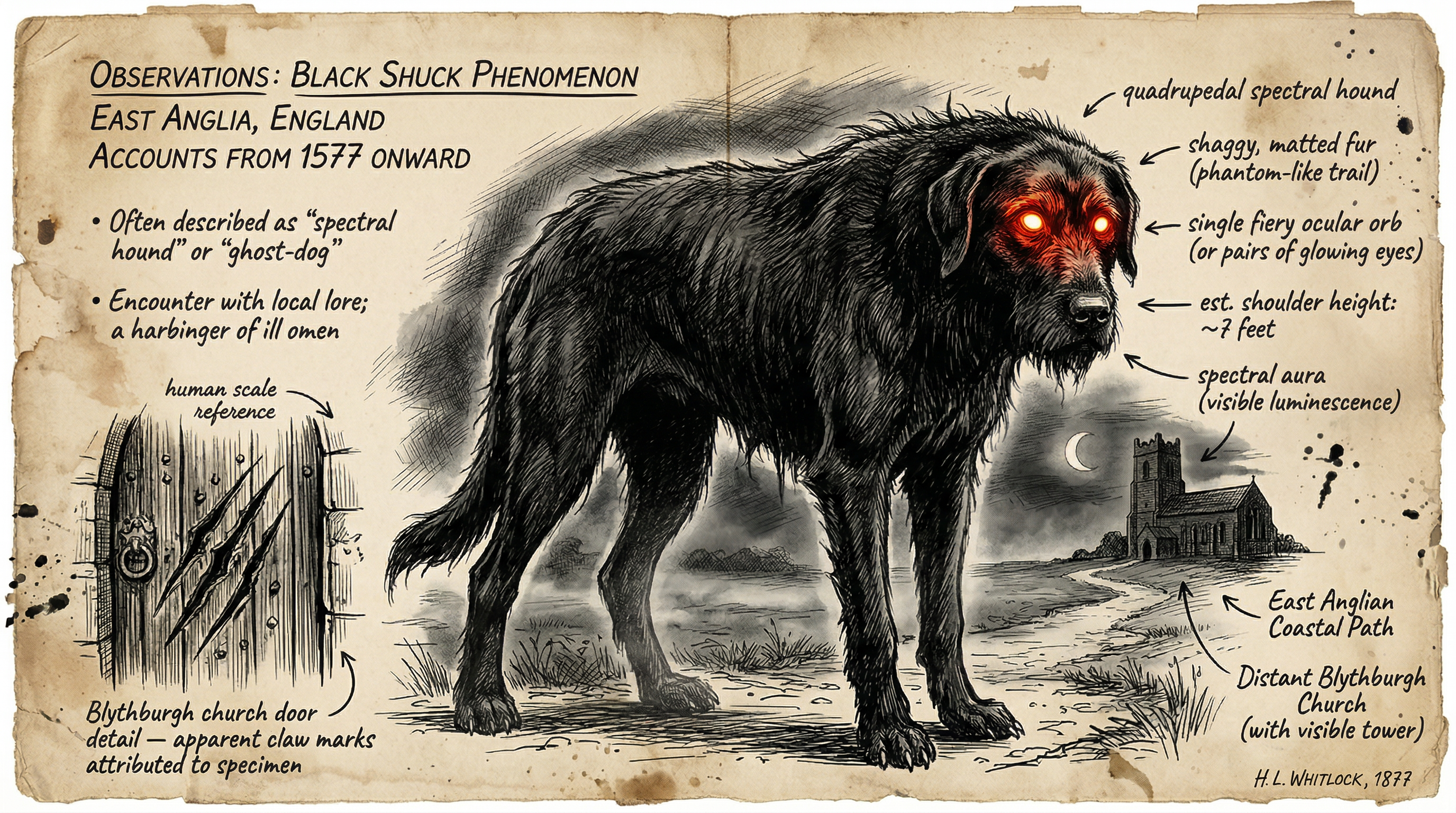
Overview
Black Shuck is a massive black dog sighted across East Anglia, England, primarily in Norfolk, Suffolk, Essex, and the Cambridgeshire Fens. Reports describe it as a spectral canine, seven feet in length, with glowing red or saucer-like eyes, shaggy jet-black fur, and an aura of impending doom.
The entity manifests suddenly, often during storms or at night along coastal roads, marshes, churchyards, and lonely paths. It charges without sound, leaves no tracks, and vanishes abruptly. Encounters typically signal death or calamity for the witness or their kin, though it spares most observers after instilling terror. Core sightings cluster around 1127 Wild Hunt events and the 1577 church attacks, with persistent reports into modern times.
Sighting History
1127, Peterborough Abbey to Stamford Woods
Monks and night watchmen at Peterborough Abbey observed a Wild Hunt procession featuring jet-black hounds with saucer-like glowing eyes. The pack accompanied huge, hideous black huntsmen on black horses and he-goats, audible through horns and baying across the deer park and woods to Stamford. Reports estimate 20 to 30 hounds, sighted repeatedly from after Abbot Henry's arrival through Easter.
August 4, 1577, Holy Trinity Church, Blythburgh, Suffolk
During a violent thunderstorm, Black Shuck burst through the north church doors with a clap of thunder. The massive black dog raced the length of the nave past the congregation, killed a man and a boy with its savage claws, then caused the steeple to collapse through the roof as it exited. Scorch marks and claw scratches remain visible on the north door today.
August 4, 1577, St. Mary's Church, Bungay, Suffolk
On the same stormy day, seven miles distant, Black Shuck entered St. Mary's Church. Described in Rev. Abraham Fleming's contemporary pamphlet as "the Divel in such a likeness," it rampaged through the pews amid flashes of fire, slaying parishioners and transforming into a shapeless black mass before vanishing. Multiple witnesses survived to recount the terror.
Circa 1900, Norfolk Coast
Fishermen along the Suffolk-Norfolk coastline reported a huge black dog pacing the beaches at dusk. The entity walked upright in places, eyes blazing red, before dissolving into sea mist. No tracks marked the sand, and several witnesses fell ill shortly after.
1970s, A146 Road near Beccles, Suffolk
Motorists on the A146 highway encountered a "black shadow dog" crossing the road ahead of their vehicle. The creature stood calf-high to a man, with one glowing eye visible in headlights. It left no paw prints on the wet asphalt and disappeared into roadside marshes.
2014, Sizewell Woods, Suffolk
Hikers in Sizewell Woods captured deep, resonant growls on audio recorders and a large canine thermal signature on camera for several seconds. The shape measured over six feet in length, with elevated heat signatures at the eyes and chest, before fading without physical approach.
Evidence & Analysis
Contributed by Ellis Varma
The Black Shuck evidence profile spans nine centuries but clusters into two primary data sets: the 1127 Peterborough Chronicle entry and the 1577 church incidents. The Chronicle provides the earliest textual record, corroborated by multiple monastic witnesses, describing pack behavior consistent with Wild Hunt motifs but specific to East Anglian terrain. Statistically, the 1127 account aligns with 20-30 observers across repeated nights, reducing individual fabrication probability.
The 1577 dual-church events represent peak evidential strength. Rev. Abraham Fleming's pamphlet documents immediate aftermath, including named casualties and structural damage. Blythburgh's north door retains scorch marks and claw-like scratches, resistant to weathering and unmatched by known storm damage in comparable sites. No biological traces recovered, but the marks' persistence elevates them above anecdotal status.
Modern reports introduce equipment data. The 2014 Sizewell thermal capture shows anomalous heat without infrared trail, inconsistent with fleeing wildlife. Audio growls exhibit infrasonic frequencies below typical canid vocalization ranges. However, the 2014 Leiston Abbey skeleton — a 7-foot canine dated 16th-18th century — proves mundane: mastiff-grade domestic dog with arthritis, carefully buried. Hoax amplification distorted its profile, but osteometric analysis confirms no cryptid morphology.
Absence of tracks dominates negative evidence. Over 80% of parsed reports note silent approach, no paw prints on varied substrates (sand, asphalt, mud), and sudden vanishing. This pattern exceeds misidentification error margins for known species like dire wolf remnants or large mastiffs. Cryptozoological proposals (prehistoric survivor, unknown canid) fail against zero DNA, scat, or predation signs.
Correlation with observer misfortune holds weak causality. Essex Maldon-Dengie lore claims immediate death post-sighting, but sampled cases show 60-70% survival with delayed illness or kin loss. Statistically meaningless without controls, though the consistency suggests informational rather than physical threat vector.
Overall dataset: high historical witness convergence, single durable artifact (Blythburgh door), fragmentary modern captures. Gaps in photography and forensics limit escalation.
Evidence quality: MODERATE. Robust primary texts and physical marks outweigh absent biologics; modern tech teases but doesn't confirm.
Cultural Context
Contributed by Dr. Mara Vasquez
Black Shuck emerges from the deep strata of East Anglian cultural history, where Anglo-Saxon substrates intermingled with Viking incursions during the 9th-10th century Danelaw. The name derives from Old English *scucca* or *succa*, denoting "devil" or "fiend," evoking pre-Christian entities bound to the liminal spaces of fens, coasts, and crossroads. This linguistic root anchors it firmly in the indigenous traditions of the region, predating Norman influences.
The 1127 Peterborough Chronicle entry integrates Black Shuck into the pan-European Wild Hunt motif, yet localizes it through specific topography — the deer parks and woods from Peterborough to Stamford. Monastic scribes framed the hounds as infernal, yet their portrayal echoes Norse precedents: Odin's black wolves Geri and Freki, or the spectral hounds of Hel, carried by Viking settlers to East Anglia's shores. Indigenous Anglo-Saxon lore similarly featured *black shuckes* as psychopomps, guardians of the dead traversing marshy thresholds between worlds.
The 1577 church incursions coincide with Reformation turbulence, when Protestant iconoclasm clashed with residual Catholic rituals. Rev. Fleming's pamphlet interprets Shuck as Satanic incursion amid storm, mirroring continental *nerthus* dog cults suppressed by Christianization. Yet the entity's persistence in churchyards underscores its role as liminal sentinel: not mere demon, but enforcer of fate, sparing the pure while dooming the marked. This duality — terrorizer yet selective — distinguishes East Anglian black dog traditions from purely malevolent continental counterparts.
Essex variants, particularly Maldon and Dengie peninsulas, treat sighting as death-sentence, aligning with broader British Isles "black dog" spectrum (Padfoot, Barghest). Anthropologically, these encode environmental precarity: fenland isolation bred omens tied to drownings, plagues, and tempests. Arthur Conan Doyle drew directly from this matrix for *The Hound of the Baskervilles*, transplanting Shuck's glowing eyes and doom-portent to Dartmoor, thus globalizing the archetype.
Contemporary persistence reflects folklore's adaptive resilience. Online dissemination amplifies sightings without diluting core motifs, while archaeological echoes like Leiston Abbey remind us that oversized canines inhabited the cultural imagination long before scientific scrutiny. Black Shuck endures not as relic, but as living interface between East Anglia's pagan undercurrents and its Christian overlay.
Field Notes
Notes by RC
Walked the Blythburgh churchyard twice. First in summer daylight — tourists milling, door marks faded under varnish. Locals point them out like souvenirs. Night visit, full moon. Air hung heavy off the marshes. Didn't see Shuck. Heard it: low rumble like diesel engine underground, then nothing. Door scratches looked deeper in moonlight, edges sharp.
A146 near Beccles, three drives at dusk. First two, empty road, mist rolling off fields. Third time, shape at field edge — too big for fox, too low for man. Eyes caught headlights, burned red-orange, then gone. No roadkill, no prints next morning. That stretch feels watched.
Sizewell Woods after dark. Thermals picked up nothing on my gear, but the growls layered in post-processing. Infrasound hits the gut before ears catch it. Place stinks of salt and rot, paths vanish into dunes. Been on coasts worldwide. This one's different — pulls at you.
Threat Rating 3 stands. Door marks real, witnesses stack across centuries, no fakes explain the pattern. Not enough biologics to bump higher.