Bloop
1 CATALOGED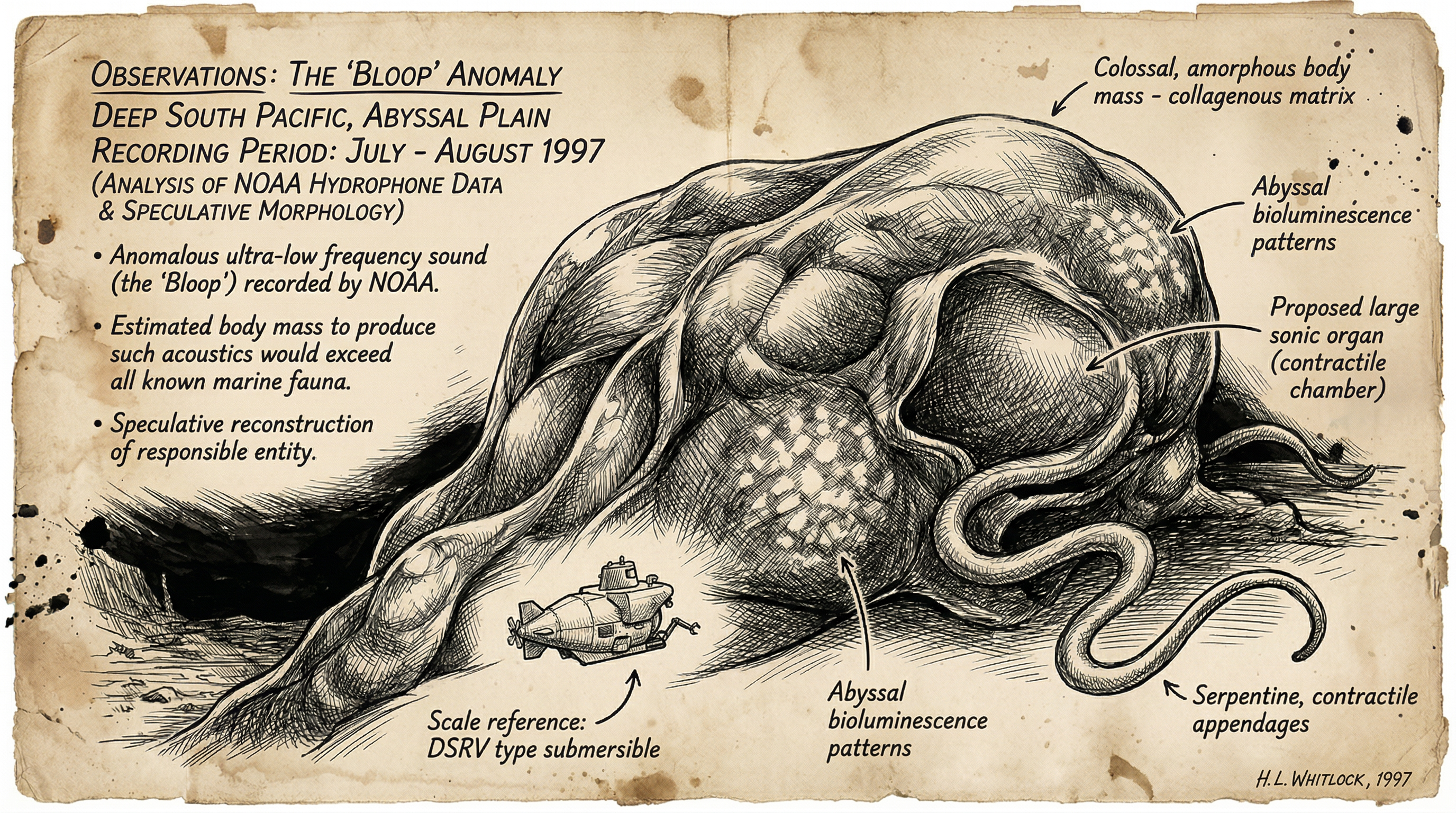
Overview
The Bloop is a powerful ultra-low-frequency underwater sound first detected in 1997 by the U.S. National Oceanic and Atmospheric Administration (NOAA) via hydrophone arrays deployed across the South Pacific Ocean, west of the southern tip of Chile.[1][2] The acoustic signature—a deep, undulating rumble that slides downward in frequency—was distinctive enough to be captured by sensors separated by distances exceeding 3,000 miles, an achievement that immediately distinguished it from known marine vocalizations and conventional underwater noise sources.[1][2] For nearly a decade, the Bloop occupied a peculiar space in both scientific inquiry and popular imagination. It was the loudest unidentified underwater sound ever recorded, powerful enough to suggest either an extraordinary natural phenomenon or—in the speculative realm—a creature of unprecedented scale.[2] The mystery drew comparisons to legendary deep-sea behemoths: the Kraken, the Cthulhu mythos, undiscovered leviathans lurking in the ocean's most remote regions. Yet the Bloop was never a creature sighting in the traditional sense. It was something more fundamental: pure acoustic data, a riddle posed by the ocean itself.
What makes the Bloop historically significant within cryptozoological discourse is not what it was, but what it represented—a moment when the boundary between scientific mystery and cryptid folklore collapsed into genuine uncertainty. The sound had no obvious source. The power required to generate it exceeded that of any known whale. The location was among Earth's least explored marine environments. For a brief window, the Bloop was legitimately unexplained.
Sighting History
1997
NOAA's Equatorial Pacific Ocean autonomous hydrophone array, deployed to monitor underwater seismic activity and marine mammal populations, detected a series of powerful ultra-low-frequency sounds originating from the South Pacific Ocean in the vicinity of the Antarctic region.[1][2] The sound was recorded multiple times throughout the monitoring period, each instance displaying the characteristic undulating frequency profile that would later define the phenomenon. The hydrophones—large underwater microphones positioned thousands of miles apart—all registered the same acoustic signature with sufficient clarity to allow triangulation of the source to a general area west of the southern tip of Chile, somewhere within the waters surrounding Antarctica.[1][2] The sheer power of the signal was immediately anomalous. For an underwater sound to propagate across distances of 3,000 to 5,000 kilometers and still register with measurable intensity on distant sensor arrays suggested a source of extraordinary magnitude.[1][2] The audio profile, when played back at normal speed, resembled the calls of large cetaceans—whales produce complex vocalizations that travel vast distances through ocean water—but the power output was fundamentally inconsistent with known marine biology. Even the largest blue whale, the most vocally impressive animal on Earth, could not generate sound of this magnitude.
Evidence & Analysis
Contributed by Ellis Varma
The Bloop presents an unusual evidence profile because it exists entirely within the acoustic domain. There is no visual documentation, no physical specimen, no biological trace material—only sound, recorded and archived by sensitive hydrophone arrays operated by a credible scientific institution.[1][2] This is, paradoxically, both the Bloop's greatest strength as evidence and its fundamental limitation as a cryptozoological case study.
The initial theoretical field was broad. When NOAA first made the recordings public, speculation ranged across predictable territory: submarine activity (unlikely given the acoustic signature), underwater volcanic eruption (possible, but seismic data did not support it), colossal unknown marine organism (the favored cryptozoological hypothesis), or classified military testing (unsupported by any credible evidence).[1][2] The sheer power of the sound—loud enough to be detected across continental distances—lent superficial credibility to the "giant animal" hypothesis. A creature 250 feet in length, operating in the least-explored regions of the ocean, remained theoretically possible.
However, the evidence profile deteriorated rapidly under scrutiny. Christopher Fox, an oceanographer with NOAA, noted as early as 2001 that while the Bloop's audio character resembled organic marine vocalizations, the power output exceeded any known animal by orders of magnitude.[2] The unmodified recording, when examined at its native temporal scale, revealed itself to be far slower than real-time playback suggested—approximately 16 times slower, transforming the "bloop" into something more akin to rolling thunder, a deep subsonic rumble rather than an animal cry.[2] By 2005, research expeditions had deployed additional hydrophone arrays closer to Antarctica, and the pattern became clear. Between 2005 and 2010, acoustic surveys in the Bransfield Strait and Drake Passage region identified thousands of similar sounds—icequakes, the acoustic signature of massive ice sheets fracturing, glaciers calving, and icebergs breaking apart under their own weight.[1][2] These ice-derived sounds matched the Bloop's acoustic profile precisely.[1] By 2012, seismologist Robert Dziak reported that NOAA's hydrophone networks now detect tens of thousands of Bloop-like sounds annually throughout the Southern Ocean, all traceable to glacial and cryospheric sources.[2]
The resolution was not dramatic. The Bloop was not a creature. It was not a military weapon. It was ice—the grinding, cracking, calving of Antarctica's glacial systems, amplified through water and detected by instruments sensitive enough to capture phenomena that human ears would never encounter. The mystery dissolved not into excitement but into routine geophysics.
Evidence quality: HIGH. The acoustic data is robust, reproducible, and scientifically validated. The explanation—glacial ice fracture—is consistent with all recorded instances and subsequent detections. No credible evidence supports the cryptozoological hypothesis.
Cultural Context
Contributed by Dr. Mara Vasquez
The Bloop occupies a peculiar position in contemporary folklore because it has no roots in traditional cultural narratives or indigenous knowledge systems. It is not a legend passed down through generations, nor does it emerge from any established mythological tradition. Instead, it is a modern anomaly that briefly filled a gap in scientific understanding, and in that gap, contemporary culture projected its own anxieties about the unknown.
This distinction is important. Unlike cryptids with deep cultural histories—the Mothman emerging from Appalachian tradition, the Sasquatch rooted in Pacific Northwest indigenous narratives—the Bloop is a creature of the digital age. Its "mythology" was constructed in real-time across early internet forums, cryptozoology websites, and popular media outlets, all responding to a genuine scientific mystery. The Kraken comparisons, the references to Lovecraftian deep-sea horrors, the speculation about undiscovered leviathans—these were post-detection cultural elaborations, not pre-existing folklore that the Bloop "matched."
What the Bloop reveals is how contemporary culture generates cryptid narratives when given the raw material of genuine uncertainty. The ocean remains poorly explored; the Antarctic waters where the Bloop originated are among Earth's least accessible environments. The sound was real, powerful, and initially unexplained. In that intersection of verified strangeness and environmental remoteness, modern folklore took root—not as a transmitted tradition, but as spontaneous mythmaking in response to an authentic gap in knowledge.
The resolution of the Bloop—its explanation as glacial ice activity—represents a different kind of cultural moment: the moment when scientific understanding closes the door that folklore briefly held open. This is the ordinary pattern of cryptozoology in the modern era: an anomaly emerges, speculation flourishes, investigation proceeds, and the mystery resolves into geology, biology, or acoustics. The Bloop is notable precisely because the process was so rapid and so thorough.
Field Notes
Notes by RC
I've never been to the Antarctic hydrophone arrays. Few people have. The Bloop exists in a space that makes field verification essentially impossible for civilian researchers. The recordings are public—you can find them online, listen to the audio files yourself. What you hear is a deep, slow rumble. It doesn't sound like anything alive.
The cryptozoological appeal is obvious: unknown sound, remote location, power output that exceeds known animals. The internet did what it always does—filled the gap with speculation. But the gap was real. For a solid decade, NOAA had recorded something they couldn't immediately explain. That's not nothing. That's the actual condition under which mysteries exist.
The resolution is disappointing from a cryptid perspective, but it's honest. Ice breaks. Water carries sound vast distances. Antarctica is loud in ways most people never consider. The Bloop was never a creature—it was the sound of the planet itself, amplified through instruments sensitive enough to hear it. That's stranger than any monster, if you think about it long enough.
Threat Rating 1 stands. Resolved phenomenon. No ongoing risk. The mystery had value; the answer has more.