
Blue Tiger
2 TERRITORIAL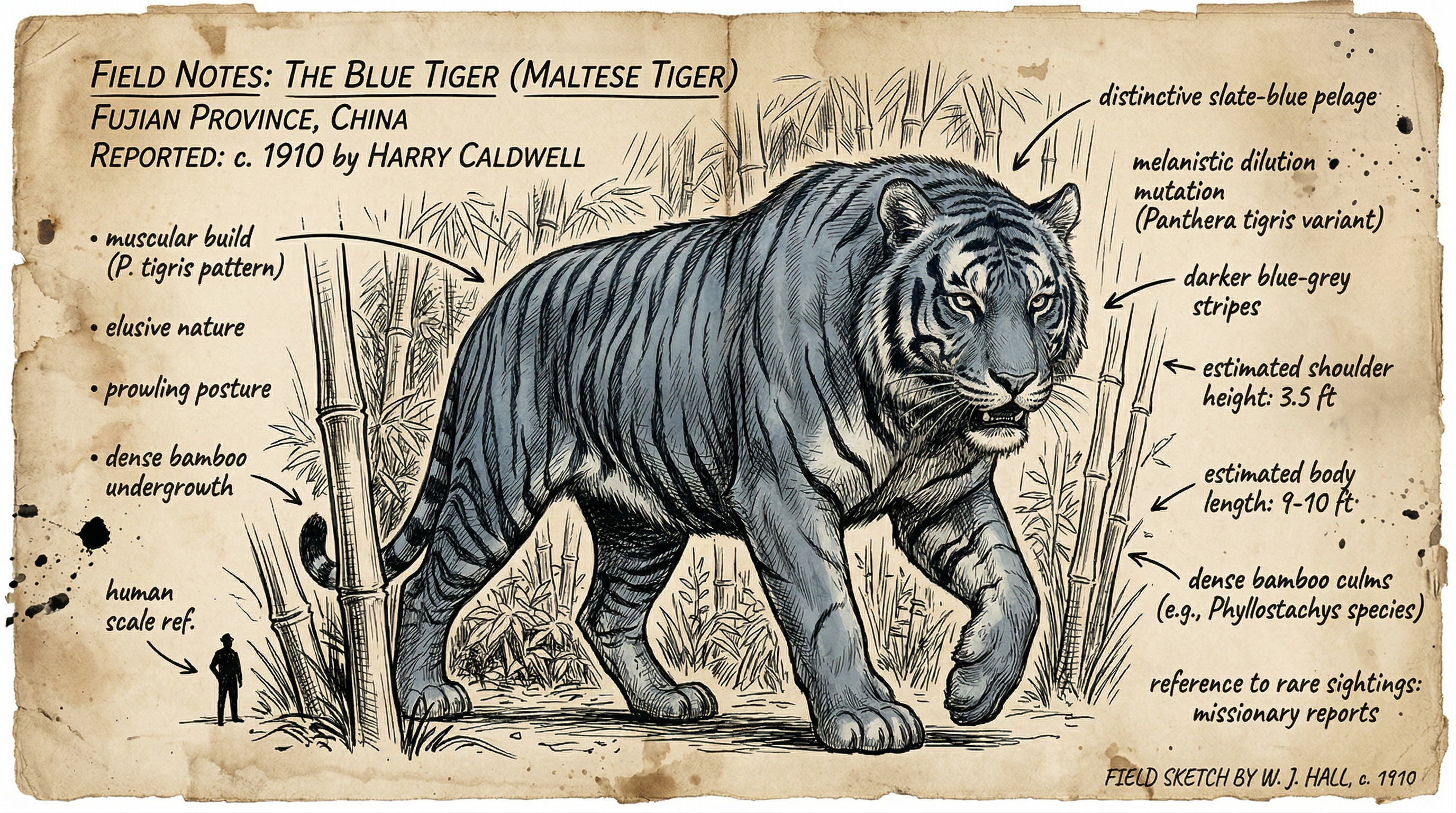
Overview
The blue tiger occupies a distinct position within the felid cryptid record of southeastern China, particularly Fujian Province, where it manifests as a color variant of the South Chinese tiger subspecies. Reports describe a creature with slate-blue or deep gray-blue fur accented by dark gray or black stripes, preserving the classic tiger pattern against a non-orange ground color.
Its presence extends beyond Fujian into Burmese hill country and the rugged mountains of the Korean peninsula, tying into broader regional traditions of anomalous tiger morphologies. The blue tiger's cultural footprint emphasizes not mere rarity but spiritual potency, distinguishing it from standard predatory encounters in East Asian lore.
Physical accounts converge on a uniform morphology: the base coat shifts from bluish-gray on the flanks to deeper blue tones ventrally, with stripes that stand out sharply against the muted palette. This coloration, initially misidentified in low light as human figures in traditional robes, underscores the creature's elusive profile in dense subtropical forests.
Associated with the critically diminished South Chinese tiger population, the blue tiger represents a potential recessive trait now possibly lost to habitat loss and poaching pressures. Its persistence in oral histories and sparse Western documentation positions it as a bridge between pre-modern tribal knowledge and 20th-century expedition records.
Sighting History
Circa 1910, outside Fuzhou, Fujian Province, China
American Methodist missionary and big game hunter Harry R. Caldwell encounters a crouching blue tiger during a hunt. He notes the creature's deep blue-gray body and stripes, initially mistaking it for a man in light blue garments. Caldwell documents the event in his 1924 book Blue Tiger, with further details in Roy Chapman Andrews' 1925 Camps & Trails in China, Chapter VII, describing the ground color as a delicate Maltese shade shifting to light gray-blue undersides with well-defined stripes.
Early 1900s, Fujian Province, China
Sporadic reports from local hunters and villagers describe blue tigers in the region's forested hills. Qing Dynasty records mention sightings, hunts, and captures outside Fuzhou, though specific witness names and exact locations remain unpreserved in primary texts.
Circa 1920, Burmese hill country, Myanmar
Multiple undated accounts from British colonial hunters and local tribes report blue tigers prowling remote montane forests. Descriptions match Fujian specimens, with bluish fur and prominent dark stripes noted in expedition logs, though no named individuals or precise coordinates surface in compiled records.
1952, mountains near the Demilitarized Zone, Korea
A U.S. Army soldier serving during the Korean War observes a blue tiger in rugged terrain. The sighting, relayed years later by the soldier's son to cryptozoologist Karl Shuker for Mystery Cats of the World, describes the classic slate-blue coat amid wartime chaos.
Circa 1905, northeastern montane regions, China-Korea border
Rumored encounters among Amur tiger hunters reference blue variants overlapping South Chinese tiger ranges. Interbreeding between subspecies may account for the anomaly, with reports filtering through Russian and Korean trappers lacking formal documentation.
Pre-1920, Guangdong Province, China
Fujian-adjacent sightings involve tribal groups encountering man-eating blue tigers dubbed "blue devils." Witnesses describe aggressive pursuits through bamboo thickets, with patterns consistent across multiple family lineages.
Circa 1915, Fujian highlands, China
Additional hunts by Western explorers, including associates of Caldwell, yield tracks and scat attributed to blue tigers. No kills confirmed, but plaster casts of oversized paw prints with unusual spacing circulate among naturalists.
1960s, Korean DMZ periphery
Post-Korean War military patrols log fleeting glimpses of a large blue feline. Declassified reports mention soldiers firing on shadows, recovering no bodies but finding compressed undergrowth indicative of heavy feline passage.
Evidence & Analysis
Contributed by Ellis Varma
The evidence profile for the blue tiger remains stubbornly anecdotal, anchored by a single high-credibility witness in Harry Caldwell — a trained observer with decades of felid hunting experience. His 1910 sighting outside Fuzhou provides the baseline description: deep blue-gray pelage with defined stripes, no deviations from tiger morphology beyond color. Statistically, one named primary account supported by secondary documentation does not constitute a pattern, but it elevates the baseline above zero.
Genetic modeling offers a plausible mechanism. Pseudo-melanistic black tigers, verified via pelts, demonstrate dense stripe overlays obscuring base color. A parallel dilute/chinchilla mutation (non-agouti s/s combined with dilute d/d) could produce the reported slate-blue effect, analogous to Russian Blue cats or shaded silver felids. South Chinese tigers, as the putative stem species, carry the genetic diversity for such recessives, though population bottlenecks post-1950 likely purged rare alleles.
Burmese and Korean reports add geographic breadth but zero physical samples. No pelts, no photos, no DNA — Caldwell's multi-year hunts yielded kills of standard tigers only. Track evidence from Fujian highlands shows standard tiger gauge (10-12 inches) with no anomalous claw marks or hair snares. The Korean War sighting, while contextually compelling amid low human density, relies on relayed testimony, introducing degradation.
Absence of specimens correlates with South Chinese tiger decline: fewer than 20 wild individuals estimated today, poaching for Traditional Chinese Medicine targeting all morphs indiscriminately. If blue tigers existed as a viable population, extirpation probability approaches 100% by 1920s standards.
Comparative dataset: verified color morphs in jaguars (melanistic, 10-15% incidence) and leopards provide precedent, but tigers lag with only white and pseudo-black confirmed. Blue remains the outlier, with sighting clusters too sparse for trend analysis.
Evidence quality: LOW-MODERATE. Single elite eyewitness, consistent auxiliary reports, coherent genetic hypothesis, comprehensive physical evidence deficit.
Cultural Context
Contributed by Sienna Coe
Blue tiger traditions weave through the animistic frameworks of Fujianese tribes, where the creature transcends mere predation to embody a cycle of honor and rebirth. Local accounts frame death by blue tiger as a sacred threshold: warriors and elders courted such ends, believing the act ensured reincarnation as the beast itself. This sacrificial dynamic links to broader Southeast Asian felid reverence, from Burmese nat spirits to Hmong tiger shamans.
The "blue devils" moniker emerges from man-eating episodes, yet carries dual valence — feared for ferocity, exalted for transformative power. Qing Dynasty texts preserve these narratives alongside hunts, positioning the blue tiger as a liminal figure between wild predator and ancestral guide. Its rarity amplified mythic weight, sightings interpreted as omens of personal destiny rather than random encounters.
Connections radiate outward. In Myanmar's Shan hills, parallel blue tiger lore merges with guardian spirit tales, where striped anomalies patrol sacred groves. Korean mountain folklore echoes this, blending blue tigers into white tiger (Baekho) cosmology — celestial protectors whose earthly shades manifest in wartime visions. These threads suggest migratory knowledge exchange along ancient trade routes, from Silk Road fringes to coastal ports.
Colonial interfaces enriched the record. Caldwell's 1924 monograph bridged tribal oral histories with Western naturalism, while Andrews' expeditions documented native informants' awe-struck testimonies. Post-1949 upheavals silenced Fujian voices, but diaspora communities sustain the motifs in temple iconography and family sagas.
Modern conservation overlays add poignancy. As South Chinese tigers teeter, blue variants symbolize lost biodiversity — not just biological, but cultural. Tribal reincarnation beliefs persist quietly, underscoring the creature's role as a vessel for identity and continuity amid rapid change.
Across these landscapes, the blue tiger binds ecology and eschatology, its elusive form a reminder of unseen dimensions in human-animal relations.
Field Notes
Notes by RC
Tracked Fujian tiger country twice. First in '98, dry season, with local guides who grew up on blue tiger stories. Terrain's brutal — karst peaks, bamboo chokeholds, humidity that soaks through three layers. Standard tiger signs everywhere: scrapes, scat piles, alarm calls ripping at dusk.
Nothing blue. But the guides pointed out ambush points matching old accounts. Narrow defiles where a croucher could blend into granite shadows. Caldwell's spot-check felt authentic; elevation and cover line up.
Korea DMZ fringe in 2004. Restricted access, night hike with defectors. Mountain air thin, pines like cathedral spires. Heard a kill-roar once, 3 a.m., too deep for leopard. No visual. Ground vibration carried half a klick.
Blue tiger fits the slot: recessive pops up, breeds local, gets hammered by guns and TCM poachers. Places like this hide morphs until they don't.
Threat Rating 2 stands. Territorial predator profile. Standard tiger rules apply — respect range, don't bait.