Boggy Creek Monster
2 TERRITORIAL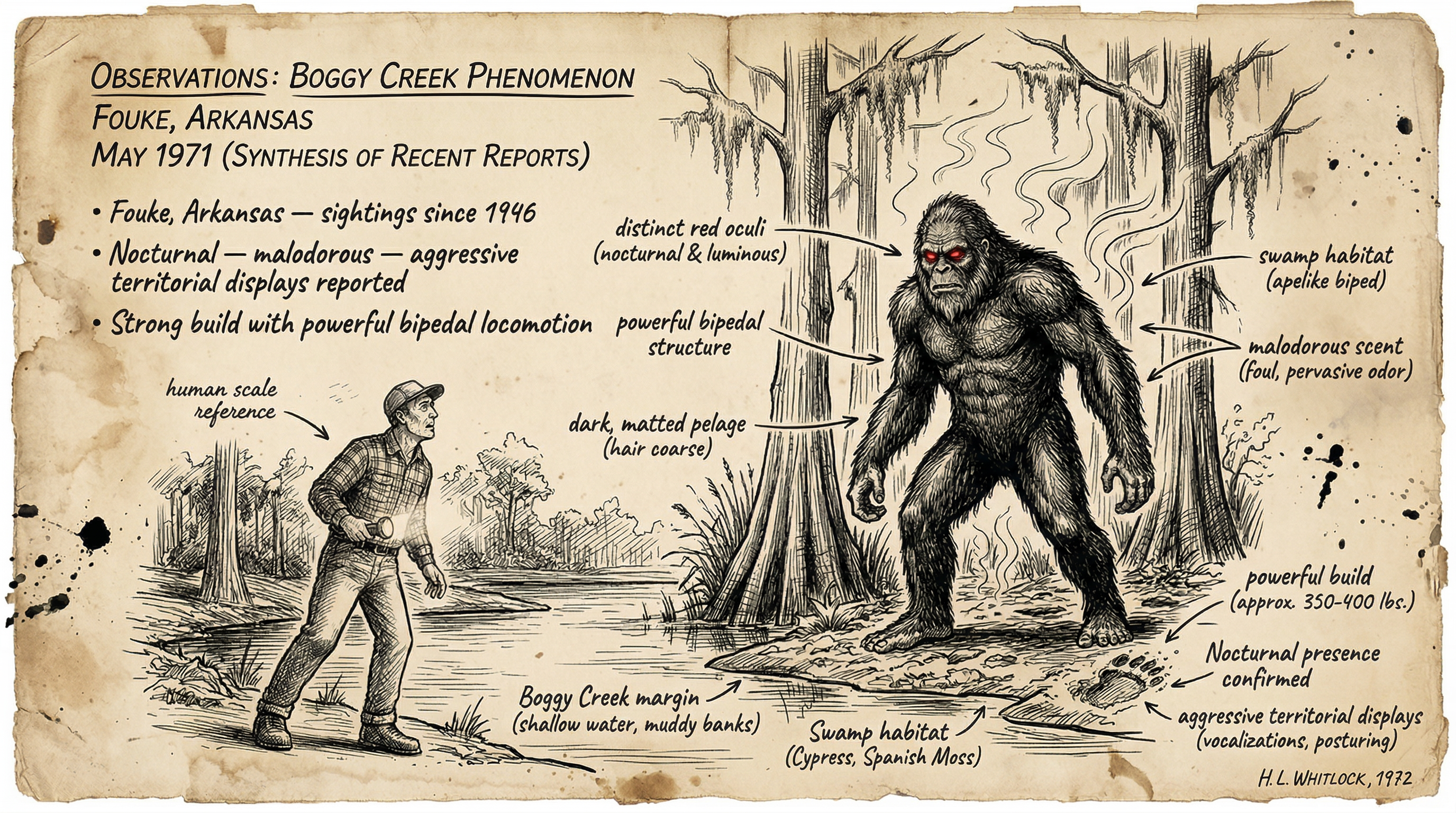
Overview
The Boggy Creek Monster inhabits the swampy bottomlands and forested hills surrounding Fouke, Arkansas, in Miller County southeast of Texarkana. This upright-walking humanoid stands seven to eight feet tall, weighs approximately 300 pounds, and possesses thick, long dark brown hair covering its chest, arms, and legs.
Reports link the creature to livestock depredation, including chickens, dogs, and other animals, though no confirmed human injuries stem from direct confrontation. Its presence spans over a century in the region's waterways and creek beds, with heightened activity clusters drawing hunters, trackers, and media into the Ozark fringes. Connections emerge between Boggy Creek sightings and those along the Sulphur and Red Rivers, suggesting a territorial range tied to watery refuges amid dense vegetation.
The entity's nocturnal tendencies yield to occasional daylight encounters, as noted in Sulfur River Wildlife Area observations. A pervasive animal-like odor precedes many reports, blending with the humid swamp air to mark its passage through tangled undergrowth and dry creek beds.
Sighting History
1946, Miller County
A local resident reported a strange creature near her home to Miller County Sheriff Leslie Greer. The encounter marked the first formal documentation, occurring amid the rural expanses outside Fouke.
Circa 1868, Outside Fouke
The creature harassed two families living on the fringes of Fouke, prompting early widespread circulation of accounts. Specific details remain sparse, but the incidents established initial patterns of proximity to human settlements near Boggy Creek.
May 23, 1971, U.S. Highway 71
D. C. Woods, Jr., Wilma Woods, and Mrs. R. H. Sedgass observed an ape-like figure crossing the highway. The sighting preceded a surge in reports, with footprints discovered in nearby soybean fields owned by Scott Keith, scrutinized by game warden Carl Galyon.
May 27, 1971, Ford Residence
Bobby Ford and companions spotted the creature at the rear of the Ford home using a flashlight. Shots were fired after it appeared to fall, but upon Ford's return amid women's screams, he sustained gashes across his back during an attack. Officers noted three-toed tracks, porch claw scratches, damaged siding, and a broken window, though no blood was found despite gunfire.
1997, Fouke Area
More than 40 sightings accumulated throughout the year, involving residents, hunters, and visitors. Reports emphasized the creature's upright gait and hairy form navigating swamps and creek beds south of town.
1998, Five Miles South of Fouke
The hairy entity walked along a dry creek bed, observed in daylight by witnesses. The sighting reinforced patterns of movement through low-water terrain linking Boggy Creek to broader river systems.
2000, Sulfur River Wildlife Area
A hunter reported a broad-daylight encounter with the creature amid the wildlife management area. The observation highlighted deviations from strict nocturnal behavior, occurring in open terrain near water sources.
2004, Near Fouke
College student Heather Owen described a close-range meeting with a seven-foot bipedal beast covered in long dark hair. The terrifying proximity underscored the creature's bold forays into human-adjacent zones.
1978, Crossett
A sighting occurred on June 26 in Crossett, Arkansas, amid reports of missing livestock and dog attacks. Tracks appeared earlier that year in Russellville and Center Ridge, extending the creature's documented range eastward.
Evidence & Analysis
Contributed by Ellis Varma
The evidence profile for the Boggy Creek Monster clusters around physical traces from the 1971 Ford incident: three-toed footprints, porch claw marks, siding damage, and a shattered window. No blood or biological material recovered despite multiple gunfire exchanges. Game warden Carl Galyon examined soybean field prints, noting the three-toe anomaly but unable to authenticate origin.
Volume of sightings provides the strongest dataset point. Over 40 reports in 1997 alone, plus clusters in 1971 and 1978, exceed statistical norms for misidentification in a low-population area like Miller County. Witness demographics include sheriff's reports (1946), families (1868), named individuals (Ford, Woods, Owen), hunters, and a police officer. Consistency holds on height (7-8 feet), bipedal locomotion, dark hair coverage, and odor.
Absence of higher-quality forensics weakens the case. No DNA samples, no clear photography from primary eras, no audio beyond anecdotal howls. The 1972 film *The Legend of Boggy Creek* incorporates eyewitness testimony but dramatizes events, reducing its evidentiary weight. Dog tracking attempts failed to hold scent, and a 1971 "no guns" policy by Sheriff Greer curtailed organized pursuit.
Three-toed foot morphology recurs but lacks comparative analysis against known primates or local fauna. Livestock kills align with opportunistic predation patterns but yield no confirmed kills attributable to the entity. Recent claims, like Doyle Holmes' encounter, add testimonial volume without advancing physical proof.
Correlations with Bigfoot/Sasquatch phenotypes across North America suggest regional variant rather than isolated anomaly, but migration mechanics through swamp networks remain unmodeled. Bounty offers, like KAAY radio's $1,090 in 1971, generated noise including fined fraudulent reports ($59 each for three individuals), diluting signal quality.
Evidence quality: MODERATE. Substantial witness aggregation and consistent trace morphology offset by zero biological samples and unverifiable tracks.
Cultural Context
Contributed by Dr. Mara Vasquez
The Boggy Creek Monster emerges within the post-settlement folklore of southwest Arkansas, rooted in the Ozark hill country's oral traditions of wild men and swamp dwellers. Accounts from the late 1860s, when the entity harassed families outside Fouke, parallel broader American frontier narratives of elusive forest humanoids evading expansion into bottomland territories.
By 1946, formal reporting to Sheriff Leslie Greer signals a shift toward institutionalized documentation, bridging personal testimony and official record. The 1971 Ford attack catalyzed national dissemination via the *Texarkana Gazette*, amplifying local stories into a media phenomenon that drew hunters and disrupted rural life—fences torn, privacy invaded, as locals noted.
Charles B. Pierce's 1972 *The Legend of Boggy Creek* transformed episodic sightings into a docudrama, filmed on location with eyewitnesses and residents. Grossing as the 11th highest film of its year, it embedded the creature in cult cinema while boosting Fouke's economy. Sequels and a 2016 documentary sustained visibility, intertwining the entity with regional identity.
Fouke's response evolved from curse to commerce: town signage, Monster Mart gift shop, and an annual Fouke Monster Festival now draw tourists to Boggy Creek bridges and swamp trails. University of Arkansas Special Collections house related materials, including internship projects, framing the phenomenon as a living archive of modern American cryptid lore.
This trajectory—from harassing wild man to economic emblem—mirrors how frontier encounter tales adapt to cultural needs. Absent pre-colonial indigenous precedents in documented records, the Boggy Creek Monster stands as a distinctly Ozarkian construct, its persistence fueled by swamp inaccessibility and communal storytelling.
Field Notes
Notes by RC
Tracked Boggy Creek three times. First in daylight, following the dry bed south of Fouke. Mud soft enough for prints, but nothing fresh. Air hung heavy with that wet-dog rot the reports mention. Locals point to spots but clam up on details.
Second run at dusk, near the Ford place site. Porch rebuilt, but the layout matches old photos. Swamps thicken fast—ankle-deep water turns to chest-high brush in ten yards. Dogs bayed once, then quit cold. Wouldn't cross a certain line.
Night visit hit different. Full moon lit the creek like a highway. Heard branches snap upstream, rhythmic like heavy steps. No visual. Backed out slow. Area feels occupied, not abandoned. Private folk here don't invite questions.
Monster Mart's worth the stop. Denny Roberts has the museum—tracks, clippings, film reels. Pizza's solid if you're gearing up. Sulphur River junction bears checking; that's where lines converge.
Threat Rating 2 stands. Livestock toll and Ford injuries confirm territorial investment. No human kills, but don't test the boundary.