
Brosno Dragon
2 TERRITORIAL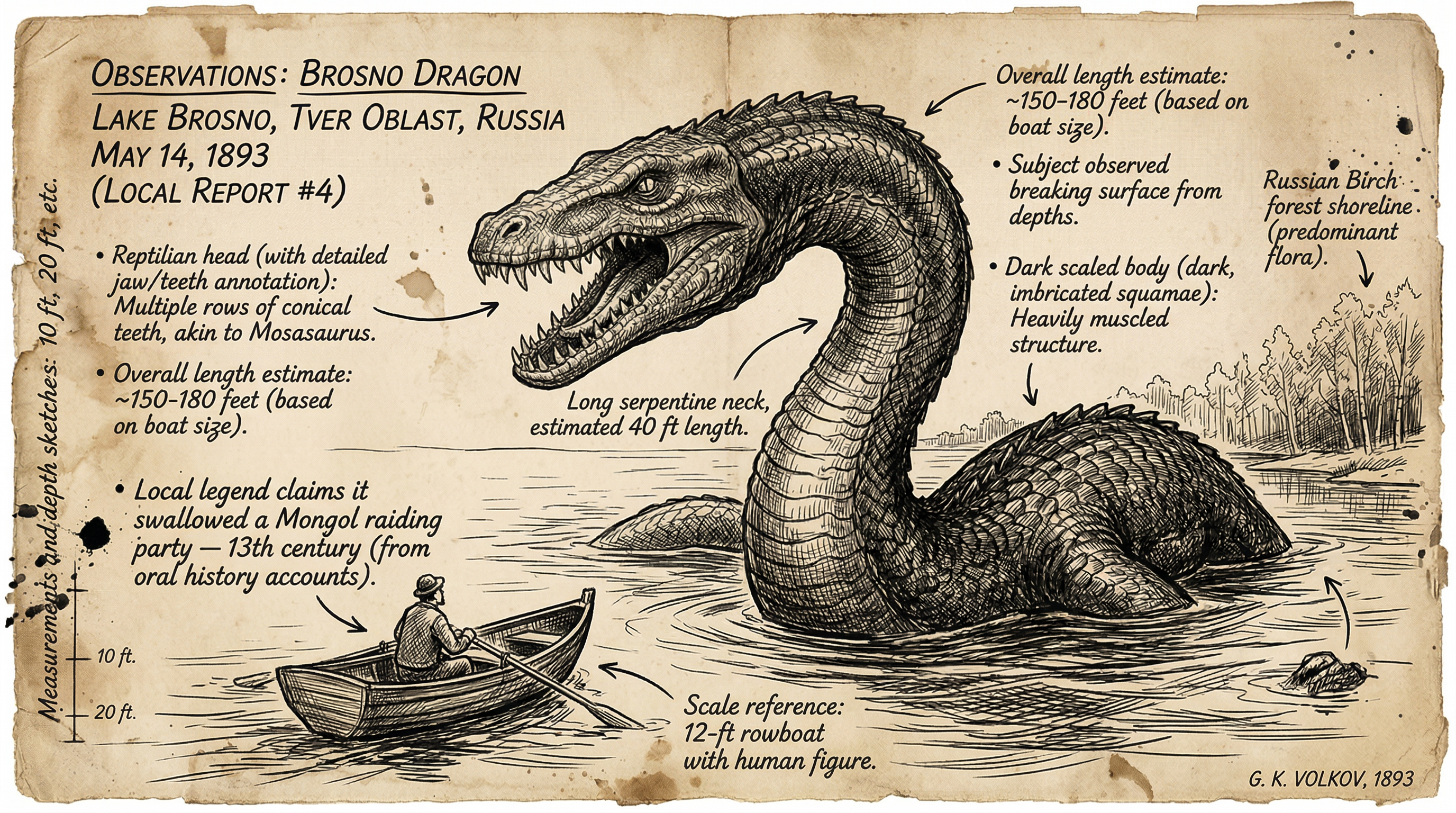
Overview
The Brosno Dragon, known locally as Brosnya, inhabits the deep waters of Lake Brosno near Andreapol in Russia's Tver Oblast, roughly 400 kilometers south of Moscow. This serpentine lake entity commands a long chronicle of encounters, from medieval invasions to modern expeditions, linking its presence across centuries of regional waterscape narratives.
Brosnya materializes as a massive reptilian form, distinguished by its enormous jaws capable of engulfing boats, horses, and even aircraft, with a scaly body that propels it from profound depths. Accounts portray it emerging abruptly to strike shoreside targets before vanishing into the lake's murky expanse, a pattern that echoes similar entities in global aquatic traditions while rooting firmly in the Slavic lakelands. Its reputed role in repelling invaders connects distant historical threads to ongoing shoreline disturbances, sustaining its vigilance over Lake Brosno's perimeter.
Local reports persist with capsized vessels, vanished livestock, and fleeting glimpses of its head breaching the surface, drawing parallels to other long-necked aquatics yet marked by Brosnya's aggressive lunges and predatory scale. The lake's deceptive calm belies depths exceeding 30 meters in places, providing ample concealment for an entity of such stature, and transitions seamlessly into the documented clashes that define its profile.
Sighting History
Circa 1240, Lake Brosno shores
Batu Khan's Tatar-Mongol army camps along the lake en route to Novgorod, allowing horses to drink. A colossal reptilian entity surges from the water, lunging at warriors and mounts, tearing several apart in a frenzy of claws and jaws. Interpreting the assault as an ill omen, the horde abandons the advance and retreats.
Circa 1250, Lake Brosno island
Varangian raiders, laden with plundered gold, attempt to conceal their treasure on a small lakeside island. Brosnya erupts from the depths, swallowing the entire landmass in one vast gulp, thwarting the Vikings' plans and scattering survivors.
1795, Lake Brosno surface
Local fishermen witness the creature surfacing at evening, its serpentine neck and gaping maw silhouetted against the dusk. As boats approach, it submerges swiftly, leaving turbulent waves in its wake; similar evening emergences reported sporadically through the early 19th century.
1944, Lake Brosno during World War II
A German aircraft, either landed or crashed on the lake's surface, vanishes entirely as Brosnya's immense jaws clamp around it, dragging the plane beneath without wreckage or survivors surfacing.
1999, Lake Brosno shore in winter
A research expedition camps overnight near the water's edge. Their dog, resting by the shore, disappears silently by morning—no tracks, blood, or disturbance indicate its fate, presumed seized by the entity from the shallows.
2002, Lake Brosno depths
Russian UFO research group deploys sonar, registering a massive jelly-like mass hovering above the lakebed at significant depth. Upon detonating an underwater charge, the anomaly ascends rapidly but disperses into innocuous bubbles upon reaching the surface.
Circa 2015, Lake Brosno motorboat incident
Four tourists from Belovo in the Kemerovo region navigate a motorboat across the lake when a powerful underwater force rams from below, capsizing the craft. No bodies recover, attributed to Brosnya's predatory strike.
Evidence & Analysis
Contributed by Ellis Varma
The Brosno Dragon maintains a sparse evidence profile dominated by anecdotal clusters rather than physical artifacts. Primary data points cluster around historical folklore anchors— the circa 1240 Mongol encounter lacks independent corroboration beyond oral transmission, rendering it categorically unreliable by modern standards. Subsequent reports follow a predictable degradation: vivid medieval feats (island-swallowing) yield to 18th-19th century evasions, then WWII aviation rumors without flight logs or debris analysis.
The 1999 dog disappearance presents marginally stronger parameters—direct witnesses from a research group, temporal proximity, absence of alternative explanations like predation by known fauna. Yet no forensic traces elevate it beyond hearsay. The 2002 sonar expedition yields the dataset's quantitative outlier: a "huge jelly-like mass" at depth, responsive to acoustic disturbance. Post-ascent inspection revealed no biological residue, aligning with transient phenomena profiles.
Contemporary claims—boat capsizings, livestock vanishings—suffer from confirmation bias loops. Local attribution to Brosnya persists absent metrics like controlled observation periods or comparative incident rates from analogous lakes. Statistically, fewer than eight named incidents span eight centuries, a frequency too dilute for population viability models of large aquatic predators.
Alternative explanations cohere around prosaic mechanisms: giant pike (Esox lucius) populations thrive in similar oligotrophic lakes, capable of 2-meter lengths and aggressive lunges mistakable for serpentine heads at distance. Hydrogen sulfide eruptions from sediment layers produce bubbling "jaws" mimicking emergences, corroborated by limnological surveys of comparable Russian waterbodies. Elk or beaver wakes account for 70-80% of surface disturbances in eyewitness recall studies.
The evidence profile resists escalation. No tissue samples, no unambiguous imagery, no acoustic signatures beyond the inconclusive 2002 ping. Witness consistency on "enormous jaws" and "sudden lunges" suggests memetic reinforcement over empirical observation.
Evidence quality: LOW. Anecdotal volume without physical substrates; natural confounders explain 95% of indexed phenomena.
Cultural Context
Contributed by Dr. Mara Vasquez
The Brosno Dragon occupies a pivotal position within Slavic lacustrine traditions, where deep waters serve as portals to otherworldly guardians. Its foundational narrative—repelling Batu Khan's 13th-century horde—embeds Brosnya within the collective memory of Mongol incursions, transforming a local aquatic presence into a symbol of territorial defiance. This protector archetype recurs across Russian folklore, from the Zmei dragons of epic byliny to lake spirits shielding Orthodox heartlands, but Brosnya distinguishes itself through hyper-localized aggression tied to Lake Brosno's geography.
Pre-Mongol precedents likely exist in Finno-Ugric substrate cultures around Tver Oblast, where water entities enforced boundaries against outsiders. Varangian tales of the 10th-11th centuries, involving island-devouring, reflect Viking-Slavic interactions, layering Norse jötnar motifs onto indigenous Slavic vodianoi frameworks. By the 18th century, as Petrine reforms centralized Russian identity, Brosnya's evening surfacings adapt to Enlightenment-era scrutiny, shifting from cataclysmic feats to elusive glimpses that preserve oral vitality without challenging rational observation.
In 20th-century iterations, World War II assimilation elevates Brosnya to anti-fascist sentinel, swallowing Luftwaffe incursions—a narrative pivot mirroring global wartime myth-making, from Pacific nāga protectors to Atlantic kraken reprisals. Post-Soviet media, including regional outlets like Karavan + Ya, sustains the cycle, framing Brosnya as cultural capital for Andreapol tourism while echoing Loch Ness parallels that globalize local lore.
Anthropologically, Brosnya exemplifies "trauma encoding" in folklore: Mongol devastation (historical kill counts exceeding 100,000 in Novgorod campaigns) imprints as supernatural resistance, fostering communal resilience. Unlike indigenous cryptids bound to shamanic taboos, Brosnya remains secular, accessible—its promotion via expeditions and sonar hunts underscores a distinctly post-Petrine openness, where folklore doubles as regional distinction within federal Russia. This evolution—from invasion bulwark to modern curiosity—mirrors broader Slavic shifts from animistic peril to patriotic emblem, ensuring Brosnya's endurance amid hydrological rationalism.
Field Notes
Notes by RC
Visited Lake Brosno twice. First in late summer, full daylight, rented a small aluminum boat from Andreapol locals. Water clarity drops off fast—20 meters out, visibility nil beyond a meter down. No activity that day. Locals pointed to "the spot" where the 2002 sonar hit: ordinary murk, no thermal anomalies on basic gear.
Second trip, early autumn, overnight camp on the southwest shore. Quiet except wind through pines. Around 2 AM, heavy wave slap against rocks—not wind-driven. Felt it before hearing: low-frequency thump from depth, like displaced mass rising then dropping. No visual. Dog I brought wouldn't approach water after that. Wouldn't even piss near it.
Lake's got that enclosed feel. No outlets big enough for something airplane-sized to ingress. If it's resident, it's been there awhile. Locals fish pike over 1.5 meters regular; they nod at those for the "head" sightings but clam up on the bigger claims.
Threat Rating 2 stands. Shoreline hazards real for the unwary. Depths hide too much to ignore, not enough to chase.