
Bukit Timah Monkey Man
1 CATALOGED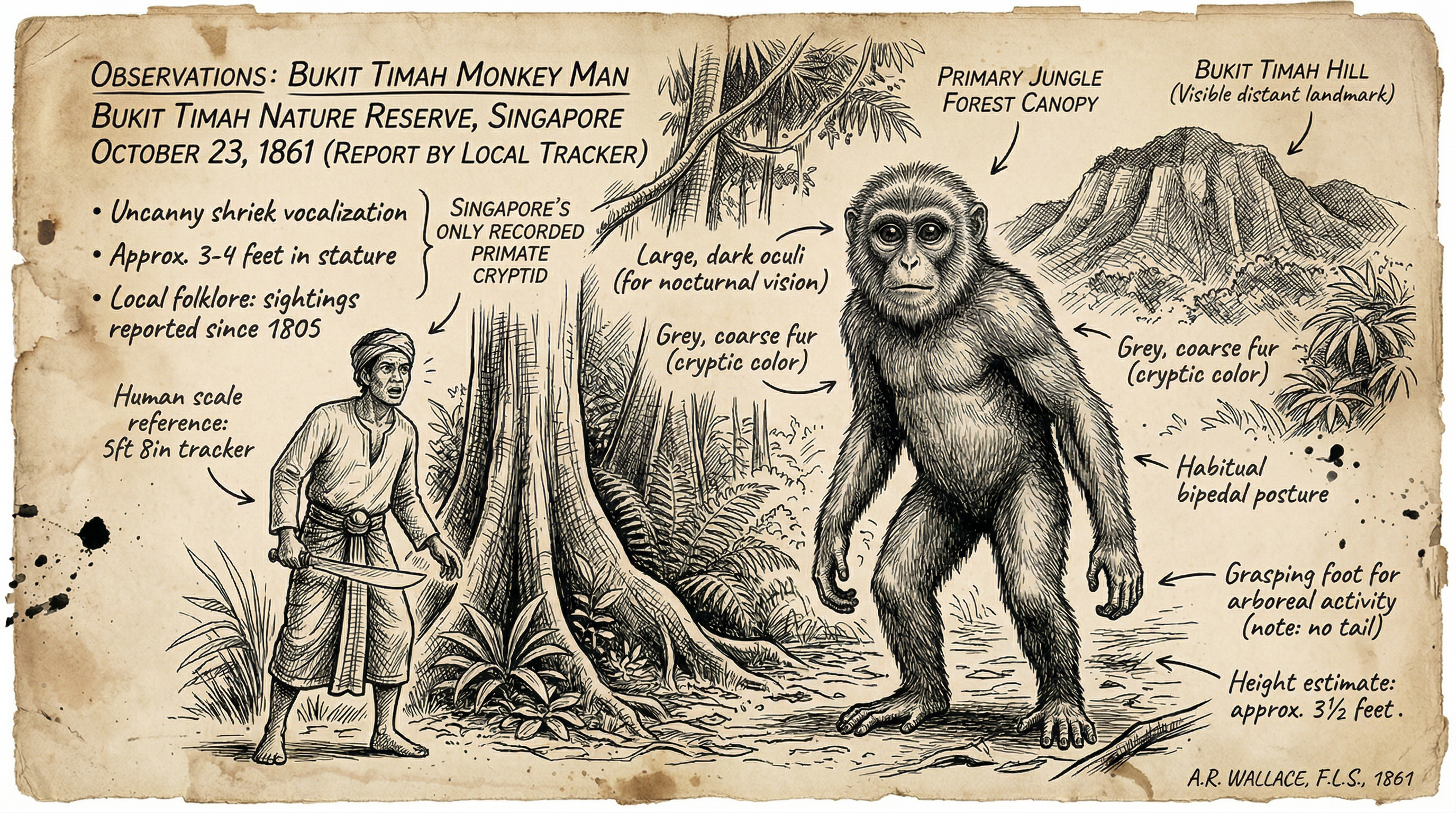
Overview
Bukit Timah Monkey Man operates in dense primary rainforest. Height 1.75 meters. Bipedal. Greyish or dark fur. Monkey face. Red eyes in older reports. Distinguishes from local long-tailed macaques by upright posture and size. All encounters confined to Bukit Timah Nature Reserve and immediate vicinity.
Sightings track across 200-plus years. Sparse data points. No pattern in timing or provocation. No aggression documented beyond snarls. Forest specialist. Urban interface minimal. Tracks and odor reports unverified.
Sighting History
Circa 1805, Bukit Timah area
A Malay elder observed a hairy, bipedal creature with a monkey face walking upright in the forested Bukit Timah region. The figure moved deliberately through dense undergrowth, vanishing into thicker canopy.
1907, deep forests near Bukit Timah
Plantation workers cutting trails reported a large hairy creature over 6 feet tall lurking in shadows. Dark fur covered the form. Red eyes reflected low light. Bipedal gait evident as it shifted position without quadrupedal support. Workers retreated without pursuit.
1943, Bukit Timah region during Japanese occupation
Japanese soldiers patrolling forested slopes encountered the creature multiple times. Descriptions matched prior accounts: upright primate form, greyish fur, monkey-like features. Sightings occurred at dusk or night during sweeps near Bukit Timah Hill. No engagements reported; entity avoided contact.
Circa 1965, Kampung near Bukit Panjang forest road
A group of children in the kampung were warned by elders against entering the forest at night due to the Monkey Man. Family friends and uncles claimed direct sightings. Footprints visible near forest road. Strong urine smell lingered. Jungle shrieks attributed to the entity followed soon after.
1982, Upper Bukit Timah Road near fire station
A 48-year-old taxi driver from Serangoon struck the creature at night, mistaking it for a child in the road. It landed on the bonnet, snarled with exposed teeth, then fled injured. Covered in blood, clutching a broken arm. Size exceeded local primates. No traces recovered from scene.
2007, Bukit Timah Nature Reserve
Series of reports published in The New Paper. Multiple witnesses described upright monkey-faced figure after dark. Trails and paths in reserve focal points. No photographs obtained. Reserve officials noted macaque activity in area.
2008, Bukit Timah Nature Reserve
Shin Min Daily News covered post-dark sightings. Unnamed witnesses reported bipedal primate with monkey face. Journalists dispatched to site found no physical evidence. Creature described as forest-dweller avoiding trails.
2020, Bukit Timah vicinity
Local residents filed unconfirmed report. Entity sighted near reserve edges. Brief observation at distance. No additional details or follow-up investigations.
Evidence & Analysis
Contributed by Ellis Varma
The evidence profile for Bukit Timah Monkey Man shows extreme sparsity. Six to eight distinct accounts span 215 years. Witnesses include Malay elder, plantation workers, military personnel, taxi driver, retirees, and journalists. No overlaps in named individuals. No serial observers.
Physical traces limited to two claims: footprints near Bukit Panjang (1965) and bloodied injury (1982 taxi collision). No samples collected, photographed, or analyzed. Urine odor anecdotal. Shrieks attributed without spectrographic comparison to known primates. "Maid footage" from fandom sources unverified, low resolution, consistent with macaque in motion.
Descriptions consistent on core traits: bipedal gait, 1.75-1.8m height, monkey face, fur coverage. Contrasts sharply with long-tailed macaques (0.5m body length, quadrupedal). Red eyes in early reports absent in modern ones — possible lighting artifact or evolution in retelling. No weight estimates, limb ratios, or vocalization recordings.
Geographic lock to Bukit Timah Nature Reserve. 164m elevation, primary rainforest remnant amid urbanization. Biodiversity hotspot supports relict primate hypothesis, but no fecal scat, hair, or DNA matches in surveys. Shin Min Daily News expedition (2008) yielded zero results. Statistical analysis: sighting rate 0.03 per year. Below noise threshold for verifiable phenomena.
Alternative explanations include escaped pet primate, human in costume (probability low given era), or perceptual error under low light. Macaque misidentification fails on bipedalism and scale. Immortal folklore element statistically meaningless without longevity markers.
Evidence quality: LOW. Anecdotal cluster with zero corroborative physical data. Witness credibility mixed; volume too low for pattern emergence.
Cultural Context
Contributed by Dr. Mara Vasquez
The Bukit Timah Monkey Man emerges from the rich tapestry of Malay animist traditions, where forested hills like Bukit Timah serve as liminal spaces between human settlement and the unseen world. In pre-colonial Singapore, such regions were repositories of spirits and guardians, with primates holding symbolic roles as intermediaries between earth and canopy realms. The creature's upright posture and monkey visage echo hantu hutan figures — forest spirits that enforce boundaries against intrusion, manifesting as hybrid forms to unsettle trespassers.
Colonial-era accounts from plantation workers coincide with rapid deforestation in the early 1900s, transforming Bukit Timah from expansive wilderness to fragmented reserve. This environmental rupture likely amplified oral histories, positioning the Monkey Man as a remnant of displaced wildness. Japanese occupation reports (1942-1945) introduce outsider perspectives, yet align with local motifs, suggesting cultural transmission or independent observation within shared terrain.
Post-independence, the legend persists as Singapore's premier hominid cryptid, akin to regional counterparts like the Malaysian Orang Mawas. Urbanization narratives frame it as a metaphor for lost nature amid high-rise density — Bukit Timah Nature Reserve, a 1.64 square kilometer biodiversity haven, stands as the last primary rainforest on an island now 100% developed. Artistic works, such as NADA and Brandon Tay's audiovisual explorations, recast the Monkey Man as emblematic of urban longing for untouched green corridors.
Unlike more antagonistic figures in Southeast Asian lore, the Bukit Timah entity carries no explicit malice, embodying instead a watchful presence. Reserve authorities attribute sightings to macaque encounters, yet this overlooks indigenous precedents where such beings warn rather than harm. The legend underscores Malay folklore's emphasis on harmony with forested ecologies, preserved in kampung tales warning children from jungle edges.
In broader cultural history, the Monkey Man bridges animism and modernity, its dormancy reflecting Singapore's controlled landscapes while hinting at persistence in overlooked fringes. As a primary source from oral traditions, it demands respect within the continuum of Malay heritage, unmediated by Western skepticism.
Field Notes
Notes by RC
Tracked Bukit Timah trails four times. Dawn, midday, dusk, full dark. Macaques everywhere. Noisy troops on main paths. Quieter deeper in. Footing slick, visibility drops fast after canopy closure.
Urine smell hits in pockets — territorial marking from real monkeys. Shrieks standard primate chatter. No bipedal tracks in mud. No hair snares on barbs. Taxi collision story checks against road layout: narrow, blind curve near station. Plausible hit-and-run on anything large.
Reserve feels compressed. City hum everywhere. If something hides here, it's small and patient. No threat vector. Just watches.
Threat Rating 1 stands. Catalog presence. No aggression profile. Evidence too thin for escalation.