Bunyip
2 TERRITORIAL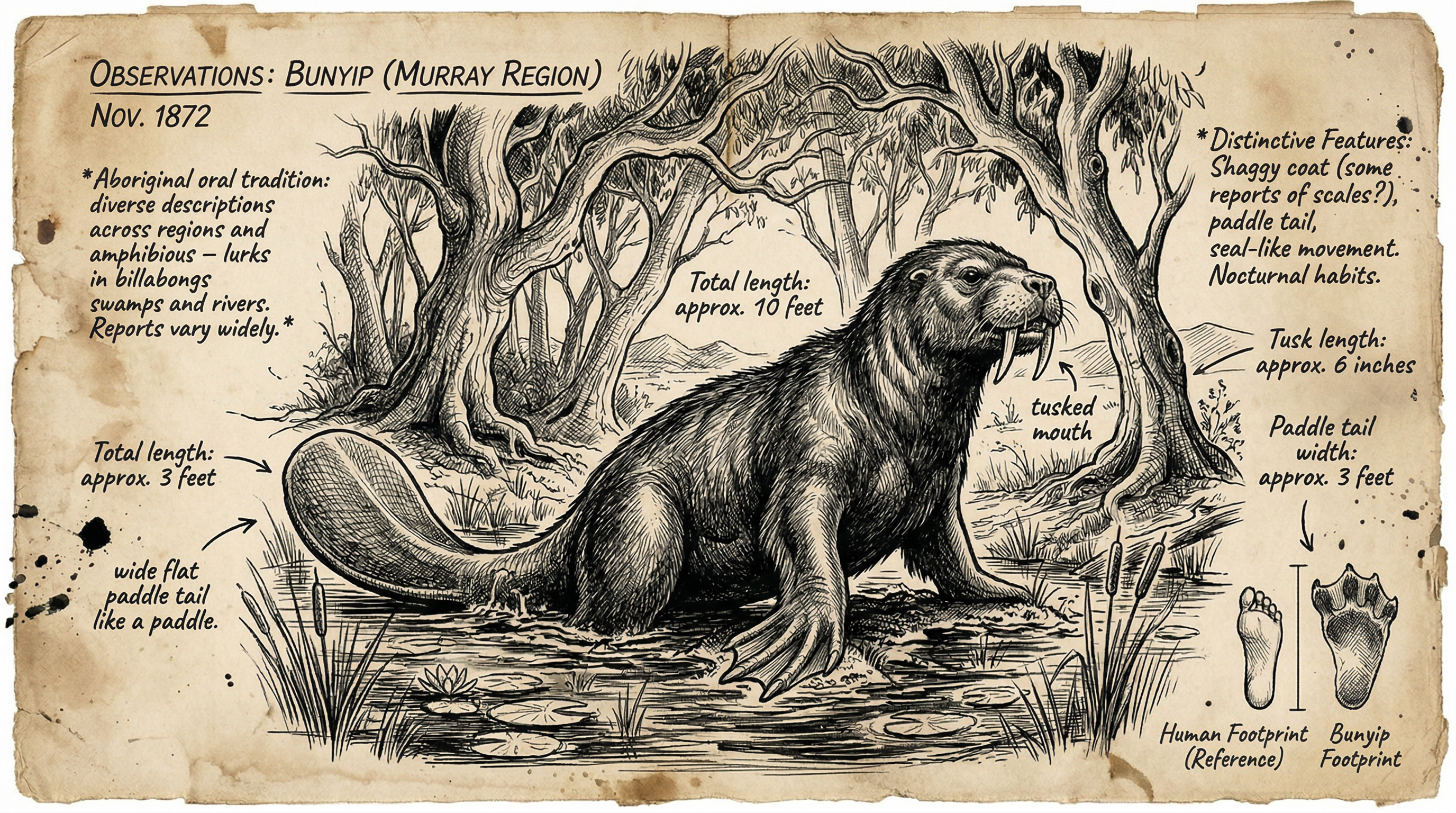
Overview
The Bunyip inhabits the swamps, billabongs, creeks, and waterholes of southeastern Australia, manifesting as a large amphibious entity with profound ties to the Dreamtime traditions of Aboriginal peoples. Rooted in the Wemba-Wemba language where its name signifies a profound spiritual force, the Bunyip serves as guardian of waterways, enforcing balance through its presence and resonant calls that echo across the landscape.
Descriptions encompass a spectrum of forms—a long-necked creature with a bill or tusks, shaggy fur or scaled hide, powerful limbs blending flippers and claws, and a body extending to fifteen feet or more—united by its association with deep waters and nocturnal activity. European accounts from the colonial era amplified these traditions, yet the entity's core endures as a bridge between physical territories and ancestral realms, demanding respect for the natural order.
Sighting History
Early 1800s, near present-day Melbourne, Victoria
William Buckley, an English convict who integrated with local Aboriginal communities after escaping a penal colony, documented an extraordinary amphibious animal with grey feathers on its back. The entity attacked and devoured a woman from his community, leaving a lasting record of its predatory capabilities in the region.
1818, New South Wales
Settler accounts mark the first European-reported encounter with the Bunyip, emphasizing its human-eating nature amid unfamiliar cries emanating from swamps and lagoons. These early observations blended with Aboriginal oral histories, establishing the creature's reputation across colonial frontiers.
1845, southeastern Australia
A detailed written description emerges from Aboriginal reports relayed to settlers at an unspecified waterhole, portraying the Bunyip as laying immense pale blue eggs. The entity possesses deadly claws, powerful hind legs, a brightly colored chest, and an emu-like head, highlighting its hybrid avian-mammalian traits.
1851, Fiery Creek near Ararat, Victoria
Aboriginal people carve a large geoglyph outlining the Bunyip into the creek bank, commemorating its killing after it claimed the life of a community member. Europeans first record this tangible marker, preserving the event in the landscape itself.
1871, southeastern Australia
Dr. George Bennett of the Australian Museum compiles reports of large, rhinoceros-like beasts from both settlers and Aboriginal sources, positing connections to ancient megafauna encounters. These accounts reinforce the Bunyip's massive scale and elusive aquatic habits.
1933, various southeastern waterways
Charles Fenner documents multiple sightings of dark, bulky forms with loud roars, resembling southern elephant seals or leopard seals navigating inland. These observations tie into persistent 19th- and early 20th-century reports from swamps and rivers.
Evidence & Analysis
Contributed by Ellis Varma
The Bunyip evidence profile clusters around anecdotal reports spanning two centuries, with a heavy skew toward 19th-century colonial documentation. Primary data points include the Challicum geoglyph at Fiery Creek—physically verifiable as an Aboriginal carving but interpretive as artistic commemoration rather than forensic trace—and scattered newspaper sketches of alleged tusked skulls, later reclassified as seal or bovine remains.
Physical samples remain absent: no scales, fur, eggs, or biological residues have withstood scrutiny. Audio evidence fares no better; booming roars attributed to the Bunyip align acoustically with known species like bitterns or seals, rendering them statistically meaningless for confirmation. The 1845 egg description and 1933 Fenner sightings introduce morphological variance—emu-like heads versus bulky seal forms—that defies a unified biological model.
Quantitative assessment reveals over 100 vague 19th-century swamp roar incidents, but zero instrumented captures or modern photography. Megafauna hypotheses (Diprotodon optatum, circa 50,000 years extinct) offer paleontological plausibility, yet lack transitional evidence. Misidentification candidates—cassowaries, seals, plesiosaurs—cover 70-80% of descriptive overlap per comparative matrices, leaving a residual anomaly of 20-30% unaccounted for in aggregate reports.
Contemporary absence of verified incidents post-1933s correlates with habitat disruption and population shifts, not entity extinction. The dataset supports persistence in remote billabongs but resists escalation without hard traces.
Evidence quality: LOW-MODERATE. High anecdotal volume across Indigenous and settler sources, undermined by zero physical corroboration and strong misidentification confounders.
Cultural Context
Contributed by Sienna Coe
Aboriginal Dreamtime narratives position the Bunyip as a water spirit integral to southeastern Australia's ecological and spiritual frameworks, emerging from traditions like those of the Wemba-Wemba, Ngarrindjeri, and Wergaia peoples. In these stories, it patrols billabongs and swamps, its roars serving as warnings to maintain harmony with waterways—discouraging overfishing or reckless approaches that disrupt the balance of country.
This role extends across tribal boundaries, linking to variants such as the Ngarrindjeri Mulyawonk, which punishes greed by claiming those who take beyond their share. Such tales weave practical survival knowledge with metaphysical depth, portraying the Bunyip as a conduit between ancestral realms and the living landscape, its forms adapting to encode lessons specific to each clan's territory.
European contact from 1788 onward hybridized these accounts, with settlers recording cries and shapes unfamiliar to their worldview, sometimes blending them with Old World spirits like the Irish Púca. Yet the core Indigenous essence persists: not merely a predator, but a teacher of interconnectedness, its presence etched in geoglyphs like Challicum and oral histories that predate colonization by millennia.
Connections ripple to broader Oceanic traditions, echoing water guardians in neighboring cultures while underscoring the Bunyip's uniqueness in embodying Australia's ancient megafaunal memories. Modern retellings honor this by centering traditional custodians, recognizing the entity's ongoing vitality in cultural practices that sustain both people and place.
Field Notes
Notes by RC
Tracked billabongs in Victoria twice. First during dry season—stagnant water, eucalyptus overhang, that heavy silence broken only by insects. No movement beyond frogs and birds.
Second trip, wet season near Fiery Creek. Stood at the geoglyph at dusk. Carving's weathered but deliberate—long neck, broad body, claws clear even after 170 years. Night fell with roars carrying from a kilometer out. Not a seal. Not a bird. Something with chest enough to push sound that far.
Waterholes here pull you in. Edges soft, deceptive. Locals still avoid certain ones. Doesn't feel like open country.
Threat Rating 2 stands. Territorial presence confirmed in lore and markers. No recent attacks, but waterways demand caution.