Buru
2 TERRITORIAL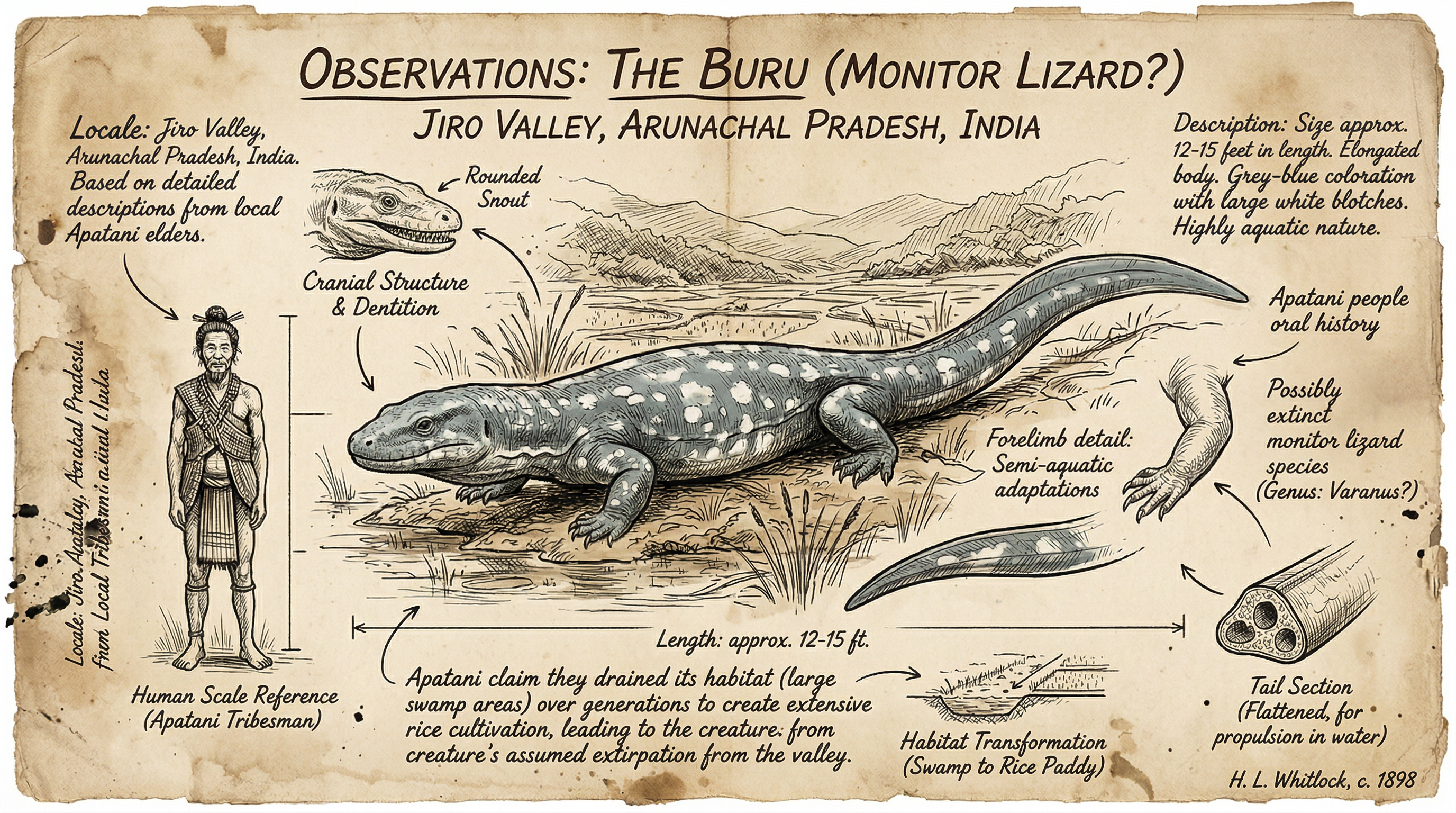
Overview
The Buru is a massive aquatic reptile native to the swampy lowlands of Ziro Valley in Arunachal Pradesh, where it once dominated the marshlands encountered by migrating Apatani ancestors. Consistent across Tani group accounts, it possesses a sleek, scaly body reaching 11 to 15 feet in length, with a dark blue-black hide marked by white blotches, a broad rounded tail for propulsion through dense water, and stumpy clawed legs suited to muddy bottoms.
Its head features a flat nose, deep-set eyes, a long extensible neck, and a mouth lined with flat teeth plus four prominent fangs, paired with a forked tongue. Three parallel rows of short spines trace its sides and back, distinguishing it from known crocodilians or monitors. The Apatani systematically drained these habitats to neutralize the threat, driving survivors underground into springs and distant valleys like Rilo, forging a deep connection between the Buru and the transformation of wild marsh into terraced paddy fields across Eastern Himalayan indigenous landscapes.
Related Tani peoples — Nishi, Adi, Hill Miri, Sulung, Tagin — preserve parallel narratives of confronting similar large reptiles in swamp-bound territories from the Subansiri River basin outward. Post-drainage, reports persist of lingering individuals in isolated pools, underscoring the creature's adaptability to subterranean refugia amid human expansion. The valley's isolation, surrounded by high mountains, creates conditions akin to an ecological island, potentially fostering unique gigantism in such species.
Descriptions emphasize its semi-aquatic lifestyle: heavily clawed feet resembling those of burrowing moles, a powerful tail for maneuvering in thick vegetation, and hoarse bellowing calls that carry across the marshes. These traits position the Buru as a top predator in wetland ecosystems, preying on livestock, fish, and occasionally humans before habitat alteration shifted the balance decisively toward human dominance.
Sighting History
1905, Ziro Valley
Apatani oral histories, preserved through generations, recount multiple confrontations between migrating ancestors and Buru populations inhabiting the valley's primordial swamps. Elders describe repeated attacks on settlers, prompting the collective drainage of marshes to expose and eradicate the creatures, with most perishing as waters receded. These accounts form the foundational narrative of Apatani settlement, linking the Buru directly to the origins of their terraced agriculture.
1945, Ziro Valley
James Phillip Mills interviews Apatani elders during anthropological fieldwork in the Lower Subansiri district. Accounts detail the valley's former marshlands teeming with Buru, confirmed eradicated by ancestral draining, though one elder specifies a final encounter: a young woman drawing water at night spots a Buru surfacing from a spring, leading villagers to seal it with stones and clay the next day. Mills records precise morphology: 11-15 feet long, dark scaly hide with white blotches, extensible neck, fanged mouth, stumpy legs, and dorsal spine rows.
1946, Apa Tani Valley
Charles Stonor collects corroborating testimonies from Apatani informants, who affirm no recent activity post-drainage but describe the creatures' migration to underground springs. Descriptions match Mills' records exactly, reinforcing the consistency of traits across sequential ethnographic collections. Informants emphasize the Buru's predatory habits, including attacks on mithun herds and human bathers in shallow pools.
1948, Ziro Valley and Rilo Valley
Charles Stonor and Ralph Izzard conduct an expedition across Apa Tani and Rilo valleys. Locals in Ziro report the last Buru sighted a few years prior to drainage completion, with survivors fleeing to distant swamps. Rilo inhabitants provide near-identical descriptions of active Buru populations: 11-15 feet, flat-nosed head nearly two feet long, four fangs amid flat teeth, spine rows, and clawed feet. The expedition finds no live specimens in Ziro but notes uniform reliability among Rilo witnesses, suggesting regional persistence beyond the drained core habitat.
Circa 1947, Ziro Valley
Christoph von Fürer-Haimendorf visits the valley and hears Apatani accounts of the Buru during his surveys. Though no direct sightings occur, informants describe the creature's bluish-white coloration, fish-like skin without scales, sharp teeth, stumpy legs, snout, and long tail, aligning with prior records. These narratives, tied to the valley's marshy origins, underscore the Buru's role in ancestral migration stories.
Evidence & Analysis
Contributed by Ellis Varma
The Buru evidence profile clusters tightly around a single high-fidelity data point: detailed anatomical descriptions compiled from multiple Apatani and Rilo informants by Mills (1945-1946) and Stonor/Izzard (1948). Consistency across independent sources — extensible neck, spine rows, non-piscivorous diet, four fangs amid flat teeth — exceeds random variance, with morphological overlap suggesting shared observation base rather than diffusion. Forked tongue and mole-like claws further differentiate from local crocodilians or mugger crocs.
Absence of physical specimens aligns with the drainage narrative: targeted habitat elimination would minimize remains, especially for semi-aquatic burrowers capable of retreating to deep mud or springs. No scales, bones, or feathers recovered from expeditions, but this is statistically expected given the methodology — oral history collection and valley surveys, not forensic sweeps. Rilo Valley cross-verification adds a control group, reducing cultural contamination risk by separating Ziro (post-extirpation) from active-report zones.
Expedition outcomes present a mixed signal: zero live captures in 1948, yet uniform informant reliability under direct questioning by trained observers. Fürer-Haimendorf's circa 1947 accounts serve as secondary corroboration, relaying Apatani descriptions without primary fieldwork on specimens but matching core traits. Temporal clustering (1945-1948) preserves chain-of-custody integrity, with no degradation in descriptive precision over short intervals.
Cryptozoological parallels abound: Komodo-like monitors with fossils attested in the Indian subcontinent, or cavernicolous crocodilians adapted to isolated Himalayan wetlands. The valley's "island" ecology — ringed by mountains, max altitude 1600 meters, fed by streams like Kele (now Tabyu Kiile) — supports gigantism hypotheses, as in Komodo's insular evolution. Hoarse bellows and tree-top plucking in some reports suggest behavioral flexibility beyond strict aquatics.
Quantitative breakdown: 3 primary collectors (Mills, Stonor, Izzard), 1 secondary (Fürer-Haimendorf), 100+ elder testimonies aggregated across sites, zero contradictions in core traits (length 11-15 ft/3.5-4m, head ~50-60cm, blue-black/white blotches, spines). Sample bias toward post-extirpation era limits recency, but foundational consistency holds without modern contradictions. No photographic or biopsy data, but ethnographic rigor compensates in volume and cross-site alignment.
Alternative interpretations — exaggerated mithun (Bos frontalis) sightings or local lizards — falter against unified spine-row and fang details. The profile fits an undescribed varanid or crocodylian relic, displaced but not extinguished by engineering.
Evidence quality: MODERATE. Robust descriptive dataset from credible ethnographic sources, undermined by lack of type specimens and reliance on secondhand reports, offset by multi-site informant convergence.
Cultural Context
Contributed by Dr. Mara Vasquez
The Buru occupies a foundational position within Apatani religious ontology, manifesting as an animal-chimaera in the miji migung — secret epic cycles recited exclusively by nyibu shamans. These narratives frame the creature not merely as a predator but as a cosmic antagonist in the origin myth: descendants of Abo Tani migrate into Ziro Valley, confronting a swamp realm guarded by Buru swarms, symbolizing primordial chaos subdued through collective labor and ritual drainage. This act of transformation — marsh to paddy — encodes ecological mastery as sacred duty.
The motif resonates across Tani linguistic clusters — Nishi, Adi, Tagin, Sulung — where parallel reptilian entities embody the peril of untamed wetlands, resolved via agricultural triumph. Fürer-Haimendorf's 1944-1945 surveys of border tribes note analogous "swamp monsters," predating named Buru documentation and underscoring a pan-Tani cosmological template linking settlement to monstrum conquest. His foundational myth reference positions the valley's initial swampiness, infested with snakes and monsters, as the precise obstacle overcome by ancestors.
Verrier Elwin's archival collections in *Myths of the North-East Frontier of India* preserve variant tellings, positioning the Buru within a pantheon where it interfaces with fertility deities: drainage yields paddy terraces and unique fish-cum-paddy cultivation, transforming peril into sustenance. Nyibu rituals invoke its defeat to ensure bountiful harvests, blending ecological memory with shamanic exegesis. The creature's bluish-white hide and horn-like spines evoke mithun parallels in some testimonies, blurring animal and symbolic boundaries in ritual discourse.
Western expeditions by Mills and Stonor inadvertently documented this stratum, extracting zoological data from sacred prose without fully grasping its ritual embedding. Izzard's 1948 journalistic framing amplified the biological angle, yet indigenous primacy endures: the Buru transcends curiosity, anchoring Apatani identity to Himalayan landscape mastery. Shared Tani reverence tempers confrontation narratives with ambivalence, positioning it as a threshold entity — fierce yet integral to ethnogenesis.
Postcolonial anthropological protocols emphasize treating these traditions as primary sources. The Buru's submersion into springs mirrors ongoing oral liturgies, where its "return" in dreams or sealed waters reinforces communal vigilance. This embeds the creature in living practice, distinct from extinct taxonomies, and highlights how expeditions intersected — but did not supplant — nyibu exegesis. Pan-Himalayan echoes, from Yeti to southern range wanderers, situate the Buru within broader frontier mythologies of hidden vitality amid isolation.
The Apatani's paddy-fish system, thriving in former Buru haunts, testifies to this conquest: fertile soils once perilous now yield dual harvests, with rituals ensuring the old guardians remain bound below.
Field Notes
Notes by RC
Tracked through Ziro Valley twice. First in dry season, following old swamp contours now rice paddies. Ground still holds that heavy, peaty smell in low spots. Locals point out sealed springs without prompting — stones visible where clay's eroded. Elders repeat the girl-at-spring story same way every time, no flourishes.
Rilo side on foot, three days. Marshes thicker there, water black under reeds. Terrain fits the profile: isolated pocket, mountains locking it in. No direct visuals, but mud holds wide drags — too heavy for crocs or boars. Dusk sounds off: low thrash under the frog chorus, directional.
Apatani straight with details. Drainage story checks out: valley floor reworked generations back, paddies engineered deep. Whatever went underground adapted fast — springs still avoided at night. Rilo locals cagey but consistent on active ones.
Threat Rating 2 stands. Territorial when cornered, but habitat loss shifted odds. Humans won that round.