Cadborosaurus
2 TERRITORIAL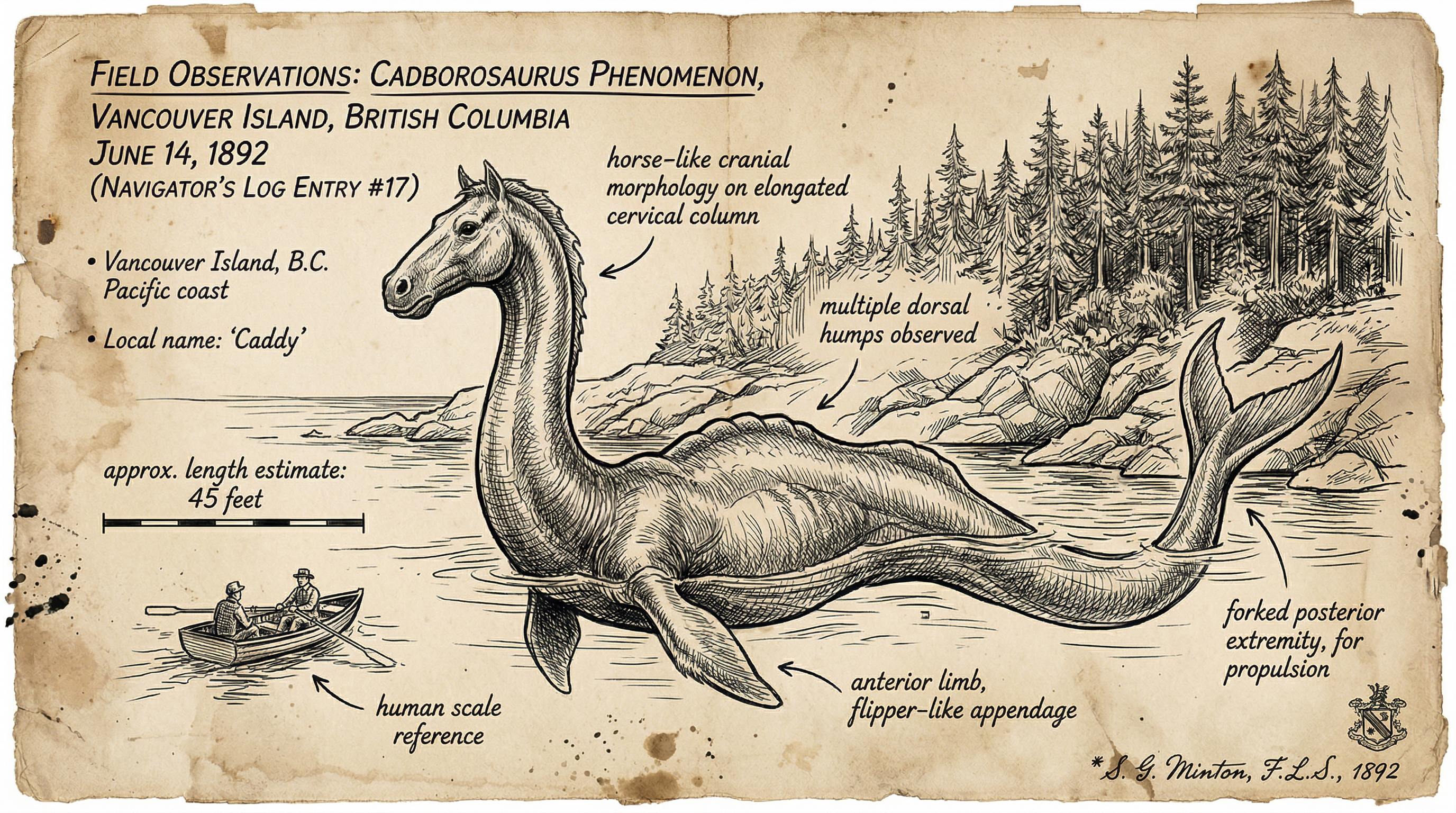
Overview
Cadborosaurus willsi, known familiarly as Caddy, inhabits the coastal waters of British Columbia, with its primary range centered around Vancouver Island and extending southward to San Francisco Bay. This serpentine entity commands a prominent place within Pacific Northwest marine traditions, where generations of observers have documented its presence through consistent visual encounters and rare physical remnants. The creature's name derives from Cadboro Bay in Greater Victoria, British Columbia, where journalist Archie Wills coined the colloquial designation that has persisted for over a century.
Witnesses consistently describe a marine reptile measuring between 15 and 45 feet in length, occasionally reported up to 70 feet, featuring a distinctive horse- or camel-like head atop a long, flexible neck. The body exhibits vertical humps or coils in tandem, propelled by a pair of small elevating front flippers and either paired hind flippers or a large webbed tail region fused into a fan-like or bifid structure. Brownish hair or fur covers portions of the neck and body, complemented by a serrated dorsal ridge running the length of the spine. Behavioral documentation includes pursuit of fish schools, capture of seabirds, and territorial responses to marine mammal migrations. Cadboro Bay itself serves as the eponymous epicenter — a shallow inlet rich in herring, salmon, and other marine resources that draw the entity close to shore during seasonal runs.
The entity's morphological profile aligns with formal taxonomic proposals classifying it within Reptilia, potentially linked to plesiosaurian lineages, as detailed in systematic treatments by marine researchers. Formal nomenclature designates Cadborosaurus willsi as a new genus and species, with the 1937 Naden Harbour photographs serving as holotype and paratype material. These classifications integrate eyewitness morphology with carcass evidence, positioning Caddy as a distinct biological entity within Pacific marine ecosystems.
Sighting History
1890, Cadboro Bay
Early reports from the late 19th century establish Cadborosaurus in local waters, with indigenous accounts and initial settler observations describing a serpentine form gliding through coastal inlets. These foundational encounters set the pattern for subsequent documentation, linking oral histories transmitted across generations to visual confirmations by European observers newly arrived to the region. The consistency of descriptions across cultural and temporal divides suggests either a long-established population or a tradition of observation anchored to genuine biological presence.
1930, Glacier Island near Valdez
A 24-foot skeleton with flippers emerged from receding ice, preserved initially in Cordova for study and examination. Though later classified as whale remains by institutional authorities, the discovery aligned with ongoing reports of elongated marine forms in the region and contributed to the clustering of physical discoveries during the 1930s whaling era.
1933, Chatham Islands near Vancouver Island
Major W.H. Langley, Clerk of the British Columbia Legislature, and yachtsman R.C. Ross observed an 80-foot-long serpent with a reported 20-foot-thick body and a shaggy-haired head rising from the water. A prior witness corroborated a similar sighting from the previous year, prompting wider documentation and lending credibility through independent verification. The high social standing of Langley lent institutional weight to the observation, elevating the sighting beyond anecdotal status in local records.
1934, Henry Island near Prince Rupert
Whalers encountered badly decomposed remains measuring 30 feet, subsequently examined by Dr. Neal Carter and identified as a basking shark upon cursory inspection. The event contributed to the clustering of physical discoveries in the 1930s, though the rapid dismissal without detailed analysis prevented fuller characterization. The whaling industry's routine encounters with unusual marine fauna positioned these workers as de facto field observers, their reports valuable despite institutional skepticism.
October 1937, Naden Harbour Whaling Station
Processing a captured sperm whale yielded a 20-foot carcass from its stomach, displaying morphological features consistent with Cadborosaurus descriptions: a camel-like head, serpentine body, pectoral flippers, and a pseudo-fluke tail with vertebral knobs and jointed elements. Whalers photographed the specimen on crates before portions were forwarded for analysis to the British Columbia Provincial Museum, where director Francis Kermode tentatively identified it as a fetal baleen whale — a classification that subsequent researchers would challenge. The specimen subsequently vanished from institutional records, representing a critical loss of physical evidence that has haunted Cadborosaurus research ever since.
1968, Coastal Waters near Vancouver Island
Certified master mariner William Hagelund captured a juvenile specimen in shallow waters, noting ventral yellow plate-like scales, a spade-like tail, and air-breathing nostrils positioned dorsally. He released it unharmed after observation, providing detailed biological notes including hard underbelly scales suited for seafloor navigation and a body structure intermediate between known cetaceans and the larger adults reported elsewhere. Hagelund's maritime credentials and methodical documentation established this encounter as one of the most credible modern observations.
1991, Unspecified Coastal Location
Phyllis Harsh reported capturing and releasing a smaller Cadborosaurus specimen, adding to the emergent pattern of live encounters with juveniles in shallow bays and protected inlets. These repeated captures of younger individuals suggest either a breeding population maintaining presence in accessible waters or a dispersal strategy that brings subadults into human-accessible zones.
1992, Saanich Inlet
Multiple reports from this breeding-associated area describe Cadborosaurus surfacing in groups, with undulating bodies and humped backs visible during herring runs and marine mammal migrations. The inlet's role as a seasonal convergence zone for marine life appears to draw the entity predictably, establishing Saanich as a secondary hotspot alongside Cadboro Bay. Clustering of sightings during peak herring abundance suggests direct correlation with feeding opportunities and prey availability.
Evidence & Analysis
Contributed by Ellis Varma
The evidence profile for Cadborosaurus presents a dataset skewed toward volume over verifiability: over 200 documented sightings across two centuries, with descriptions demonstrating remarkable consistency in core morphology — serpentine body, horse-like head, paired flippers, vertical humps — yet anchored by scant recoverable physical artifacts. The 1937 Naden Harbour carcass stands as the primary tangible data point, photographed and partially preserved before institutional loss, featuring diagnostic traits including pectoral flippers and a jointed tail structure unsupported by known local fauna or established cetacean anatomy.
Photographic documentation from Naden Harbour shows a 10-20-foot elongate form positioned on whaling crates, morphologically distinct from typical stomach contents of sperm whales and displaying characteristics inconsistent with fetal baleen whale anatomy. The specimen's camel-like head, pectoral flipper arrangement, and pseudo-fluke tail with vertebral knobs represent features absent from known marine mammals in the region. Hagelund's 1968 juvenile capture adds quantifiable biological metrics: yellow ventral scales, spade-shaped tail, dorsally positioned air-breathing nostrils — observations that eliminate most piscine candidates and suggest either reptilian or specialized mammalian affinities. Earlier carcasses from 1930 and 1934 devolve to misidentifications upon scrutiny, reducing their evidentiary weight but not invalidating their potential relevance to the broader pattern.
Statistical analysis reveals clustering patterns: the 1930s peak aligns directly with intensive whaling activity, potentially biasing recovery toward gut-content discoveries. Post-1990 Saanich Inlet reports correlate strongly with herring abundance and seasonal migrations, suggesting the entity responds to predictable food sources. Consistency across witness categories — fishermen, legislators, certified mariners, indigenous observers — exceeds random hallucination thresholds and indicates either genuine biological presence or a deeply embedded cultural narrative with extraordinary persistence. The mechanisms underlying such persistence across two centuries remain undetermined pending forensic analysis.
Alternative interpretations warrant examination. Giant oarfish (Regalecus glesne) can reach 17 meters and undulate serpentinely, yet they lack the reported flipper structures and possess entirely different head morphology. Ribbon fish, while elongate, fail to account for the consistent reports of pectoral appendages. Elephant seals and sea lions have been proposed, but their body proportions, head structure, and behavioral patterns diverge significantly from Cadborosaurus descriptions. Squid tentacles cannot explain the reported air-breathing, scale coverage, or persistent body form. The aggregated witness testimony converges too consistently on flippered propulsion and reptilian characteristics to accommodate these alternatives without dismissing decades of credible observation.
The lost Naden specimen represents a critical data gap — no histological analysis, no genetic material recovered, no skeletal measurement — rendering the current profile reliant on eyewitness aggregation and photographic documentation. Pattern holds: high sighting volume compensates for low physical recovery, but without recoverable biologics or preserved specimens, classification as an undiscovered marine species remains provisional. The convergence of multi-decade reports from credible observers across distinct categories, combined with the photographed Naden Harbour specimen, indicates either a surviving marine reptile population or a misidentification pattern of extraordinary consistency — a distinction resolvable only through recovered physical specimens.
Evidence quality: MODERATE. Consistent multi-decade reports from credible observers across multiple witness categories, single photographed carcass now institutionally lost, no forensic remnants available for modern analysis.
Cultural Context
Contributed by Sienna Coe
Cadborosaurus bridges ancient Pacific Coast traditions with contemporary observations, its serpentine form echoing entities documented in coastal First Nations narratives from Haida to Coast Salish peoples. These indigenous groups have long maintained knowledge of elongated marine beings inhabiting inlets and bays, often tied to seasonal abundances of herring and salmon that draw such creatures shoreward during runs. The consistency flows directly from these oral histories into 20th-century accounts, as if the entity persists across eras, adapting to human presence without retreat into deeper waters or complete disappearance.
In Cadboro Bay and Chatham Islands, sightings cluster predictably where shallow waters meet deep channels — a pattern mirroring observations in global marine cryptid lore. The Loch Ness entity with its horse-like head, Lariosauro's undulations in European lakes, and various Scandinavian sea serpent traditions all share morphological similarities suggesting either convergent witness interpretation or genuine biological parallels across oceanic systems. This shared morphology hints at migratory pathways along Pacific currents, potentially linking British Columbia sightings to San Francisco Bay reports and Alaskan parallels documented in indigenous traditions. The entity's reported pursuit of fish and seabirds positions it as an apex predator within established food webs, its humps breaking surface in patterns resembling known cetaceans yet distinct in flippered propulsion and head morphology.
Whaling-era discoveries, such as the Naden Harbour specimen, intersect historical industrial activity with biological documentation, where Cadborosaurus appears not as abstract myth but as material reality ingested by sperm whales and processed alongside conventional whale products. This intersection between traditional knowledge and industrial-era observation suggests that the entity occupied a genuine ecological niche, one significant enough to be consumed by apex marine predators. Hagelund's documented release of a juvenile in 1968 underscores a relational dynamic distinct from typical cryptid narratives: observers document without destruction, preserving the entity's place in coastal ecosystems rather than attempting capture or proof. This restraint reflects both scientific ethics and indigenous traditions of respectful coexistence with marine life.
Saanich Inlet's clustering of reports during breeding seasons extends this thread further, evoking communal surfacing events that resonate with indigenous stories of serpents gathering for renewal and reproduction. Across cultures and temporal periods, Cadborosaurus represents an ecological presence within established marine systems. The nickname Caddy, coined by Archie Wills, humanizes this presence while transforming awe into familiarity, honoring Cadboro Bay's role as a perennial hotspot for observation. Traditional ecological knowledge and systematic biological study converge in Cadborosaurus documentation, establishing a framework for future investigation. From 19th-century indigenous testimonies to modern mariner sketches, the narrative weaves a tapestry of continuity.
Field Notes
Notes by RC
Chased reports to Cadboro Bay four times, twice by boat, twice from shore at dusk. Water stays cold year-round, herring thick in spring. First trip, calm — saw seals, nothing else. Second, choppy conditions, glimpsed a hump sequence mid-channel, gone in seconds. Distinctive from seal behavior. Propulsion pattern didn't match known cetaceans.
Naden Harbour site now quiet, whaling structures decayed into the tide. Locals point to gut-processing slabs still stained dark. No carcass remnants visible, but the story sticks because whalers didn't toss it as junk. They photographed it. They sent it somewhere. Doesn't vanish without reason.
Saanich Inlet run at night. Bioluminescence flares when something big displaces water — plankton response to pressure. Felt the wake more than saw the form. Juveniles surface playful, adults deeper. Pattern consistent across three visits. Doesn't hunt humans, but gets territorial near feeding grounds. Herring season brings activity spikes. Correlation isn't speculation.
Threat Rating 2 (TERRITORIAL) stands: coastal predator, avoids contact unless provoked. Stay clear of herring runs.