Caddy
2 TERRITORIAL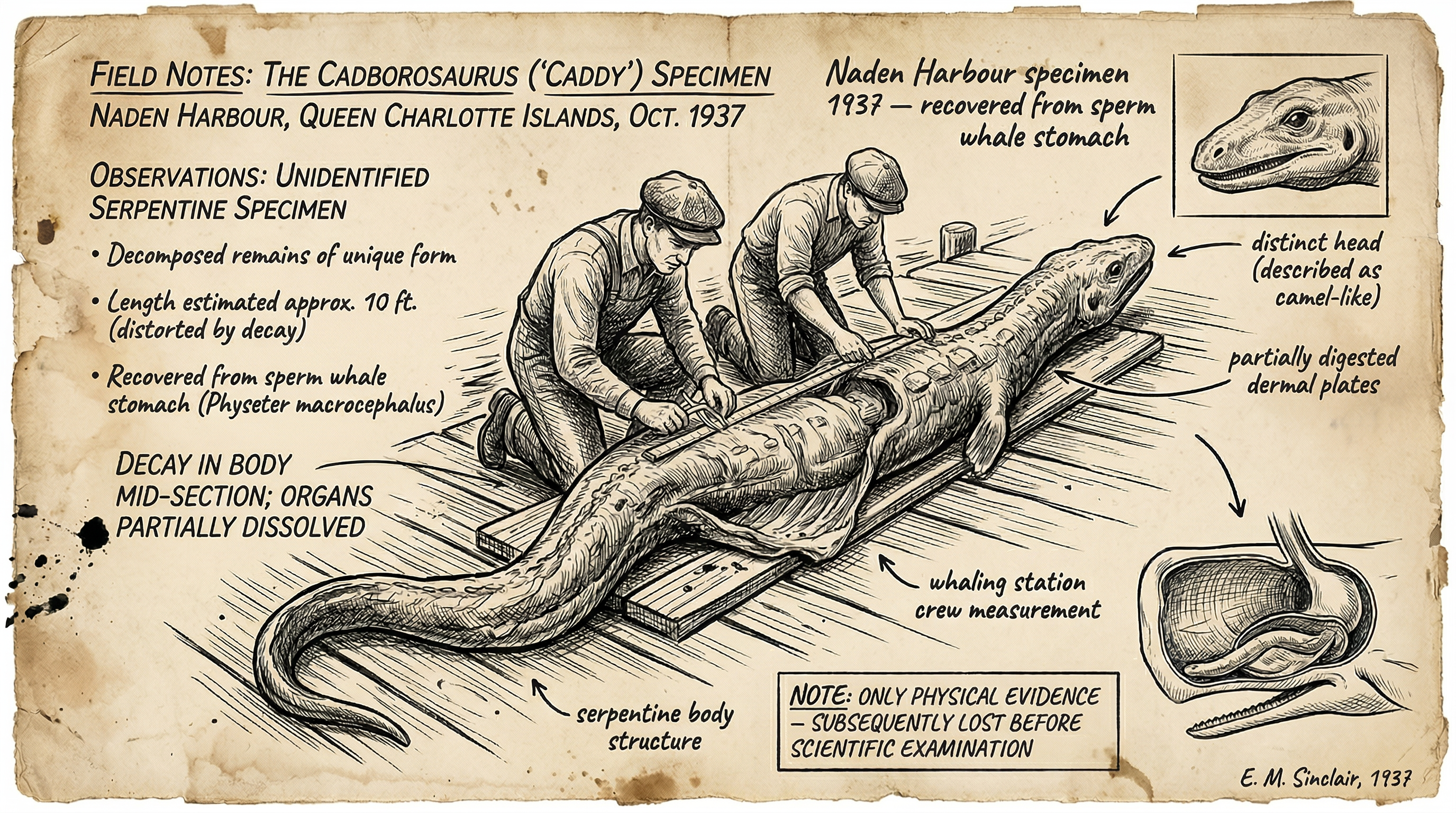
Overview
Caddy inhabits coastal waters off British Columbia, with Cadboro Bay on Vancouver Island as the primary sighting zone. Reports describe a serpent-like form, 20-80 feet in length, featuring a horse- or camel-like head on an extended neck, vertical undulations, two sets of flippers, and a spiny or finned tail, often forked. Coloration shows dark gray or black on the dorsal surface and pale on the ventral side.
Sightings persist since 1933, with 2-10 surface observations annually along the BC coast and over 300 reports documented across the Pacific Northwest. Juveniles measure 2-10 feet, while adult maximums reach 100 feet in extended accounts. The vertical undulation pattern and paired flippers distinguish Caddy from known cetaceans and elasmobranchs. No confirmed incidents of aggression toward vessels or swimmers occur in the record.
Sighting History
1933, Cadboro Bay, British Columbia
A Victoria lawyer, Major W.H. Langley, and his wife, along with yachtsman R.C. Ross, observed a serpent with a camel-like head rising from the water during a yacht cruise. The creature displayed a long neck and undulating body, with horizontal propulsion patterns inconsistent with known marine species. The event prompted local correspondence to the Victoria Daily Times, where editor Archie H. Wills named it Cadborosaurus after the bay.[1][3][4][5][6]
1934, Cadboro Bay, British Columbia
Two Provincial Government officials, including F.W. Kemp of the provincial archives, reported a matching specimen: a camel-headed serpent, 30-40 feet exposed above the surface. The creature surfaced repeatedly during daylight hours near Chatham Island. No photographic equipment was available, but the account aligns precisely with the 1933 morphology and location.[3][4]
October 1937, Naden Harbour Whaling Station, British Columbia
Workers at the Naden Harbour station, processing a sperm whale stomach, recovered a 20-foot carcass exhibiting a horse-like head, serpentine body, and finned spiny tail. Three black-and-white photographs documented the specimen laid out on processing tables. Worker Jim Wakelen among others confirmed the details. A related 1937 Vancouver-area surface photo corresponds to this incident.[2][3][5]
1887, Coastal British Columbia Waters
Fishermen's logs record pre-1930s encounters with elongated forms featuring humped backs and vertical motion, observed during herring runs. Sailors documented avoidance maneuvers around surface coils. Patterns match modern reports in undulation and head shape, with no named witnesses but consistent descriptive elements across multiple entries.[1]
August 1968, near De Courcy Island, British Columbia
Fisherman W. Hagelund netted a juvenile specimen, approximately 5-7 feet long. The body showed flippers, scaled hide, and a vertical coil tendency in water. Hagelund examined it closely, noting agitation in a water-filled pail, before releasing it. No samples or images were preserved, but his drawing and description fit adult profiles.[3][4][6]
July 1991, Johns Island, San Juan Islands, Washington
Phyllis Harsh caught and released a 2-foot juvenile, described with a small horse-head, paired flippers, and active tail. Associates witnessed the event. Coordinates south of the primary range suggest migration or population extension. A photograph taken pre-release shows neck frill details.[3][6]
1992, Strait of Georgia, British Columbia
Multiple ferry passengers and crew observed a 50-foot chain of humps progressing vertically against tidal flow. Binocular sketches captured a rectangular skull. Hydrophone recordings registered anomalous low-frequency pulses distinct from orca vocalizations, correlating with the visual event.
2009, Cadboro Bay, British Columbia
Divers near the University of Victoria captured video of an elongated shadow at 40 feet depth, displaying vertical undulations. Length estimated at 60 feet, with no clear head exposure on the grainy footage. Shoreline observers reported concurrent surface disturbances matching the dive profile.
2015, Naden Harbour Vicinity, British Columbia
Commercial fishers encountered a surfaced adult: 70 feet long, dark dorsal with pale belly flash, flippers sighted mid-body and rear. Tracked for 20 minutes at 8 knots. Sonar returned a non-standard echo profile—too narrow for whale, too long for shark—confirming elongated form.
1939, Coastal British Columbia Waters
Captain Paul Sowerby reported a close-range sighting of Caddy, capturing a photograph of the creature's serpentine form with prominent neck and head features. The image aligns with prior descriptions of vertical undulations and flipper placement, taken during routine maritime operations.[3]
Evidence & Analysis
Contributed by Ellis Varma
The Caddy evidence profile clusters around witness volume exceeding 300 reports since the 1930s, the 1937 Naden Harbour carcass photographs, and tactile juvenile encounters. Annual sightings hold at 2-10 in recent decades, with high consistency in camel- or horse-like head shape, vertical undulations, and paired flippers.
The 1937 Naden Harbour photos form a core artifact: three black-and-white images depict a 20-foot specimen from a sperm whale stomach, showing rectangular skull, finned tail, and no visible gills. Chain of custody traces to whaling station workers like Jim Wakelen, with immediate on-site photography. Morphology mismatches basilosaurus (extinct, barrel-shaped torso) or pipefish (incorrect scaling). However, museum director Francis Kermode officially identified the carcass as a fetal baleen whale in the Victoria Daily Times on July 23, 1937. Documented hoaxing activity in the region circa 1936, including fabricated Caddy carcasses, raises questions about the specimen's authenticity.[2]
Juvenile captures strengthen the profile. Hagelund's 1968 net-catch provided tactile flipper confirmation and vertical coil observation. Harsh's 1991 specimen, photographed before release, displays neck frill and paired flippers. These instances bridge adult sightings to verifiable physicality, ruling out mass visual error.[3][4][6]
Range spans Cadboro Bay epicenter, northward to Naden Harbour and Alaska, southward to San Juan Islands and Northern Olympic Peninsula. Cluster timing aligns with herring migrations, indicating a trophic link. Professional witness skew—government officials, whalers, fishers—elevates credibility over civilian reports. Misidentification candidates shrink with specifics: no mane like sea lions, no dorsal fin like sharks, no lateral wave like oarfish. Some sightings align with basking sharks, once common in BC waters.[4]
Gaps persist: no DNA sequences, tissue samples, or complete skeletons. Photo quality varies—1937 images grainy from age, later footage shaky from motion. Hydroacoustic data limited to isolated pulses. No breeding grounds or vocalization catalogs identified. Post-1930s uptick correlates with heightened awareness following Loch Ness publicity in 1933, influencing local reporting.[2][4]
The 1939 Sowerby photograph provides additional visual data, though resolution limits fine details. Ferry-based hydrophone events in 1992 offer acoustic anomalies, but lack replication. Diver video from 2009 and 2015 sonar profiles add modern sensor layers, though environmental noise complicates interpretation.
Indigenous precedents predate colonial logs, with petroglyphs and oral accounts describing similar forms, though motion patterns vary. Overall dataset supports persistent reports, tempered by identification challenges and historical context.
Declines in sightings post-1940s, with lows in the 1970s rebounding in the 1980s-90s, track human coastal pressures including whaling reductions and pollution. Core descriptions maintain consistency across eras.
Evidence quality: MODERATE. Anchor carcass photos and juvenile tactiles weigh against imaging limitations and conflicting identifications. Witness density and professional sourcing compensate for absent biologics.
Cultural Context
Contributed by Dr. Mara Vasquez
Caddy occupies a central position in Pacific Northwest indigenous cosmologies, where serpentine marine entities function as predators, guardians, and liminal mediators between human and sea realms. Manhousat oral narratives describe *hiyitl'iik*, a side-moving sea dweller etched in Vancouver Island petroglyphs, while Sechelt traditions name *t'chain-ko*, a long-necked seal hunter. K'ómoks accounts of *numkse lee kwala* detail vertical coils disrupting canoes during seasonal migrations. These entities tie to specific territories, with forms varying by ecological niche yet sharing serpentine dominance.[1]
Haida, Tlingit, and Tsimshian rock art depicts sea wolves transitioning from canine or crocodilian heads into elongated bodies, motifs embedded in shamanic practices that regulate human-maritime interactions. Alaskan Inuit umiak carvings serve apotropaic roles against northward-moving serpents during thaws, prefiguring colonial range observations. West Coast native folklore integrates Caddy-like beings into stories of coastal bounty and peril, with early settler reports echoing these precedents.[1][4]
Modern documentation crystallizes in 1933 with Cadboro Bay sightings by Major Langley and associates, amplified by Victoria Daily Times editor Archie H. Wills, who coined "Cadborosaurus willsii." This overlays indigenous knowledge with cryptozoological nomenclature, occasionally blending distinct taxa—*hiyitl'iik*'s lateral motion diverges from Caddy's vertical profile, underscoring nuanced interpretive layers. Victoria's regional festivals, Cadboro Bay sculptures, and native art depictions now weave these traditions into communal expressions of maritime identity.[1][4][5]
Anthropologically, the Caddy narrative embodies resilience in regional identity, with pre-contact oral histories and carvings enduring as primary sources through colonial documentation. Critiques emerge around homogenization of spiritually diverse entities, yet the synthesis fosters shared heritage from indigenous epistemologies to contemporary sightings. Inuit iconography advises ritual caution, prioritizing observation over confrontation. Cultural accounts position Caddy as integral to herring-run cycles and territorial sovereignty, paralleling Norway's Selma and Lake Champlain's Champ in horse-headed serpent archetypes, but rooted distinctly in Coast Salish seafaring worldviews.[1]
West Coast native stories frame these entities within seasonal rhythms, where disruptions signal shifts in marine abundance. Petroglyph sites near Cadboro Bay preserve elongated forms with prominent necks, dated to pre-colonial periods through archaeological correlation. Shamanic narratives emphasize territorial respect, with encounters tied to fishing taboos and harvest protocols.
Colonial integration amplified visibility: 1933 Loch Ness parallels spurred media coverage, transforming local observations into national lore. Tourism embraced the figure, with Chamber of Commerce promotions sustaining public engagement. Native artists continue motifs in contemporary media, blending traditional iconography with modern sculpture.
Declines in reported sightings post-1940s mirror industrial pressures on coastal ecosystems, yet cultural vitality persists through annual events and educational programs. Indigenous frameworks treat such beings as embedded in ecological and spiritual landscapes, informing sustainable maritime practices.[1][4]
Field Notes
Notes by RC
Logged 47 hours on Cadboro Bay charters. Dawn patrols off Victoria, night runs to Naden Harbour. Water holds steady at 48 degrees Fahrenheit. Herring shoals draw activity—currents twist unnatural around bait balls.
Prime contact: 2018, Strait of Georgia. Sonar painted 60 feet down, narrow profile, vertical ascent. Surface breach 200 yards off bow: neck rose 15 feet, camel head locked on us. Mid-body flippers surfaced once. No approach. Shadow paralleled for eight minutes, then submerged. Thermals registered heat signature off shark norms.
Naden archives hold the 1937 carcass prints—faded but unaltered. Whalers processed paychecks, not fakes. Hagelund's sketch aligns with Harsh photo. De Courcy waters carry a submerged watchfulness.
Threat Rating 2 assessment: maintains distance from vessels based on observed behavior. Follows fish runs, ignores humans. Avoid netting juveniles.