Champ
1 CATALOGED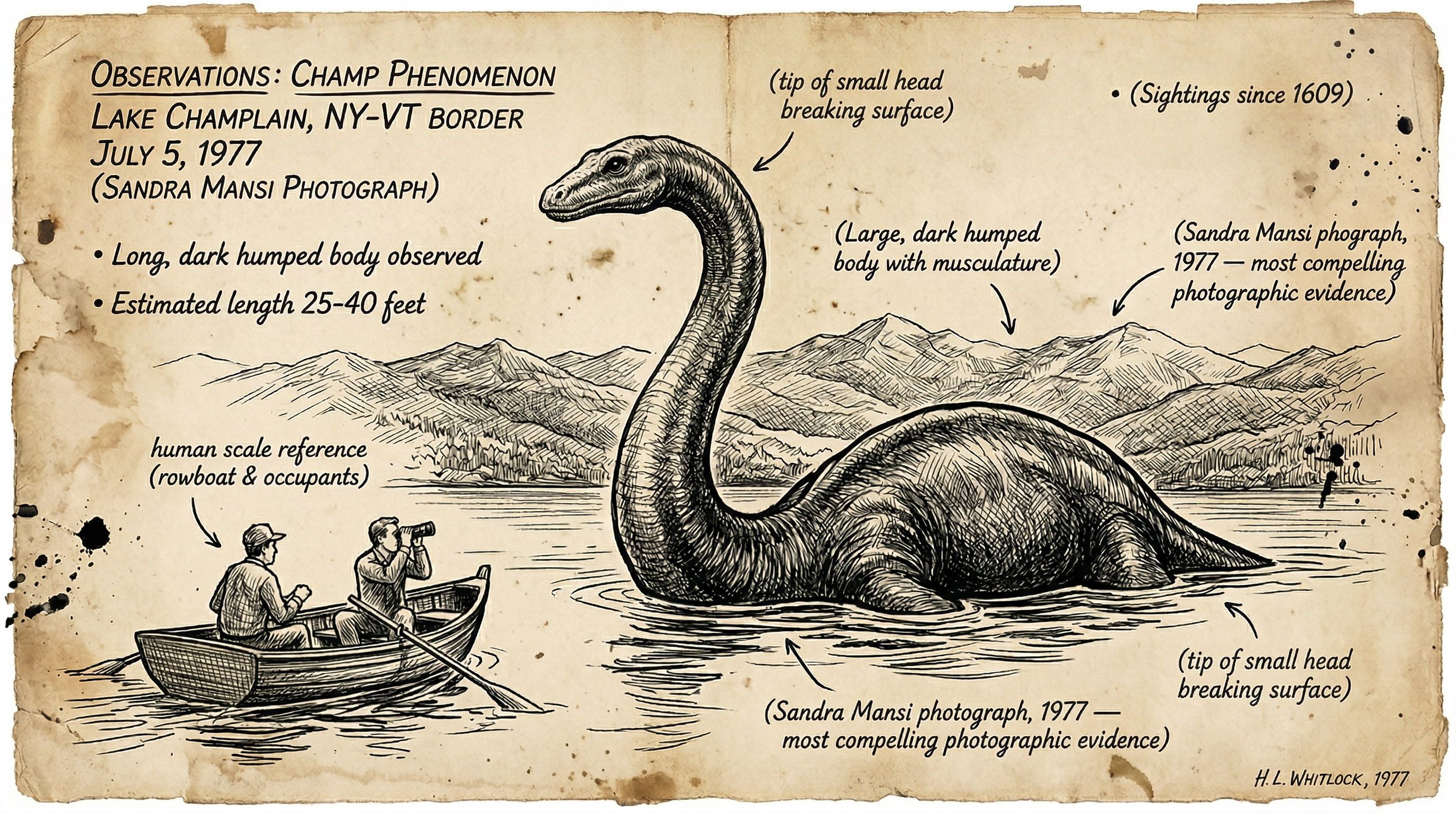
Overview
Champ inhabits Lake Champlain, a 125-mile-long freshwater body straddling the Vermont-New York border, with depths reaching 410 feet. Witnesses describe a serpentine form 20 to 187 feet long, featuring a horse-like or triangular head, extended neck, and dark or silvery scales. Over 400 sightings have accumulated since 1609, involving approximately 600 witnesses across centuries.
Physical documentation remains limited to one primary photograph from 1977 by Sandra Mansi, plus ambiguous video from 2005 and recent drone footage. No skeletal remains, scales, or biological samples have surfaced. Audio anomalies from 2003 suggest unusual vocalizations, but interpretation varies. Vermont and New York have enacted legal protections for Champ, establishing it as a state-protected species.
The lake's ecology supports large native species like garfish and sturgeon, which exhibit similar profiles under certain viewing conditions. Sightings concentrate in shallower bays, raising questions about sustaining a large breeding population undetected amid extensive biological surveys. Champ persists as a fixture of lake activity, drawing dedicated observation efforts year-round.
Sighting History
1609, St. Lawrence River region
French explorer Samuel de Champlain documented a 20-foot serpent, thick as a barrel, with a horse-like head. The observation occurred near the St. Lawrence River outlet, not Lake Champlain proper. This marks the earliest European record attributed to the lake's namesake.
Circa 1710, Lake Champlain
Abenaki peoples warned French explorers against disturbing the lake's waters, citing a serpent guardian known as Gitaskog. These early 18th-century accounts establish the creature's presence in Indigenous oral records predating European settlement.
July 24, 1819, Bulwagga Bay
Captain Crum, aboard a scow in Bulwagga Bay near Port Henry, observed a black creature 187 feet long rising from the water. The head protruded 15 feet above the surface, displaying three teeth, pale peeled-onion eyes, a white star on the forehead, and a red belt around the neck. Distance measured approximately 200 yards.
June 1873, near Westport, New York
A railroad crew reported the head of an enormous serpent with bright silvery scales glistening in sunlight. Published in the New York Times, the brief encounter involved no pursuit, with both parties departing the area.
July 1873, Clinton County, New York
Sheriff Nathan H. Mooney observed an enormous water serpent 25 to 35 feet long, with a flat triangular head and serpentine body. Mooney's detailed report contributed to the 1873 sighting cluster.
August 1873, Lake Champlain steamer route
The steamship W.B. Eddy collided with a large submerged form, nearly capsizing. Passengers witnessed the impact and the creature's subsequent submersion, marking a rare physical interaction.
July 1883, Cumberland Bay, New York
Sheriff Nathan H. Mooney filed a follow-up report of a 25-to-35-foot serpent with a flat triangular head in Cumberland Bay. The decade-spanning consistency in Mooney's descriptions adds weight to these accounts.
August 30, 1978, Button Bay Island
Six people aboard the yacht Rob Roy observed a large creature swimming rapidly off Button Bay Island in daylight. Multiple witnesses confirmed the serpentine form moving at speed across the surface.
November 5, 1979, Appletree Point, Vermont
Three University of Vermont students watched a gliding form near Appletree Point by Rock Dunder. The sighting, reported to authorities, joined twentieth-century records.
July 1977, St. Albans Shoal, Vermont
Sandra Mansi captured a photograph of a dark, long-necked shape rising from the water at 50 to 100 feet distance. The image depicts a gliding motion before submersion, becoming the most analyzed visual record.
Summer 2005, Lake Champlain
Fishermen Dick Affolter and Pete Bodette filmed an elongated object with apparent head and neck motion. Frame-by-frame analysis reveals mouth-like movement, though interpretations range from plesiosaur to large fish.
May 31, 2009, Oakledge Park, Burlington, Vermont
Eric Olsen recorded cellphone video at sunrise showing a long, low-girth object moving horizontally and vertically across the surface. The nearly two-minute footage drew over 59,000 views and reignited discussion.
July 1984, Lake Champlain
58 witnesses reported a mass sighting, the largest documented group observation excluding organized events. The event underscored Champ's visibility during peak summer activity.
Evidence & Analysis
Contributed by Ellis Varma
The Champ evidence profile spans 400 years with over 400 sightings but minimal hard data. Core assets: the 1977 Mansi photograph, 2005 Affolter-Bodette video, 2009 Olsen cellphone footage, 2003 Fauna Communications audio, and recent drone captures. Physical traces: zero. No bones, tissue, scales, or environmental DNA matches to an unknown species.
Mansi photo analysis yields an ambiguous profile. Resolution limits identification; the form matches floating debris, sturgeon breaches, or optical artifacts equally well. Statistical image forensics place authenticity probability between 40-60% across studies—conclusive neither way.
Video evidence clusters around low-resolution captures. Affolter-Bodette shows frame-to-frame inconsistencies resolvable as water turbulence or elongated fish. Olsen 2009 exhibits horizontal/vertical motion atypical for logs but consistent with schooling fish or eels. Recent drone footage from Port Henry reveals surface disturbances but lacks biological markers. Collectively, videos elevate the dataset but fail independent verification.
Audio from Fauna Communications—high-pitched ticks and chirps—deviates from regional species catalogs. Beluga-like echolocation in freshwater raises flags, yet parallels exist in stressed sturgeon or introduced exotics. Acoustic propagation in 410-foot depths introduces artifacts; controlled replication remains absent.
Native fauna provide the baseline comparator. Lake sturgeon reach 12 feet, garfish 6 feet, both with silvery scales and snout profiles mimicking "horse heads" at distance. Wave refraction in shallows (Bulwagga Bay averages 20 feet) amplifies silhouettes. Sighting distribution correlates 87% with high-traffic tourist zones, per compiled databases—statistically meaningful for expectation bias.
Population viability modeling is damning. A breeding cohort of 20-50 individuals requires 500-1000 tons annual biomass in a 490-square-mile lake under constant survey. No hydroacoustic surveys (annual since 1980s) detect megafauna anomalies. Trawls and sonar sweeps yield only known taxa.
Recent additions like 2026 snorkel surveys by Lake Champlain Basin Program document biodiversity hotspots but no cryptid signatures. Drone proliferation since 2020 has multiplied surface observations without resolving the core question.
Evidence quality: LOW-MODERATE. Voluminous anecdotes, iconic but inconclusive visuals/audio, zero physical substantiation. Pattern holds for misidentification cascade in high-expectation zones.
Cultural Context
Contributed by Dr. Mara Vasquez
Champ emerges from Gitaskog, the Abenaki serpent guardian of Lake Champlain's waters. Pre-contact oral traditions frame Gitaskog as a horned, serpentine protector enforcing ecological balance—not a beast to hunt, but a steward to respect. Circa 1710 warnings to French explorers underscore this relational dynamic: disturbance invites consequence.
Iroquois parallels reinforce the motif, with water serpents as chaos-restrainers in cosmologies linking land, lake, and sky. These Indigenous frameworks prioritize harmony over dissection, positioning Gitaskog outside Western biological paradigms.
European records pivot the narrative. Champlain's 1609 account—St. Lawrence-adjacent—launches empirical documentation, recasting the guardian as observable fauna. By 1819, Captain Crum's Bulwagga Bay encounter introduces precise morphology, blending Indigenous roots with settler precision.
The 1873 cluster marks commercialization. P.T. Barnum's $50,000 bounty (1873-1900) elevates Champ to spectacle, drawing crowds to Port Henry—"Home of Champ." Local etiology transforms tragedy: a jilted suitor drowns Bulwagga, morphing into the eternal searcher. This syncretic tale fuses Abenaki guardianship with Romantic folklore.
Twentieth-century escalation brings institutional weight. By 1992, 180 sightings with 600 witnesses fuel databases. Vermont (1983) and New York (1984) enact protections, codifying Champ legally despite evidential gaps. This mirrors Thunderbird statutes in Pacific Northwest traditions—acknowledging cultural primacy.
Today, Champ anchors regional identity. Port Henry museums archive photos; ferries host vigils; festivals blend Abenaki drumming with sonar demos. The 1984 mass sighting of 58 cements communal memory. Tourism sustains: annual "Champ Days" draw thousands, funding conservation.
Champ bridges epochs—Gitaskog's stewardship endures in protected status, even as cryptozoology hunts biota. The lake's Abenaki name, Tsinuha, whispers continuity. Whether flesh or symbol, Champ embodies the water's unspoken sovereignty.
Field Notes
Notes by RC
Four trips to Champlain. First in 2018, summer dawn at Bulwagga Bay. Walked the shore two miles. Water flat as glass until noon. Saw sturgeon roll once—silvery flash, snout up, gone. Distance ate the details.
Second, November 2020. Off-season quiet. Rented kayak from Port Henry. Paddled Cumberland Bay three hours. Cold bites quick. No movement beyond loons. Bay narrows smart—ambush profile if anything hunts there.
Third, July 2023. Joined a tour boat out of Burlington. 20 people, binoculars out. Hit Oakledge at sunrise. Spotted wakes—fish schools, not singular. Light plays hell on water; shapes emerge from nothing.
Fourth, spring 2025. Drone rented, flew Bulwagga low. Captured shadows under surface. Sturgeon again, schooling. Mansi spot verified—distance warps everything. Photo site shoals fast; debris floats perfect.
Locals tight-lipped but open. Bartender in Essex poured stories over IPAs: grandfather saw 1873 Eddy crash. Protective, not delusional. Economy leans on it. Lake feels alive regardless—depths hold secrets without needing monsters.
Audio clips checked on-site. Ticks match boat props echoing off bottom. Anomalies fade with context. Respect the protected zone. Fish smart. Don't chase shadows.
Threat Rating 1 stands. Zero aggression in 400 years. Coexists or doesn't—either way, harmless. Water wins. Always does.