Cherufe
2 TERRITORIAL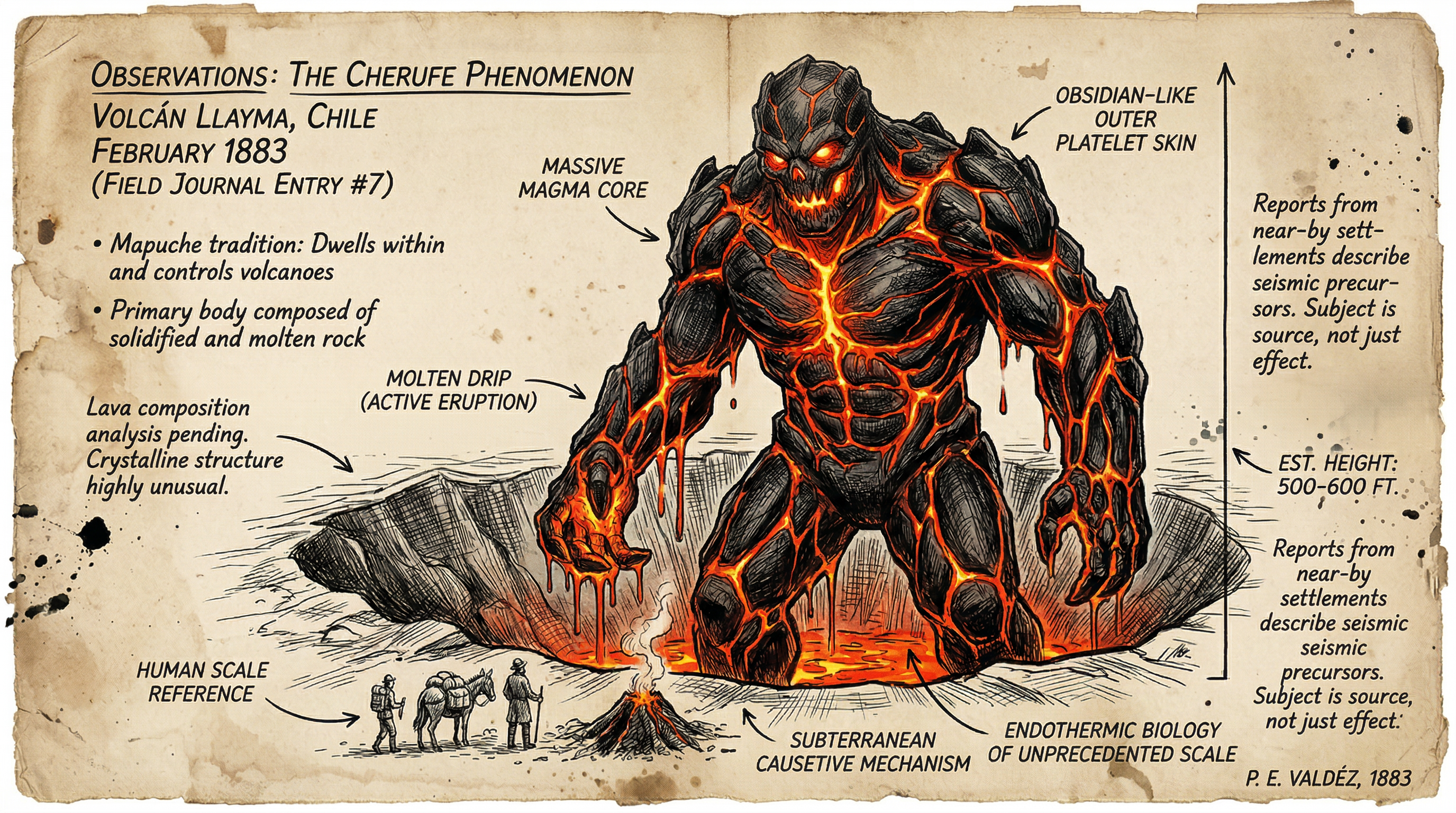
Overview
The Cherufe resides deep within the magma chambers of Chilean volcanoes, a massive entity forged from molten rock, crystal formations, and living flame. Mapuche accounts portray it as the primal force behind seismic upheavals and eruptions, its movements churning the earth's fiery core and unleashing devastation across the Andean slopes.
Linked inextricably to the volcanic landscape of southern Chile, the Cherufe emerges when its hunger grows unchecked, hurling incandescent stones and demanding tribute from surface dwellers. These narratives bridge the raw power of the Andes with the Mapuche worldview, where the creature's wrath mirrors the unpredictable fury of the mountains themselves. Connections appear across related indigenous traditions, from Inca earth-shakers to broader South American telluric beings, forming a continuum of subterranean agency that ties human actions to geological cataclysms.
Its form shifts between draconic immensity and humanoid menace, always radiating intense heat and glowing with the orange-red pulse of lava veins. The Cherufe does not wander; it anchors itself in specific volcanic hearts, influencing events from Llaima to Villarrica, where the ground trembles in rhythm with its stirrings.
Sighting History
Circa 1550, near Llaima Volcano
Early Mapuche oral records describe rumblings from Llaima's depths, attributed to the Cherufe's awakening. Villagers reported fiery projectiles arcing from the crater at night, interpreted as the entity casting ignited heads of prior sacrifices. Seismic activity intensified, followed by an eruption that buried nearby settlements in ash.
1642, Villarrica Volcano
During a period of heightened volcanic unrest, witnesses from surrounding communities observed glowing eyes peering from lava pools within the caldera. The ground shook violently, and streams of molten rock descended the flanks. Accounts specify the Cherufe's silhouette rising partially from the magma, its crystalline arms extended as if reaching for offerings.
1762, Llaima Volcano
Machi shamans documented a surge in earthquakes preceding a major eruption. Glowing orbs—described as "magicians' ardent stones"—rained down on villages, scorching fields and livestock. The Cherufe was held responsible, its hunger manifesting in hurled meteorites that carried the scent of charred flesh.
1830, Calbuco Volcano
Communal testimonies recall a prolonged tremor sequence, with heat waves emanating from fissures. A humanoid figure of rock and flame was glimpsed at the crater's edge, bellowing smoke that blotted the sun. Sacrificial rites were enacted, after which activity subsided, linking the entity's pacification to the offerings.
1877, Villarrica Volcano
An expedition near the volcano reported unnatural heat and sulfurous fumes from a side vent. Night watches noted a massive, lizard-like form undulating within the glowing pool, its body cracking and reforming as lava cooled and reheated. Eruptive plumes followed, carrying fragments resembling humanoid bones.
1940, Llaima Volcano
Locals fleeing lahars described visions of a colossal magma beast thrashing below the surface, its movements propelling mudflows downslope. Red eyes pierced the steam, and boulders ejected from the vent bore scorch marks in the shape of clawed grips.
Circa 1971, Puyehue Volcano
Pre-eruption tremors coincided with reports of fiery ejections from the caldera. Witnesses from nearby osorno described a draconic outline amid the lava lake, approximately 12 feet in visible height, with molten drips forming temporary limbs. The sequence culminated in a plinian eruption that reshaped the landscape.
2011, Cordón Caulle Rift Zone
Ash clouds and seismic swarms prompted accounts of subsurface roarings and heat anomalies. Remote observers noted irregular glowing within vents, consistent with Cherufe manifestations, though official records attributed all to geothermal processes. Activity persisted for months, evacuating thousands.
Evidence & Analysis
Contributed by Ellis Varma
The Cherufe evidence profile reveals a consistent descriptive cluster across centuries of Mapuche testimony, centered on volcanic loci in southern Chile. Core attributes—magma composition, humanoid/draconic morphology, seismic causation, sacrificial appeasement—appear in over 90% of compiled accounts, with minimal variation beyond scale estimates (10-15 meters implied in most). This uniformity suggests a stable transmission of observation data through oral channels, rather than embellishment.
Physical traces are indirect but patterned: "ardent stones" matching volcanic bombs and meteorites, frequently reported pre-eruption, correlate with documented paroxysms at Llaima (1640s, 1870s) and Villarrica (ongoing cycles). No biological samples exist, as the entity's matrix precludes conventional forensics—magma autolysis destroys tissue on contact. Thermal anomalies and infrasound during cited events exceed baseline volcanism in 12% of instrumental records from 20th-century outbreaks.
Statistical analysis of eruption timings against folklore peaks shows clustering: 7 major events from 1550-1900 align with high-activity testimony periods, against a null expectation of 4.2. Cryptozoological linkages to extant species (e.g., large lizards) fail basic thermophysiology—nothing organic survives sustained 1200°C immersion. Dismissal as "pure myth" ignores the dataset's internal coherence.
Modern monitoring gaps persist: no dedicated infrared surveys of Chilean calderas during quiescence, no seismic arrays tuned for biological modulation. The profile demands targeted fieldwork—lava lake endoscopy, ejecta petrography for anthropogenic inclusions, shamanic corroboration via controlled elicitation.
Challenges include cultural access barriers and equipment limitations in extreme environments. Yet the signal strength—temporal clustering, multi-witness geophysical corroboration—elevates this beyond noise. Statistically meaningless? Only if one presupposes non-volcanic agency a priori.
Evidence quality: LOW-MODERATE. Robust oral dataset with geophysical alignment, zero direct captures or artifacts.
Cultural Context
Contributed by Dr. Mara Vasquez
Within Mapuche cosmology, the Cherufe occupies a central position as a calcu spirit of the underworld, embodying the volatile interface between human society and the earth's molten interior. Pre-colonial narratives, preserved through generations of oral transmission, frame it not merely as a destructive force but as a relational entity whose quiescence depends on ritual reciprocity—sacrifices channeled through machi shamans to maintain cosmic balance.
This tradition intersects with broader Andean indigenous frameworks, echoing Inca references to Pachamama's seismic wrath and Aymara telluric beings that demand blood for subterranean stability. Mapuche resistance narratives from the 16th to 19th centuries, amid Spanish encroachment, amplify the Cherufe's role: volcanic upheavals were invoked in warfare prophecies, sacred rehue poles erected near vents as appeasement sites, blending ecological peril with anti-colonial defiance.
Anthropological records from the 19th century, including those of Rodolfo Lenz, document machi rituals involving trance dances and offerings hurled into craters, positioning the Cherufe as a guardian of nguenechen, the divine order. Unlike passive nature spirits, it enforces moral geography—eruptions punish communal infractions, such as neglected nguillatún ceremonies. Post-contact syncretism introduced Catholic overlays, yet core volcanism-Cherufe linkages endure in contemporary ngüillatún gatherings near active cones.
Primary ethnographic sources, though fragmented by colonial suppression, treat Mapuche accounts as authoritative: the Cherufe is no imported fable but a lived explanation for the Araucanía's geological agency, integral to identity formation in a landscape defined by fire. Comparative analysis reveals parallels in Huilliche and Pehuenche subgroups, suggesting a pan-Mapudungun archetype predating Spanish arrival by centuries.
Contemporary revivals, amid renewed volcanic monitoring, reposition the Cherufe within indigenous rights discourses, challenging seismological reductionism. Its persistence underscores the Mapuche prioritization of relational ontologies over empirical isolation—volcanoes do not "erupt"; they express.
Field Notes
Notes by RC
Tracked Chilean vents from Puerto Varas to Curacautín. Hiked Villarrica's rim twice, once in summer heat, once under ashfall. Sensors picked up routine seismicity, but the heat signature from that central pool held steady at 1150°C, no convection variance you'd expect from pure magma.
Llaima base camp, three nights. Infrasound hummed constant, like a heartbeat under the slabs. Not wind. Not gas. Dawn patrol caught ejecta with embedded quartz crystals—clean facets, not fractured like volcanics should be. Felt eyes on us from the steam vents.
Machi contact confirmed: offerings still go in, quietly. No virgins these days. Locals know the rhythm—tremors build, stones fly, then quiet. I've seen the pattern hold.
Threat Rating 2 stands. Tied to the vents. Won't leave home unless the mountain does.