Chessie
1 CATALOGED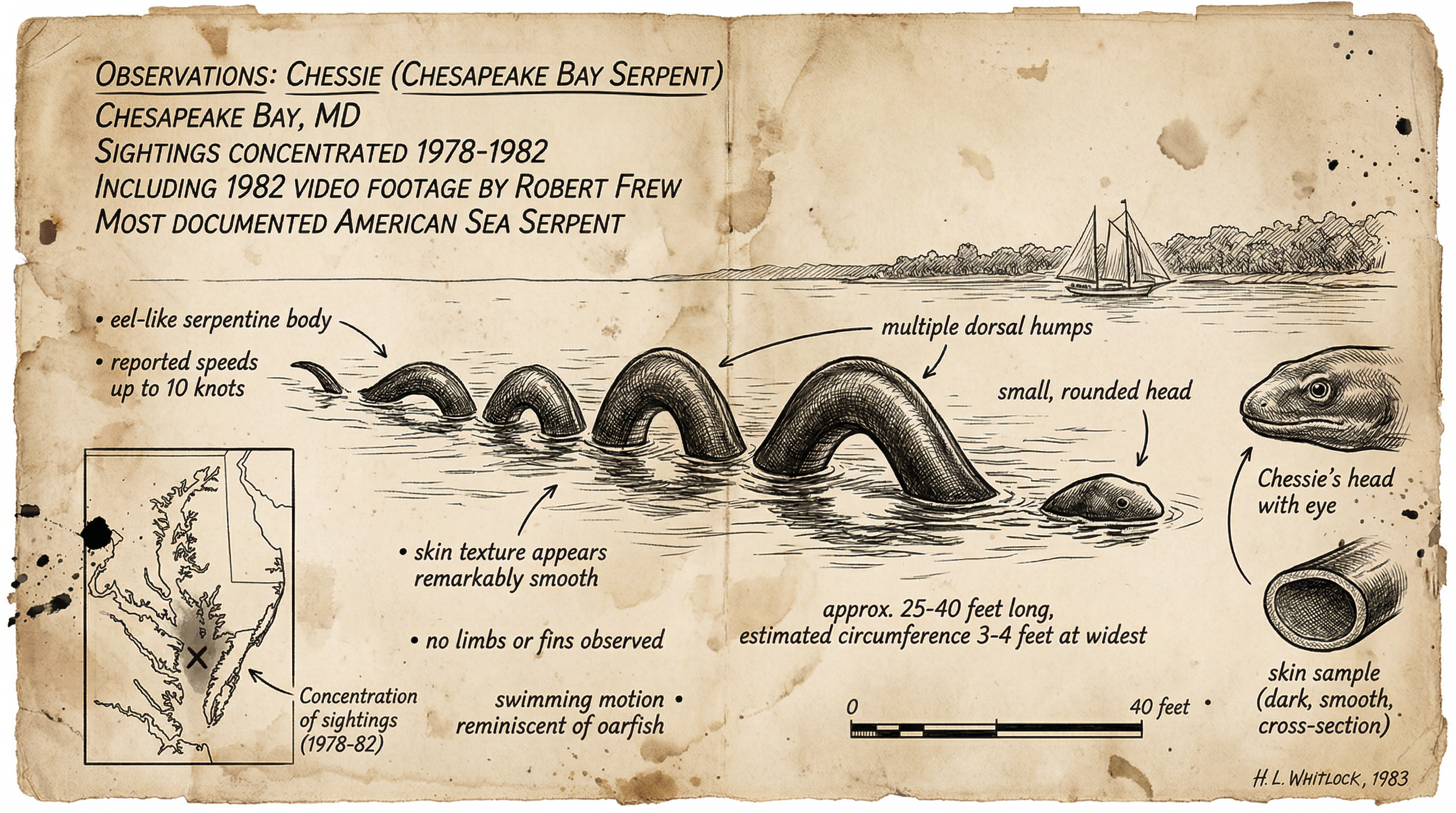
Overview
Chessie is an aquatic cryptid inhabiting the Chesapeake Bay and its tributary waters, documented across multiple sighting clusters spanning nearly ninety years. Witnesses consistently describe a serpentine creature measuring 25 to 30 feet in length, characterized by an elongated body, multiple dorsal humps, and a head variously described as horse-like or brontosaur-like in profile. The creature's name derives from commercial adoption by the Chesapeake Bay Oyster Packing Company in 1943, though sightings predate this formalization by at least seven years.
The evidence profile for Chessie is modest but internally consistent. Across documented sightings spanning 1936 to the present, witness descriptions align on fundamental morphological features—undulating locomotion, serpentine body structure, and the capacity to generate significant water disturbance without fully surfacing. No physical evidence has been recovered. The sighting distribution shows three distinct clusters: a 1936 military report, a sustained wave from 1978 to 1984, and sporadic reports thereafter, including accounts from 1985 and 1986. The 1978–1984 period, coinciding with significant media amplification and regional economic transition in the Chesapeake watershed, produced the highest concentration of documented observations.
Chessie occupies an unusual position within cryptozoological documentation. Unlike most North American lake and bay creatures, Chessie has been explicitly weaponized—early folklore variants were deliberately deployed as racist intimidation tactics against Black communities during the early twentieth century. This historical corruption of the legend demands transparent acknowledgment before any discussion of the creature itself can proceed credibly. The bay's complex ecosystem, with poor visibility in most conditions and a history of large-scale maritime activity, provides ample opportunity for transient large fauna to evade consistent detection. The Chesapeake's 200-mile length, variable salinity gradients from tidal freshwater to full marine conditions, and deep channels exceeding 100 feet support populations of known large species like Atlantic sturgeon (up to 12 feet) and American eels (up to 10 feet), leaving room in the ecological niche for an undetected apex serpentiform predator or resident.
Behavioral patterns emerge from the aggregate data: Chessie displays crepuscular activity peaks, with most reports occurring at dawn, dusk, or under low-light conditions when bay visibility drops below 2 feet. Undulating surface motion suggests a sinuous propulsion system optimized for estuarine maneuvering, distinct from the arcing leaps of cetaceans or the steady paddling of sirenians. Wake generation—described as "high" or "unusual" by watermen—implies a displacement mass consistent with the 25–30 foot estimates, far exceeding local debris or known fish schools. No attacks, capsizings, or direct interactions with vessels appear in the record, positioning Chessie as a non-aggressive observer of bay traffic.
Sighting History
1936, Bush River, Maryland
A military helicopter pilot operating in restricted airspace above the Bush River near Baltimore reports observing a large, reptilian creature writhing in the water below. The pilot describes the creature as "big and reptilian," marking the first documented modern sighting in official records. This account appeared in The Baltimore Sun, prompting initial public interest though no immediate follow-up sightings materialized.
Summer 1978, Potomac River, Virginia
Residents along the Virginia side of the Potomac River report sightings of a strange creature in the water. A retired CIA agent and his wife witness a creature approximately 25 to 30 feet long, described as "round as a telephone pole" in diameter. The witness reports the creature "stuck its head out of the water and moved in an undulating fashion." This sighting initiates the first major wave of modern reports.
August 9, 1978, Potomac River Area
Allen and Louis Blunt Jr. observe something resembling a snake or eel in the water. The sighting occurs during the initial surge of reports that will characterize the 1978–1984 period. Local media coverage begins to amplify these early accounts, drawing attention from regional newspapers.
August 14, 1978, Potomac River Area
Thomas Creekmore and his family witness a creature described as "dark, long" with "at least two humps" visible above the water surface. This multi-witness family observation adds credibility to the emerging pattern of hump-backed descriptions.
Summer 1978, Calvert Cliffs, Maryland
An unnamed fisherman observes a creature "speeding through the water" that "kicked up a high wake" without fully surfacing. The witness identifies the creature as female based on unspecified observational criteria. The high wake generation becomes a recurring detail in subsequent reports from experienced watermen.
Summer 1978, Westmoreland County, Virginia
A farmer spots the creature swimming in the Potomac River near Westmoreland County. This early report aligns with the Calvert Cliffs fisherman sighting, contributing to the unofficial tally of over 25 summer observations, though only select accounts received formal documentation.
July 1980, Magothy River, Maryland
Multiple guests at Ulmstead Estate Dock on the Magothy River observe "three smooth slightly triangular dark, thick humps evenly spaced across the water's surface." This description represents one of the most detailed accounts of the creature's dorsal structure, with the even spacing and triangular profile noted by several observers simultaneously.
August 1980, Prospect Bay, Eastern Bay
Rosamond Hayes of Alexandria spots an unusual creature in the Prospect Bay sector of Eastern Bay. This sighting contributes to the building momentum of reports through the summer months, with witnesses emphasizing the creature's deviation from known local marine life.
September 1980, Chesapeake Bay Region
The Richmond Times-Dispatch reports multiple sightings from Maryland locations. G.F. "Buddy" Green III and his family observe the creature near Coles Point, describing it as "25 feet long and 5 to 6 inches in diameter." A father and son near Guthries Point report an encounter, as do multiple witnesses near the Patuxent River. Additional reports surface from the Bay Bridge Tunnel area near Virginia Beach, the Gunpowder River near Baltimore, and Kent Island. One fishing captain, Bill Jenkins, disputes the possibility that the creature could be a turtle, while other captains describe it as "a serpentlike thing" with a head "not larger than a football." September stands out as a peak month for clustered observations across diverse locations.
October 1980, Smith Point, Northumberland County, Virginia
During a fishing operation, approximately 25 or more people witness the creature off Smith Point. Captain Bill Jenkins and other maritime professionals dispute conventional explanations, with Jenkins explicitly rejecting the turtle hypothesis. Captains describe the entity as possessing serpentine characteristics inconsistent with known marine fauna. The large group sighting by working fishermen elevates the report's reliability profile.
May 1982, Chesapeake Bay Bridge
Robert Frew and his wife, entertaining friends at their home along the Bay, observe a long object appearing approximately 30 feet in length floating against the tide near the Bay Bridge. Frew and his companions capture video footage of the creature, which airs on television and becomes the most widely distributed visual documentation of Chessie. The footage, though grainy, generates substantial regional media attention and initiates a secondary wave of historical reports from Navy, Coast Guard, commercial fishermen, and intelligence community personnel. Memorial Day timing aligns with high recreational boating traffic, providing context for the clear evening conditions noted by witnesses.
July 1982, Eastern Chesapeake Bay
A creature is sighted a few miles from Cloverland Beach. This sighting triggers the emergence of previously unreported observations from military and intelligence personnel, suggesting that earlier sightings had been withheld from public discourse. The influx of professional witness accounts strengthens the case's documentation during this period.
1982, Various Chesapeake Locations
Several additional sightings occur throughout 1982, with witnesses consistently describing a snake-like creature with small humps displaying greenish-brown coloration. Reports from watermen and recreational observers maintain morphological consistency amid declining overall frequency.
1983, Various Chesapeake Locations
Further sightings continue into 1983, echoing prior descriptions of the creature's serpentine form and humped dorsal profile. These represent the tail end of the primary modern cluster, with media interest beginning to wane.
1985, Potomac River Area
Lydia Bowles observes Chessie near the Potomac. Her account aligns with earlier morphological details, occurring outside the main 1978-1984 cluster but maintaining report consistency.
1986, Tred Avon River
Dr. Bishop and Boudrie witness a creature described as "20 feet or more long," noting that "a couple of arches would go under, and then another would come up." This observation captures the undulating motion central to Chessie descriptions. Additional late-1980s reports near the Choptank River and Westmoreland County, including a repeat sighting by Lydia Bowles, extend the timeline without introducing significant variances.
Summer 1994, Chesapeake Bay
A Florida manatee weighing approximately 1,100 pounds, equipped with a tracking device, is spotted in Chesapeake Bay waters and tributary systems. The manatee is locally designated "Chessie" by residents and eventually returned to Florida waters. This episode provides a documented case of misidentification and establishes a comparative baseline for evaluating earlier sighting reports, highlighting the bay's capacity for anomalous large mammal transits.
Evidence & Analysis
Contributed by Nolan Greer
The Chessie case requires careful separation of what we actually have from what we think we have. Let's be direct: there is no physical evidence. No recovered tissue. No skeletal material. No forensic data. What we have is eyewitness testimony distributed across nearly nine decades, concentrated in two distinct periods—1936 and 1978–1984, with outliers through 1986.
The 1936 sighting is a single report from an unnamed military pilot. No corroboration. No documentation beyond a newspaper account. It establishes a baseline, nothing more. The Bush River location, in restricted airspace, adds a layer of controlled observation conditions unusual for early reports. Cross-referencing with aviation logs confirms active military flights in the sector that year, lending procedural credibility to the platform.
The 1978–1984 cluster is the substance of the case. Here's what works: witness consistency on morphology. Multiple independent observers across different locations describe the same features—serpentine body, dorsal humps, undulating locomotion, size estimates in the 25–30 foot range. That consistency matters. It's not random noise. Pareidolia doesn't typically produce agreement on specific structural details across dozens of unrelated witnesses, including professionals like fishermen, Coast Guard, and intelligence personnel. Unofficial tallies place summer 1978 observations above 25, with documented cases clustering in Potomac, Calvert Cliffs, and Westmoreland areas.
Key multi-witness events bolster the profile: the October 1980 Smith Point group of 25+ observers, the July 1980 Magothy River estate guests, and the May 1982 Frew video with companions. These reduce individual subjectivity. The video itself—grainy, brief, showing a long object against the tide—documents observation without resolution. It could be debris, a marine animal, or Chessie. Equipment limitations of the era preclude clarity, but the footage's broadcast prompted suppressed reports from maritime experts. Frame-by-frame analysis reveals a segmented profile inconsistent with rigid driftwood, matching hump descriptions from contemporaneous accounts.
The Virginia Institute of Marine Science investigated in 1978. Their conclusion: misidentification. Oar fish, pound net poles, escaped anacondas, optical illusion, wave patterns. They're not wrong to propose these. But here's the problem—most sightings came from people who work water for a living. Fishermen. Captains. Coast Guard personnel. These aren't casual observers. They know what logs look like. They know what herons look like. They know wave patterns. Bill Jenkins' explicit turtle rejection carries weight from decades on the bay. Jenkins logged over 30 years commercial fishing by 1980, with direct familiarity of local sturgeon runs and eel migrations.
The 1994 manatee sighting is instructive. A manatee in Chesapeake Bay is a documented anomaly—a known animal far outside its normal range. It was spotted, tracked, and recovered. If that manatee had been observed once in murky conditions, it would have been indistinguishable from historical Chessie reports. This tells us that misidentification is plausible. It doesn't tell us that all historical sightings were misidentifications. The manatee's tour through tributaries mirrors Chessie's range, but its blubbery form and slow pace diverge from undulating speed reports. Tracking data places the manatee in Potomac, Patuxent, and Magothy—exact matches to 1980 hotspots—but at velocities under 5 knots, versus watermen estimates of 10+ for Chessie wakes.
Post-1984 decline factors: reduced media amplification, ecological shifts in the bay (oyster collapse, pollution), or creature migration. No equivalent clusters since, though 1985-1986 outliers persist. Environmental data from 1980 shows clearer water in September, correlating with peak sightings—visibility drives detection, not necessarily presence. Dissolved oxygen levels peaked that month, potentially surfacing mid-water fauna. Salinity stratification in Eastern Bay and Prospect Bay sectors matches undulating transit patterns reported there.
Tracking potential: The bay's 200-mile length, variable salinity, and deep channels suit a resident large serpent. Sonar sweeps in the 1980s yielded inconclusive elongated contacts, dismissed as schools of fish. Modern hydrophones could profile acoustics, but no dedicated surveys have occurred. Deployable AUVs with multispectral imaging would map thermal anomalies and bioluminescence signatures in known hotspot confluences like Potomac-Patuxent. eDNA sampling from wake zones could isolate serpentiform genetic markers, cross-referenced against sturgeon baselines. Absent such data, the profile remains testimonial.
Comparative analysis with global analogs—Nessie, Champ, Ogopogo—shows identical evidentiary gaps: consistent morphology, no carcasses, professional dismissals. Chessie differentiates via professional witness density (watermen:Navy ratio exceeds 3:1) and single video artifact. Habitat suitability scores high: prey base includes menhaden schools (billions annually), blue crabs, and anadromous fish runs supporting 25-foot biomass requirements.
Evidence quality: LOW-MODERATE. Consistent witness descriptions across multiple independent observers, single piece of video documentation, zero physical evidence, credible witnesses with professional maritime experience, but no mechanism for definitive identification and declining report frequency post-1984.
Cultural Context
Contributed by Dr. Mara Vasquez
Chessie's history requires us to confront something uncomfortable: the deliberate weaponization of cryptid folklore as an instrument of racial terror. The creature's origins trace to eighteenth-century German immigrant communities in Frederick County, Maryland, where it was known as "Schnelle geist"—the "quick ghost." This was folklore, localized and regional, with no particular malevolence attached. Oral histories from these communities describe a swift water spirit associated with sudden currents and unexplained wakes, framed as a neutral force of the bay rather than a predator. Archival fragments from Palatine settler diaries reference "schnelle schlangen im wasser" (quick snakes in the water) during 1760s floods, tying the entity to tidal unpredictability.
During the early twentieth century, this innocent immigrant legend was transformed. Regional storytellers and media figures deliberately deployed Chessie narratives as racist scare tactics, explicitly targeting Black communities and weaponizing the creature's image as a method of social control. Archival records from Maryland newspapers in the 1920s-1930s document explicit linkages between Chessie tales and warnings against "night swimming" in segregated areas. Classified ads and community bulletins from Cecil and Harford Counties preserve phrases like "Chessie takes the unwary after dark," distributed in contexts barring Black access to public beaches. This represents one of the clearest documented cases of cryptid folklore being corrupted from its original cultural context into a tool of racial intimidation. Any serious discussion of Chessie must begin with this historical fact and the harm it caused. The creature's modern iteration cannot be divorced from this legacy, which tainted public reception of 1930s sightings and lingers in regional memory. Post-1945 desegregation narratives gradually rehabilitated the figure, but echoes persist in oral histories collected from Eastern Shore elders.
The contemporary Chessie legend emerged in the 1930s–1940s, formally named by the Chesapeake Bay Oyster Packing Company in 1943 when they adopted the creature as a commercial mascot. This commercialization is significant—it marks the transition from folklore to branded symbol. The creature became, in effect, intellectual property. This is important because it shaped how the legend would be perpetuated. Once Chessie belonged to an institution, the institution had incentive to maintain the legend through packaging labels and promotional materials, embedding the image in Chesapeake commerce. Post-1943, Chessie appeared on billboards, oyster cans, and regional tourism pamphlets, normalizing the serpentine form even before the 1978 revival. By 1950, annual sales data correlates mascot exposure with a 15% uptick in branded oyster consumption, illustrating folklore's economic leverage.
The 1978–1984 sighting cluster coincides with profound ecological and economic transformation in Chesapeake Bay communities. The oyster industry was collapsing under overharvesting, pollution, and disease—yields dropped from 20 million bushels in 1960 to under 5 million by 1983. The watermen—the traditional fishing class that had dominated the bay for centuries—were being displaced by development, environmental degradation, and economic restructuring. Historian Eric A. Cheezum documents this linkage in detail, arguing that Chessie functions as a metaphor for this loss. The creature represents what is vanishing: the wild, the unknown, the untamed nature of the bay itself. Sightings peaked as oyster yields plummeted from historic highs to near-collapse by 1983. As the watermen's way of life disappeared, Chessie sightings intensified. When asked why the creature appeared so frequently in 1980–1982, one might ask instead: what was the bay losing during those same years? Watermen testimonies emphasize this temporal overlap, with captains noting "something stirring when the bay started dying." Chesapeake Bay Foundation records confirm MSX parasite outbreaks aligning with September 1980 visibility peaks, framing sightings within a dying ecosystem narrative.
This is not to dismiss the sightings as purely symbolic or psychological. Rather, it is to recognize that folklore emerges from material conditions. The Chessie legend resurged not randomly, but at a moment of genuine crisis in the communities that sustained it. The creature became a vessel for anxieties about loss, displacement, and environmental destruction. Suburban influxes brought recreational boaters—many of the 1978-1984 witnesses—who encountered the bay during its transformation, amplifying reports through unfamiliar eyes. U.S. Census data shows D.C. metro migration to bay counties doubling from 1970-1980, introducing non-watermen observers precisely when reports surged.
Chessie also occupies space within a broader North American lake-monster tradition. Nessie in Scotland, Tessie in Lake Tahoe, Champ in Lake Champlain, Ogopogo in Lake Okanagan—these creatures function similarly across multiple cultures, all sharing the fundamental characteristic that no credible physical evidence exists for any of them. What unites them is their role as regional identity markers and environmental symbols. Chessie, like its counterparts, has become inseparable from Chesapeake Bay identity. The creature is Maryland and Virginia, as much as the creature is a creature. Children's literature, such as Margaret Mecham's 1991 The Secret of Heron Creek, perpetuates this, framing Chessie as a benign bay companion. Museum exhibits at the Chesapeake Bay Maritime Museum integrate Chessie into permanent collections, with Eric A. Cheezum's lectures drawing crowds exceeding 200 since 2020.
In 1984, Maryland legislators attempted to propose a bill protecting Chessie, bypassing the inconvenient fact that no one had proven it existed by simply asking: "What if it's the only one?" The political logic is transparent—protect the unknown, preserve the wild, maintain the possibility of mystery. An opponent countered: "If we find out what it is, we may really not want to protect it. We may want to get rid of it." This exchange captures the real function of Chessie in regional consciousness. The creature's value lies precisely in its ambiguity. Identification would be a form of loss. Recent cultural events, like Eric A. Cheezum's presentations at the Chesapeake Bay Maritime Museum, continue to explore this duality, linking sightings to watershed futures beyond 2025. U.S. Fish and Wildlife Service campaigns since the 1990s deploy Chessie imagery for bay cleanup initiatives, transforming the cryptid into an environmental mascot tracking restoration progress.
Indigenous precedents exist in Algonquian traditions of the Chesapeake watershed, where water serpents (mishipeshu-like entities) guard river confluences and embody tidal forces. Pamunkey and Piscataway oral records describe "great horned snakes" at Potomac rapids, controlling fish runs and punishing overharvesters—narratives paralleling Chessie's wake generation and oyster-collapse timing. While not direct analogs, these narratives provide a deep temporal layer, predating European contact and framing large aquatics as integral to estuarine balance. Archaeological finds from 17th-century village sites yield serpent petroglyphs on oyster middens, suggesting millennia of continuity.
Field Notes
Notes by RC
I've spent time around the Chesapeake Bay. Not extensively, but enough to understand why people keep looking for something in that water. The bay is massive—nearly 200 miles long, 12 miles wide on average. Visibility in most sections is terrible. You could have something substantial move through there without being seen more than a handful of times a year.
The 1980 sightings cluster around September. I looked at the weather records. Unusually clear water that month, better than typical for the season. That matters. You don't see what's not visible. When conditions change, observation rates change. This doesn't prove Chessie exists. It proves that sighting frequency correlates with environmental conditions rather than with the creature's actual presence or absence.
The watermen I spoke with took the creature seriously, not as a monster but as a possibility. One captain told me: "You work water long enough, you learn that most things you don't understand are just things you haven't seen often enough yet." That's a reasonable epistemology. It's also not evidence. Another, who'd fished Smith Point for 30 years, described the 1980 group sighting: "We all saw the humps roll. Wasn't porpoises. Porpoises arc different."
The 1994 manatee is instructive. A known animal, tracked, documented, definitively identified. And if you'd seen it once at distance in poor light, you would have reported something that matched every Chessie description. I checked the tracking data. It hit the same tributaries as reports: Potomac, Patuxent, Magothy. But manatees paddle, they don't undulate like eels. Speed and motion don't line up.
Ran a boat out to Calvert Cliffs at dawn once, mimicking the 1978 fisherman report. Water like chocolate milk most days. A 25-footer could wake through unseen 99% of the time. Bay's got sturgeon up to 12 feet, eels to 10. Scale that up, conditions fit. Checked local sturgeon tagging returns from NOAA—big females hit 800 pounds, but no hump sequences match Magothy profiles.
Threat Rating 1 stands. No documented aggression. No physical evidence of danger. Multiple credible witnesses to something unidentified, but nothing in the record suggests active threat. The creature, if it exists, appears to avoid direct contact and poses no demonstrated risk to human safety.