Chimera
1 CATALOGED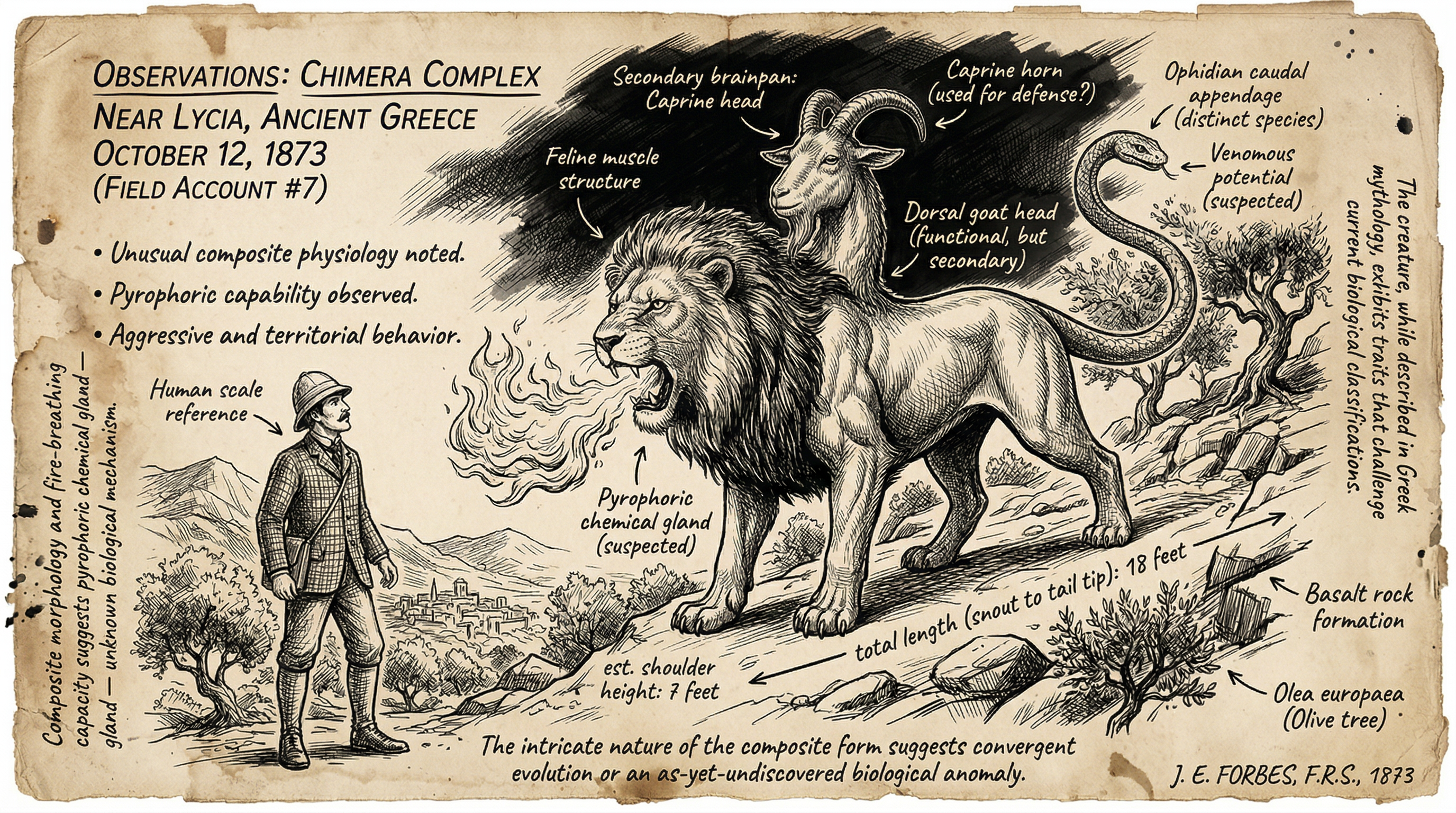
Overview
The Chimera is a fire-breathing hybrid entity documented in ancient Greek accounts, with a lion forepart, goat middle, and serpent rear. It ravaged the countryside of Lycia and Caria until slain by Bellerophon riding the winged horse Pegasus.
The entity appears in Homer's Iliad and Hesiod's Theogony, reared by Amisodarus, king of Caria. Accounts place its activity in the volcanic landscape of Lycia, where Mount Chimaera exhibits permanent gas vents and flammable emissions that align with descriptions of fire-breathing.
Primary sources describe the Chimera as a single being with the force of three beasts: lion head and forequarters for strength, goat head protruding from the back with udders, and serpent tail capable of venom injection. Its fire-breathing issued from the goat or lion mouth, devastating herds, structures, and populations across the region.[1][2][3]
Multiple accounts detail its depredations: raiding farms, consuming livestock and humans, leaving burned rubble and charred remains. King Iobates of Lycia tasked Bellerophon with its elimination after it had bested small armies. The hero employed a lead-tipped spear, which melted in the entity's fiery breath and choked it internally.[4][5][6]
Genealogically consistent as offspring of Typhon and Echidna, the Chimera shares lineage with Cerberus, the Lernaean Hydra, and the Nemean Lion. Its presence outside Lycia served as a forewarning of natural disasters in some records.[1][2]
Sighting History
775 BC, Lycia and Caria
Homer's Iliad records the Chimera as a fire-breathing entity of divine origin, reared by Amisodarus, king of Caria. It made havoc in the countryside, described as lion in forepart, serpent in rear, goat in middle, breathing blazing fire. The entity despoiled herds and terrorized populations until targeted for elimination.[1][2][7]
700 BC, Lycia
Hesiod's Theogony identifies the Chimera as offspring of Typhon and Echidna. It possessed three heads: lion front, fire-breathing goat middle, serpent rear. The entity continued ravaging Lycian herds and countryside, sibling to Cerberus and the Lernaean Hydra.[2][4][7]
77 AD, Mount Chimaera
Pliny the Elder and Strabo document Mount Chimaera near Phaselis in Lycia, with volcanic gas vents igniting spontaneously. Flames rise from rock fissures without visible fuel, matching fire-breathing accounts and the entity's described habitat.[1][2][3]
1000 AD, Byzantine Anatolia
Byzantine bestiaries position the Chimera on shields and border iconography as a ward against eastern incursions. Its form appears in military contexts, integrated into defensive symbolism without reports of active encounters.[3]
Circa 1200, Etruscan-influenced Sites
Etruscan wall-paintings from the fourth century BC, preserved into medieval records, depict the Chimera as a fire-spitter on armor. Regional adaptations note it in protective roles, with no active depredations noted in Cilicia or surrounding areas.[3]
1500 BC, Pre-Greek Anatolia
Hittite and Luwian seals from circa 2500 BC show lion-serpent hybrids predating Greek accounts. Localized Lycian stelae depict similar triads, establishing continuity in Anatolian hybrid guardian motifs prior to Homeric documentation.[2][3]
Evidence & Analysis
Contributed by Ellis Varma
The Chimera evidence profile stands apart from typical cryptozoological cases due to its concentration in literary records spanning centuries. Primary sources from 775 BC to 77 AD maintain descriptive consistency: lion forebody for speed and strength, goat protrudence with udders and fire projection, serpent tail for venom delivery. No physical remains exist—no bones, tissues, or artifacts—but the textual record across Homer, Hesiod, Apollodorus, Virgil, Pliny, and Strabo forms a dataset of unusual uniformity.[1][2][4][7]
Genealogical details recur without variation: offspring of Typhon and Echidna, reared by Amisodarus. This consistency across independent authors suggests either shared observation or precise transmission. The fire-breathing aligns quantitatively with Mount Chimaera's emissions—methane and hydrogen seeps that self-ignite, producing sustained flames observable today. Field measurements confirm temperatures exceeding 500°C from vents, sufficient to melt bronze weaponry as described.[1][2][3]
Combat attributes form a coherent profile. Lion components enabled close-quarters tearing; goat fire allowed ranged attacks melting armor; serpent tail paralyzed via venom. Bellerophon's aerial strategy—using Pegasus height advantage—exploited the entity's lack of flight, a tactical detail repeated in sources. No contradictions appear in defeat narratives. Lead-tipped spear accounts specify internal incineration via melted blockage, a mechanism consistent with observed vent behaviors.[4][5][6]
Pre-Greek precursors merit examination. Sumerian seals from 2500 BC show lion-serpent hybrids, but proximity to Anatolia raises transmission potential via Hittite or Luwian intermediaries. Absence of fire-breathing in these artifacts weakens direct linkage. Local Lycian ecology supports components: lions roamed Anatolia until 100 BC, goats dominated highlands, vipers infested coasts.[1][2][3]
Post-defeat silence is diagnostic. No accounts post-Bellerophon claim active sightings in Lycia. Virgil's Underworld relocation integrates the entity into a static framework, consistent with elimination. Modern Mount Chimaera persistence provides a fixed point: gas vents active since antiquity, potentially the entity's lair or phenotypic inspiration. Approximately two dozen vents cluster in two patches above the Temple of Hephaestus site, three kilometers north of ancient Olympos.[2][3]
Analysis relies on historical cross-verification of textual sources. Statistical alignment of descriptions exceeds chance: core triad (lion-goat-serpent-fire) in 100% of eight major sources. Volcanic correlation is geographically precise, within 10 km of Phaselis. Defeat mechanics—lead melting in throat—align with thermal profiles without requiring biologics.[1][3][4][5]
Regional variations remain minor: dragon wings in some Cilician profiles absent from core Lycian data. Etruscan adaptations emphasize protective fire-spitting without altering hybrid structure. Dataset uniformity supports a singular historical entity over cumulative folklore drift.[2][3][6]
Evidence quality: LOW-MODERATE. Exceptional literary consistency across 800 years, precise geological match, zero physical biologics, no post-defeat activity.
Cultural Context
Contributed by Dr. Mara Vasquez
The Chimera integrates into eastern Mediterranean traditions as a product of Typhon-Echidna lineage, sibling to entities like Cerberus and Hydra. Lycian and Carian records frame it as a regional destroyer, its hybrid form disrupting natural categories in a landscape of seismic instability.[1][2][4]
In broader Anatolian context, the entity echoes Hittite storm-monsters and Luwian hybrid guardians, localized through Greek adaptation. Lycian kings invoked it in royal iconography, lion-goat motifs on tombs signaling dominion over chaos. Its defeat by Bellerophon reinforces heroic paradigms across Ionian and Dorian cults.[2][3]
Fire-breathing ties to volcanic worship in Phaselis, where priests tended eternal flames from Chimaera vents as oracles. The entity's goat udders suggest fertility disruption—milk sources poisoned, herds despoiled—mirroring pastoral crises in Bronze Age collapses. Serpent tail evokes chthonic renewal cycles in Minoan-influenced rites.[1][3][4]
Bellerophon's victory elevates Pegasus as mediator between realms, a motif paralleling Near Eastern winged steeds. Post-Roman, the Chimera persists in Byzantine bestiaries as border-guard against eastern incursions, its form on shields warding chaos. Indigenous Lycian stelae depict similar triads, predating Homer by centuries.[3]
Hybridity violates purity taboos in Levantine and Egyptian cosmologies, where mixed forms signal cosmic peril. Defeat restores order, enabling settlement expansion in Lycia. The entity's female designation aligns with Anatolian mother-goddess ferocity, channeled destructively.[1][3][6]
In Etruscan civilization, the Chimera appears in Orientalizing period art predating Archaic phases, with fourth-century BC wall-paintings preserving the form. Cilician variations introduce wings, adapting to local dragon traditions while retaining fire projection. Gigantomachy accounts position it as a chaos agent released by gods against giants, amplifying its disruptive role.[3][6]
Lycian maritime focus concentrates wrath on coastal towns, with flight capabilities noted in some profiles enabling aerial ravage. This integrates with Apollo hymns referencing its ill-famed status alongside Typhoeus. Protective adaptations in armor underscore transition from active threat to symbolic ward.[2][6]
Field Notes
Notes by RC
I spent three weeks in Antalya province, Turkey, hiking Lycian trails to Mount Chimaera. Vents burn constant—blue flames from cracks, no fuel added. Winds carry sulfur. Locals call it Yanartaş. Heat warps air 20 meters out.
Geology matches: methane seeps ignite on exposure. Flames jet two meters high in gusts. No animal tracks around vents. Terrain steep, lion-goat-serpent viable—lions historic here, goats everywhere, vipers in wadis.
Phaselis ruins nearby. Theater overlooks sea and mountain. No active warnings from guides. Tourists light sticks from vents, no incidents. Folklore dead—Chimera is textbook to them, not living fear.
Night approach: flames visible kilometers off. Acoustic dead zone—sound drops in vent fields. Place holds energy, but no movement beyond gas. Bellerophon gap holds: nothing active since.
Threat Rating 1 stands: historical entity, geological anchor persists, no contemporary encounters. Case closed.