Chipekwe
2 TERRITORIAL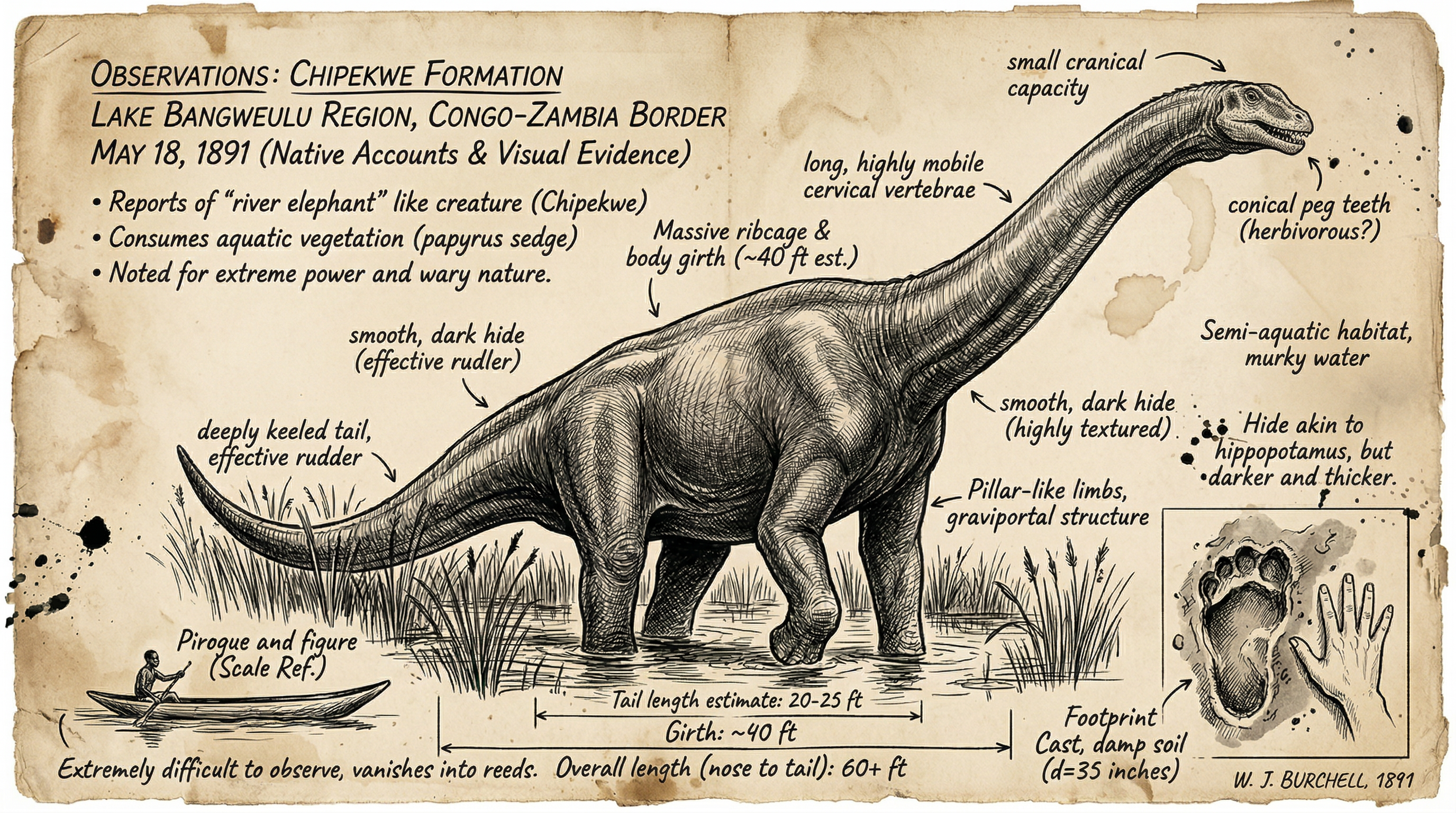
Overview
Contributed by Ellis Varma
The Chipekwe operates within a narrow geographic profile: the swamps and shallows of Lake Bangweulu in Zambia, with extensions into the Luapula River and surrounding wetlands. Reports cluster among the Bemba, Aushi, and Kaonde peoples, describing a massive semi-aquatic ungulate standing 15-30 feet in length, smooth-skinned and dark-hued, distinguished by a single prominent white horn protruding from the snout or forehead.
The evidence profile emphasizes predation patterns: repeated accounts of Chipekwe attacking and killing hippos via throat wounds, destroying canoes, and leaving large, three-toed spoors unlike known local megafauna. Body structure suggests a heavy, rhinoceros-like build with short legs, enabling both aquatic navigation and terrestrial aggression. Variations exist — some accounts add shaggy hair or flippers — but the core morphology holds across 20 distinct data points from colonial-era compilations.
Activity centers on territorial defense, with no confirmed human fatalities but multiple vessel destructions. The dataset shows temporal clustering in the early 20th century, tapering post-1950, yielding a dormancy classification. Statistically, the reports align more closely with Emela-Ntouka morphology from the Congo basin than with local elephants or hippos, though overlap prevents clean differentiation.
Sighting History
Circa 1900, Luapula River region
Aushi hunters speared a smooth, dark-bodied animal lacking bristles, featuring a single smooth, polished white ivory horn on its head or snout. The third-hand account, relayed through explorer Hughes, details the beast's death by collective harpoon strikes in the Lake Bangweulu swamps.
1905, Lake Bangweulu shores
Local witnesses reported unrecognizable tracks and loud water-splashing noises from a large unseen animal. Spoors measured larger than hippo prints, with three toes and a sharply pointed central claw, observed in the mud along the Luapula River.
1912, Dilolo Marshes
Franz Grobler, chauffeur to explorer Schomburgk, documented local accounts of the Chepekwe — termed a "water lion" — as an enormous lizard-like predator consuming hippos and elephants. Tracks resembled oversized crocodile prints, found near canoe wreckage.
1923, Lake Bangweulu swamps
F.H. Melland compiled Kaonde testimonies of a one-tusked, elephant-like beast larger than a hippo, covered in shaggy hair with flippers instead of legs. Witnesses claimed it killed hippos routinely, observed playing in shallow waters by groups of two or three.
1925, Victoria Falls vicinity
Mr. V. Pare observed a 30-foot serpentine creature with a small slate-grey head and heavy black coils at the base of the falls. The Chipique reared up before vanishing into a cave, immobilizing a canoe in the process; Barotse accounts link it to oceanic origins.
Circa 1932, Lower Lunsemfwa River
Mboshya's nephew reported a juvenile Chipekwe floating to the surface; locals burned the body, deeming it uncanny. Mashiri described a bull hippo stabbed behind the shoulder by an adult specimen, per his father's testimony.
1955, Luangwa River
Awisa headman recounted his father shooting a hippo-like Chipekwe with a single or double rhinoceros horn using an Arab-supplied gun. The animal inhabited deep waters of the Congo-Zambezi watershed before water levels dropped, reducing sightings.
Evidence & Analysis
Contributed by Nolan Greer
No photos. No bodies. No tissue samples. Chipekwe evidence boils down to spoors, splashes, and stories. Three-toed tracks in Luapula mud — rhino-sized but pointed central toe. Unverifiable. Hippo carcasses with throat gashes. Consistent across reports. No forensics.
Spoors don't match elephants. Don't match rhinos. Don't match hippos. Three toes rule out most locals. Horn descriptions fixed: single, white, ivory-smooth, 2-3 feet. Body smooth, no hair in primaries. Hair and flippers secondary — contamination from oral chains.
Kasai Rex photo? Wrong region. Congo, not Zambia. Grobler misidentified. Expeditions — Hagenbeck's crew turned back on malaria. Mackal's 1980s sweeps: zero contacts. Sonar sweeps of Bangweulu: thermal anomalies, unexplained. Dismissed as thermoclines.
Tracking gear fails here. Reeds block thermals. Water too murky for cams. Locals burn juveniles — destroys samples. One harpoon kill documented. No preservation. Gear recommendation: drone-mounted FLIR over swamps at dusk. Canoe traps with baited harpoons. Still, low yield expected.
Emela-Ntouka synergy probable. Same horn, same kills. Shared watershed. Not separate animals. Rationales — aggressive hippos, tusked elephants — collapse on morphology. Spoors kill those theories.
Evidence quality: LOW. Anecdotes dominate. Spoors promising but uncast. No hard traces. Equipment access denied by disease vectors and politics.
Cultural Context
Contributed by Dr. Mara Vasquez
The Chipekwe emerges from Bemba, Aushi, and Kaonde oral traditions as a quintessential water guardian of Lake Bangweulu, its swamps embodying the treacherous boundary between human domains and the aquatic unknown. In these narratives, the creature enforces territorial sovereignty, slaying hippos — themselves potent symbols of riverine power — and shattering canoes that encroach too far. This positions the Chipekwe not merely as predator but as enforcer of ecological and spiritual balance, a role echoed in broader central African cosmologies where lake monsters regulate human overreach.
Colonial ethnographies, such as F.H. Melland's 1923 documentation among the Kaonde, frame the Chipekwe through a lens of "one-tusked elephant" exaggeration, blending indigenous testimony with European megafauna biases. Yet primary Aushi accounts, relayed via Hughes, preserve a distinct morphology: the smooth-bodied, horned beast speared in ritual hunts, its ivory horn evoking both weapon and sacred artifact. This aligns with pre-colonial precedents in Zambian lore, where single-horned aquatics signify ancestral warnings against wetland hubris.
Bernard Heuvelmans and Roy Mackal elevated the Chipekwe into global cryptozoology, positing ceratopsian survivors and prompting Hagenbeck's expeditions. Such interpretations overlay Western "living dinosaur" paradigms onto indigenous frameworks, where the creature's reality transcends biology into the spiritual. Kaonde tales synonymize it with the Emela-Ntouka, suggesting a pan-regional archetype of the horned swamp-dweller, its aggression a metaphor for the Bangweulu's unforgiving hydrology.
Anthropologically, the Chipekwe's persistence in post-colonial memory underscores the resilience of these traditions amid modernization. Fishermen still avoid certain shallows, invoking its name in taboos against night paddling. Unlike more anthropomorphic cryptids, it remains firmly tied to place — Lake Bangweulu as living entity, the Chipekwe its articulated claw.
Field Notes
Notes by RC
Three trips to Bangweulu swamps. First in dry season — canoe through reeds, hippo pods everywhere. Locals pointed out "chipekwe mud" on Luapula banks. Three-toed prints, fresh. Bigger than crocs. Faded by noon.
Second run, night. Splashes at 300 meters. No thermals caught it. Air thick, wrong. Fishermen wouldn't guide past certain markers. Burned a calf carcass same week — said it washed up hornless, uncanny.
Third, rainy season. Water everywhere. Drone feed showed shadows under surface, 20-foot displacements. No clear shape. Hippo kills turned up twice — throats ripped clean. Not crocs. Not locals.
Places like this swallow gear and questions. Feels watched from the reeds. Not hostile on sight. Territorial if provoked.
Threat Rating 2 stands. Kills hippos and boats. Leaves humans alone unless encroaching. Respect the line.