Chuchunya
2 TERRITORIAL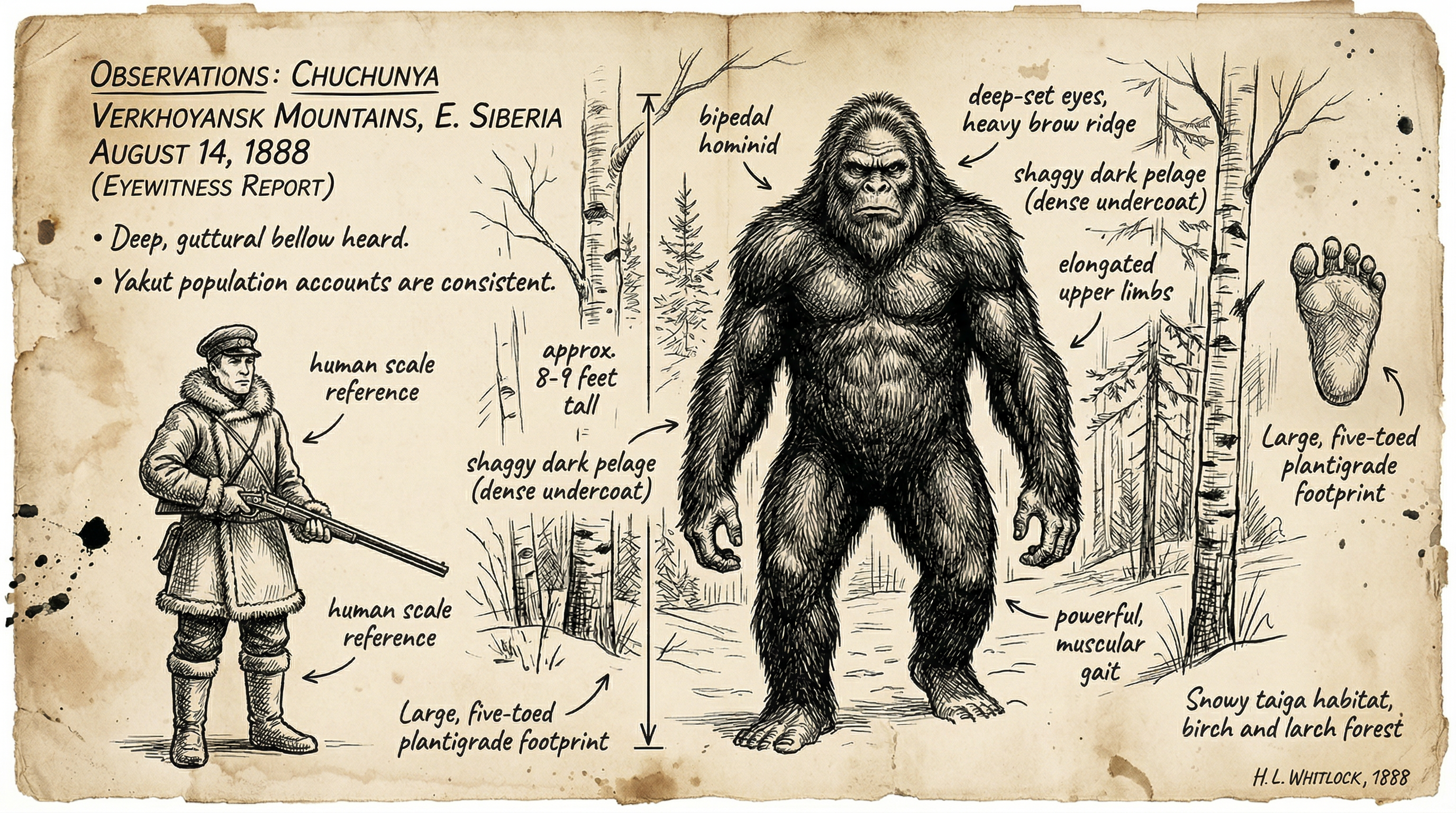
Overview
The Chuchunya represents one of the least-examined yet culturally embedded cryptid traditions in the circumpolar regions—a creature whose name derives from the Yakut word for "outcast" or "fugitive," carrying implications that extend far beyond simple animal classification.[2] Standing between six and seven feet tall, broad-shouldered, covered in matted hair, and bearing a pronounced brow ridge, the Chuchunya occupies an unusual taxonomic space in cryptozoological discourse: it is described not as an undiscovered animal but as something that walks the boundary between human and other, sometimes clothed in reindeer skins, sometimes stealing from encampments under cover of darkness.
What distinguishes the Chuchunya from other hominid cryptids is its deep embeddedness in the traditions of the Yakuts and Tungus peoples of Siberia, groups whose knowledge of these beings stretches back centuries—potentially millennia.[1] The creature exists simultaneously as indigenous folklore, as the subject of Soviet-era scientific expeditions, and as a modern cryptid, yet these three contexts rarely intersect cleanly. The Yakuts call it ChunChun, meaning "evil spirits." The Tungusic peoples call it Mulen—"bandit"—with specific associations to theft and predation. These are not neutral descriptors. They carry cultural weight, historical memory, and practical warning.
The Chuchunya's relationship to the broader circumpolar wildman tradition—encompassing the Komi "chud," the Sámi traditions, and other northern European and Asian accounts—suggests a phenomenon with deep historical roots. Anthropologists have recognized striking parallels across these geographically dispersed cultures, yet no unified written origin story has survived to modern times.[2] What remains is scattered across oral tradition, fragmentary Russian ethnographic records, and the accounts of isolated communities who continue to inhabit the regions where these creatures are said to dwell.
Sighting History
Pre-1928, Multiple Locations
Indigenous Yakut and Tungusic oral traditions document encounters with Chuchunya spanning centuries prior to modern documentation. The Yakuts maintain accounts of creatures that hunted reindeer, wore animal skins, and produced terrifying vocalizations when encountering humans. Tungusic accounts describe theft from camps during nighttime hours and predatory behavior. These traditions were sufficiently established and consistent that by the early 20th century, Russian ethnographers had begun collecting and cataloging them systematically.
Circa 1928, Indigirka and Yana River Expeditions
The Soviet government, having accumulated sufficient indigenous reports, dispatched explorers into the upper Indigirka and Yana river basins to investigate these accounts directly. The expedition's purpose was explicitly to collect testimonies from native Siberians regarding the creatures. According to available records, the explorers encountered a being described as human-like in body structure but animal-like in bearing—standing six to seven feet tall, with strong broad shoulders, long matted hair, a pronounced brow ridge, and covered entirely in fur. The creature reportedly wore garments fashioned from various animal skins, including reindeer hides, suggesting either intentional manufacture or habitual scavenging of useful materials. The Soviet government's response to these findings remains unclear; no comprehensive published account of the expedition's conclusions has entered Western cryptozoological literature.
Scattered 20th Century Reports
Accounts of Chuchunya encounters continue to emerge from remote Siberian regions throughout the 20th century, primarily from isolated communities and rural inhabitants—both native Siberians and European Russians who have chosen remote, self-sustaining lifestyles, sometimes for religious reasons (such as members of the Old Believer communities). However, specific documented incidents with named witnesses, precise dates, and detailed physical evidence remain absent from available records. The remoteness of the regions and the limited infrastructure for systematic documentation mean that many encounters likely remain unreported to any formal archive.
Evidence & Analysis
Contributed by Ellis Varma
The Chuchunya evidence profile presents an unusual problem: robust cultural documentation paired with complete absence of physical corroboration. We have centuries of consistent indigenous testimony from two distinct cultural groups (Yakuts and Tungus) describing a creature with remarkably consistent physical characteristics. We have a Soviet expedition explicitly tasked with investigating these reports in 1928. We have no photographs, no specimens, no hair samples, no skeletal material, no audio recordings, and no forensic evidence whatsoever.
The consistency across indigenous accounts is noteworthy. Both Yakut and Tungusic descriptions align on basic morphology: large humanoid, six to seven feet tall, prominent brow, covered in hair or fur, wearing animal skins. Both cultures associate the creature with predatory behavior—theft, occasionally cannibalism in the Tungusic accounts. Both maintain that the creature is sufficiently intelligent to manufacture or acquire clothing and sufficiently coordinated to raid camps. These are not vague folklore abstractions. They are specific behavioral claims.
The Neanderthal hypothesis, proposed by some Russian researchers, deserves scrutiny. Neanderthals went extinct approximately 40,000 years ago. Maintaining a viable breeding population in Siberia for four millennia without leaving skeletal material, DNA evidence, or any forensic trace would be extraordinary. However, the relict population hypothesis—that the Chuchunya represents a surviving population of Paleo-Asiatic peoples adapted to extreme environments—carries more plausibility. Human populations have survived in marginal ecological zones through cultural adaptation and behavioral specialization. A population deliberately avoiding contact with expanding Russian settlements and maintaining oral traditions among isolated indigenous communities is theoretically possible, though still unproven.
The 1928 Soviet expedition remains the single point where systematic investigation supposedly occurred. No detailed results from that expedition have entered public record. Whether this represents genuine documentation lost to Soviet archives, suppression of findings, or simple lack of conclusive results remains unknown. This is a critical evidentiary gap.
Evidence quality: LOW-MODERATE. High consistency in indigenous testimony across centuries and multiple cultural groups; complete absence of physical evidence; single documented systematic investigation with unknown results; modern sightings largely anecdotal and unverified.
Cultural Context
Contributed by Dr. Mara Vasquez
The Chuchunya cannot be understood as a cryptid in isolation. It exists within a broader circumpolar tradition of wildman figures that spans from northeastern Russia through Siberia and into northern Europe. The Komi people describe the "chud"—short, white-eyed beings who were miners and hoarders of wealth, who disappeared by hiding to escape taxation and Slavic religious conversion. The "siirtja" of other circumpolar peoples share morphological and behavioral similarities. Anthropologists have recognized these parallels as evidence of deeply rooted cultural traditions, suggesting either a shared historical experience or a common response to the psychological and ecological pressures of living in extreme northern environments.
What is significant about the Yakut and Tungusic traditions specifically is that they are not primarily supernatural. The Chuchunya is not a spirit, not a demon, not a creature of magic. It is dangerous, yes—it steals, it may consume human flesh, it vocalizes in ways that terrify—but it operates within the realm of the material and the behaviorally comprehensible. It wears clothing. It hunts. It raids camps. These are the actions of a being with agency, intelligence, and practical concerns. This framing suggests the Yakuts and Tungus are describing something they encountered in the material world, not a figure from their spiritual cosmology.
The terminology itself carries weight. "ChunChun" means "evil spirits" in Yakut, yet the creature described is not ethereal or supernatural. "Mulen" means "bandit" in Tungusic—a term that implies criminal behavior within a social framework, not bestial predation. These names suggest the indigenous peoples understood the Chuchunya as transgressive beings—existing outside normal society, operating by different rules, but nonetheless comprehensible within human social categories. A true animal would not be called a bandit. Bandits operate within a social system, even if they violate it.
The historical context of these traditions is also significant. Both the Yakuts and Tungus maintained nomadic or semi-nomadic lifestyles across vast territories with low population density. They possessed detailed ecological knowledge of their regions. If the Chuchunya was a pure fabrication, it would be unusual for two distinct cultures separated by significant geography to maintain such consistent descriptions across centuries. Oral traditions do drift and diverge; the convergence of these accounts suggests either a shared source experience or a deliberate cultural transmission of observed phenomena.
The relationship between these indigenous traditions and Soviet-era cryptozoology is problematic. Russian researchers, influenced by Western cryptozoological frameworks, began interpreting Yakut and Tungusic accounts through the lens of "relict human populations" and "Neanderthal survival"—frameworks that may or may not reflect how the indigenous peoples themselves understood these beings. The 1928 expedition represents a moment where indigenous knowledge was filtered through Soviet scientific ideology, with unknown consequences for how the findings were recorded, interpreted, or preserved.
Modern engagement with the Chuchunya requires careful attention to this distinction. The creature as understood by the Yakuts and Tungus may represent something quite different from the "Siberian Bigfoot" or "Neanderthal survivor" of contemporary cryptozoology. Responsible scholarship requires centering indigenous perspectives and recognizing that these traditions carry meanings and functions within their original cultural contexts that may be entirely lost in translation to modern cryptid discourse.
Field Notes
Notes by RC
Never made it to the Indigirka or Yana basins. That's deep Siberia—the kind of place where logistical support becomes theoretical. But I've corresponded with researchers who've worked in those regions, and the consistency they report in local accounts is striking. Not the sensationalized version you get in cryptid forums. Just practical people describing something they know exists in their territory, something they account for in how they organize camps and movement.
The 1928 expedition is the ghost in this case. Soviet archives are not transparent. The expedition happened—that's documented. What they found, what they concluded, whether specimens were collected—none of that has surfaced in accessible form. Either the results were inconclusive enough not to merit publication, or they were deemed sensitive enough to remain classified. Or the documentation simply degraded in some archive. Absence of evidence is not evidence of absence, but it's also not evidence of presence.
What strikes me about the indigenous accounts is that they're not trying to be cryptozoology. They're not performing mystery for an audience. They're describing a problem—something that steals, something that hunts, something that exists in their landscape and requires practical response. That tone is different from folklore that's been shaped for entertainment. Whether that means the Chuchunya exists as described, exists differently than described, or doesn't exist at all—I can't determine from available information.
Threat Rating 2 stands. Indigenous testimony is consistent and specific enough to warrant documentation. Behavioral descriptions (theft, predation, apparent intelligence) suggest potential danger. Complete absence of physical evidence and unresolved status of the 1928 investigation prevent escalation. The remoteness of the region and low contact probability place this in territorial rather than unpredictable range.