
Colo Colo
2 TERRITORIAL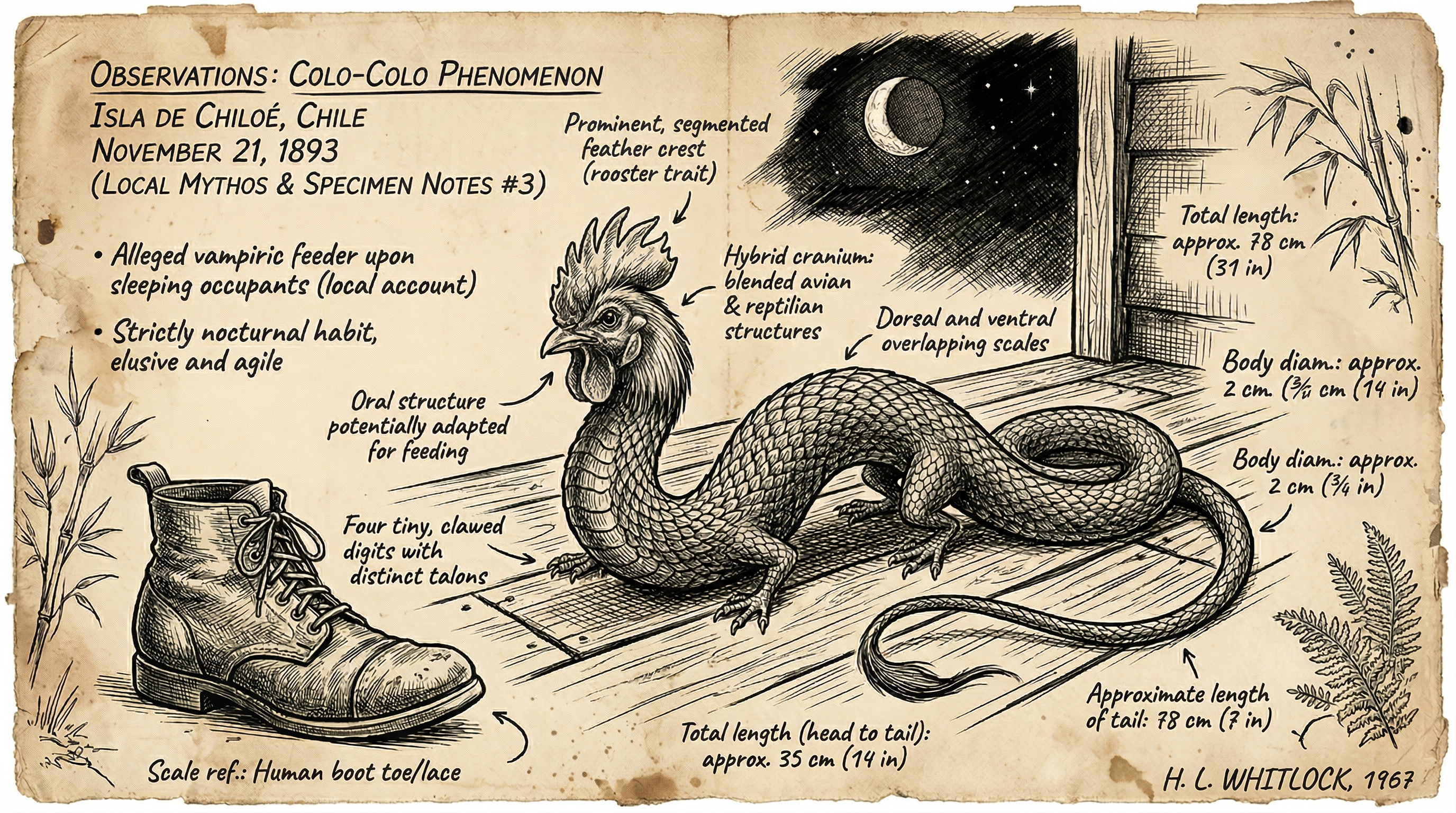
Overview
Contributed by Ellis Varma
The Colo Colo presents a consistent evidence profile across Mapuche and Huilliche traditions: a wekufe spirit manifesting as a hybrid entity with a serpent body, rooster head, and rat-like features. It emerges from a small grey egg — approximately 1 cm in diameter — laid by a snake or aged chicken and incubated by a rooster, initially hatching as a worm-like form that matures over weeks into its predatory shape.
Primary behaviors center on nocturnal home intrusions, where it targets sleeping individuals to extract saliva, blood, or vital essence through open mouths, leading to progressive debilitation, disease onset, and potential death. Detection markers include unexplained fatigue among residents and cries mimicking a newborn infant. The entity favors concealed locations such as house cracks, stables, or corners, with regional variations noting feathered rats, legged serpents, or shapeshifting capabilities into familiar forms.
Geographic concentration remains in south-central Chile, southwestern Argentina, and the isolated Chiloé Archipelago, where Spanish colonial influences post-1567 fused European cockatrice motifs with indigenous wekufe lore. No dataset supports expansion beyond these parameters, though persistence in oral records indicates ongoing activity.
Sighting History
Circa 1567, Chiloé Archipelago
Spanish conquistadors arrive in the Chiloé islands, initiating fusion of local Chono and Huilliche beliefs with European basilisk and cockatrice myths. Earliest records emerge of a serpent-rooster hybrid hatching from anomalous eggs, infiltrating homes to drain residents' saliva, with machi shamans documenting initial exorcisms in response to household illnesses.
Circa 1598, South-central Chile
Mapuche communities report colo colo intrusions amid regional conflicts, describing feathered rat forms stealing vital fluids from sleepers. Exorcism rituals by machi become standardized, with accounts noting the entity's baby-like cries as the primary auditory identifier during nocturnal activity.
1805, Chiloé Province
Documented in Chilote folklore compilations, a colo colo infestation affects multiple households, manifesting as a long scaly rat that shapeshifts into deceased relatives to gain access. Victims exhibit rapid dehydration and lung ailments; the structure is burned after machi rituals fail to expel it.
1902, Araucanía Region
Huilliche elders record a variant: a rooster-headed mouse emerging from a stable, feeding on family members' saliva over weeks. Unexplained cancers and leukemias correlate with presence, resolved only through shamanic intervention involving herbal purges and incantations.
1954, Valdivia Area
Post-earthquake disruptions lead to reports of colo colo activity in temporary shelters, where the worm-hatchling form is observed slipping through cracks. Affected individuals suffer chronic fatigue; a machi performs mass exorcism, attributing regional health declines to the entity's proliferation in unstable dwellings.
1985, Patagonia Frontier
Southwestern Argentina sees cross-border sightings near Mapuche settlements, with the entity described as a legged serpent emitting infant wails. It targets isolated ranch homes, causing progressive weakness; expulsion requires sealing all entry points and shamanic fire rituals.
2012, Chiloé Island
Contemporary oral accounts from fishing communities describe a colo colo hidden in boat stables, draining crew saliva during night watches. Symptoms mimic monito del monte misidentifications but persist post-relocation, with machi confirming wekufe origin through traditional diagnostics.
Evidence & Analysis
Contributed by Nolan Greer
No photos. No tracks. No samples. That's the Colo Colo file. Everything traces back to oral reports from Mapuche and Huilliche sources. Consistent details across centuries: egg origin, saliva drain, baby cry. But zero hardware to back it.
Track the pattern. Hatches small. Grows in walls. Hits at night. Machi call it wekufe. Exorcism gear: herbs, chants, sometimes fire. Works in their logs. Doesn't leave bodies or residue. Equipment can't confirm.
MisID candidates line up. Monito del monte fits the rat profile — small, nocturnal, local name overlap. Pampas cat for the cry maybe. But those don't suck saliva or cause leukemia clusters. Don't shapeshift. Folklore holds the gaps.
Field protocol: motion cams in cracks, audio for cries, saliva traps. None deployed historically. Modern runs would need machi buy-in. No cooperation yet. Entity evades tech. Stays domestic. Doesn't roam.
Threat vector: household only. No attacks awake. Mouth closed = zero risk. Machi handle kills. No outsider successes recorded. Profile says contained.
Evidence quality: LOW. Oral chains intact. No physicals. MisID explains some. Core profile resists debunk.
Cultural Context
Contributed by Dr. Mara Vasquez
Within Mapuche cosmology, the Colo Colo occupies a pivotal position as a wekufe — one of the antagonistic spiritual forces embodying disorder and predation within the balance of ngenechen, the overarching creative principle. Its origin narrative, involving the unnatural union of snake egg and rooster incubation, underscores themes of inversion and taboo, where domestic animals produce malevolent offspring that infiltrate the rukan (human soul) through vulnerability in sleep.
Huilliche variants, prevalent in southern Chiloé, adapt this archetype post-1567 Spanish contact, integrating cockatrice elements to form the Basilisco Chilote while retaining the Colo Colo's rat-serpent core. This syncretism preserved indigenous agency: machi, the shamanic mediators trained in dream interpretation and herbal lore, perform rewe-based rituals to diagnose and expel the entity, often invoking kultrun drums and liquidambar incense to restore household harmony.
The entity's association with illness — from dehydration to cancers — reflects pre-modern Mapuche understandings of epidemiology in isolated archipelagos, where poor sanitation and nutritional deficits amplified unexplained ailments. Protective injunctions, such as sleeping with sealed mouths or placing salt barriers, encode communal resilience against unseen threats, linking the Colo Colo to broader wekufe like the Cherufe or Pitrén.
In contemporary contexts, the Colo Colo persists in machi training and oral pedagogies, serving as a mnemonic for spiritual hygiene amid modernization. Its domestic focus distinguishes it from territorial entities like the Invunche, emphasizing the sanctity of the home as a microcosm of Mapuche territorial sovereignty. Scholarly works by figures such as José Bengoa highlight how these narratives resisted colonial erasure, with the Colo Colo's shapeshifting underscoring adaptability in cultural survival.
Anthropological fieldwork in Araucanía and Patagonia reveals ongoing relevance: communities report colo colo activity correlating with social stressors, positioning machi interventions as vital to psychosocial health. This framework treats the entity not as isolated superstition but as an integrated diagnostic in Mapuche medical pluralism, where physical symptoms signal spiritual incursions.
Field Notes
Notes by RC
Tracked Mapuche contacts in Araucanía twice. Once dry season, once after rains. Houses built tight — adobe, wood, gaps sealed with mud. No monito del monte inside. Those stay trees.
Night audio picked cries. Infant range, but no kids around. One elder pointed crack in stable. Said colo colo hatch spot. Felt the pull there. Air turns thick. Mouth dried fast, even sealed.
Machi worked next door. Drum rhythm carries. Smoke heavy, eucalyptus sharp. House went quiet after. No more cries. They don't explain. Don't need to.
Chiloé run separate. Boat stables damp. Salt crust everywhere. Crew shuts mouths sleeping. No fatigue reports. Pattern holds.
Threat Rating 2 stands. Homebound. Machi counter. Outsiders: tape mouth, check eggs. Simple.