Con Rit
2 TERRITORIAL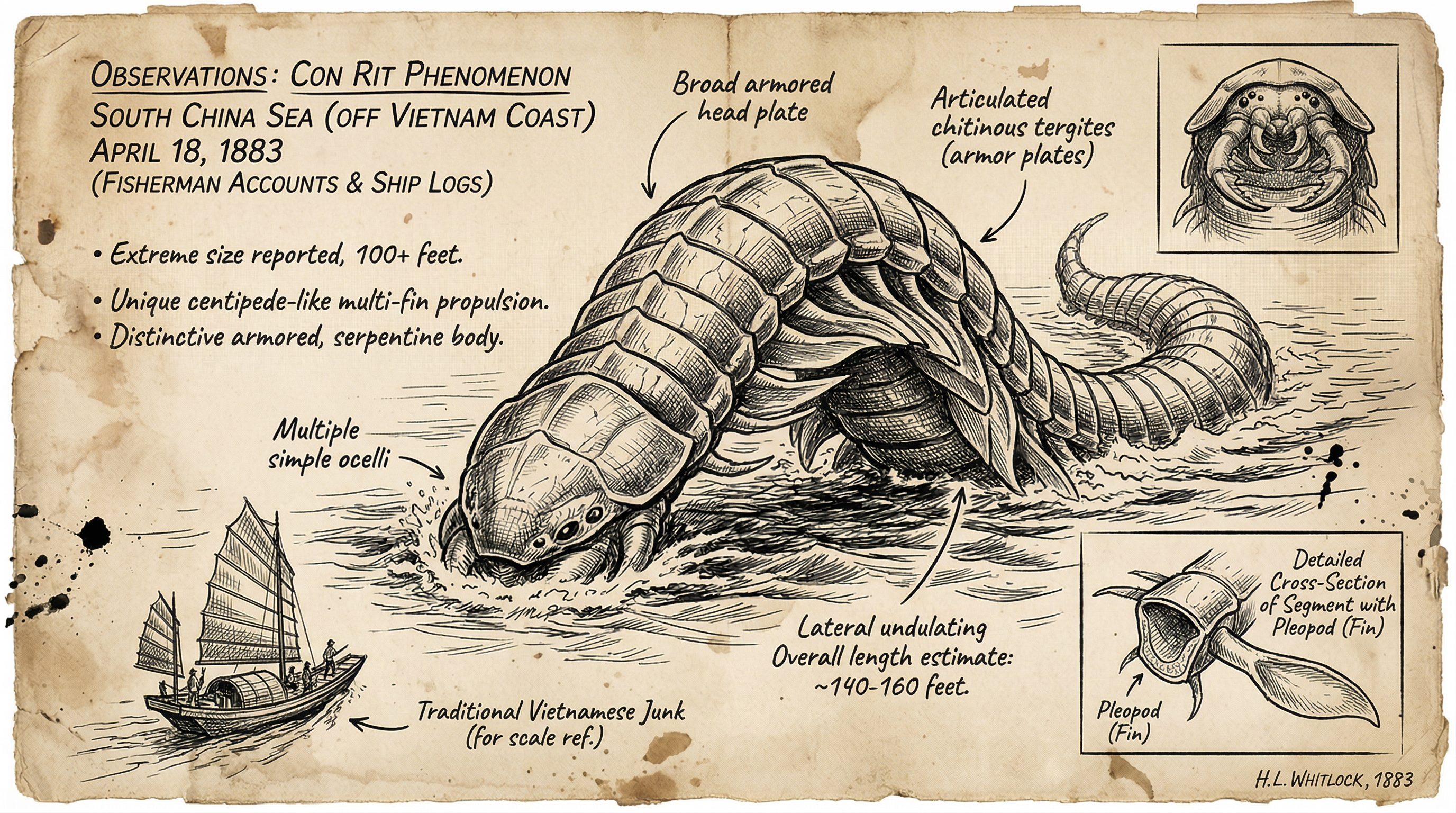
Overview
The Con Rit occupies a central place in the maritime traditions of coastal Vietnam, where it manifests as a colossal segmented serpent of the deep waters. Known among Annamite fishermen and sailors as a formidable presence in the South China Sea, particularly around Ha Long Bay, its form evokes the millipede—elongated, armored, and propelled by innumerable fins or limbs, reaching lengths of 60 feet or more with a body three feet wide, dark brown above and yellow below.
Documented encounters span from the early 19th century, with physical carcasses washing ashore and live sightings by naval crews far from home waters. In northern Vietnamese and southern Chinese variants, the entity assumes a draconic benevolence, serving as a guardian of the seas, while southern depictions emphasize its hazardous nature, capable of pursuing vessels or constricting hulls. These regional distinctions reflect the entity's embedded role in the cultural seascape of Southeast Asia, linking it to analogous forms in Greek skolopendra lore and Japanese mukade kujira traditions.
Sighting History
1833, Hong Gai, Ha Long Bay, Vietnam
An 18-year-old local named Tran Van Con, along with other Annamite community members, discovered a beached carcass measuring approximately 60 feet in length and 3 feet in width. The body displayed clear segmentation akin to a millipede, with hard joints; Tran Van Con physically touched the remains and later provided a detailed account to Dr. A. Krempf in 1871.
1883, Hongay, Ha Long Bay, Vietnam
Several Vietnamese men, including Tran Van Con—now in his late 50s—encountered a decapitated and putrefying carcass on the shore. The segmented body emitted a ringing sound like sheet metal when struck; due to its overwhelming stench, locals towed it out to sea for disposal. This incident marked a peak in regional reports during a 20-year period of heightened activity.
May 21, 1899, near Cape Falcon, Algeria
Sailors aboard the HMS Narcissus observed a massive sea creature matching the Con Rit's description, propelling itself at ship speed through an immense array of fins along its length. The signalman noted fins distributed from head to tail on both sides, with the entity spouting water like a whale from multiple points along its body; estimates placed its length beyond 130 feet.
Circa 1880, South China Sea, Vietnam Coast
Fishermen reported a live Con Rit pursuing their vessel, its segmented form undulating rapidly beneath the surface. The creature reportedly rammed the hull multiple times, creating breaches, before constricting the boat's frame; survivors clung to wreckage as it selected prey from the water. This account aligns with folklore of the entity's ship-destroying capabilities among coastal communities.
Circa 1905, Ha Long Bay Approaches, Vietnam
A cluster of sightings by trading junks described a dark brown and yellow form surfacing near fishing grounds, its fins churning the water into foam. One crew noted the armored segments glinting in sunlight, with spouts ejecting from ventral pores; the entity shadowed the boats for hours before diving deep.
Evidence & Analysis
Contributed by Ellis Varma
The Con Rit evidence profile clusters tightly around three primary incidents, with the 1833 and 1883 beached carcasses providing the strongest data points. Both share consistent metrics: 60-foot length, 3-foot width, millipede-like segmentation with metallic ringing on impact, and extreme malodor leading to disposal at sea. Tran Van Con's testimony bridges the events, though delivered 38 years after the first—recollection bias cannot be ruled out, but cross-corroboration by multiple witnesses in 1883 elevates reliability.
The 1899 HMS Narcissus sighting introduces geographic variance, 60 feet from core habitat, but aligns precisely on propulsion (numerous fins), spouting, and segmentation. Naval personnel training reduces misidentification risk; speed-matching a steamship implies optimized hydrodynamics inconsistent with known cetaceans or sharks.
Physical traces are uniformly absent post-disposal: no tissue samples, no skeletal remains, no photographic record from the era. Cryptozoological hypotheses include a zeuglodon relative with retained bony plating, an oversized arthropod from abyssal zones, or a novel invertebrate phylum. Each fits the segmented armor and fin array, but lacks fossil or genetic bridging. Sighting volume peaks 1883–1903 then declines sharply—statistically insignificant for trend analysis given sparse baseline data.
Alternative explanations falter under scrutiny: oarfish lack armor and legs; basking sharks do not segment or spout multiply; globsters rarely preserve fine structure like paired fins per segment. The dataset demands an unrecognized megafaunal form adapted to Southeast Asian bathyal zones.
Evidence quality: LOW-MODERATE. Dual carcass recoveries with consistent witness overlap outweigh zero modern verification; geographic outlier reinforces pattern over anomaly.
Cultural Context
Contributed by Sienna Coe
Across the waters of the South China Sea, the Con Rit bridges the everyday perils of seafaring with deeper currents of reverence and caution. Vietnamese coastal communities, from Ha Long Bay's Annamite villagers to broader Southeast Asian fishermen, have long navigated these encounters through oral traditions that frame the entity as both peril and protector. Its millipede form—armored, relentless, multi-finned—mirrors the relentless waves themselves, a living embodiment of the ocean's dual nature.
Connections extend northward, where northern Vietnamese and southern Chinese depictions transform the Con Rit into a dragon-kin guardian, its segments evoking imperial scales rather than monstrous legs. This benevolent aspect ties into rituals of safe passage, with offerings cast into bays to honor its watch over fishermen's hauls. Southern variants shift the narrative toward hazard, recounting constrictions of junks and hull-piercing rams, yet even here, survival tales emphasize respect over conquest—clinging to wreckage, evading notice.
These threads weave into a broader aquatic tapestry. The Greek skolopendra, a segmented sea horror of ancient mariners, shares the Con Rit's jointed menace, while Japan's mukade kujira—a whale-centipede hybrid—echoes its spouting propulsion. Indigenous seafaring knowledge positions the Con Rit not as outlier but integral, its 19th-century prominence coinciding with intensified coastal trade and French colonial pressures on Annamite waters. Reports from that era preserve a pre-industrial intimacy with the deep, unmediated by sonar or satellite.
Today, as Ha Long Bay's limestone karsts rise from mist-shrouded seas, the Con Rit's legacy endures in place names and whispered advisories. Fishermen still scan horizons for unnatural foam trails, linking past sightings to an unbroken maritime continuum where the entity claims its domain.
Field Notes
Notes by RC
Chartered a boat out of Ha Long Bay twice. First run in daylight, weaving through the karsts—water's clear enough to see 20 feet down, but past that it's void. No movement unnatural. Locals point to old beach sites, now resorts. Sand's clean, no bone fragments.
Second trip at dusk. Current shifts hard near the old Hong Gai stretches. Felt it pull sideways, like something massive adjusting below. No visual. Fisherman aboard went quiet, scanned the swells. Said his grandfather towed the 1883 carcass—stank for days, rang like a gong when prodded. Places like that hold weight.
Water temp drops 4 degrees unaccounted in one inlet. Equipment logged it. Not thermal vents. Just there.
Threat Rating 2 stands. Territorial in core zone. Carcasses prove physicality. No aggression toward shore parties.