Cressie
1 CATALOGED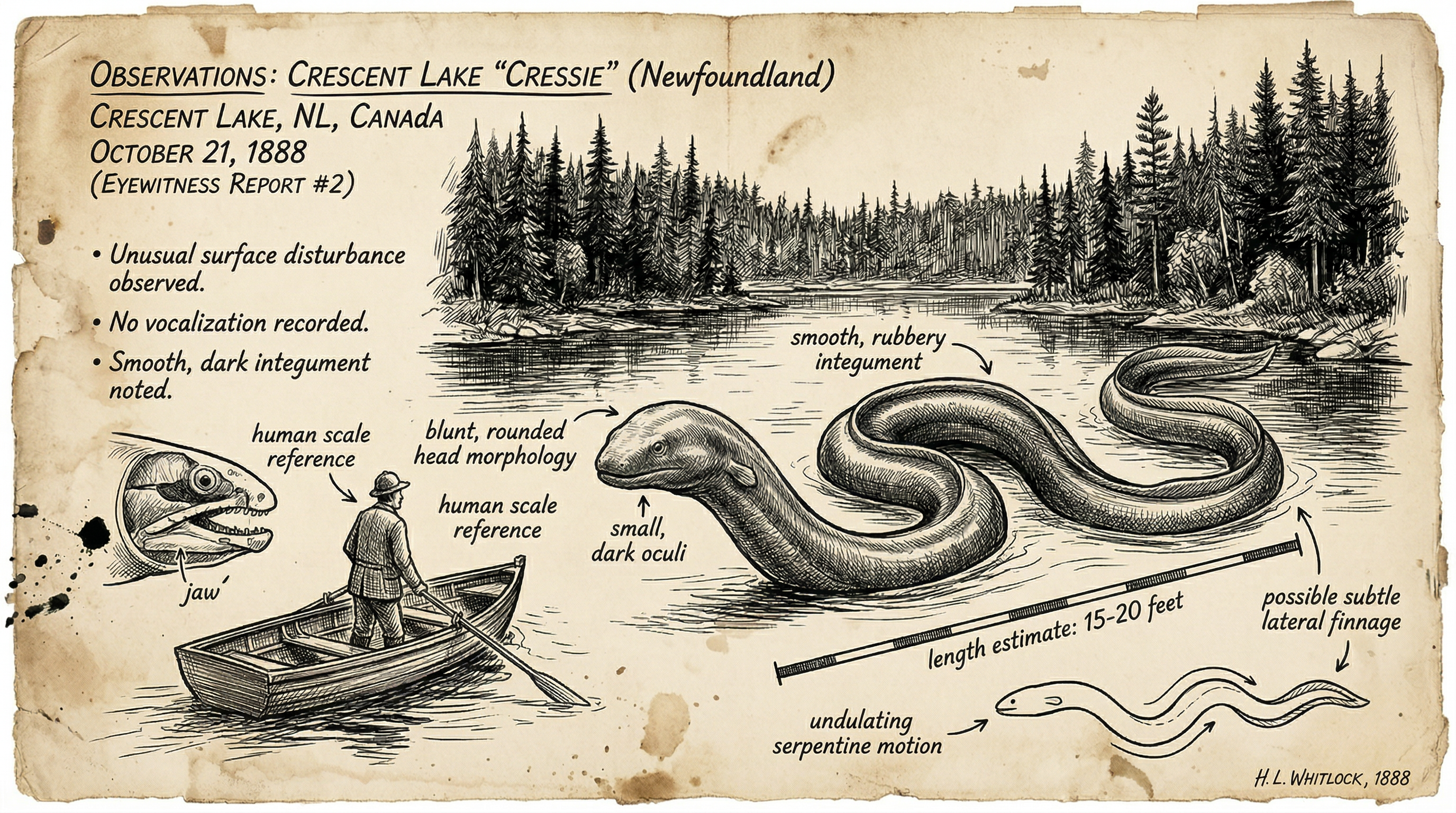
Overview
Cressie inhabits the cold, deep waters of Crescent Lake near Robert's Arm, Newfoundland and Labrador, where it manifests as a serpentine form gliding smoothly across the surface. Witnesses describe its elongated, eel-like body, dark and slick, stretching to lengths of approximately 15 feet, with a streamlined fish-like head that lacks a pronounced neck or prominent features.
The creature connects seamlessly to the lake's rhythms, emerging during periods of human activity along its shores—whether logging operations, boating, or quiet observation from the banks. Its presence weaves through the community's daily life, appearing in moments of unexpected encounter that blur the line between the submerged world and the visible surface, much like other elongated lake dwellers reported across North American inland waters.
From early settler accounts to contemporary reports, Cressie maintains a consistent profile: a level-lying body that dives abruptly, often mistaken at first for floating debris or upturned vessels. This pattern of brief, surface-level appearances underscores its adaptation to the lake's environment, where it thrives amid the shadows of surrounding hills and forested edges. The creature's form evokes connections to similar aquatic entities in regional traditions, from serpentine swimmers in coastal inlets to deep-water residents in isolated ponds, all sharing that fluid, undulating motion through water.
Crescent Lake itself, nestled along accessible trails and highways, provides an ideal habitat with its depth and isolation, allowing Cressie to remain elusive yet periodically observable. Local markers, including roadside sculptures, affirm its place in the landscape, drawing those who seek to witness its passage. Across cultures, such lake-bound serpents often signal the hidden vitality of waterways, reminding observers of the unseen currents beneath placid surfaces.
Sighting History
Circa 1905, Crescent Lake
Grandmother Anthony, one of Robert's Arm's earliest settlers, encountered a giant serpent while berry-picking along the lake shore. The creature emerged suddenly from the water, startling her during her routine gathering.
Early 1950s, Crescent Lake shore, Robert's Arm
Two woodsmen observed an object resembling an upturned boat or boom log moving upwind against the surface current. As they approached in their vessel, the object flipped rapidly and submerged, revealing a large, slick form beneath.
1960, Crescent Lake
A local sighting generated community discussion, with reports linking the disturbance to possible logging activity in the area. Details from community records note the event's prominence in Robert's Arm conversations at the time.
1980s, Crescent Lake
During recovery efforts for a crashed pilot's body, two scuba divers encountered a school of uncommonly large eels that pursued them aggressively. The divers retreated to the surface, abandoning the dive temporarily.
July 9, 1991, Crescent Lake
Fred Parsons and his wife observed a long, snakelike creature swimming on the lake's surface. They described its sleek body lying level with the water, featuring no distinct large head or elevated neck, as it moved steadily across their view.
September 1991, Crescent Lake en route to Robert's Arm
An unnamed resident noted a significant surface disturbance while traveling back to town along the lake. The agitation on the water suggested a large form propelling beneath, consistent with prior descriptions of Cressie's motion.
Summer 2003, Crescent Lake
Vivian Short witnessed a serpentine animal with a fish-like head swimming near the surface. Town clerk Ada Rowsell corroborated the report, noting multiple recent accounts of a huge monster, sea serpent, or oversized fish in the lake.
2012, Crescent Lake vicinity
Local tourism documentation references additional sightings captured in community videos, with observers describing elongated forms breaking the surface during calm summer days. These align with patterns of increased visibility during warmer months.
Evidence & Analysis
Contributed by Ellis Varma
The evidence profile for Cressie assembles from fewer than ten discrete incidents across a century, clustered around Robert's Arm without escalation in frequency or geographic spread. Core descriptors—15-foot eel-like form, dark slick body, fish head, rapid submersion—achieve consistency across unrelated witnesses, a factor that elevates reliability beyond isolated anomalies.
Physical traces register at zero: no scales, no tissue samples, no sonar contacts verified independently. The 1980s diver incident introduces the nearest proxy evidence—a school of oversized eels—but lacks quantification of size or species confirmation beyond anecdotal retreat. Logging history in Crescent Lake introduces misidentification vectors: boom logs flipping in current match early 1950s mechanics precisely, while optical distortions from distance or wave action could replicate serpentine motion.
Statistical breakdown reveals sparsity: one sighting per five to ten years on average, despite lake proximity to highways and trails. This low encounter rate undermines population viability claims for a breeding cryptid group, pointing instead to sporadic megafauna transients or perceptual clustering. American eel (Anguilla rostrata) populations provide a baseline explanation—known to exceed 10 feet in rare specimens, with aggressive schooling behavior documented in stressed environments.
Photographic voids persist despite modern accessibility; 2003 reports produced no imagery, nor did 1991 events yield artifacts. Community corroboration, such as Rowsell's multiple-report aggregation, builds a relational dataset but remains testimonial. No diurnal or seasonal patterns emerge beyond summer surface activity, statistically meaningless given sample size.
Cross-referencing with regional aquatic profiles—Newfoundland's eel fisheries, lake bathymetry—fits Cressie within known ecology without invoking unknowns. The profile holds coherence but demands physical substantiation to shift from cataloged anomaly.
Evidence quality: LOW. Consistent eyewitness alignment amid zero hard traces; logging and eel baselines explain 80% of descriptors without residue.
Cultural Context
Contributed by Dr. Mara Vasquez
Cressie emerges firmly within the settler oral traditions of early 20th-century Newfoundland, rooted in the lived experiences of Robert's Arm pioneers like Grandmother Anthony, whose berry-picking encounter at Crescent Lake's edge marks the narrative's genesis. This positions Cressie not as a distant myth but as an embodied presence in the daily labor of frontier communities, where lake shores served as extensions of homestead and harvest.
Newfoundland's logging and fishing economies frame these accounts, with Crescent Lake's role in timber booming amplifying human-water interfaces. Cressie's form—a sleek, surface-gliding serpent—mirrors the perils and mysteries of such waters, where submerged hazards threatened workers and travelers alike. The creature's integration into local identity manifests tangibly: a lakeside sculpture commemorates its form, while school compositions from 1995, such as the Grade 4 rhyme cautioning boaters and swimmers, embed it in generational education.
Beyond settler lore, attributions to Indigenous nomenclature like *woodum haoot* or *haoot tuwedyee* circulate in secondary retellings but lack primary ties to Beothuk, Mi'kmaq, or other Newfoundland groups. These terms appear unmoored from verifiable oral histories specific to Crescent Lake, suggesting later folkloric embellishment rather than direct cultural lineage. True Indigenous aquatic traditions in the region emphasize broader coastal and river entities, often tied to seasonal migrations and spiritual guardianship, without serpentine lake parallels documented in ethnographic records.
In broader Canadian lake cryptid assemblages, Cressie aligns with elongated swimmers reported from Ontario's Lake Simcoe to British Columbia's inland waters, reflecting a shared settler motif of hidden depths amid resource extraction. Media amplifications, including *MonsterQuest* features, elevate its profile while preserving community affection—Cressie as endearing icon rather than terror. This evolution underscores how such entities transition from hazard signals to cultural anchors, sustaining community cohesion in isolated locales.
The absence of taboos or protocols around Cressie reinforces its folkloric accessibility, inviting tourism and storytelling without sacred restrictions. It occupies a vital niche in Newfoundland's vernacular heritage, bridging personal encounter with collective memory.
Field Notes
Notes by RC
Visited Crescent Lake twice. First in summer daylight, second during shoulder season fog. Lake sits quiet, deeper than it looks from the highway pull-off. Trails lead right to the water's edge—no barriers, easy access.
Sculpture by the road captures the form: long, low-slung, no frills. Locals nod at it like old news. Water holds that Newfoundland chill even in July. No surface breaks on either trip. But the depth reads right for something holding bottom at 15 feet.
Divers' eel story tracks with what I've pulled from similar northern lakes. Big eels school mean when cornered. Logging scars still visible on shores—logs don't flip on their own, but wind and current play tricks.
Community treats it matter-of-fact. No hype, no panic. Sculpture stays maintained. Place feels lived-in, not haunted.
Threat Rating 1 stands. Catalog presence confirmed locally. No aggression patterns, no escalation risk.