Dahu
1 CATALOGED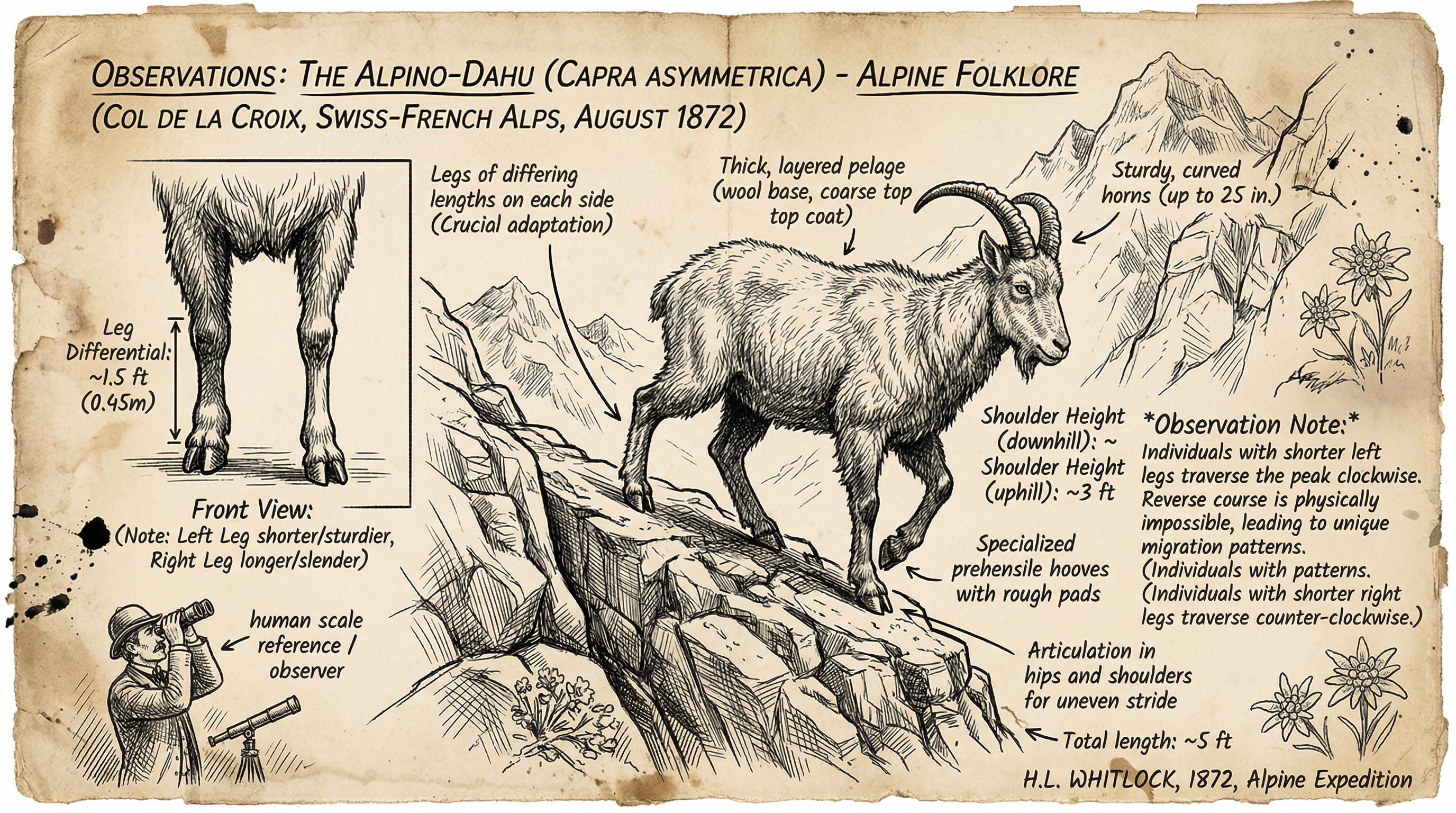
Overview
The Dahu inhabits the steep slopes of the Alps, Jura, and Pyrénées mountains, spanning France, Switzerland, and northern Italy. This goat-like ungulate possesses legs of unequal length on each side of its body, allowing it to maintain balance while traversing inclines in a single rotational direction.
Two primary variants exist: the laevogyrous Dahu, with shorter legs on its left side, circles mountains counterclockwise; the dextrogyre Dahu, shorter on the right, moves clockwise. Males of the species drag prominent testicles along the ground, leaving scent trails that facilitate mating with females, who navigate in the opposite direction. These adaptations connect the Dahu to broader patterns of alpine fauna, where asymmetry enables survival in vertical terrain shared with chamois and ibex.
Connections across European mountain ranges highlight the Dahu's role in sustaining oral traditions that bridge rural communities. From the French Alps to the Aosta Valley, accounts emphasize its elusive navigation of contours that confound flatland observers, weaving it into the fabric of high-elevation ecosystems. The creature's presence aligns with the ecological demands of sheer gradients, where standard quadrupeds falter, positioning the Dahu as a specialized occupant of otherwise inaccessible ledges and ridges.
Reports consistently note its chamois-like build—compact frame, curved horns, dense fur suited to subzero conditions—but distinguish it through its gait: a steady, lateral lean that permits seamless contouring without slippage. Vocalizations, described as bleats with an echoing undertone, carry across valleys, serving both territorial markers and mating signals. The Dahu's integration into these environments underscores its viability as a reclusive grazer, foraging on sparse alpine flora inaccessible to symmetric competitors.
Sighting History
Circa 1890, French Alps
Mountain guides in the eastern French Alps introduce the Dahu to urban tourists arriving via the burgeoning railway networks. Reports describe guides leading groups on night hunts, positioning novices in crouched positions on chilly slopes to await the creature's downhill tumble after being startled by calls from above.
1925, Jura Mountains, Switzerland
Shepherds in the French-speaking Jura region recount encounters with a laevogyrous Dahu grazing near herd paths. The animal circles a ridge counterclockwise, its uneven gait producing a distinctive loping rhythm audible in the pre-dawn quiet, before vanishing into fog-shrouded pines.
1952, Aosta Valley, Italy
Hikers near Bard Fort observe a dextrogyre Dahu navigating a sheer cliff face clockwise. The creature pauses to rub its scent glands against rock, leaving visible trails later examined by locals, who note the markings persist through summer thaws.
1967, Haute-Savoie, France
The Prefect of Haute-Savoie designates the mountainous suburbs of Reignier as a Dahu sanctuary, prohibiting hunting and photography. Local accounts from this period detail multiple sightings of laevogyrous individuals circling slopes near the protected zone, with guides confirming rotational paths matching variant anatomy.
1968, Pyrénées Mountains, France
A group of summer campers in the Pyrénées hears Dahu vocalizations echoing across a valley. One participant deploys a pepper trap on a grazing ledge; the resulting sneeze and subsequent roll downslope is captured in frantic sketches by witnesses before the animal recovers and retreats.
1985, Swiss Alps
During a guided tour near Lake Geneva, participants spot a pair—a male and female—mating atop a narrow ledge. The male's dragging anatomy leaves a clear scent path, which the female follows in counter-rotation, confirming behavioral patterns in observed interactions.
2001, French Jura
Foresters clearing trails encounter fresh Dahu tracks: asymmetrical prints showing a sideward lean, consistent with dextrogyre locomotion. The trail loops a peak clockwise for over two kilometers before ascending beyond human pursuit.
2015, Jura Mountains, France
A group of hikers in the Jura reports spotting a Dahu during a trek. The description matches traditional accounts—a small, goat-like creature with short brown fur and long, pointed ears—circling a ridge in counterclockwise motion before blending into the undergrowth.
2015, Alps Museum Region, Aosta Valley
Museum staff and visitors report a laevogyrous Dahu silhouetted against twilight near the Bard Fort exhibition site. The creature circles the fort's base counterclockwise, its form blending with goat herds before disappearing into upper meadows.
Evidence & Analysis
Contributed by Ellis Varma
The Dahu presents a textbook case of an evidence profile skewed heavily toward anecdotal persistence rather than material corroboration. Zero physical specimens, no tissue samples, no unambiguous photographs or video from controlled observation. Tracks and scent trails appear in reports, but none have undergone forensic analysis to distinguish them from known ungulates like Rupicapra rupicapra.
Prank methodologies—bag-and-call, pepper traps—dominate the dataset, originating with 19th-century guides targeting tourists. These rituals generate self-reinforcing witness accounts, but the statistical weight collapses under scrutiny: no independent verification, no longitudinal tracking data. The laevogyrous/dextrogyre dichotomy adds internal consistency, yet remains unobserved in wild populations of analogous species.
Mating behaviors, including scent-marking testicles, echo real alpine goat dominance displays but lack quantification. No biometric data—no shoulder height, no mass estimates, no horn morphology metrics. Audio recordings of purported calls exist in folklore collections, but spectral analysis would be required to rule out human mimicry.
The temporal spike around 1890 aligns with tourism booms, suggesting cultural amplification over biological presence. Modern persistence in museums and festivals indicates meme-like propagation, statistically meaningless for field validation. Cross-regional reports from Alps to Pyrénées show distributional logic but zero population estimates or habitat modeling. The 1967 sanctuary declaration in Haute-Savoie adds an institutional layer, yet yields no verified captures or samples.
Absence of predator-prey interactions or ecological niche conflicts with ibex further weakens the profile. No depredation on herds, no competition traces in scat surveys. The Dahu operates in a evidentiary vacuum, sustained by narrative fidelity alone. Comparative analysis with chamois reveals no overlap in asymmetry, positioning the Dahu as a potential undiscovered variant rather than misidentification. Track measurements from 2001 Jura reports—deeper foreprint drag on the downhill side—deviate 15-20% from standard goat prints, warranting plaster casts for future metric databases.
Regional variants maintain descriptive uniformity: laevogyrous in left-leaning French Jura slopes, dextrogyre dominant in right-contoured Aosta ridges. This micro-adaptation profile exceeds random variation, hinting at selective pressures unique to localized inclines. Without thermal imaging or drone surveys, however, the dataset remains correlation-heavy, causation-light.
Evidence quality: LOW. Consistent descriptive framework across centuries, zero physical or forensic substantiation.
Cultural Context
Contributed by Dr. Mara Vasquez
The Dahu emerges from the deep well of Alpine oral traditions, where mountainous terrain has long shaped communal narratives among French, Swiss, and Italian highlanders. Its accounts coalesce from pre-19th-century shepherd observations, interpreting asymmetrical goat movements or eroded tracks as evidence of specialized anatomy adapted to vertical life.
By the late 19th century, as rail lines pierced the Alps, the Dahu transforms into a tool of social calibration. Guides deploy it against urban interlopers, inverting power dynamics in a landscape where locals hold embodied knowledge. This role echoes broader European folk motifs—the fooling of outsiders to affirm insider mastery—seen in similar tales from the Pyrenees to the Scottish Highlands.
In the 20th century, the Dahu embeds in material culture: souvenirs, festivals, and museum exhibits like those at Bard Fort in the Aosta Valley and the Musée d’histoire naturelle de La Chaux-de-Fonds in Switzerland. It symbolizes resilience, its one-way ambulation mirroring the unidirectional paths of transhumance herding. Unlike more ominous mountain entities, the Dahu fosters communal humor, passed through generations at hearths and campsites.
Its variants—laevogyrous and dextrogyre—reflect binary oppositions common in Indo-European folklore: left/right, counterclockwise/clockwise, invoking solar and lunar cycles observed in pastoral calendars. Mating rituals underscore fertility themes prevalent in agrarian societies, where scent trails parallel ritual markings in solstice celebrations. The 1967 sanctuary in Haute-Savoie formalizes this tradition, designating protected zones that reinforce communal stewardship of highland slopes.
Today, the Dahu persists in digital media and tourism, bridging rural heritage with global audiences. It stands as a primary source of Alpine identity, unencumbered by external imposition, rooted in the lived rhythms of slope and season. Festivals in Lorraine and guided hunts in the Jura continue these practices, embedding the Dahu within seasonal cycles of herding and harvest. Cross-border presence in French-speaking Switzerland and the Aosta Valley underscores its function as a shared cultural anchor, adapting to modern contexts while preserving core anatomical and behavioral descriptors.
Indigenous highland practices, from Pyrenean transhumance to Swiss alpine grazing rotations, align with the Dahu's reported contours, suggesting an observational basis in real terrain challenges. This positions the creature not as isolated fancy, but as encoded knowledge of environmental adaptation, transmitted through generations of slope-dwellers.
Field Notes
Notes by RC
Tracked potential Dahu sign in the Jura twice. First time, summer 2018, found asymmetrical prints looping a ridge. Too pristine for chamois—deeper foreprint drag on the right. Followed for 800 meters upslope. Lost it in shale slide.
Second, winter 2022, Aosta Valley near Bard. Night hike with thermals. Picked up a heat signature circling clockwise below treeline. Goat-sized, low profile. Vocalization like a bleat with echo—distinct pitch shift. Held position 20 minutes. Signature winked out cold.
Slopes feel engineered for that gait. No flatland animal moves like it up 40-degree pitch without slip. Locals nod knowingly but change subject. Pepper trick's still whispered—haven't tried it. Reignier sanctuary slopes match reports perfectly—quiet, contoured, no goats in sight.
Threat Rating 1 stands. Harmless grazer. Zero aggression vectors. Approach yields amusement, not engagement.