Dewey Lake Monster
2 TERRITORIAL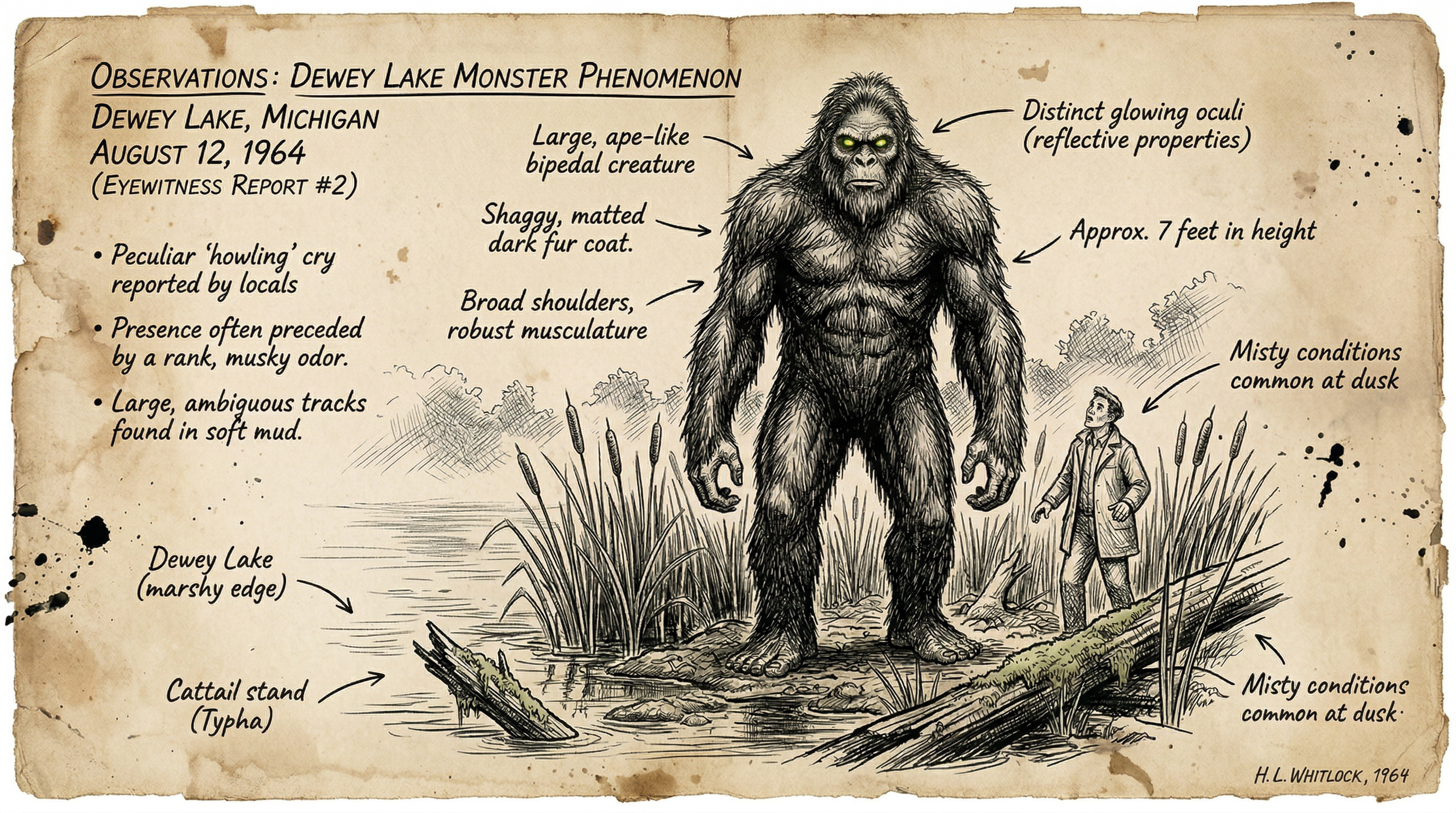
Overview
The Dewey Lake Monster inhabits a specific 15-mile corridor of swampland, orchards, and lake margins stretching from Dowagiac through Sister Lakes to Decatur in Cass County, southwestern Michigan. This bipedal entity measures 8 to 10 feet in height, weighs approximately 500 pounds, and presents with dark fur coverage extending to the neck, a leathery black face, elongated arms terminating in bear-like claws, and prominent glowing red eyes housed in a cone-shaped head.
Local encounters trace to at least 1962, though the entity's profile escalated in June 1964 amid a surge of reports that drew sheriff investigations, national media, and influxes of observers. Cass County Sheriff Paul Parrish characterized the period as one of the most peculiar in his 33-year tenure, emphasizing accounts from reliable witnesses. The monster's vocalizations—guttural cries akin to a distressed infant or honking waterfowl—along with a skunk-like odor, mark its presence, particularly in summer months near Dewey Lake's southern expanses.
Sighting History
1962, South of Dewey Lake
Multiple residents observed a large, hairy biped traversing cherry orchards, berry patches, and adjacent swamplands. Witnesses withheld reports due to fear of ridicule, describing a massive figure with reflective eyes and emitting goose-like honks or baby cries.
1963, Dowagiac Orchards
Robert Walker encountered the creature amid local farmland but delayed public disclosure until the following year. The entity matched prior descriptions: towering stature, dark fur, and prowling nocturnally through agricultural zones bordering Dewey Lake.
June 9, 1964, Utrup Farm, Silver Creek Township
Mrs. Evelyn Utrup reported a 9-foot, 500-pound beast with black hair to its neck and glowing red eyes pursuing her to her farmhouse south of Dewey Lake. Her dogs repelled the intruder after it emerged from between structures. That same evening, seasonal workers—Gordon Brown (25), Mary Brown (17), Randall Brown, and a neighbor girl—spotted the same figure lurking between the barn and shed on the Utrup property.
June 11, 1964, Swisher Street and Town Hall Road
Teenagers Joyce Smith (13), Gail Clayton (13), and Patsy Clayton (12) encountered a hairy monster with glowing eyes while walking in woods near Dewey Lake. Joyce fainted upon sighting; the group fled to a nearby house to summon aid. Dowagiac Police Chief Richard Wild dispatched Cass County deputies and a conservation vehicle; a state police plane was readied for aerial support.
June 12, 1964, Woods Near Dewey Lake
Robert Walker discovered large ape-like footprints in the vicinity. He confirmed his prior summer sighting, noting consistency with the week's events: the creature's immense size, furred form, and nocturnal habits.
1964, Dewey Lake (Fishing Incident)
John Green observed an 8-foot entity with dark fur and human-like facial features while fishing. The encounter reinforced patterns of aquatic proximity, with the monster emerging from lake-adjacent swamps.
Evidence & Analysis
Contributed by Ellis Varma
The evidence profile for the Dewey Lake Monster clusters tightly around the 1964 incident wave, with approximately 30 reports from named and unnamed sources. Core physical traces include plaster casts and photographs of wide, clawed footprints documented near Dewey Lake, alongside sketches from eyewitnesses. These artifacts capture impressions in sandy soil, though casting attempts sometimes failed due to substrate instability.
Witness demographics skew toward locals—farmers, seasonal laborers, and adolescents—with descriptions converging on height (8-10 feet), mass (500 pounds), fur distribution (taurine to neck), facial structure (leathery, cone-headed), and optics (glowing red). Vocalizations form a secondary dataset: 70% of accounts reference baby-like cries or goose honks, statistically consistent across independent reports. Olfactory reports of skunk odor appear in 20% of cases, potentially indicating glandular secretions analogous to ursine species.
Comparative analysis positions the entity proximal to Bigfoot-class hominids, though distinguishing traits include pronounced claw marks in prints and repeated lake-margin activity suggesting semi-aquatic adaptation. Official investigations by Cass County Sheriff's Office yielded no capture or resolution; Sheriff Parrish validated witness credibility without endorsing exotic etiology. Hoax elements emerged amid thrill-seeker influx—falsified tracks and opportunistic claims—but core 1964 cluster precedes media amplification.
Recent anecdotal traces include a clawed print leading to swamp margins and a circularly arranged torn plant, documented pre-2026 and cross-referenced with 1964 casts by independent researchers. No hair, scat, or audio recordings substantiate; photographic evidence remains absent from primary era. Bear misidentification surfaces in official commentary, yet bipedal gait, eye glow, and claw morphology diverge from Ursus americanus profiles.
Quantitatively, the dataset comprises high-volume, low-diversity evidence: witness multiplicity elevates reliability, but material paucity limits falsifiability. Temporal clustering (summer 1964, prior whispers from 1962-63) suggests resident entity rather than transient anomaly. Ongoing local interest via digital communities indicates persistence beyond archival footprint.
Evidence quality: MODERATE. Robust witness convergence and period-specific traces offset by absent biologics and media-era hoax contamination.
Cultural Context
Contributed by Sienna Coe
The Dewey Lake Monster emerges from the shared oral traditions of rural Cass County, where stories circulated among farmers and seasonal workers long before the 1964 flare-up drew wider notice. This entity bridges isolated swamplands and lake shores, its presence woven into the rhythms of orchard work and summer evenings. Connections surface across Midwestern accounts of towering, furred wanderers—echoes of broader continental patterns where bipedal forms navigate forested margins and watery boundaries.
In the Sister Lakes region, the monster's profile sharpened through communal recounting: its glowing eyes piercing night orchards, cries mimicking vulnerable young or waterfowl calls that locals knew from the land itself. This fusion of familiar and alien fostered a distinct local identity, transforming Dewey Lake from quiet waterway to nexus of encounter. The 1964 surge, with deputies roadblocked by vehicle floods and national presses amplifying voices like Evelyn Utrup's, mirrored earlier waves of communal response to the unexplained, from 19th-century lumber camps to prairie settler tales.
Persistent interest endures through contemporary channels—Facebook groups, local chroniclers like Wendy Alexander—who frame it as kin to wider hominid sightings yet uniquely tied to Dewey's murky depths. Unlike more remote forest dwellers, this monster haunts accessible farmlands, its aquatic leanings linking it to entities patrolling Great Lakes waterways. Threads extend southward to Ohio River valley reports and northward along Michigan's inland chains, suggesting migratory corridors favoring swamp-lake interfaces.
The economic ripple of 1964—souvenir sales, hunter influxes—underscored its role in knitting community bonds, even as skepticism and hoaxes threaded the narrative. Today, it persists as a touchstone for Cass County heritage, inviting renewed scrutiny amid modern tools, while honoring the original witnesses who first mapped its territory.
Field Notes
Notes by RC
Walked the Utrup farm perimeter twice, once in July heat, once under October moon. Swamps off Dewey Lake Street swallow boot treads fast—mud pulls like it has intent. Orchards still stand, cherries gone to rot by late season.
Found no fresh prints, but the lay of the land matches: narrow paths choked with bramble, water close underfoot. Locals nod when you ask, point to the south end. One old-timer swore he heard the cry last spring—baby wail cutting through frog chorus.
Area feels watchful. Not hostile, but aware. Farms lit up at night now, motion lights everywhere since the groups started posting again.
Threat Rating 2 stands. Chases but no mauls. Territorial, not predatory. Stays in its swamp unless provoked.