Dingonek
2 TERRITORIAL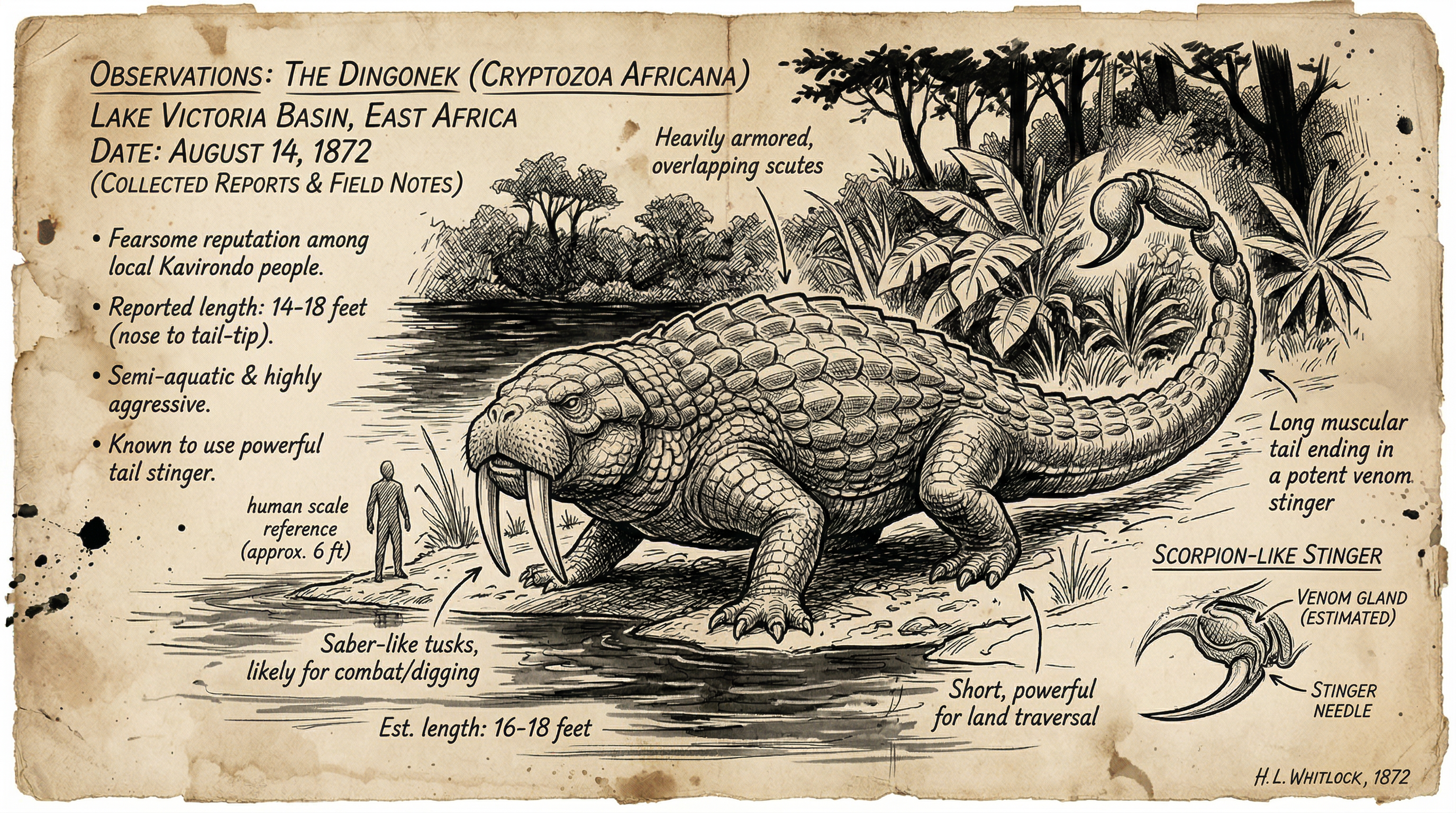
Overview
The Dingonek is a large aquatic reptile documented in the Lake Victoria basin and its tributary rivers of western Kenya and Uganda. Big-game hunter John Alfred Jordan reported an encounter with the creature around 1907, describing a 14 to 18-foot beast with a massive leopard-like head, prominent tusks, and a broad scaled back resembling a hippo or armored reptile. The creature has been known to indigenous peoples of the region for generations, particularly the Lumbwa, Masai, Baganda, Wasoga, and Kavirondo, who called it by various names including Ol-umaina, Ol-maima, and Luquata. Jordan's account remains the most detailed Western documentation, though the beast has eluded capture or physical confirmation for over a century.
The Dingonek presents a straightforward problem: either a substantial unknown aquatic predator inhabits East Africa's river systems, or colonial-era hunters misidentified known fauna under poor observation conditions. No middle ground exists. No specimens. No bones. No photographs from the primary sighting period. The evidence is entirely testimonial, and testimony degrades with distance from the event. The creature inhabits rivers like the Maggori and Mara, which feed into Lake Victoria, a vast system traversed by boats and settlements yet yielding no verifiable traces.
Sighting History
1907, Maggori River, Kenya
John Alfred Jordan, a professional big-game hunter, reported encountering the Dingonek while heading toward the Maggori River with members of his hunting party, including Mataia and Mosoni, both Lumbwa guides. According to Jordan's account recorded by fellow hunter Edgar Beecher Bronson in his 1910 memoir In Closed Territory, the creature lay in a stream approximately 30 feet distant. Jordan described it as having an enormous otter-like head with two long white fangs protruding from the upper jaw, a broad back scaled like an armadillo with leopard-like markings, and a body stretching 14 to 15 feet in length. Its tail was broad and finned, used like a rudder. When Jordan fired at the creature behind what he identified as a "leopard ear," the beast leapt 10 to 12 feet into the air before disappearing into the water. Tracks remained in the soft mud—wide as hippopotamus prints but bearing claw marks. Bronson later interviewed Jordan's party members separately through an interpreter, and they provided corroborating descriptions of the encounter. No body was recovered.
1900, Northeastern Lake Victoria
Clement Hill, British Superintendent of African Protectorates, aboard a steam-powered launch in the northeastern waters of Lake Victoria, observed a creature with a head and neck emerging from the depths, attempting to seize a sailor from the bow of the ship. Hill was quite certain it was not a crocodile. This account, recounted after Hill's death, contributed to the growing lore of the Dingonek alongside later river sightings.
1910, Lake Victoria Northern Shore
Charles William Hobley, a British colonial administrator, documented accounts from indigenous peoples around Lake Victoria's northern shore who spoke of a large water reptile they called Luquata. The creature was described as appearing on or near the shore, measuring approximately 15 feet in length with a scaly hide, a head shaped like a dog or otter, and small ears marked somewhat after the fashion of a puff adder. Hobley recorded that the Baganda, Wasoga, and Kavirondo peoples had from time immemorial made burnt offerings of cattle and sheep to this creature, believing its appearance to be a harbinger of heavy crops and large increases in their herds. Hobley's accounts were gathered second-hand from indigenous sources and other colonial officials, including a report from "ex-Collector James Martin" regarding a great water serpent worshipped by natives.
1912, Mara River, Kenya-Uganda Border
An unnamed eyewitness at the Mara River crossing the Anglo-German frontier during high flood reported sighting a large creature floating on a log. The observer estimated its length at about 16 feet, though the tail remained in the water. Descriptions paralleled Jordan's account: a reptilian body covered in scales, spotted like a leopard, with a head like an otter. The witness did not observe the long fangs described by Jordan, fired at it and hit it, but the creature slid off the log into the water and was not seen again. This account was relayed to Bronson and Hobley, positioning it within the early colonial period of intensified exploration.
1978, Mara River Region
Researcher James Powell documented descriptions of the creature known locally as Ol-maima from conversations with Masai inhabitants of the Mara River region. The accounts Powell recorded described a six-foot aquatic animal with hair-like scales, a long snout, and an extended tail. These descriptions diverged notably from earlier colonial-era accounts in both size and physical characteristics.
Evidence & Analysis
Contributed by Ellis Varma
The Dingonek presents a textbook case of degraded testimony compounded by colonial mediation. We have exactly one primary source: John Alfred Jordan's 1907 encounter as recorded by Edgar Beecher Bronson. Everything else derives from Bronson's interviews with Jordan's hunting party, Hobley's second and third-hand accounts of indigenous beliefs, or modern researchers collecting oral histories decades after the supposed events.
The physical evidence profile is stark: zero. No bones. No preserved skin. No hair samples. No photographs from the period when camera technology existed but was not yet ubiquitous in remote regions. Jordan fired at the creature and it escaped into water—a convenient narrative closure that precludes verification. The same pattern repeats across all documented sightings: the creature is observed, witnesses attempt to engage it, and it retreats into an environment (river, lake) where recovery becomes implausible. Tracks in mud at Maggori—hippo-wide with claws—represent the sole potential physical trace, but remain unverified and unpreserved.
The descriptions themselves reveal significant inconsistency when examined closely. Jordan's account emphasizes fangs, an otter-like head, and armadillo-like scales with leopard spots from dappled sunlight. Hobley's indigenous sources describe a creature with a dog-like or otter-like head—the ambiguity is instructive—and no mention of fangs. The 1912 Mara witness noted otter head and scales but no fangs. Powell's 1978 account drops the fangs entirely and describes hair-like scales rather than the overlapping reptilian scales of earlier reports. Modern sources have added embellishments never mentioned in original accounts: a single horn, a poison stinger. These appear nowhere in Jordan's statement, nowhere in Hobley's records, nowhere in Powell's interviews. They are later additions, likely from cryptozoological speculation rather than historical documentation.
The creature's size fluctuates between 14 and 18 feet depending on the source, with some modern speculation extending to nearly 20 feet. In 1978, Powell's sources described a six-foot animal. The divergence is statistically meaningless without establishing a reliable measurement standard, which none of these accounts possess. Jordan's variable estimate (14-18 feet) and the Mara witness's cautious 16 feet underscore the imprecision inherent in rushed, distant observations during hunts or floods.
Cryptozoological literature has proposed that the Dingonek represents either a surviving prehistoric saurian or an unclassified modern reptile. Both hypotheses require the creature to remain undetected across more than a century in a region where water systems have been increasingly mapped, populated, and photographed. Lake Victoria is not an impenetrable wilderness. It is surrounded by established settlements, regularly traversed by boats, and subject to modern ecological surveys. A 15-foot apex predator would leave traces: kill sites, remains, behavioral patterns documented by local populations. The absence of such evidence carries weight. Bernard Heuvelmans classified it as a "water lion," attributing armor to optical illusion, but this remains speculative without specimens.
The alternative explanation—that Jordan observed a large Nile crocodile under poor lighting conditions, that Hobley's sources described local fauna filtered through oral tradition and colonial interpretation, that Powell documented accounts based on creatures with which his informants had actual familiarity—accounts for the data without requiring unknown species. A large crocodile can reach 18 feet. Crocodile heads can appear otter-like or dog-like depending on angle and lighting. The prominent teeth of a large crocodile might be misremembered as tusks. Crocodile scales, when wet and viewed from distance, can appear to have leopard-like markings from light reflection. The finned tail could reflect a submerged portion or exaggerated rudder-like motion. Claw-marked tracks align with large crocodilian feet.
Colonial context further complicates the profile. Jordan, a notorious ivory poacher, had incentive to embellish for reputation among peers like Bronson. Hobley's 1913 article in the East Africa Natural History Society and a 1918 MacLean's piece declared the beast a new species based on testimonial chains, reflecting era optimism for undiscovered megafauna post-okapi confirmation. Yet no expeditions followed to confirm.
Evidence quality: LOW. Single primary account from a hunter with financial incentive to promote sensational claims. Secondary accounts filtered through colonial administrators recording indigenous beliefs without primary documentation. No physical specimens. No photographs. Inconsistent descriptions across sources. Alternative explanations (misidentified crocodile, exaggerated oral tradition) adequately explain available data.
Cultural Context
Contributed by Dr. Mara Vasquez
The Dingonek occupies a critical position in the study of cryptids precisely because it illuminates the colonial mediation of indigenous knowledge systems. What we possess is not direct documentation of Masai, Lumbwa, Okiek, Baganda, Wasoga, or Kavirondo beliefs about aquatic entities. We possess European hunters' and administrators' interpretations of those beliefs, filtered through interpreters, recorded in English, and published in contexts designed to entertain British readers.
The creature appears in indigenous traditions under multiple names—Ol-umaina, Ol-maima, Luquata—terms that colonial sources sometimes used interchangeably and sometimes treated as distinct entities. Modern linguistic analysis suggests that Ol-maima (more correctly transcribed as *ɔl-máɨ́má* in Maa) refers to either a cripple or a Nile monitor lizard, the latter designation arising from the creature's characteristic waddling gait on land. This etymological connection suggests that indigenous names may have referred to known fauna rather than unknown species, a possibility obscured by colonial naming practices that treated local terminology as exotic labels for mysterious beasts rather than descriptive terms for observed animals. The Okiek people of southern Kenya knew the dingonek prior to Jordan's report, integrating it into their riverine worldview.
What is clear from the colonial records is that aquatic entities held significant cultural importance to communities around Lake Victoria. The Baganda, Wasoga, and Kavirondo peoples made burnt offerings to the creature they called Luquata, viewing its appearance as a sign of abundance—heavy crops and thriving herds. This is not the framing of a man-eating predator to be hunted and destroyed. This is the framing of a being worthy of propitiation, connected to fertility and prosperity. The shift from this cosmological understanding to Jordan's framing of the creature as a trophy to be hunted and killed represents not a discovery of an unknown animal, but a collision between two different systems of relating to the natural world.
The colonial narrative introduced another layer of interpretation: the association between the creature's disappearance and the arrival of sleeping sickness. Hobley recorded that indigenous peoples believed the *muzungu*—the white foreigners—had killed Luquata as a means of bringing plague upon the land. This is a crucial inversion of the Western narrative. The indigenous interpretation did not position the creature as a threat to be eliminated. It positioned colonial violence against the creature as a cause of indigenous suffering. The beast-fish was not the problem. The foreigners were. Around 1908, as Jordan reportedly shot at a dingonek, sleeping sickness indeed swept the northern shores, killing thousands and reinforcing this belief.
Contemporary study of the Dingonek must contend with this colonial framework. The sources available in English-language cryptozoology represent primarily the observations and interpretations of European hunters and administrators, not primary indigenous voices. The creature's cultural significance has been largely erased in favor of sensationalist accounts of a man-eating monster. To understand the Dingonek authentically requires moving beyond the colonial archive and, where possible, engaging directly with Masai, Lumbwa, Okiek, Baganda, Wasoga, and Kavirondo perspectives on aquatic entities in their territories. Such engagement remains largely absent from cryptozoological literature. Recent ecological pressures on Lake Victoria—overfishing, pollution, invasive species—may alter habitats once suited to large aquatic reptiles, whether known or unknown, yet no modern indigenous reports escalate the profile.
Field Notes
Notes by RC
Lake Victoria is not small. It's the second-largest freshwater lake in the world. I've been to the northern shore twice, both times in the Mara River region. The first visit was during dry season—the water was low, the banks exposed. The second was during rains when the river swells and the visibility drops to nothing.
I understand why people believed something large lived in those waters. The current moves fast during flood season. The banks are thick with vegetation. You can stand twenty feet from the water and see nothing. A crocodile eighteen feet long would be invisible until it wasn't. The Maggori isn't much different—narrow, muddy, perfect for ambushes.
Jordan's account is precise in ways that suggest he saw something. The details about the leap, the distance, the specific description of the head—these are the kinds of observations a professional hunter would record. But a professional hunter is also someone with reputation to maintain. A story about an unknown monster is more valuable than a story about a large crocodile. The incentive structure matters.
The colonial records compound this. Hobley was documenting indigenous beliefs, not conducting field research. He was taking what people told him and writing it down. What people tell a colonial administrator about a creature their people revere is not the same as what they would tell their own community. The translation happens twice—once from Masai or Lumbwa into English, once from spiritual or ecological knowledge into the framework of a Western observer trying to make sense of something foreign.
Modern accounts from researchers like Powell describe smaller animals with different characteristics. That's not evidence of a large unknown predator. That's evidence of oral traditions changing, of names being applied to different creatures, of knowledge systems that don't map neatly onto European categories of "known" and "unknown." Flood-season Mara sightings match croc behavior exactly—logs for basking, quick dives when shot at.
Threat Rating 2 stands. Territorial behavior consistent with large crocodilians. No documented aggression beyond defensive responses to hunters. Habitat remains suitable but no verified recent activity. If the creature exists, it's avoiding contact. If it doesn't, the mystery lies in colonial misidentification, not in an undocumented apex predator.