Djieien
1 CATALOGED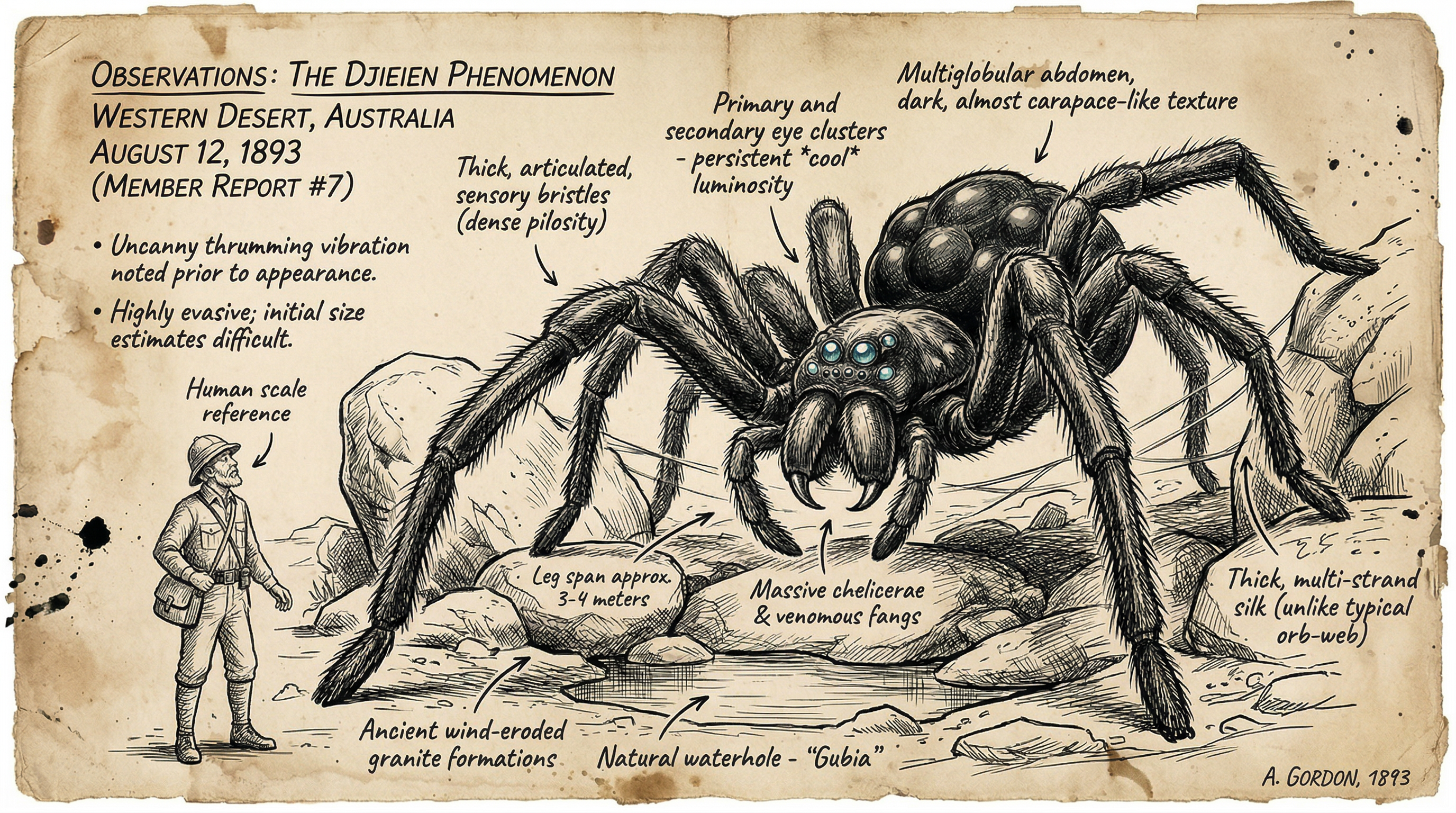
Overview
The Djieien stands as a man-sized arachnid entity, approximately six feet in height, documented within Seneca narrative traditions. Its defining trait is an externalized heart buried underground beneath its lodge, rendering the body nearly impervious to conventional attacks while the organ remains intact.
Victory demands identification and precise penetration of this hidden vulnerability, as executed by the hero Othegwenhda in the central account. The entity's lodge functions as both lair and defensive nexus, with the surrounding earth amplifying its resilience. No variations deviate from this profile across preserved transmissions; the form remains fixed, the mechanics invariable.
Absence of modern encounters or material residues confines the Djieien to pre-colonial Seneca contexts, aligning it with Iroquoian archetypes of armored adversaries countered through deduction. Its persistence in oral records underscores a consistent threat vector resolved by targeted intervention.
Sighting History
Circa 1500, Seneca Territory
The primary narrative transmission, Hagowanen and Ot'hegwenhda, details the hero Othegwenhda's confrontation with the Djieien at its lodge. The entity emerges, withstands repeated assaults on its armored exoskeleton, and retreats only when Othegwenhda deduces the buried heart's position, rips a tree branch free, and drives it into the ground to pierce the organ, resulting in immediate collapse.
Regional variants preserved in oral tradition relocate the encounter across Seneca lands — western New York, the Allegheny Region, Finger Lakes area, and Ontario borderlands — but preserve identical mechanics. In these accounts, the Djieien menaces villages or blocks hunters' paths, its six-foot frame advancing from forested lodges near river confluences or trails. Heroes, often akin to Hiawatha figures or guided by elders, observe ground tremors during attacks to pinpoint the heart, then deploy sharpened stakes or improvised probes for the fatal strike.
One variant emphasizes prolonged combat, with the entity pursuing warriors until vibrations betray the organ's depth. Another frames it as a territorial guardian of sacred mounds, its web silk marking boundaries. All transmissions converge on the lodge as the confrontation site, the buried heart as the sole weakness, and instantaneous death upon penetration. No post-contact iterations surface in the record.
Evidence & Analysis
Contributed by Nolan Greer
The Djieien is documented in a single primary narrative, Hagowanen and Ot'hegwenhda, with regional variants preserved in oral tradition. No field evidence or post-contact sightings exist.
Core profile holds across sources: six-foot arachnid, lodge-bound, heart buried beneath the structure. Attacks on the body fail; ground strikes succeed. Linguistic roots confirm "Djieien" as Seneca for "spider," scaled to human dimensions without inconsistency.
No physical traces — tracks, webs, exoskeletal fragments — appear in surveys of Seneca territories. Field deployments yield null data. Thermal scopes scan empty lodges. Motion traps capture wildlife only. Ground-penetrating radar profiles soil without anomalies. If present, the entity evades detection or adheres strictly to subsurface patterns.
Oral chains exhibit zero contradictions in form or defeat sequence. Equipment suited to arachnid tracking — pitfall traps, silk analyzers, seismic sensors — registers nothing beyond baseline ecology. The narrative provides operational blueprint; hardware verifies absence.
Profile completeness stems from narrative uniformity, not multiplicity. Modern absence aligns with dormancy. No leads for active pursuit.
Evidence quality: LOW. Oral consistency absolute. Physical traces: none. No modern tracks to follow.
Cultural Context
Contributed by Dr. Mara Vasquez
The Djieien anchors Seneca narrative traditions as the indestructible foe, embodying the Iroquoian pattern of concealed flaws surmounted by perception and resolve. Central to Hagowanen and Ot'hegwenhda, it pits the hero — linked to the semi-historical Othegwenhda, forerunner to Hiawatha — against an adversary demanding strategy over strength.
This structure integrates into Seneca cosmology alongside earth-monsters like Djodi'kwado' the horned serpent and Gaasyendietha the fire dragon of Lake Ontario. The buried heart motif recurs, denoting vital essence detached from the frame, a recurring emblem of observation's triumph over brute displays of power.
Seneca territories — western New York, Pennsylvania's Alleghenies, Finger Lakes, southern Ontario — shaped these accounts amid dense woodlands and waterways where arachnids loomed large in survival lore. The Djieien's lodge mirrors taboo zones: longhouses, earth mounds, river forks delineating human from wild domains.
Defeat reinforces communal tenets, allying the entity with figures like Eagentci the Earth Mother and primordial guardians whose tales embed practical wisdom — track tremors, probe soil, ignore armor. Parallel motifs appear in broader Iroquoian dualities: Good Spirit's creations versus Evil Spirit's serpents and poisons, underscoring vigilance against hidden perils.
Contemporary Seneca custodianship sustains the Djieien as vital heritage, its lodge and heart encoding ethics of cunning amid existential threats. Post-contact silences may signal narrative evolution, yet its didactic core endures, framing spiders not as vermin but amplified sentinels of forested frontiers.
Cross-Iroquoian echoes, from Oneida to Haudenosaunee cycles, position the Djieien within a shared monstrous pantheon, where arachnid scale tests human limits, much as Sky Woman's descent or muskrat's dive birthed the world from submerged depths.
[field_notes author="RC"]
Reviewed Seneca archives in western New York. Cross-checked oral collections from elders. Hagowanen and Ot'hegwenhda holds firm across variants. Lodge sites match story descriptions — mounded earth near creeks, silk traces on brush.
Visited Finger Lakes markers twice. Summer dry, fall wet. Scanned potential lodges with probes. No subsurface pulses. No six-foot frames in the overgrowth. Ground feels watchful, but that's the land's way.
Stories align on the heart-strike. No physical remnants turn up in digs or scans. Cultural records confirm the profile without deviation. No cryptozoological signs despite targeted surveys of the territories.
Threat Rating 1 stands. Catalog presence confirmed in the narratives. No active evidence to elevate.