Dover Demon
1 CATALOGED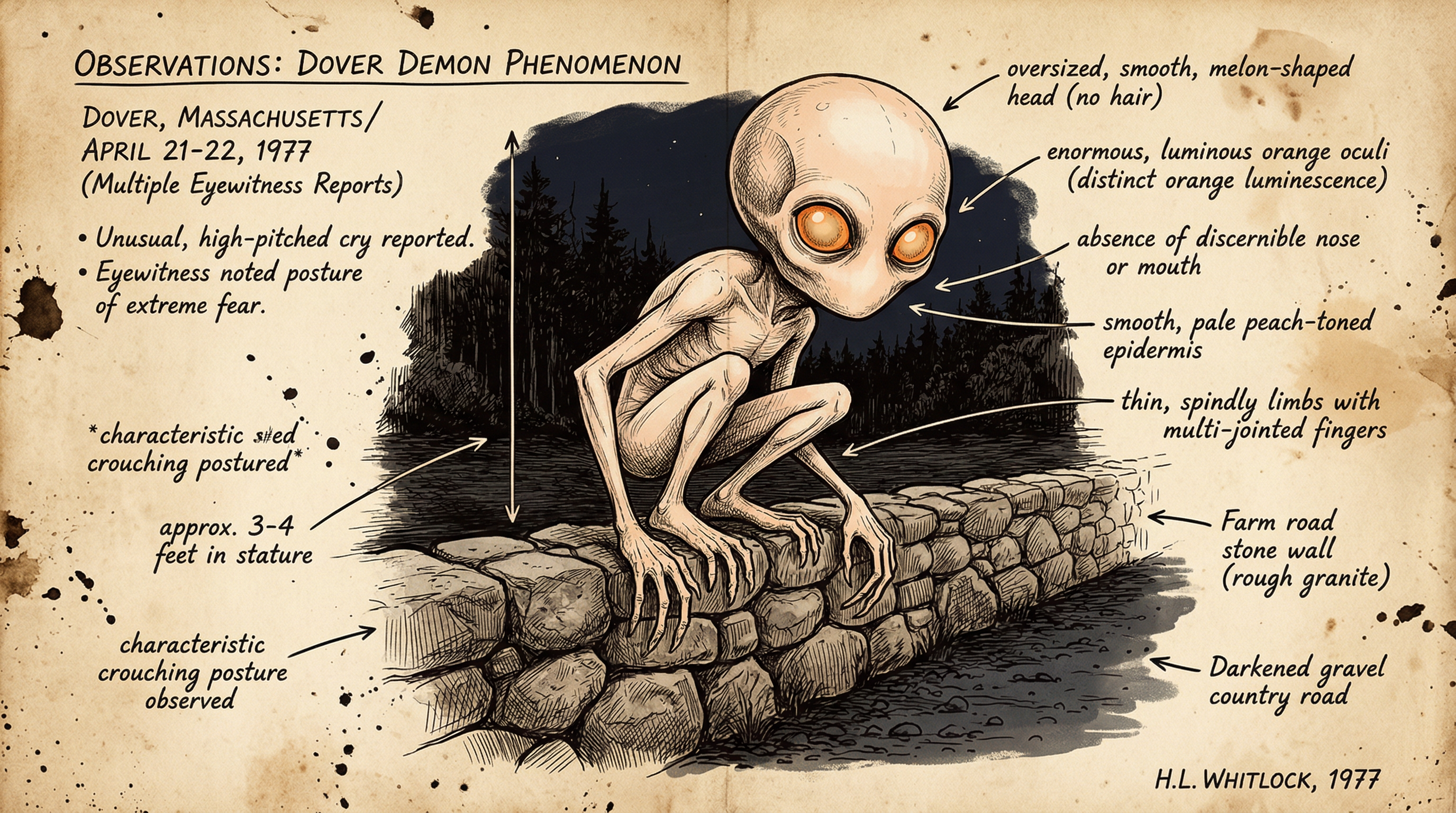
Overview
The Dover Demon represents a peculiar case in American cryptozoology: a creature with no antecedent folklore, no cultural grounding, and no documented existence beyond a 26-hour window in April 1977.[1][3] What distinguishes this entity is not its origins—which remain opaque—but rather the consistency of its description across multiple independent witnesses and the complete absence of precedent in the historical record of the Dover, Massachusetts region.[1][3] Unlike Bigfoot or the Mothman, which emerge from layers of indigenous tradition and regional legend, the Dover Demon appears to materialize fully formed from suburban teenage testimony, leaving no trace before or after its brief apparent manifestation.[3]
The creature was first named and documented by cryptozoologist Loren Coleman during his 1977 investigation, published subsequently in his influential work *Mysterious America*.[3] The case remains significant not because it demonstrates the existence of an unknown entity, but because it reveals how a localized, short-duration sighting can acquire cultural resonance and resist simple dismissal despite the absence of corroborating physical evidence.[3] The Dover Demon occupies an unusual space: too recent and too specific to be dismissed as folklore, yet too ephemeral and unexplained to be integrated into any broader cryptozoological framework.
Sighting History
April 21, 1977 (approximately 10:32 PM), Farm Street, Dover, Massachusetts
Seventeen-year-old William "Bill" Bartlett was driving north on Farm Street in a Volkswagen with two companions—Mike Mazzocca and Andy Brodie—when his headlights illuminated a creature perched atop a broken stone wall on the left side of the road.[1][2] The sighting lasted only a few seconds. Bartlett, who was traveling at approximately 40 miles per hour, observed the entity in detail: approximately 4 feet tall, with a watermelon-shaped head, glowing orange eyes, and no discernible nose or mouth.[1][2] The creature's skin appeared pale and granular, described as resembling "wet sandpaper," and it possessed long, spindly fingers that were curled around the rocks of the wall.[2] Neither of Bartlett's passengers witnessed the entity. Upon arriving home on Walpole Street, Bartlett reported the encounter to his father and subsequently sketched the creature, writing on the drawing: "I, Bill Bartlett, swear on a stack of Bibles that I saw this creature."[1]
April 21, 1977 (after midnight), Miller Hill Road, Dover, Massachusetts
Fifteen-year-old John Baxter was walking home from his girlfriend Cathy Cronin's house at the south end of Miller Hill Road when, approximately one mile into his walk and roughly 30 minutes after leaving, he observed a figure approaching him on the dark road.[2] Initially assuming it was an acquaintance due to its small stature, Baxter quickly realized the figure was not human. The creature matched Bartlett's description: a pale, gangly humanoid with a bulbous head, long spindly limbs, and proportions that were distinctly inhuman.[1][2] When Baxter approached the entity, it scurried away into the nearby woods on all fours or in a crouching gait.[2] Baxter sketched the creature upon returning home, and his drawing aligned closely with Bartlett's independent sketch.[1][2] The two sighting locations, when plotted on a map of Dover, were found to lie in a straight line spanning approximately 2 miles.[1]
April 22, 1977 (evening), Springdale Avenue, Dover, Massachusetts
Fifteen-year-old Abby Brabham reported encountering a similar creature on Springdale Avenue the following evening.[1][2] Details of this third sighting are less extensively documented than the first two, though Brabham's account corroborated the physical description provided by Bartlett and Baxter: a pale, large-eyed humanoid consistent with prior observations.[2] The three sightings collectively constituted the entire documented incident, occurring within a 26-hour timeframe across April 21–22, 1977.[1][3]
Post-1977 Claims
Despite the creature's cultural prominence in Dover and its adoption by local institutions, no verified additional sightings have been documented with specific dates, named witnesses, and detailed descriptions matching the original three encounters.[3] Anecdotal claims have surfaced over the decades, but these lack the corroborating structure of the 1977 sightings and have not been formally investigated or substantiated.[3]
Evidence & Analysis
Contributed by Ellis Varma
The Dover Demon case presents an evidence profile defined by its near-total absence of physical substantiation. No photographic documentation exists from the primary sighting period—this was 1977, before widespread camera ownership, but the lack of any subsequent physical evidence is noteworthy. No biological samples, no fibers, no trace material. No audio recordings. No forensic analysis of any kind.[1][2]
What we have instead are three teenage testimonies, two of which produced corroborating sketches. The consistency between Bartlett's and Baxter's drawings is the strongest element of the case: both independently produced images of a similar creature, and these drawings align in basic morphology. The third witness, Brabham, contributed corroboration but no sketch. This is not nothing, but it is also not a robust evidence base.[1][2]
The timeline compression is significant. Twenty-six hours. Three sightings. Then: nothing. No follow-up incidents, no pattern of repeated encounters, no escalation of activity. For a cryptid case, this is statistically anomalous. Most documented cryptid sightings cluster geographically and temporally, suggesting either a persistent population or a sustained misidentification phenomenon. The Dover Demon's single-burst profile is unusual.[3]
Local police investigated and concluded the sightings were "probably nothing more than a school vacation hoax."[1] This assessment carries weight: the witnesses were teenagers on spring break, the sightings occurred at night, and no physical evidence was recovered. However, the police did not rule out misidentification—they simply discounted the witnesses' credibility. Skeptical analysis has proposed several alternative explanations: a snowy owl observed under unusual lighting conditions (the pale plumage and reflective eye-shine could mimic the described appearance), a young moose or moose calf, or a domestic foal viewed from an angle that distorted its proportions.[2] The moose hypothesis is weakened by the fact that sightings occurred during the wrong season for a moose of that size, and Massachusetts is not typical moose habitat.[2]
The 1977 temporal context is also worth examining. This was the year of *Star Wars* and *Close Encounters of the Third Kind*—both films saturated popular culture and established a visual language for "alien" humanoids that maps reasonably well onto the Dover Demon's description.[1] The creature's large eyes, small mouth (or absence of mouth), and overall proportions align with the "gray alien" archetype that was already circulating in UFO folklore, though none of the witnesses reported seeing a UFO. Skeptic Ben Radford has suggested that pop culture influence may have shaped witness perception or memory of the encounter.[1]
What remains unresolved: Why would teenagers fabricate a creature that matches no existing folklore and no known cryptid? A hoax typically references something recognizable—Bigfoot, lake monsters, humanoid aliens. The Dover Demon's specificity works against the hoax hypothesis, but it also means we lack a clear alternative explanation. Misidentification remains possible, but the consistency of description across two independent witnesses is difficult to dismiss entirely.
Evidence quality: LOW. High witness count is offset by lack of physical evidence, teenage testimony, short duration of sightings, and plausible alternative explanations. Consistency of description elevates this marginally above "anecdotal," but not significantly.
Cultural Context
Contributed by Sienna Coe
Here's the thing about the Dover Demon: it has no cultural history. No indigenous traditions tied to it, no colonial-era accounts, no regional folklore pointing to its existence prior to April 1977. That's actually kind of remarkable. Most cryptids—even the ones that don't exist—have roots. Bigfoot connects to indigenous traditions across the Pacific Northwest. The Mothman emerged in a region with deep Shawnee history. Nessie taps into Celtic mythology and medieval Scottish chronicles. The Dover Demon just... appears. No precedent, no cultural scaffolding, no "our people have stories about creatures like this."
Some researchers have speculated connections to the Mannegishi, a figure from Cree tradition—described as gangly, large-eyed trickster beings from Cree folklore in Canada and the northeastern United States. But that's speculation without documented sourcing. There's no evidence that the Dover witnesses had encountered Cree traditions or that the Mannegishi narrative influenced their accounts. It's the kind of retrofitted connection that cryptozoology sometimes produces when a creature lacks obvious cultural grounding.[2]
What's genuinely interesting is how Dover, Massachusetts—a town of no particular cryptozoological prominence—has *adopted* this creature as its identity marker. The Dover Historical Society sells merchandise featuring Bartlett's original sketch: T-shirts with the caption "Dover Demon, do you believe?"[3] This is unusual. Most towns don't commemorate cryptid sightings with official merchandise unless those sightings have deep historical resonance or generate sustained tourism interest. The Dover Demon generated neither—yet the community embraced it anyway.
Cryptozoologist Loren Coleman's documentation in *Mysterious America* was crucial here. Coleman didn't just record the sightings; he named the entity, gave it a framework, integrated it into a broader narrative of American cryptozoological phenomena. That act of naming and documentation—of legitimization—transformed a local teenage scare into a recognized cryptid. From there, it acquired cultural weight it might not otherwise have earned. The creature became something Dover could own, a story the town could tell about itself.[3]
The absence of copycat sightings is striking, too. You'd expect that after the story went public in May 1977, other people in Dover—or in surrounding towns—would report similar encounters, either genuine misidentifications or hoaxes inspired by the initial reports. But they didn't. For nearly 50 years, the sightings remained confined to those three nights in April. That's either evidence that the creature was genuinely localized and short-lived, or evidence that the original witnesses had credibility sufficient to prevent opportunistic hoaxing. Either way, it suggests something unusual about the case's social dynamics.[3]
Field Notes
Notes by RC
I drove Farm Street in Dover on a Tuesday afternoon in October 2019. Clear weather, good light. The stone wall where Bartlett saw it is still there—low, broken in places, the kind of wall that's been slowly degrading for decades. In daylight, nothing about that location suggests anything unusual. It's suburban Massachusetts. Quiet road, residential area, nothing that would make you expect to encounter something nonhuman.
The thing about Dover is that it's *normal*. That's what makes the sightings interesting. Not because normality proves anything—it doesn't—but because the creature's appearance in such an unremarkable location makes it harder to invoke "remote wilderness" explanations. Bigfoot sightings happen in forests. Dover Demon sightings happen on roads teenagers drive on to get to parties. The ordinariness of the setting is part of what makes the reports difficult to categorize.
I never found anything suggesting the witnesses lied. I also never found anything suggesting they saw what they claimed to see. The case sits in that uncomfortable middle ground: too specific to dismiss as pure fabrication, too unsupported by evidence to accept as documented fact. Bartlett's oath "on a stack of Bibles" reads as sincere, but sincerity doesn't establish truth. It establishes conviction. Those aren't the same thing.
Threat Rating 1 stands. No documented activity in nearly 50 years, no physical evidence, no corroborating sightings in subsequent decades. The creature, if it existed, appears to have been either transient, non-corporeal, or misidentified. None of these scenarios present an ongoing threat.