
Emela-ntouka
2 TERRITORIAL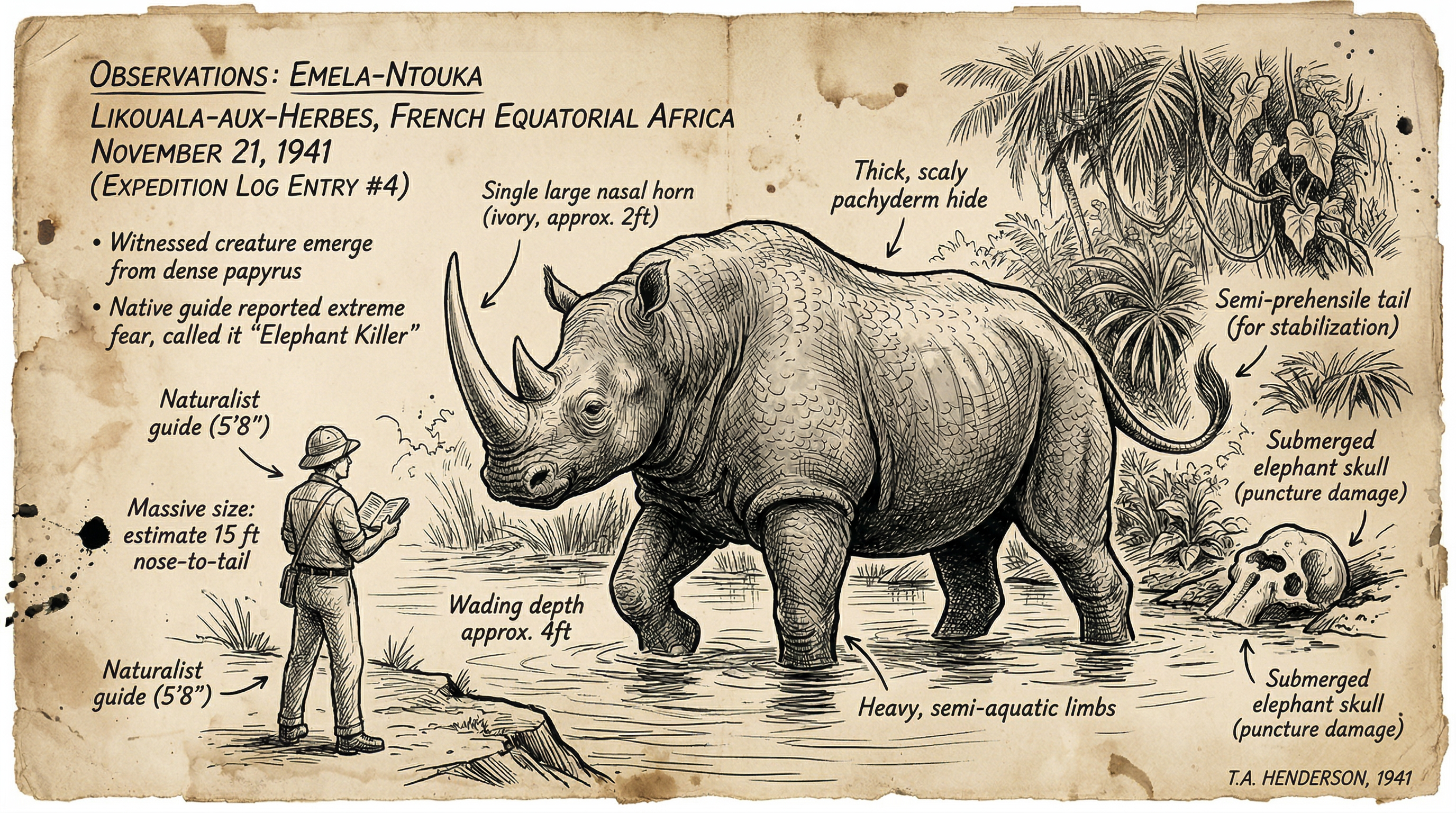
Overview
The Emela-ntouka is an elephant-sized semi-aquatic creature, larger than buffalo, characterized by a single horn on its snout, four short stump-like legs, and a bulky frame. Its grayish, hairless skin and crocodile-like tail make it instantly recognizable to those familiar with Congo Basin waterways. The creature inhabits the Likouala Swamps and Congo Basin rivers, where it feeds on malombo plants and the tops of palm trees. Despite its herbivorous diet, the Emela-ntouka is notorious for killing elephants, buffaloes, and hippos when its territory is disturbed, earning its Lingala name—"killer of elephants"—through a pattern of aggressive territorial defense rather than predatory behavior.
Local populations avoid swamp areas where the creature patrols, noting its ability to move silently through water using its powerful tail for propulsion. The animal's smooth skin bears no frills or distinctive markings beyond its prominent horn. Pygmy trackers occasionally locate it through rare three-toed prints, though identification remains disputed among researchers. The creature's vocalizations—snorts, rumbles, and low growls—carry across water at dusk and dawn, signaling its presence to those who know how to listen. Its semi-aquatic nature confines it primarily to the deeper swamps and river systems of the Likouala region, where visibility remains low and terrain hostile to sustained expedition work.
Sighting History
1933, Luapula River
Wa-Ushi tribesmen slaughtered an unnamed animal matching Emela-ntouka description along the shores connecting Lake Bangweulu to Lake Mweru. The incident was reported in J.E. Hughes' Eighteen Years on Lake Bangweulu, published in 1933. No named primary witnesses were documented, and the body was not preserved for examination.
1930, Dongou, Congo
An Emela-ntouka was killed near Dongou on the left bank of the Ubangi River, extending into Belgian Congo territory. The account derives from Lucien Blancou, the Likouala game inspector, though no primary witnesses were formally named. The incident would later anchor Blancou's broader documentation of the species in his 1954 Mammalia journal entry.
1954, Kellé District
Pygmies north of Kellé described an animal larger than buffalo, nearly elephant-sized, with tracks so rare that sightings remained infrequent. The creature was feared more than other forest dangers, with its presence known around Epéna, Impfondo, and Dongou. Blancou's Mammalia journal article formalized these reports, drawing from decades of Likouala locals' testimonies and establishing the first printed documentation of the species.
1958, Likouala Region
Jacques Mangin, a French hunter, claimed confirmation of killing an Emela-ntouka, though the specific location remained unspecified and the account was tied to the broader Likouala swamps region. Mangin's participation in later Mackal expeditions lent credibility to his earlier claims, though potential conflation with Mokele-mbembe reports cannot be ruled out.
1980, Impfondo and Epena, Congo
Dr. Roy P. Mackal and James Powell, traveling to the region to investigate reports of the Mokele-mbembe, interviewed Joachim Mameka, a young Bomitaba man, who provided a detailed description of a horned elephant-killer known locally as emeula natuka—the eater of palm tops. Mackal noted the potential overlap between this nomenclature and Mokele-mbembe terminology, suggesting possible conflation in oral traditions or deliberate distinction by local informants.
1981, Northwest Likouala Swamp
Mackal's expedition team documented pygmy reports of Emela-ntouka activity, with locals in Impfondo, Epena, and Dongou confirming the creature's presence. Witnesses blamed the animal for disemboweling three elephants that year, using its horn to gore large herbivores that encroached on its territory. No direct sightings by the expedition team were recorded, though tracks and behavioral signs were noted by local guides.
Evidence & Analysis
Contributed by Ellis Varma
The evidence profile for Emela-ntouka clusters tightly around secondhand pygmy testimonies relayed through colonial and cryptozoological intermediaries. Lucien Blancou's 1954 Mammalia entry provides the earliest print documentation, drawing from Likouala locals without named primary sources. J.E. Hughes' 1933 book adds a pre-print incident, but again lacks direct witness affidavits or physical remnants.
Key data points: elephant killings attributed in 1981 (three cases, Mackal expedition), 1930 Dongou kill, 1958 Mangin claim. Zero bodies recovered. No photographs. Tracks described as three-toed, hippo-like but disputed—Heuvelmans noted potential fourth toe obscuration by mud; Rémy Jalowézak argued misidentification of hippo prints. Vocalizations (snorts, growls) unrecorded. No audio, scat, or hair samples exist in any archive.
Conflation risk remains high. Mackal's 1980-1981 teams explicitly noted name overlap with Mokele-mbembe (emeula natuka as possible synonym), raising the possibility that these represent a single entity known by multiple regional names or two distinct creatures whose oral traditions have merged over time. Physical description remains consistent across reports—horned, stump-legged, semi-aquatic—but sample size is small: fewer than ten distinct incidents over fifty years, all anecdotal. Statistically meaningless for population estimate or behavioral pattern analysis.
Differential diagnosis rules out several candidates. Rhino can be eliminated due to ivory horn structure and consistent losses to elephants in documented conflicts. Hippo mismatch on tracks and horn morphology. Ceratopsian speculation remains unsupported—no fossil analogs exist in modern swamp ecology, and the energetic requirements of such a creature would demand a substantially larger prey base than Congo Basin ecosystems could support. A forest elephant variant or unknown bovine remains possible, though the horn and aggression profile constitute significant outliers from known species behavior.
Geographic clustering in Likouala swamps is logical for a semi-aquatic creature. No expansion signals have been documented beyond the core swamp region. Witness credibility presents a mixed picture: pygmies are experienced trackers with intimate knowledge of forest ecology, while intermediaries like Blancou and Mackal were field-qualified but demonstrably biased toward megafauna hypotheses that would elevate their professional standing.
Evidence quality: LOW. Volume of consistent verbal reports is elevated by cultural continuity and independent corroboration across ethnic groups. Physical evidence remains absent. High conflation potential with Mokele-mbembe and other basin cryptids undermines independence of individual sightings.
Cultural Context
Contributed by Dr. Mara Vasquez
Within Mbuti, Twa, Aka, and Bomitaba traditions of the Congo Basin, Emela-ntouka occupies a vital position in the forest's spiritual architecture. Its Lingala name—"killer of elephants" or "eater of the tops of trees"—encapsulates not mere physical prowess but the forest's assertion of dominance over even its largest terrestrial inhabitants. Pygmy cosmology frames the wilderness as a living entity, interwoven with spirits that manifest through animals; Emela-ntouka embodies territorial boundaries in swamps and rivers, where human incursions risk invoking its wrath.
Unlike predatory beasts, its aggression targets herbivores—elephants, buffaloes, hippos—mirroring pygmy anxieties about the forest's hidden enforcers. Oral histories, preserved across generations, position it alongside kin like Mokele-mbembe, with variant names (Aseka-moke, Njago-gunda, Ngamba-namae, Chipekwe, Irizima) extending into Cameroon and Central African Republic tribal memories. These accounts, documented by Blancou (1954) and Mackal (1980s), serve as primary sources revealing a worldview where megafaunal threats reinforce human humility before the sacred ecosystem.
The creature's semi-aquatic nature ties it to waterways as liminal spaces—thresholds between physical hunting grounds and spiritual depths. Pygmies express greater fear of Emela-ntouka than lions or leopards, not due to predation on humans but its disruption of ecological balance. This reverence underscores indigenous knowledge of megafaunal dynamics, predating colonial records like Hughes (1933). Modern expeditions risk cultural distortion by framing it as "dinosaur survivor," sidelining its role as forest guardian.
Across Congo Basin peoples, Emela-ntouka narratives foster communal caution: avoid provoking elephants near swamps; respect rare tracks; understand that certain territories belong to forces beyond human control. This integrates into initiation rites and hunting taboos, preserving ecological wisdom accumulated over centuries. Anthropological expeditions, from Blancou's inspections to Mackal's teams, inadvertently amplified these traditions globally, bridging oral heritage with written record while highlighting the pygmies' unparalleled intimacy with the basin's mysteries.
Field Notes
Notes by RC
Tracked Likouala edges twice. Once by pirogue, once on foot with local guides. Swamps swallow sound. Elephants trumpet miles off—then silence. Guides point to churned mud, say Emela-ntouka passed. Prints too splayed for hippo. No horn marks, but saplings sheared clean at ten feet.
Night camp near Impfondo. Low rumble carries over water, like diesel engine underwater. Not frogs. Not crocs. Guides pack up fast, no explanation. Dongou side feels heavier—air thick, paths avoided. Pygmies detour wide around certain bays.
Boat motors spook everything else. This doesn't flush. Stays put. Territorial fits. Elephants avoid those spots too.
Threat Rating 2 stands. Territorial aggression confirmed. Humans outside its target profile, but territorial incursion triggers escalation.