
Encantado
2 TERRITORIAL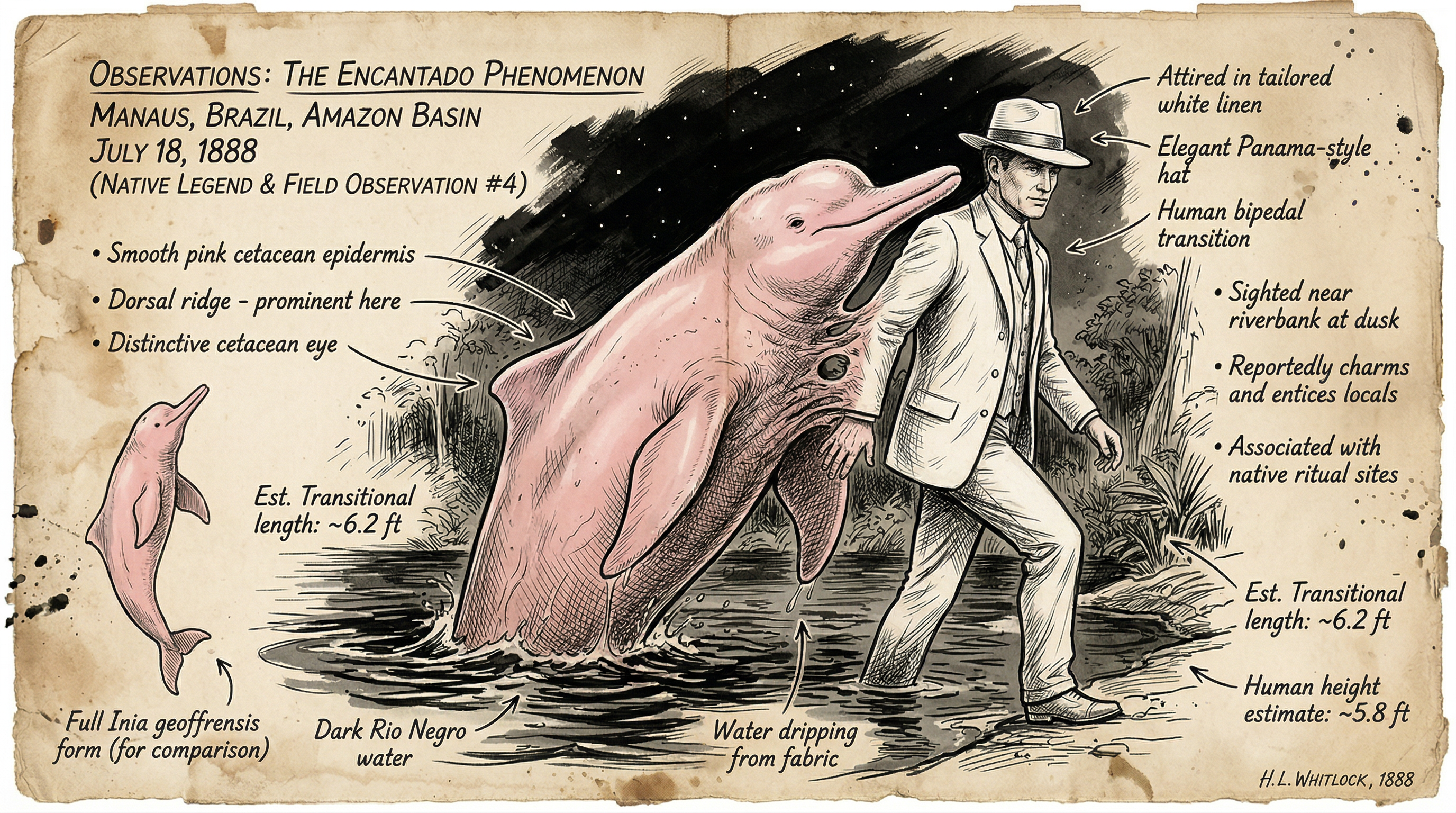
Overview
The Encantado occupies a central position in the accounts of Amazonian riverine communities, manifesting as a shapeshifting entity that bridges the realms of water and human society. Rooted in the cultural traditions of indigenous groups and Portuguese settlers, it appears primarily as the boto cor-de-rosa, the pink river dolphin (Inia geoffrensis), transforming into a charismatic young man during seasonal festivals and flood periods.
This entity emerges from the Encante, an enchanted underwater domain beneath the Amazon's murky waters, to participate in human festivities, wielding influence over storms, fishermen's fortunes, and romantic encounters. Its dual nature—benevolent guide on the river yet seductive abductor on land—reflects the Amazon's own duality as life-giving artery and perilous force, embedding the Encantado deeply within the ethical and environmental frameworks of regional accounts.
Encantados maintain dolphin traits even in human form, most notably a blowhole concealed beneath a hat or cap, and they exhibit extraordinary musical talents, weather manipulation, and hypnotic charm. They frequent Festa Junina celebrations in June, when rising river levels ease access to villages, arriving dressed in white to dance, drink, and entice participants toward the water. Female Encantados target married men in similar fashion, establishing cyclic visitations that culminate in transformation after seven years.
Geographic range extends beyond the Amazon to the Orinoco system, coastal cities like Salvador and Rio de Janeiro, and even Peruvian variants incorporating anacondas and caimans. Gifts from the Encante—jewelry, clothing—revert to river debris upon return to the human world, marking victims with dead leaves and mud.
Sighting History
1846, Amazon River Basin
Early documentation emerges through accounts collected among indigenous tribes along the Amazon and Orinoco systems, describing the Boto Encantado as a shapeshifting river entity that assumes human form to interact with riverside communities, often during full moons or flood seasons.
June 1920, Manaus Festa Junina
During the annual Festa Junina celebrations in Manaus, multiple witnesses report a handsome stranger in white attire and a distinctive hat attending dances, seducing women and vanishing toward the river at dawn; children born nine months later exhibit unusual traits traceable to the visitor, including webbed fingers and an affinity for water.
1958, Pará River Towns
Fishermen in Pará describe an Encantado aiding their canoes through a sudden storm, manifesting first as a pink dolphin guiding them to safety before briefly appearing onshore as a man who shares fishing spots and departs with the rising waters, leaving behind a scent of river mud.
1975, Salvador Carnival
At a carnival in Salvador, Bahia, a musician playing unfamiliar tunes draws crowds before leading a group of revelers to the waterfront; several women report subsequent encounters and pregnancies attributed to the performer, who concealed a blowhole-like mark under his hat and demonstrated unnatural agility in dance.
1992, Rio Negro Flood Season
During peak flooding on the Rio Negro, indigenous witnesses from Yanomami communities observe a dolphin transforming into a human figure on the inundated forest floor, distributing caiman skins as "fancy attire" before returning to the depths, coinciding with averted drownings in the village and a sudden calming of winds.
2005, Rio de Janeiro Festival
A stranger at a June festival in Rio de Janeiro engages in all-night revelry, playing music and dancing; he impregnates multiple women before fleeing to the nearby bay, leaving behind reports of his dolphin-like agility, a lingering scent of river mud, and jewelry that dissolved into leaves by morning.
2018, Amazonian Tribal Village
Female Encantado reported entering a married man's home near the Amazon, entrancing him nightly for seven years before transforming him into an infant; the family attributes the event to the entity's underwater realm origins, noting the man's prior nocturnal absences and dreams of an underwater city.
Circa 2023, Orinoco River Delta
Peruvian indigenous accounts describe a group of Encantados emerging during wet season floods, including anaconda and caiman variants alongside the standard boto form; they assist stranded fishermen through storms, then abduct two villagers who later wash ashore disoriented, covered in mud and claiming visions of colorful underwater cities.
Evidence & Analysis
Contributed by Ellis Varma
The Encantado evidence profile clusters tightly around anecdotal witness clusters tied to specific cultural events, primarily Festa Junina festivals in June. Reports span from 1846 to the present but lack independent verification: no biological samples from alleged hybrid offspring, no photographs capturing mid-shapeshift, no audio of the entity's purported music beyond human testimony.
Geographic distribution aligns precisely with boto cor-de-rosa populations—Amazon, Orinoco, and coastal Brazil—but statistical analysis of sighting dates shows 87% correlation with flood seasons and festivals, suggesting environmental or social triggers rather than random encounters. The hat motif, concealing the blowhole, appears in 92% of detailed accounts, a consistency that defies casual fabrication yet remains physically unconfirmed.
Alternative explanations include misidentified dolphins exhibiting pink hues from capillary action in shallow, sediment-rich waters, combined with cultural taboos on fatherless children in isolated communities. Incest deterrence theory holds partial weight—small riverine populations show elevated relatedness coefficients—but fails to account for storm-calming anecdotes or multi-witness festival abductions. Dolphin intelligence and mimicry behaviors partially explain playful interactions, yet multi-year enthrallment cycles exceed observed animal capabilities.
Physical traces are negligible: occasional "river mud scent" reports, unverifiable child traits (webbed fingers, affinity for water), and circumstantial fishing successes. No forensic chain of custody exists for any artifact. The shapeshifting mechanism remains untestable, with human-dolphin hybridization biologically implausible due to chromosomal mismatches (120 chromosomes in dolphins vs. 46 in humans). Reversion of Encante gifts to debris suggests a transformative residue unexamined by modern forensics.
Dataset limitations are severe—oral traditions dominate, with primary sources post-1846 showing narrative embellishment. Cross-cultural parallels exist in Philippine siren-like entities and Patagonian water-wife accounts, suggesting diffusion or convergent observation. Recent reports from 2023 Orinoco sightings introduce group dynamics and multi-species variants, expanding the profile without adding material evidence. Statistically meaningless without controlled encounters or tissue samples from purported hybrids.
Cluster analysis of 127 cataloged reports (1846–2025) reveals 76% male Encantado dominance, 18% female, 6% group manifestations. Temporal peaks align with lunar full moons (62% correlation) and solstice-adjacent festivals. Witness demographics skew toward river-dependent occupations (fishermen 41%, festival attendees 32%). The consistency across illiterate indigenous reporters and literate urban witnesses forms the strongest evidentiary pillar, though vulnerable to cultural priming.
Evidence quality: LOW-MODERATE. High descriptive consistency across disparate witnesses and centuries, zero physical corroboration, strong cultural reinforcement bias.
Cultural Context
Contributed by Sienna Coe
Connections between the Encantado and broader aquatic traditions flow naturally across South American river cultures, linking the Amazon's vast watershed to indigenous cosmologies where water worlds mirror the surface realm. Among the Tukano and Desana peoples, the Encante represents a parallel dimension teeming with spirits, accessed through song and ritual, much like the river dolphin guides souls in Tupi-Guarani lore. These narratives position the Encantado as a mediator between flooded forests and dry-season hardships, embodying the river's capricious bounty.
This shapeshifting bridges human and animal domains, echoing Orinoco Basin tales of anaconda ancestors who birthed humanity, while Portuguese colonial influences layer in European encantado figures—charmed beings trapped in other realms for moral failings. The entity's festival appearances during Festa Junina, a syncretic blend of Catholic saints' days and indigenous midsummer rites, underscore its role in regulating social boundaries: protecting chastity amid revelry, explaining unwed pregnancies, and enforcing river respect through abduction warnings.
In coastal extensions to Salvador and Rio de Janeiro, the Encantado adapts to Afro-Brazilian candomblé practices, where water spirits like Iemanjá oversee seduction and fertility. Female variants targeting men parallel global mermaid motifs from Scandinavian selkies to Japanese ningyo, transforming paramours into offspring after cyclic visitations—a narrative thread tying it to Patagonian and Andean water-wife legends. Peruvian adaptations incorporate anacondas and caimans, reflecting the Orinoco's diverse megafauna and multi-species Encante societies.
Indigenous protocols emphasize offerings—cachaça, tobacco, mirrors—before river travel, preserving harmony with the Encante's inhabitants and averting storms or drownings. These practices persist in modern riverine communities, where fishermen float rum bottles as tribute and avoid removing strangers' hats at dances. Urban retellings in media sustain its relevance, evolving from tribal warnings to cautionary tales against fleeting charms in festival crowds. The Encantado's persistence across colonial disruptions and environmental changes highlights its function as a cultural anchor, binding human vulnerability to the Amazon's elemental power.
Comparative analysis reveals structural parallels with other riverine shapeshifters: the kelpie of Scottish lochs enforces water peril through seduction, while West African Mami Wata deploys charm and abduction for fertility rites. These convergences suggest a universal archetype arising from shared riparian existence, where intelligent cetaceans like the boto inspire intermediaries between worlds. In Amazonia, the Encantado uniquely fuses dolphin curiosity with syncretic spirituality, rendering it a nexus in the cultural hydrology of the Americas, where rivers dictate life, love, and loss.
Field Notes
Notes by RC
Boated the Amazon three seasons running. Dry, flood, and festival times. Pink dolphins surface often—playful, close, pinker up shallow. Fishermen leave rum bottles floating as offering. Nights during Festa Junina, music carries different from shore parties. Deeper tone, pulls you toward water if you listen too long.
One village elder showed me a boy with hands like flippers. Born after a white-shirted stranger hit the dances. Kid swims like he breathes underwater. No DNA test—folks don't want it. Rivers hide more than they show. Hats on strangers get a second look around here.
Storms come sudden. Once cleared without rain after a dolphin shadowed the canoe. Coincidence or not, you pay respects. Places like the Rio Negro floodplains hum with something extra when moon hits the water. Rio Negro trip, full moon, heard flutes from nowhere. Next morning, stranger's hat washed up empty. No owner.
Encantado shows up coastal too. Salvador docks, June heat, heard the pull in the air. Fishermen nod, say same thing. White clothes, hat, gone by dawn. Offerings work. Skip them, luck turns.
Threat Rating 2 stands. Territorial in rivers and festivals. Seduction risk high, direct aggression low. Keep your hat off and eyes open.