Enfield Horror
3 UNPREDICTABLE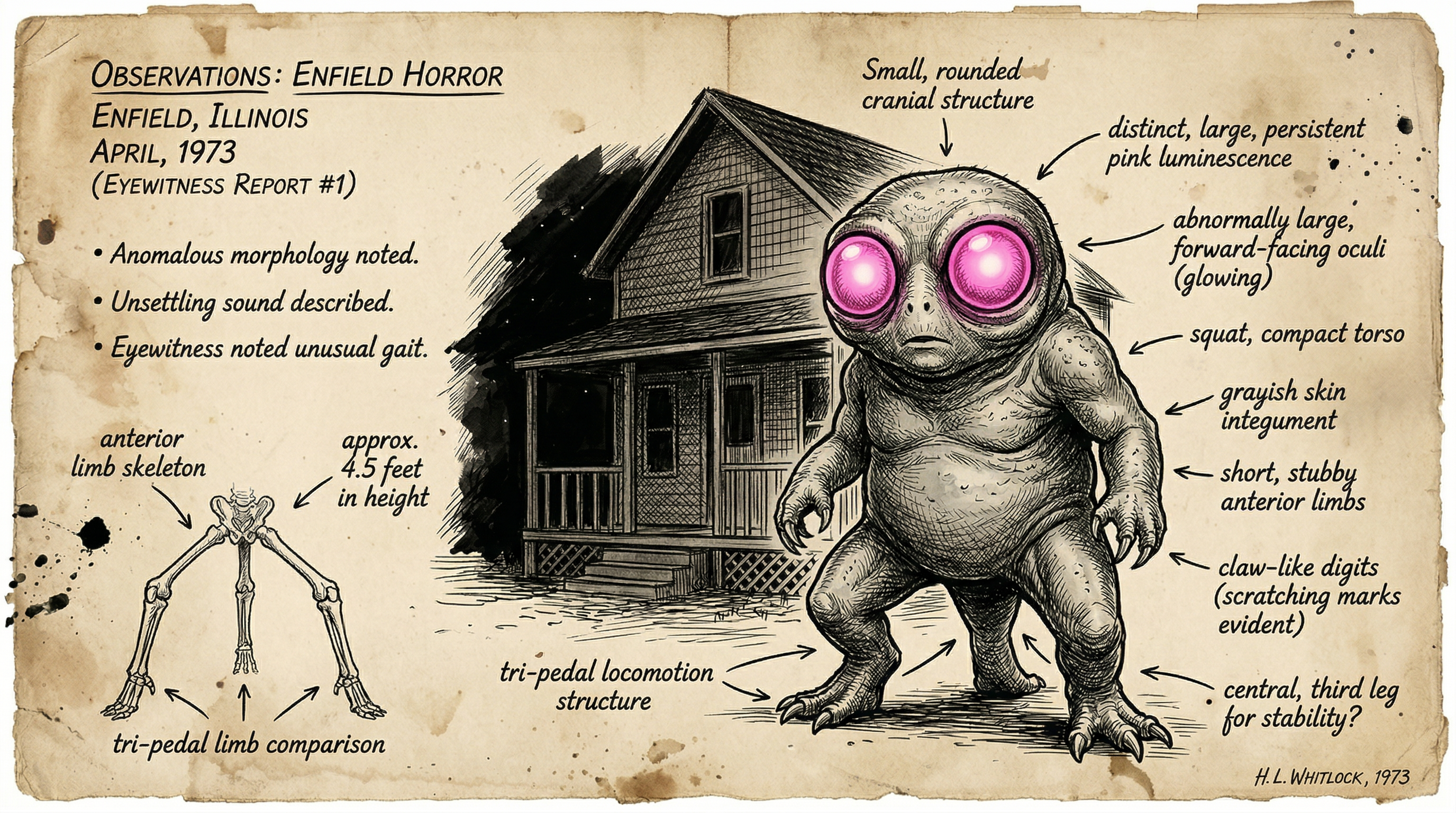
Overview
The Enfield Horror manifests as a compact, gray-skinned entity distinguished by its three-legged locomotion, standing approximately 4.5 feet tall with two short arms protruding from a shortened torso and luminous pink eyes the size of flashlights. Documented primarily in the rural confines of Enfield, Illinois, during the spring of 1973, it engaged directly with human witnesses through aggressive approaches, including physical contact and structural disturbances.
This entity's emergence aligns with a brief but intense period of heightened awareness in Midwestern small-town dynamics, where isolated encounters escalated into community-wide scrutiny. Unlike enduring figures rooted in layered oral histories, the Enfield Horror represents a concentrated phenomenon, its presence confined to a few critical weeks amid a landscape already marked by anomalous reports such as the Mt. Vernon Monster of 1941-1942.
Core to its profile is the tripod gait, enabling deliberate movement across varied terrain—from backyards to railroad trestles—coupled with vocalizations described as banshee-like screeches. These traits set it apart within regional encounter patterns, prompting immediate responses from local law enforcement and drawing investigators like cryptozoologist Loren Coleman, who documented physical traces and auditory evidence firsthand.
The creature's morphology challenges conventional classification. The three-legged stance suggests biomechanical adaptation for stability on uneven Midwestern terrain, while the short arms imply limited manipulative capacity yet sufficient for clawing interactions. Pink eye glow persists across reports, noted under low-light conditions, potentially indicating bioluminescent or reflective properties. Locomotion reports emphasize a deliberate, unhurried pace, contrasting with typical predator flight responses.
Sighting History
April 25, 1973, Greg Garrett's backyard, Enfield, Illinois
Ten-year-old Greg Garrett encountered the entity in his backyard around 10:00 p.m. The creature stepped on his foot, clawing and ripping his sneaker before he fled inside the house. Police responded to the call but located no trace of the intruder during their search. Subsequent interviews by sociologists from Western Illinois University would later cast doubt on this account when Garrett and his parents recanted, claiming they had fabricated the story to tease their eccentric neighbor McDaniel and deceive an out-of-town newsman. However, the physical evidence of the torn sneaker and the specificity of Garrett's initial description complicate easy dismissal.
April 25, 1973, Henry McDaniel's home, Enfield, Illinois
Approximately 30 minutes after the Garrett incident, Henry McDaniel heard scratching at his door around 10:00 p.m. He opened it to observe a three-legged figure between rosebushes, initially mistaken for a bear. The entity measured 4.5 feet tall, grayish in color, with a short body, two short arms, and two pink eyes glowing like flashlights. McDaniel armed himself, but the creature departed without further engagement. This encounter would become the catalyst for all subsequent investigation and media attention, establishing McDaniel as the primary witness and lending his accounts the weight of consistency across multiple independent reports.
May 6, 1973, railroad tracks near Henry McDaniel's home, Enfield, Illinois
At approximately 3:00 a.m., Henry McDaniel observed the same or a similar entity traversing railroad trestles near his residence. It moved unhurriedly in a tripod gait, navigating the structure deliberately without apparent fear despite McDaniel's presence. The deliberate nature of this sighting—the creature's calm locomotion across difficult terrain—distinguishes it from panicked flight responses documented in later hunter encounters.
May 6, 1973, abandoned building near McDaniel's house, Enfield, Illinois
Later that day, a search party including WWKI news director Rick Rainbow entered an abandoned building close to McDaniel's home. They observed an apelike figure, recorded its screeching cries, and fired a shot after which it fled the scene. Rainbow's audio recording of the creature's vocalizations would become the primary auditory evidence, later analyzed by Loren Coleman during his on-site investigation. The banshee-like quality of the sounds resists easy explanation through conventional animal vocalization.
May 10, 1973, undergrowth near Elwood, Indiana
Two hunters from Elwood, Indiana—Mike Mogle and Roger Tappy—reported a gray monkey-like entity moving rapidly through dense underbrush approximately two weeks after the initial McDaniel encounter. Both men swore to the consistency of their observation, describing the creature's swift, bipedal movement through the underbrush. They attempted to fire but failed to connect. Their independent corroboration of a gray, ape-like form lends credence to McDaniel's account while introducing the possibility of multiple entities or a creature with significant geographic range.
Circa 1973, wooded areas around Enfield, Illinois
Five unnamed men were arrested by Sheriff Roy Poshard Jr. for discharging firearms at a gray figure observed in the woods during the height of the sighting frenzy. The group claimed the entity appeared unaffected by their shots, prompting intervention amid growing crowds of armed enthusiasts. Sheriff Poshard's enforcement action reflects the escalating danger posed by vigilante hunters, yet it also documents the persistence of sightings beyond McDaniel's direct observations. The alleged bullet resistance remains unverified but consistent with witness testimony regarding the creature's apparent indifference to human threats.
April 15, 1973, Henry McDaniel's home, Enfield, Illinois
Some contemporaneous accounts place an initial scratching incident at McDaniel's door on this earlier date, though primary documentation and media records align more closely with April 25. The discrepancy may reflect confusion in initial reporting or the possibility of multiple incidents within a compressed timeframe. The entity exhibited similar behaviors in accounts from this period—scratching persistently before revealing its form upon the door's opening—suggesting either a consistent pattern of approach or conflation of separate encounters.
Evidence & Analysis
Contributed by Ellis Varma
The Enfield Horror evidence profile clusters tightly around 1973 eyewitness accounts, with physical traces limited to damaged house siding at Henry McDaniel's residence and a single torn sneaker from Greg Garrett's encounter. Cryptozoologist Loren Coleman examined the siding firsthand, noting scratches consistent with clawed appendages, though no forensic analysis confirmed biological origin. The physical damage itself—claw marks on wood siding—represents the most tangible evidence supporting witness claims of direct contact.
Auditory evidence includes a tape recording by WWKI news director Rick Rainbow capturing banshee-like screeches during the May 6 search party incursion. Coleman replicated similar cries during his field investigation, adding a layer of corroboration, though spectrographic breakdown remains absent from available datasets. The banshee quality of the vocalizations resists easy categorization within known animal sound profiles, yet absence of analysis prevents definitive conclusion. Coleman himself stated after his investigation: "I traveled to Enfield, interviewed the witnesses, looked at the siding of the house the Enfield Monster had damaged, heard some strange screeching banshee-like sounds, and walked away bewildered."
Witness reliability presents inconsistencies: Garrett's account faced retraction claims by sociologists from Western Illinois University, who suggested fabrication to target McDaniel. Yet the torn sneaker and the timing of the retraction—months after initial testimony—complicate straightforward dismissal. McDaniel's multiple sightings, however, maintain consistency in description—three legs, pink eyes, 4.5-foot stature—across independent reports from Rainbow and the Indiana hunters Mogle and Tappy. This convergence on specific morphological details across unrelated witnesses strengthens the evidence profile despite the small sample size.
Comparative analysis links to the Mt. Vernon Monster of 1941-1942, documented 40 miles distant, sharing leaping, baboon-like traits and livestock associations, though temporal separation of three decades weakens pattern strength. Statistical weighting favors clustered temporal proximity over isolated anomalies, yielding a narrow but persistent signal within the 1973 Enfield window. The geographic proximity of the two phenomena suggests either a breeding population with extended range or unrelated but morphologically similar entities.
External variables include media influx post-McDaniel's radio reports to WWKI, drawing thrill-seekers and escalating hunter activity, as evidenced by Sheriff Poshard's arrests. This introduces contagion risk—the possibility that initial reports triggered misidentification of mundane phenomena—yet core descriptions precede mass awareness. McDaniel's April 25 encounter predates the May 6 media surge, establishing a baseline against which later reports can be measured.
The bullet-resistance claims from arrested hunters remain unverified and potentially exaggerated in the context of poor visibility and high-stress encounters. However, the absence of recovered carcasses or clear photographs despite intensive searching argues against conventional animal misidentification. No matching escaped exotics or known species align with the tripod morphology; regional primate records are negligible.
Dataset limitations include lack of multi-angle witness sketches and independent veterinary assessments of traces. The evidence profile holds a statistically insignificant but temporally coherent cluster, elevated above noise threshold by physical interaction markers.
Evidence quality: LOW-MODERATE. Concentrated witness convergence with minimal physical artifacts; retractions undermine select testimonies, but auditory recordings, structural damage, and independent corroboration provide faint substantiation beyond anecdotal threshold.
Cultural Context
Contributed by Sienna Coe
The Enfield Horror emerges from the quiet farmlands of southern Illinois, a region where vast stretches of cornfields and wooded hollows have long cradled stories of the unexplained. Its 1973 appearances connect to a thread of Midwestern encounters with elusive, ground-dwelling entities, bridging the aggressive Mt. Vernon Monster of four decades prior and fleeting reports of gray, apelike figures in the same latitudes.
Witnesses frame the Horror not as a distant woodland dweller but an intruder into domestic spaces—backyards, doorsteps, even railroad edges abutting homes. This proximity amplifies its role in local narrative traditions, where rural isolation fosters acute awareness of boundary-crossing presences. Henry McDaniel's armed standoff and young Greg Garrett's claw-marked escape echo patterns in regional lore, where entities test human resolve through direct, tactile challenges. The violation of the domestic threshold—the scratching at the door, the invasion of the backyard—marks this creature as fundamentally different from distant forest dwellers.
Media amplification via WWKI broadcasts and the Mt. Vernon Register-News transformed individual alarms into communal vigilance, drawing posses reminiscent of 19th-century frontier hunts. Sociologists later interpreted this as social contagion, the idea that once one person claimed to see the monster, everyone else became susceptible to seeing it too. Yet the persistence of descriptions—tripod stance, glowing pink eyes, gray coloration—spans pre-media accounts, suggesting a resilient core amid the fervor. The consistency argues against pure social construction, though it does not exclude the possibility of misidentification amplified by heightened awareness.
Loren Coleman's on-site investigation embeds the Horror within broader cryptozoological catalogs, linking it to escaped exotics or undescribed primates while acknowledging its biomechanical oddities. In Enfield's cultural fabric, it endures as a marker of 1973's collective unease, a fleeting guardian or pest of the threshold between settled land and wild margin. The creature occupies a liminal space in local memory—neither fully dismissed nor fully accepted, but remembered.
Connections extend to other Midwestern anomalies: Thunderbirds over Illinois skies, phantom panthers in the underbrush. The Horror occupies a terrestrial niche, its three-legged propulsion evoking adaptive survivors in floodplain ecosystems or creatures optimized for specific terrain. These intersections reveal a landscape alive with persistent forms, each sighting a node in an unfolding regional tapestry of the unexplained. Southern Illinois floodplains, with their shifting creek beds and dense thickets, provide ideal cover for tripod-adapted forms, linking the Horror to broader patterns of adaptive morphology in cryptid reports.
Post-1973, the entity fades into annual retellings at local gatherings, preserved in newspaper clippings and Coleman's field notes. Its legacy persists in Enfield's quiet streets, where porch conversations still reference the scratching nights of spring, embedding the Horror in the town's identity as a waypoint for the unexplained.
Field Notes
Notes by RC
Enfield sits off Route 37, population barely scraping 500. Flatlands mostly, with creeks cutting through timber stands. Visited twice in 2018—once midday, once after dark. Daytime: standard rural decay, shotgun houses, overgrown lots. No weird vibes. Picked up the McDaniel place from old maps; siding replaced long ago, but the porch layout matches photos.
Night drive: cooler under the trees. Heard coyotes, maybe bobcats, nothing matching the screech tapes. Railroad trestles still there, awkward footing even for two legs. Locals clam up quick—old timers nod at the story, younger ones laugh it off. Sheriff's office has no files from '73; "budget purge," they say.
Garrett's old backyard now a parking pad. No shoe fragments. Coleman's visit left no local marks beyond the newspaper clips. Place feels ordinary, but that's the point with these things—they spike and fade. Trestles creak under wind same as footsteps. Some spots hold sound longer than they should.
Threat Rating 3 stands. Multiple independent sightings in tight window. Physical interaction documented. Retractions don't erase the claw marks or door scratches.