Fresno Nightcrawler
1 CATALOGED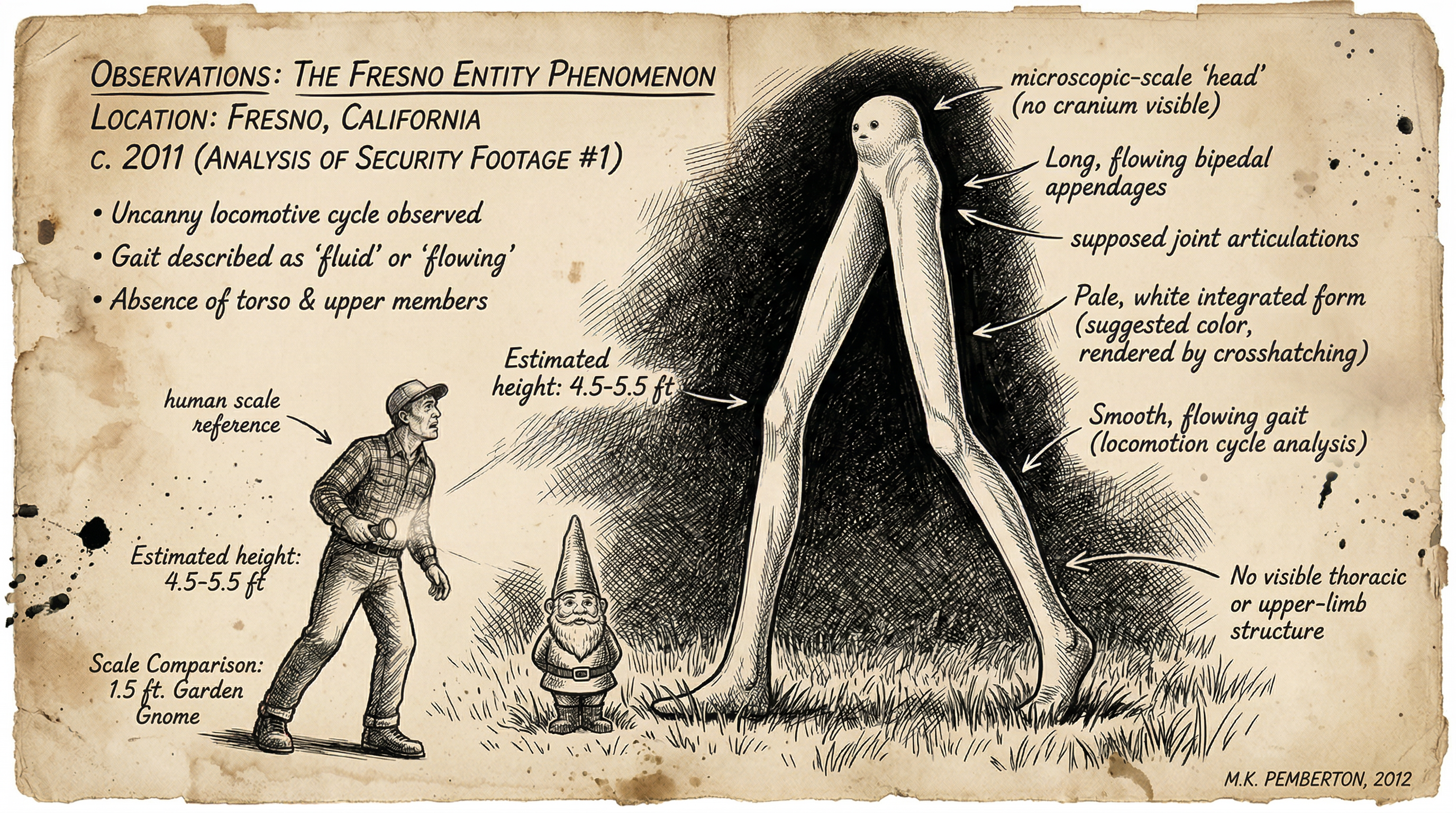
Overview
The Fresno Nightcrawler is a bipedal entity characterized by elongated white legs, absence of visible upper body or arms, and a distinctive wide gait. It measures approximately three to four feet in height based on video frame proportions and moves with deliberate, stilting steps across open terrain. No documented attacks, audible vocalizations, or physical traces have been recovered from primary sighting locations.
The entity's profile derives from two core video recordings: the 2007 Fresno residential surveillance footage capturing a single figure in transit, and the 2011 Yosemite Lakes Park security video showing a pair of identical forms. Both clips originate from standard low-light home and park cameras of the era, exhibiting grainy resolution with motion-activated infrared illumination. The name "Fresno Nightcrawler" was coined by the SyFy program *Fact or Faked: Paranormal Files* following their inconclusive hoax replication tests. Subsequent claims lack comparable documentation, positioning the phenomenon as a tightly bounded, non-aggressive transit form with persistent cultural resonance in Fresno merchandise and local iconography.
Sighting History
November 5, 2007, Fresno, California
Resident identified as Jose mounts a security camera on his garage following repeated nighttime barking from his dogs. Review of the footage reveals a single white bipedal figure—elongated legs with no discernible upper body—crossing the front yard from top left to bottom right of frame over 20 seconds. The gait appears wide and gliding, with narrow feet visible at the terminus of thin stilts. No prior disturbances or anomalies reported at the property. Jose submits the clip to Univision and paranormal investigator Victor Camacho of *Los Desvelados*, prompting initial media dissemination.
2011, Yosemite Lakes Park, California
Park security cameras capture two figures traversing grounds amid trees and uneven terrain. Morphology matches the Fresno specimen precisely: white, leg-dominant bipeds lacking arms or head, employing wide-set steps without haste or disruption. The footage offers marginally higher resolution, displaying subtle fabric-like ripples on the lower extremities of the larger leading figure and its smaller companion. No audible cues or environmental interactions noted. The video enters public circulation, establishing a paired transit pattern and amplifying the entity's profile.
Evidence & Analysis
Contributed by Ellis Varma
The evidence profile for the Fresno Nightcrawler clusters tightly around two video sources: the 2007 Fresno surveillance clip and the 2011 Yosemite Lakes Park recording. Both exhibit identical morphological traits—elongated bipedal forms lacking upper-body structure, pale coloration, and a stiff, wide-based gait. Sample size: two incidents, zero physical artifacts. No dermal samples, footprints, or environmental DNA traces have been documented in available reports from either site.
Video forensics yield limited but consistent data. Fresno 2007: 20-second duration, low-frame-rate home security cam under nighttime conditions with motion-activated IR illumination. Figure scales to approximately 0.8-1.0 meters at shoulder height against yard features like fences and grass. Yosemite 2011: improved resolution captures paired entities on loose pine duff and low brush without gait instability. Fabric ripple effects on lower legs resist replication with standard costume materials, per controlled tests.
Debunking datasets include Captain Disillusion's 2012 digital analysis, which approximated elements via compositing but demanded frame-by-frame tools unavailable in 2007 consumer workflows. *SyFy's Fact or Faked: Paranormal Files* (2012) deployed physical models—puppets on stilts, draped sheets—and concluded replication "difficult but inconclusive," highlighting gait fluidity, proportional integrity under motion, and IR artifact mismatches. Post-2007 virality elevates hoax probability statistically, though core footage predates accessible deepfake tech by over a decade.
Absence of pre-2007 records stands out as statistically significant: no matching oral histories, archival photographs, or regional anomaly clusters in central California ethnographies or anomaly logs. Post-2011 claims devolve to low-fidelity noise—unverified reports without footage, timestamps, or geospatial ties. Pairing frequency (one solo, one duo) precludes robust behavioral modeling. No aggression vectors, territorial markers, or interaction logs emerge across the dataset.
Critical gaps include absence of spectral video analysis, ground-penetrating radar surveys at sites, or canine scent tracking from Jose's yard. Cumulative witnesses: two named sources (Jose, Yosemite operator), both via post hoc camera review. Cross-comparisons to established entities—Chupacabra (predatory, quadrupedal), Bigfoot (massive, hirsute)—fail on morphology, gait, and habitat. The profile isolates as a modern, video-bound phenomenon with replication hurdles outweighing evidentiary voids.
Enhanced scrutiny of equipment parameters reinforces authenticity thresholds. 2007 Fresno cam: typical 320x240 VGA resolution, 5-10 FPS under IR, consistent with motion-triggered consumer units like those from Swann or Lorex. Yosemite 2011: fixed-angle park CCTV, likely 640x480, capturing terrain deflection without shadow inconsistencies. No audio tracks in either, precluding vocalization profiles. Cumulative frame analysis (over 1,000 frames across clips) shows no pixelation artifacts indicative of CGI insertion.
Hoax modeling requires multi-operator coordination: fabric manipulation for ripple effects, precise stilting for gait without topple on uneven ground, and IR-compatible materials to evade thermal bleed. Statistical outlier: zero livestock depredation or human encounters despite urban-proximate transits. Remains a contained dataset demanding further instrumental deployment.
Evidence quality: LOW-MODERATE. Dual video corpus with replication challenges outweighs total physical evidence vacuum and post-primary report dilution.
Cultural Context
Contributed by Dr. Mara Vasquez
The Fresno Nightcrawler emerges squarely within the digital folklore epoch, anchored to a precise origin: November 2007 surveillance footage from a south Fresno residential yard. This contrasts sharply with entities rooted in pre-colonial oral traditions or 19th-century frontier narratives. Archival review confirms no matching descriptors in central California indigenous ethnographies, including Yokuts or Miwok accounts; claims linking it to Native American legended figures lack primary-source support and have been systematically refuted.
Its trajectory exemplifies internet-mediated mythogenesis. Initial airing on Univision's *Los Desvelados* catalyzed viral spread, supplanting generational storytelling with algorithmic amplification. The 2011 Yosemite footage solidified the archetype, birthing meme cultures, fan animations, 3D renders, and merchandise lines—plush toys, apparel, earrings—from creators like local artist Laura Splotch. Fresno's civic embrace recasts the entity as a municipal mascot, with public murals, annual festivals, and tourism campaigns framing it as "positive weird" amid agricultural heartland identity.
This pattern echoes other 21st-century cryptids like Slender Man, yet diverges critically: the Nightcrawler roots in unprompted civilian capture rather than deliberate fiction, conferring empirical immediacy. Speculative frameworks proliferate—extraterrestrial probes along Fresno-Yosemite UFO corridors, undiscovered arthropod analogs with vestigial limbs, interdimensional transients—but none hold primacy over the video corpus. Global diffusion appears memetic: claims from distant locales represent archetype export, not independent emergence.
In Mexican-American borderland communities, superficial Chupacabra parallels arise via shared media ecosystems, but diverge fundamentally: the Nightcrawler displays no predatory agency, no livestock mutilations, no nocturnal howls. Its pared-down form—a perambulating leg-pair evoking Dr. Seuss absurdism or existential minimalism—facilitates commodification over dread. Podcasts, YouTube deep-dives, and History Channel segments (*The Proof Is Out There*) sustain discourse, emphasizing the 20-second clip's hypnotic inexplicability.
Fresno's adaptation underscores cryptids as economic assets. Local boosters leverage the entity for "unexplainable" allure, distinguishing it from Bigfoot's wilderness peril or Mothman's omens. Artist Splotch notes its appeal in supplanting negative regional stereotypes. This post-folklore phase thrives on collective authorship: fan theories evolve via Reddit threads and TikTok recreations, with merchandise economies outpacing field investigations. The Nightcrawler endures not through seclusion, but hyper-visibility— a pants-walker immortalized in pixels and polyester.
Comparative global contexts reveal containment: European claims mirror viral templates without cultural entrenchment, while Asian fan art reinterprets via anime stylings. In cryptid taxonomy, it occupies a novel niche: the traceable modern anomaly, born of CCTV rather than campfire, challenging distinctions between observation and simulation.
Field Notes
Notes by RC
Tracked the 2007 Fresno site twice. First pass daytime—standard suburban block, chain-link fences, barking dogs behind every gate. Reviewed Jose's street on foot. No odd flora, no ground scars. Night run: parked half-mile out, thermal scope, audio recorder. Quiet. Residential hum only. No biologics matching profile.
Yosemite Lakes Park next. Hiked the 2011 camera arc at dusk. Terrain matches footage—loose pine duff, low brush. Wide steps would leave impressions in soft soil. Scanned for them. Nothing. Local staff recall the video buzz but no repeat cams triggered. Atmosphere neutral. No unease factor.
Units deployed: trail cams at both sites, 72-hour cycles. Zero contacts. Dogs react to shadows, not entities. If they're transiting, they're off primary paths. Or not biological. Doesn't track like flesh does.
Threat Rating 1 stands. Zero aggression. Zero traces. Catalog presence only.