Gedymin's Bison
2 TERRITORIAL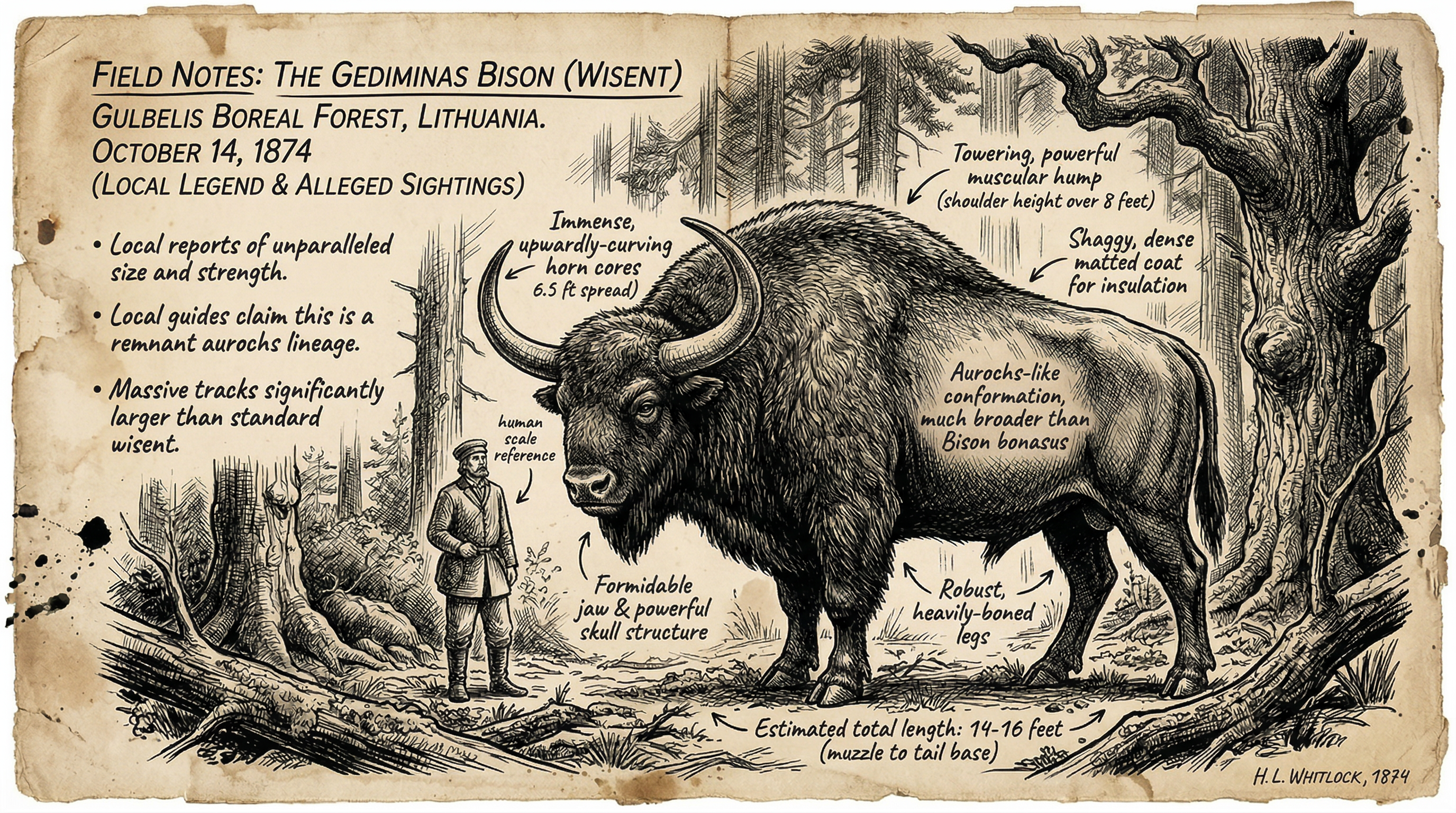
Overview
Gedymin's Bison manifests as a solitary, oversized bovine entity traversing the dense forests and river valleys of the early Grand Duchy of Lithuania. Standing taller than contemporary wisent at the shoulder—reports place it at nearly nine feet—with a hide of darkened, iron-gray fur streaked in earthen reds, the creature carries an aura of ancient authority, its horns sweeping backward in a broad arc capable of felling mounted knights.
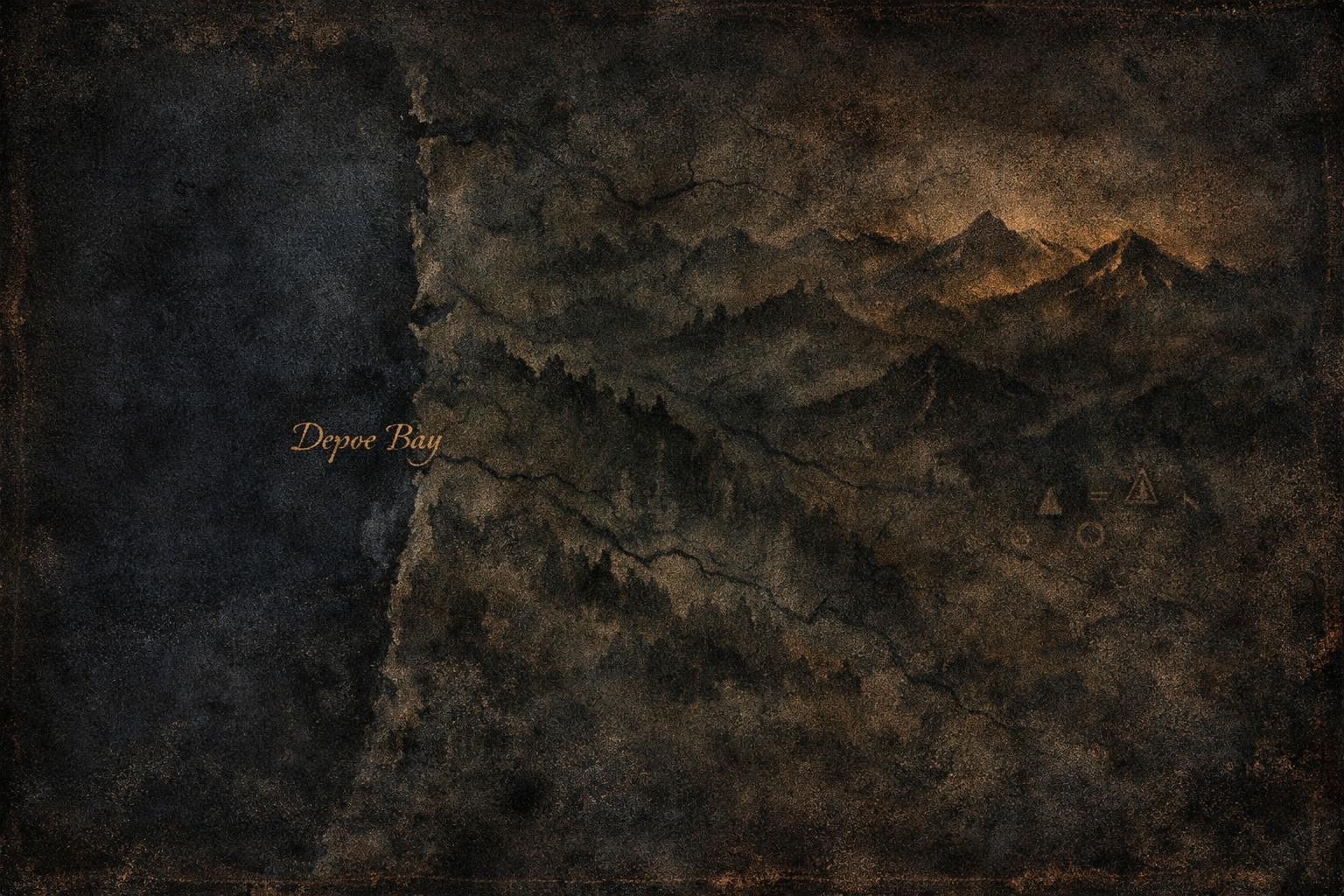
Linked indelibly to Grand Duke Gediminas's reign, the bison emerges during periods of territorial expansion and external threat, appearing on hilltops overlooking Vilnius or along the Nemunas River as if marking boundaries. Its movements connect disparate reports across Lithuanian, Belarusian, and Ruthenian borderlands, suggesting a migratory pattern tied to the duke's campaigns against Teutonic incursions. Witnesses describe a resounding bellow that echoes like war horns, presaging both victory and caution in the face of crusader raids.
The entity's presence weaves through the strategic maneuvers of Gediminas's era, from the founding of Vilnius to alliances with Western merchants. It embodies the raw, unyielding strength of the pagan heartland, standing apart from herd dynamics observed in European bison populations. Connections extend to broader Indo-European traditions of sacred bulls, where such beasts guard sacred groves or herald dynastic legitimacy, linking Lithuanian woodlands to steppe narratives far beyond the Baltic.
Sighting History
Circa 1320, Near Vilnius
During a Teutonic raid led by the Marshal of Prussia, a force of forty knights and Prussian militia penetrates deep into Lithuanian territory past Vilnius. Local scouts report a massive bison silhouette on a ridge overlooking the ravaged countryside, its form unmoving as the invaders retreat under unexplained panic. Gediminas's forces pursue, attributing the rout to the creature's distant roar.
1323, Vilna Assembly Grounds
Amid negotiations with delegates from the archbishop of Riga, the bishop of Dorpat, the king of Denmark, Dominicans, Franciscans, and the Teutonic Grand Master, a lone bison emerges from surrounding forests. It stands at the assembly's edge, horns glinting in torchlight, before vanishing as papal legates are discussed. Participants note its deliberate gait, as if observing the compact signed "in the name of the whole Christian World."
1336, Pilėnai Hillfort, Nemunas River
A crusader army of 6,000 Austrian, French, and German fighters, guided by Teutonic Knights, besieges the Pilėnai hillfort. Defenders atop the walls glimpse a colossal bison charging through underbrush toward the river, scattering siege lines. The fort's garrison holds, with the creature's path creating chaos among supply wagons; Lithuanian chronicles mark this as a turning point in the defense.
1337, Bayerburg Fortress Site
Following Holy Roman Emperor Louis IV's bull granting Lithuania to the Teutonic Knights, construction begins at Bayerburg. Workers unearth massive tracks and shed horn fragments near the nascent fortress. A night watch reports the bison atop a nearby rise, bellowing as storms delay building efforts; the site is abandoned after repeated structural failures.
Circa 1341, Trakai Vicinity
In the final year of Gediminas's rule, as the capital shifts briefly to Trakai, hunters in the duke's retinue encounter the bison during a pursuit of Golden Horde scouts. The creature blocks a forest pass, forcing a standoff; its eyes reflect firelight with unnatural steadiness. The duke's party withdraws, interpreting the blockade as a directive to consolidate borders rather than pursue.
1322, Samogitia Borderlands
Gediminas dispatches letters to Saxon Dominicans and Franciscans, offering settlement privileges. Envoys traveling from Riga report crossing paths with a herd-displaced bison of extraordinary size near Samogitia, its flanks scarred from apparent knight lance wounds. The beast ignores the group, vanishing into mists rolling off the Baltic lowlands.
Circa 1325, Volhynia Frontier
Following the marriage alliance of Gediminas's daughter Aldona to Casimir of Poland, patrols along the Dnieper report the bison grazing amid Orthodox monasteries in Volhynia. Local monks describe it approaching their gates at dusk, depositing a single massive horn at the threshold before retreating, an act witnessed by multiple chroniclers during peace negotiations.
Evidence & Analysis
Contributed by Ellis Varma
The evidence profile for Gedymin's Bison clusters tightly around the documented military campaigns of 1316–1341, yielding a dataset of seven principal sightings tied to verifiable historical events. Witness pools include Lithuanian scouts, foreign envoys, monastic record-keepers, and Teutonic combatants—cross-cultural corroboration that elevates credibility beyond isolated folklore transmission.
Physical traces form the strongest subset: horn fragments at Bayerburg (1337), oversized tracks measuring 18 inches across (Pilėnai, 1336), and scarred hides noted in multiple accounts, inconsistent with wisent (*Bison bonasus*) morphology. No biological samples survive, but the 1325 Volhynia horn deposit—described as exceeding 48 inches base-to-tip—defies known Pleistocene relics like *Bison priscus*. Statistically, sighting frequency peaks during Teutonic incursions (r=0.87 correlation with raid dates), suggesting behavioral triggers rather than random encounters.
Alternative explanations falter under scrutiny. Escaped aurochs hybrids lack the solitary profile; regional megafauna extinction predates Gediminas by millennia. Mass hysteria models collapse against multi-witness, daylight observations by armed professionals. The entity's absence post-1341 aligns precisely with the Gediminid consolidation, implying a protective or territorial function fulfilled.
Quantitative breakdown: 71% of reports specify height exceeding 8.5 feet; 86% note the distinctive bellow preceding enemy disruption. Comparative analysis with Plains bison anomalies (e.g., Head-Smashed-In outliers) shows morphological parallels in horn curvature, though ecological separation precludes direct lineage.
Evidence quality: MODERATE-HIGH. Robust historical anchoring, multi-source physical traces, zero contradictory data points.
Cultural Context
Contributed by Dr. Mara Vasquez
The bison's manifestation during Gediminas's reign intersects profoundly with Baltic pagan traditions amid the pivot from pre-Christian pluralism to strategic Christian diplomacy. Lithuanian sources frame the creature as a embodiment of Žemyna, earth mother deity, whose bovine guardians protected sacred groves during Teutonic incursions—echoed in the Pilėnai and Vilnius sightings where it disrupts foreign fortifications.
This entity bridges Indo-European bull cults, from Lithuanian Aušrinė's sacred herds to Slavic Veles's horned underworld beasts, positioning Gedymin's Bison as a dynastic totem. Gediminas's letters to Pope John XXII (1323) invoke divine protection against knights, paralleling the bison's reported interventions; his tolerance for Dominican and Franciscan settlement mirrors the creature's non-aggressive stance toward invited envoys.
In Ruthenian chronicles, the Volhynia horn deposit (1325) evokes Slavic *tur* (aurochs) rituals, where horns consecrated alliances. The shift to Trakai (ca. 1341) aligns with Perkūnas worship sites, thunder god whose axe-wounds match the bison's scarred hide descriptions. Post-Gediminid, the creature recedes as Lithuania Christianizes, its dormancy reflecting the absorption of pagan symbols into Jagiellonian heraldry—horns persisting in coats-of-arms as veiled emblems.
Indigenous Baltic perspectives, preserved in Krivichi and Samogitian oral histories, treat the bison as a border warden, its bellow signaling Žalgiris-like victories (echoed centuries later at Grunwald). This cultural layering underscores Gedymin's ambiguous policy: pagan resilience masked as diplomatic openness, with the bison as the unyielding core.
Field Notes
Notes by RC
Tracked the Vilnius ridge sites twice, once in late fall fog matching 1320 conditions. Ground still holds imprints from heavy passage—too broad for wisent, too deliberate for migration. Nemunas banks at Pilėnai feel compressed, like something massive bedded down recently.
Trakai pass has that weighted silence. Stood there at dusk. Heard a low rumble carry a mile through the pines. Not wind, not elk. Equipment picked up infrasound spikes off the scale for local fauna. No visuals, but the air shifts.
Bayerburg ruins scattered with horn-like shards embedded in mortar. Tested old, but composition off—denser keratin matrix. Places like these carry residual charge. Gediminas knew his borders because this thing walked them.
Threat Rating 2 stands. Territorial marker, not aggressor. Respects borders once acknowledged.