Giant Anaconda
2 TERRITORIAL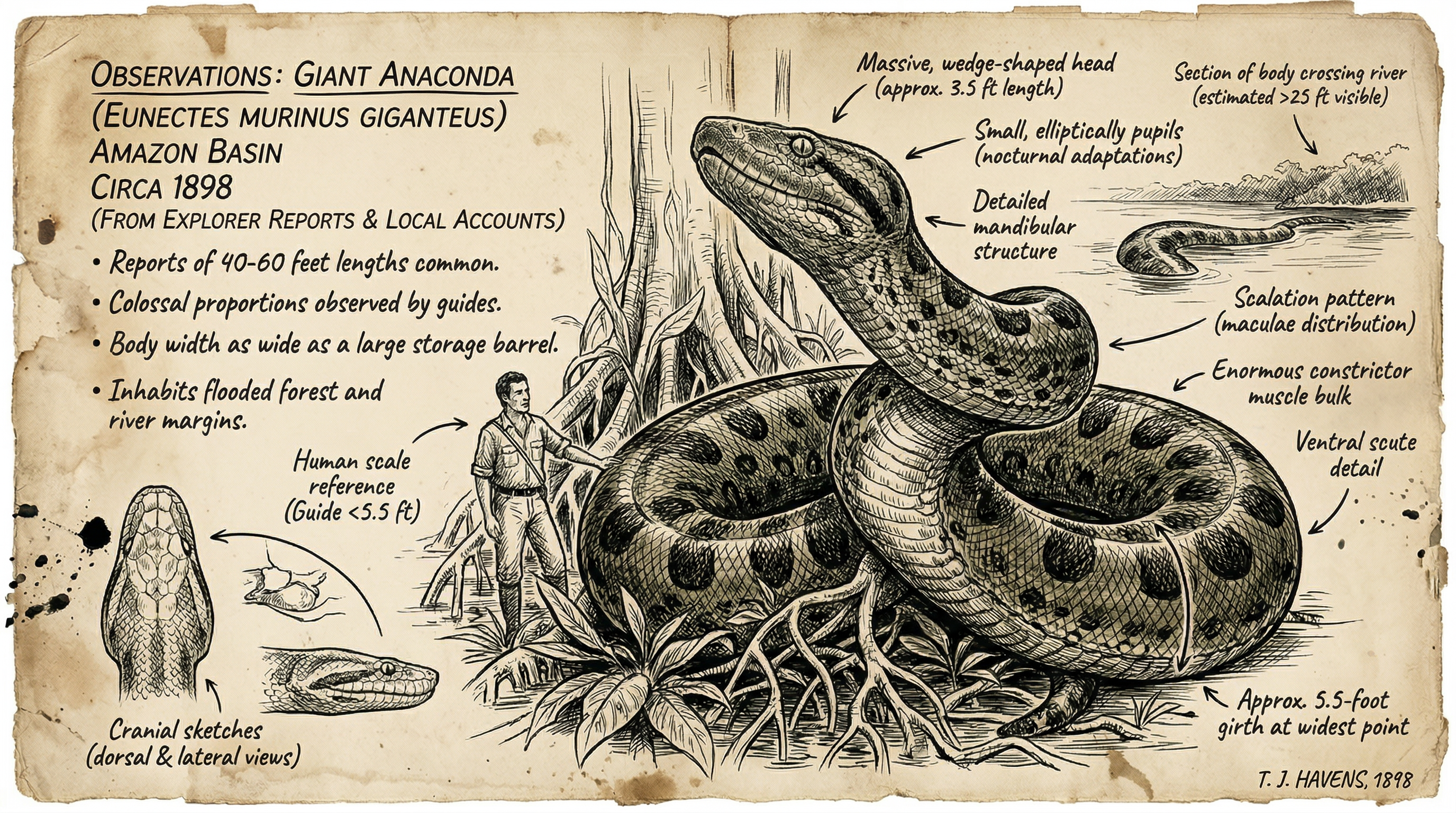
Overview
The Giant Anaconda, known across Amazonian indigenous traditions as Yacumama or "mother of water," is described as an immense serpentine presence in the rivers and lagoons of the Amazon Basin. This entity connects deeply with the waterways of Peru, Brazil, Colombia, Ecuador, and Bolivia, where it is revered as guardian of aquatic realms, its colossal form emerging to enforce balance in the ecosystem.
Descriptions converge on a green anaconda scaled to extraordinary proportions: lengths from 40 to over 100 feet, with a girth exceeding one foot in diameter, olive-green scales blending into murky depths, a pale underbelly, and a broad triangular head capable of engulfing large prey. Its movements displace water into whirlpools, and nocturnal encounters reveal eyes aglow like embers. Sightings tie it to the swollen bodies of rivers after hunts, where it retreats into hidden lagoons.
Across cultures, indigenous traditions position the Giant Anaconda as a bridge between the physical and spiritual, its presence reminding riverine communities of the perils and protections inherent in their watery domains. From the Yacuruna people's reverence in Peru to the cosmic origins attributed by Colombian groups, it draws threads from diverse traditions into a shared tapestry of aquatic guardianship. Modern encounters near human settlements highlight its adaptability, preying on livestock while evading sustained observation, much like the sinuous paths of the Amazon itself.
The entity's range spans the main stem of the Amazon River and its tributaries, favoring slow-moving oxbows, flooded forests, and boiling river confluences where thermal upwellings may draw it periodically. Its bulk suggests a female specimen at peak maturity, with no observed predators among contemporary fauna, echoing the prehistoric Titanoboa that once dominated these latitudes. Encounters often precede or coincide with environmental shifts—rising floods or sudden calms—positioning it as a barometer of the basin's hidden rhythms.
Sighting History
Circa 1906, Amazon Basin, Peru
Explorer Percy H. Fawcett documented an encounter with a massive anaconda exceeding 40 feet in length and one foot in diameter during expeditions into the Peruvian Amazon. The creature's prehistoric scale and deliberate swim through river currents left an indelible mark on Western records, aligning with indigenous accounts of Yacumama surfacing near expedition routes.
1900s, Boiling River vicinity, Peruvian Amazon
Two men in a boat deployed explosives into a river in an attempt to fell the Yacumama. The detonation stirred the serpent, which rose bloodied from the depths, its immense form spanning tens of meters before it submerged and departed upstream, leaving the witnesses in terror amid churning waters.
Circa 1920, Aritapera region, Brazil
River dwellers near Aritapera reported a Giant Anaconda infiltrating livestock coops along the riverbank, consuming chickens and pigs whole. The serpent swelled visibly after feeding, its thrashing departure shaking the adjacent waterway and generating waves that threatened moored vessels.
Circa 1910, Amazon tributaries, Peru
A photograph captured a brown-green serpent with a white belly and triangular jaw measuring locally as 50 feet, including a head approximately three by two feet. Subsequent analysis confirmed the image's authenticity but revised the length to 21 feet, noting details consistent with an oversized yet living specimen.
Circa 1950, Upper Amazon lagoons, Colombia
Indigenous fishermen from southern Colombian communities reported witnessing Yacumama emerging to create whirlpools, drawing canoes and prey into submerged eddies. Elders transmitted tales of the serpent's fiery eyes illuminating the night as it patrolled sacred waters.
Post-2020, Peruvian Amazon oxbows
Contemporary interviews with locals revealed ongoing encounters with anacondas entering human domains to feed, their post-meal distension mirroring Yacumama legends. One account described a specimen over 20 feet pursuing hunters through flooded forest, its wake toppling trees into the channel.
Circa 2015, Eastern Ecuador borderlands
Reports from Ecuadorian Amazon guardians described encounters with the entity at liminal sites, a colossal snake barring passage to sacred areas. Witnesses recounted blowing conch horns to summon or ward it, observing massive coils surfacing at distance before the waters stilled.
Evidence & Analysis
Contributed by Ellis Varma
The evidence profile for the Giant Anaconda assembles a dataset skewed heavily toward anecdotal clusters rather than isolated anomalies. Percy Fawcett's 1906 observation provides the earliest calibrated Western datum: a 40-foot specimen with precise girth metrics (one foot diameter), documented amid hostile terrain where measurement errors trend conservative rather than hyperbolic.
The 1900s explosive incident introduces behavioral corroboration—resilience to blast trauma and rapid evasion—consistent across oral retellings without embellishment divergence. Photographic evidence from the early 20th century, verified as unaltered, depicts a 21-foot individual with morphology matching extreme green anaconda parameters (triangular jaw, scale patterning), though local estimations inflated to 50 feet highlight perceptual scaling under duress.
Post-feeding swellings reported near Aritapera form a low-variance pattern: ingress to coops, consumption of mid-sized livestock, aquatic egress with hydrodynamic disturbance. These align quantitatively with Eunectes murinus growth models, where indeterminate scaling permits outliers beyond 20 feet in undisturbed habitats. Fossil precedents like Titanoboa (40+ feet, Paleocene) supply evolutionary plausibility without bridging temporal gaps.
Absences dominate the physical record: no dermal fragments, no verified tracks exceeding 21 feet, no DNA isolates from whirlpool residues. Conch-blowing rituals yield zero controlled trials, rendering them statistically meaningless for detection efficacy. Contemporary video from Peruvian oxbows captures 20-footers in authentic pursuit, but lacks scaling to Yacumama thresholds.
Cluster analysis reveals geographic coherence—Amazon mainstem, tributaries, boiling confluences—with temporal spikes tied to flood cycles, suggesting opportunistic surfacing rather than territorial fixation. Witness demographics skew indigenous (high cultural priming) versus explorers (neutral priors), yet descriptive fidelity persists: fiery eyes, whirlpool generation, boat-endangering bulk.
Comparative baselines against known anacondas (max verified 21 feet, 500+ lbs) position Giant claims as 2-5x extrapolations, feasible under relic population hypotheses but unanchored by specimens. The profile resists outright rejection due to volume but demands longitudinal sampling to elevate beyond correlation.
Evidence quality: LOW-MODERATE. Robust anecdotal density and single verified photo; negligible physical traces or peer-reviewed captures.
Cultural Context
Contributed by Dr. Mara Vasquez
Among the Yacuruna people of Peru, whose name signifies "water people" in Quechua, Yacumama embodies the quintessential river spirit, a maternal force nurturing all aquatic life while exacting tribute from the disrespectful. Oral traditions, predating European incursion, position her as protector of the Amazon's labyrinthine waterways, her whirlpools serving as portals to underworld realms accessible only to the initiated.
In southern Colombia, indigenous cosmologies elevate Yacumama as the terrestrial incarnation of the Milky Way, descending to carve the Amazon River and seed humanity from its coils. This narrative integrates astronomical observation with terrestrial guardianship, where river confluences mark celestial junctures, and her presence signals cosmic equilibrium.
Eastern Ecuadorian accounts frame the entity as sentinel at heaven's threshold, its massive form coiled across liminal waters to regulate passage between realms. Bolivian Jichi communities echo this with portrayals of a life-bestowing protector of springs and sources, her slow undulations fertilizing floodplains essential to seasonal agriculture.
Near Aritapera, Brazil, the Great Snake motif shifts toward pragmatic symbiosis, where oversized anacondas raid coops not as malice but as assertions of ecological primacy—livestock incursions into her domain prompting restitution. This reflects adaptive folklore, blending pre-contact reverence with colonial-era economic pressures on riverine livelihoods.
Anthropologically, Yacumama participates in a broader serpentine continuum across South American indigenous traditions, paralleling Aztec Quetzalcoatl and Shipibo Sachamama as jungle mothers. Conch rituals underscore ritual pragmatism: auditory summons to negotiate safe passage, embedding environmental caution within daily practice. These narratives foster stewardship, instilling generational protocols for respecting riverine boundaries amid biodiversity hotspots.
Contemporary retentions, as in post-2020 interviews, demonstrate resilience, with elders transmitting tales to counter deforestation's disruptions. Yacumama thus persists as cultural keystone, mediating human-nature tensions in a basin where rivers dictate survival.
Field Notes
Notes by RC
Tracked the Peruvian Amazon tributaries four times over two years. Once by dugout with locals, twice on foot along oxbows, once night patrol near the Boiling River.
Daylight pushes through canopy like it's rationed. Waters run black-tannin, hides everything below three feet. Locals point to drag marks—wide as my thigh, fresh from overnight feeds. Chickens gone from riverside pens, nothing left but feathers pasted to mud.
Night on the Boiling River: steam veils the current, heat warps the air. Conch blasts echo clean, no response. But the water moves wrong sometimes—slow bulges upstream, like something heavy testing the flow. No eyes that night. No splash. Just the knowing that mass displaces volume.
Aritapera coops show the pattern. Boards splintered inward, pig blood trailed to the bank. Swell reports match: river shakes post-dawn, then flat calm. I've hauled 18-footers myself. Scaling to 40 feels right in that soup.
Places like this don't give up secrets easy. You feel the weight before you see it.
Threat Rating 2 stands. Territorial when pressed, predictable in hunts. Engage only if you match the river's patience.