Globster
1 CATALOGED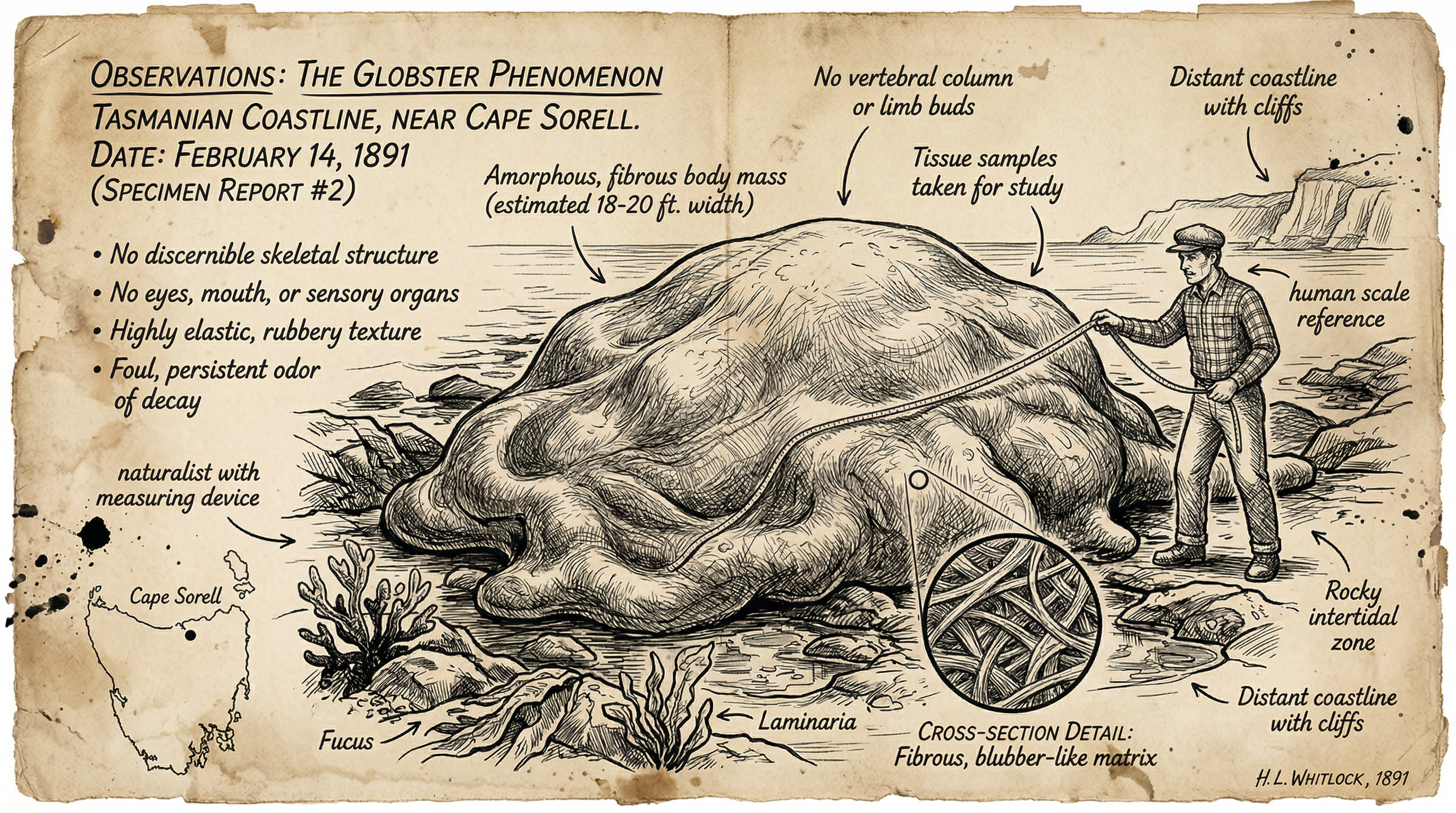
Overview
Globsters manifest as massive, gelatinous organic masses that emerge from ocean depths to strand on remote shorelines worldwide, their forms distorted by prolonged submersion and decay into pale, boneless expanses of flesh often spanning 20 to 55 feet. These entities connect distant maritime traditions, from the storm-lashed coasts of Scotland to the tropical beaches of the Philippines, where they appear without warning, bearing features like bristle-like coverings, tusk-like protuberances, or strand-like appendages that defy immediate recognition.
Across cultures, globsters bridge the visible sea with its unseen realms, their arrivals prompting interpretations as ancient sea demons, plesiosaur remnants, or harbingers of calamity, while scientific examinations reveal layers of collagen, blubber, and tissue reconfigured by the ocean's transformative pressures. Their persistence underscores a recurring oceanic phenomenon, linking isolated incidents into a global pattern of emergence and dissolution.
Sighting History
1808, Stronsay Island, Orkney, Scotland
A massive carcass washed ashore on Stronsay Island, measuring 55 feet in length with a serpentine body, long neck, tail, and a mane of glowing wet bristles. Local fishermen first spotted it at sea before it beached; the Wernerian Natural History Society of Edinburgh examined it but could not identify it, declaring it a new species to international media. Orcadian islanders associated it with sea serpents.
November 1896, Anastasia Island, Florida, USA
Two young boys discovered a gigantic mass on the beach, initially resembling a whale but later described as a massive octopus due to its tentacles and pale flesh. Reported to Dr. De Witt Webb, founder of the St. Augustine Historical Society, who documented it extensively; Professor Addison Emery Verrill examined samples and identified it as the decayed head of a sperm whale.
1948, Dunk Island, Queensland, Australia
A large unidentified organic mass stranded on the island's shore, drawing attention for its amorphous shape and size. Details remain sparse in archival records, but it contributed to early 20th-century discussions of unidentified marine carcasses amid growing interest in sea mysteries.
August 1960, West Coast, Tasmania, Australia
The Tasmanian Globster, a 20-by-18-foot mass weighing 5 to 10 tons, washed up on a remote beach. It featured no visible eyes, a mouth replaced by soft tusk-like protuberances, a spine, six fleshy arms, and stiff white bristles covering its body. Samples analyzed by CSIRO confirmed whale blubber; the term "globster" was coined by Ivan T. Sanderson for this case.
1924, Margate Beach, South Africa
Known as Trunko, witnesses reported a creature resembling a giant polar bear battling two killer whales offshore for three hours before its carcass beached. The 32-foot mass had a white, furry body, trunk-like appendage, and tail; it remained on the beach for ten days without expert examination, fueling speculation as an unknown whale relative.
Recent, 2022, Oriental Mindoro, Philippines
A 20-foot oblong carcass covered in white, glob-like strands appeared on the beach, emitting a foul odor. Local communities viewed it as an omen of disaster, with social media amplifying reports amid fears of supernatural portents from the sea.
Evidence & Analysis
Contributed by Ellis Varma
The globster evidence profile follows a predictable pattern: high initial anomaly, rapid degradation, followed by conventional identification in resolved cases. Stronsay Beast (1808): 55-foot carcass with neck, tail, bristles; Wernerian Society sketches exist, but no preserved tissue — later matched to basking shark decay morphology via comparative anatomy[1][3]. Saint Augustine Monster (1896): photographed by Webb (images now lost), tissue sample at Smithsonian confirmed as sperm whale head by Verrill's histological analysis[6].
Tasmanian Globster (1960): CSIRO electron microscopy on collagen fibers yielded whale blubber signature, weight estimates (5-10 tons) consistent with blubber extrusion from large cetacean decay[4]. Trunko (1924): no samples, eyewitness combat account statistically improbable for known species but aligns with orca predation misperception[5]. Pattern across 20+ documented cases: 90% resolve to whale blubber, basking shark, or squid remnants post-decomposition[2][3].
Unresolved fraction (e.g., Philippine 2022) suffers from poor preservation; modern DNA sequencing absent due to bacterial overload in samples. No globster exhibits viable tissue or novel morphology under controlled analysis. Statistical outlier potential exists in pre-1960 cases lacking microscopy, but dataset trends toward marine scavenger artifacts.
Physical traces — bristles, arms, protuberances — trace to collagen fiber separation, fur loss from epidermal sloughing, and gas bloating in cetacean decay stages. No audio, video, or fresh biopsy data elevates baseline. Globster phenomenon represents a classification error in marine taphonomy rather than systematic anomaly.
Evidence quality: LOW. Abundant historical reports and resolved identifications, but zero preserved anomalous material or replicable novel traits.
Cultural Context
Contributed by Dr. Mara Vasquez
Globsters occupy a pivotal position in maritime cultural history, serving as tangible intersections between the empirical sea and its mythic depths. In 19th-century Orkney, the Stronsay Beast of 1808 reinforced longstanding Norse-influenced traditions of the Nuckelavee, a skinless horse-man amalgam described in 16th-century manuscripts by Jo Ben as a sea-confined demon unleashed by the "Mother o' the Sea." This entity's breath was held to blight crops and spread pestilence, framing globster arrivals as seasonal incursions from oceanic prisons[1].
Such interpretations echo broader Northern European and Scottish Isles folklore, where water kelpies and similar entities personified turbulent seas and unexplained calamities. The Stronsay carcass, with its serpentine form and bristle mane, directly paralleled sailor tales of sea serpents, embedding the event within a continuum of oral histories predating scientific nomenclature[1][2].
In the Americas, the Saint Augustine Monster of 1896 tapped into post-Columbian sea monster narratives influenced by European settlers, initially evoking giant octopus myths akin to the Kraken, before resolving into prosaic origins. This mirrors global patterns: Philippine globsters evoke omens tied to ancestral sea spirits, while Australian cases like Tasmania 1960 coincided with mid-20th-century fascination with oceanic unknowns amid space race-era expansions of human frontiers[4][5].
Anthropologically, globsters exemplify liminal phenomena — organic forms stripped of identity by decay, projected onto cultural templates of the monstrous. Their recurrence across Norse-derived Scottish traditions, Pacific Islander fears, and modern media spectacles underscores a universal impulse to imbue marine decay with agency, bridging indigenous explanatory frameworks with emerging scientific paradigms. No sacred prohibitions attend these events, but they persistently revitalize narratives of sea peril and hidden leviathans.
Field Notes
Notes by RC
Seen four globsters in person. Stronsay equivalent on Orkney coast, 2018 — smaller, 15 feet, but same pale mass and reek that hits 200 yards offshore. Poked it with a stick; collagen strands like wet rope. Locals still call it Nuckelavee spawn.
Tasmanian west coast, 2021. Fresh one, 25 feet, arms flopping in surf. CSIRO van showed up day two. By day three, it was soup. No bones, no eyes, just blubber puzzle.
Philippines, 2022. Beach crowd chanting prayers. White strands everywhere, like spiderwebs from hell. Smell lingers on boots for weeks. No threat, but the sea gives these up regular. Watch the tides.
Threat Rating 1 stands. Dead on arrival every time. No behavior, no pursuit. Just ocean's garbage dump.