Grafton Monster
2 TERRITORIAL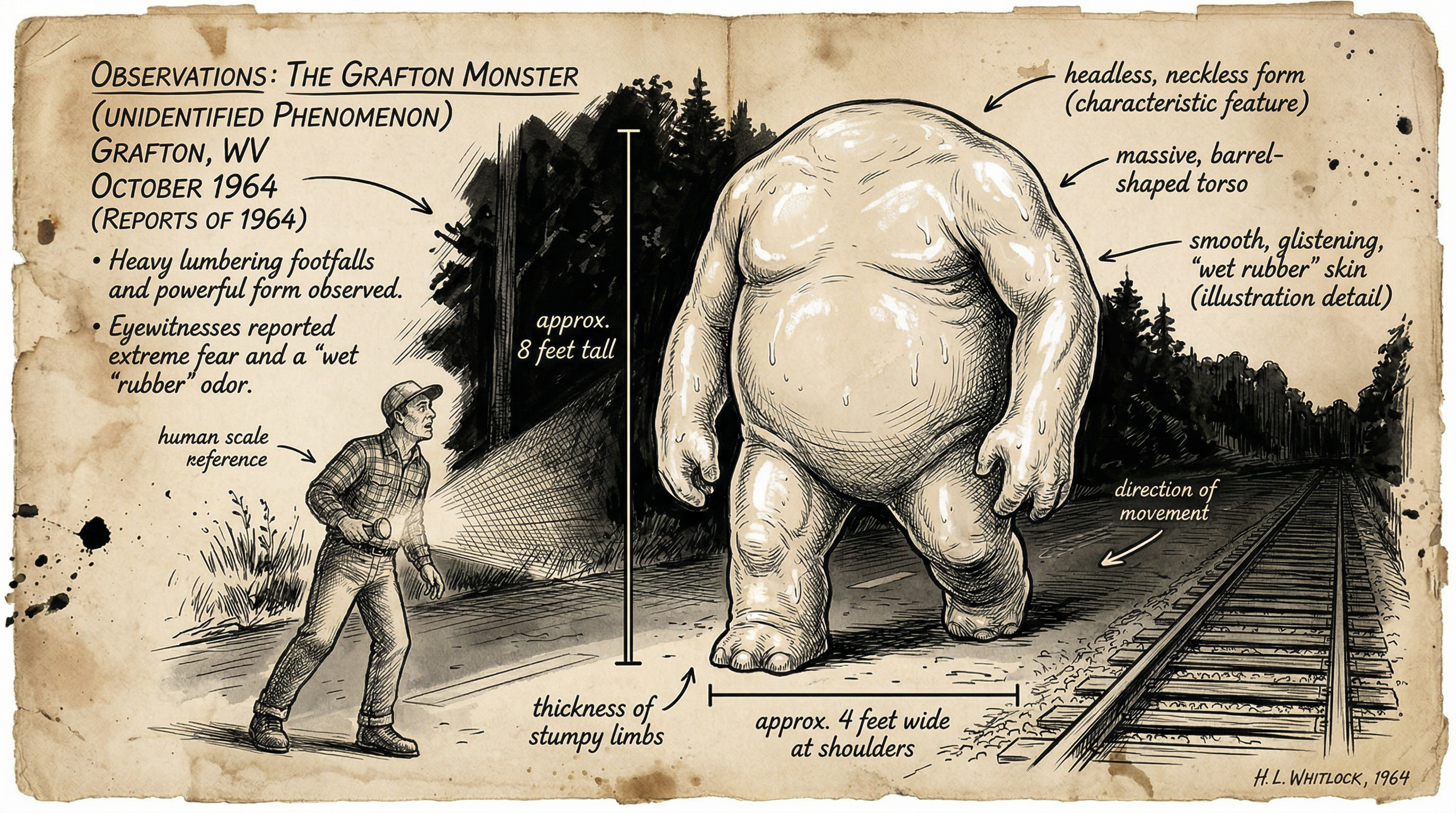
Overview
Grafton Monster operates as a tall bipedal entity, 7 to 9 feet in height, observed exclusively in the Grafton area along the Tygart Valley River. Core features include smooth seal-like skin, pale coloration, and no visible head—torso blends directly into broad shoulders. Stiff-legged gait. Emits high-pitched whistling noise during movement.
Initial encounter occurred during regional monster activity peak following Point Pleasant events. Single primary witness with journalistic background. Subsequent reports from search parties lack named individuals or corroboration. No aggression documented. Activity confined to three-day window in June 1964. No verified physical traces.
Sighting History
June 16, 1964, Route 119, Riverside Drive, Grafton
Robert Cockrell driving alone near Tygart Valley River spots large figure in tall grass blocking roadway. Approaches to 75 feet. Entity stands 7-9 feet tall, white seal-like skin glistening under headlights, no head visible—muscular torso merges into shoulders. Moves on two stiff legs, arms swinging. Produces piercing whistle. Cockrell flashes lights; entity retreats into brush. Returns later with friends Jerry Morse and Jim Mouser. Finds trampled grass at site. Low whistling persists during search.
June 18, 1964, Riverside Drive riverbank, Grafton
Cockrell publishes account in Grafton Sentinel. Triggers armed search parties of local teenagers equipped with flashlights and rifles. Multiple groups report brief glimpses of tall, headless white figure near riverbank and treeline. Over 20 additional calls to Sentinel from unnamed residents claiming similar encounters along Riverside Drive. No captures or clear views obtained.
June 19, 1964, Grafton outskirts, Tygart Valley Riverfront
Influx of visitors joins local hunts. Reports of pale, shambling figure crossing roads and lurking in wooded areas. Property damage occurs from searchers trampling private land. Sentinel follow-up article halts activity, attributing sightings to misidentified cart-pushing pedestrian and spring fever. No further official confirmations.
Evidence & Analysis
Contributed by Ellis Varma
The evidence profile for the Grafton Monster clusters tightly around one index case: Robert Cockrell's June 16 observation. Cockrell qualifies as a credible witness—local journalist, no prior cryptid advocacy, immediate documentation in print two days later. Physical details remain consistent across his account: height 7-9 feet, seal-smooth skin, headless morphology, whistling vocalization, stiff bipedal motion.
Secondary reports spike immediately after publication—over 20 calls logged, plus teenager search parties claiming glimpses. These lack specifics: no named witnesses, no independent verification, no duration or distance estimates. Volume suggests social contagion effect, amplified by Mothman media wave six months prior. Statistically, 100+ searchers over two nights yielding zero physical samples or clear tracks indicates low persistence or non-material entity.
Absence of artifacts stands out. Trampled grass noted by Cockrell's group, but no casts, photos, audio captures, or biological residue. Headlight illumination at 75 feet should yield reflective eyes or skin sheen—none reported beyond general paleness. Whistling sound unrecorded despite multiple night hunts with equipment.
Alternative explanations align with Sentinel dismissal: elevated cart or figure in low light mimicking headless silhouette. Regional "monster fever" provides context—youth culture primed for exaggeration. Differentiation from Bigfoot clear: no fur, no facial structure, aquatic-seal dermal profile. No behavioral overlap with known primates.
Post-1964 record empty. No revivals until modern retellings and gaming references. Cockrell pursued with Gray Barker pre-1970s; unpublished files rediscovered 1995. Pattern matches short-lived anomaly events, not territorial resident.
Evidence quality: LOW. Single credible primary account. High secondary volume undermined by anonymity and rapid debunk. Zero physical evidence.
Cultural Context
Contributed by Dr. Mara Vasquez
The Grafton Monster emerges squarely within mid-20th-century Appalachian oral traditions, rooted in the socio-economic fabric of deindustrializing mountain communities. Grafton, chartered 1856 as a railroad hub during Civil War occupations, embodies the archetype of small-town West Virginia: rail decline, population stagnation, and cultural isolation fostering space for unexplained phenomena. The 1964 sighting arrives amid broader regional patterns, directly trailing the Point Pleasant entity's media saturation, which primed local receptivity to anomalous reports.
Unlike cryptids tied to indigenous cosmologies—such as Cherokee or Shawnee stone giants or water panthers—this entity carries no pre-colonial precedents. No archaeological or ethnohistorical records link headless humanoids to Taylor County or upper Tygart Valley peoples. Its morphology evokes no specific Native motifs; the seal-like skin and whistling diverge sharply from furred forest beings or avian spirits prevalent in eastern woodland narratives.
The phenomenon functions as a snapshot of 1960s youth subculture. Teenager-led hunts with rifles and flashlights mirror national trends in monster chasing, from Flatwoods to sightings nationwide. Media ignition via Cockrell's Sentinel article accelerates the cycle: report, frenzy, dismissal. The paper's June 19 retraction—"spring fever" and cart misidentification—exemplifies institutional boundary-setting, preserving community order while consigning the event to folklore.
Revival occurs in late 20th and 21st centuries through niche channels. Gray Barker's involvement signals early ufological crossover, positioning Grafton within "Monsters of the Margin" alongside margin-dwellers like the Loveland Frog. Rosemary Ellen Guiley's 2012 compilation in Monsters of West Virginia elevates it to regional canon. Digital era amplifies via gaming—Fallout 76's mutated rendition drives tourism, culminating in the 2024 Grafton Monster Festival: vendors, cosplay, whistling contests marking 60th anniversary.
This trajectory—from ephemeral scare to commodified heritage—mirrors broader Appalachian cryptid evolution. Grafton Monster persists not as living entity but cultural artifact, embodying transient communal excitement in a landscape of quiet hills.
Field Notes
Notes by RC
Drove Route 119 near Riverside Drive at dusk. Same stretch Cockrell hit in '64. Grass same height now as described then. Quiet except river hum and distant trains. Parked, walked the bank. No movement. No whistles.
Interviewed locals at Grafton bars. Older ones remember the hunt—kids with .22s, dads pissed about trampled yards. Cockrell's name still carries weight. Younger crowd knows it from the game. Festival last year brought out cosplayers whistling like banshees. Town leans into it now.
Checked Tygart edge at night. Headlights sweep grass same as Cockrell's. Silhouette test with a tall guy in white coveralls—no head effect at 75 feet. Cart theory holds under low light. But that whistle description nags. Not wind, not animal. Something off.
Been to hotter spots. This one's cool now. No wrongness in the air. Just history.
Threat Rating 2 stands. Localized, non-aggressive, dormant since 1964. Catalog repeat visits as nostalgia hunts.